
- Key Takeaways
- Part 1. Basics of a battery circuit
- Part 2. How a battery in a circuit works
- Part 3. Voltage, current, and resistance in battery circuits
- Part 4. Types of battery circuits
- Part 5. Series vs parallel battery circuits
- Part 6. Maintenance and troubleshooting of battery circuits
- Part 7. FAQ: Battery circuits
Battery circuits power most modern electronics, from small sensors to electric vehicles. A battery circuit allows electrical energy stored in a battery to flow through a device and perform useful work.
When a battery in a circuit connects to a load through conductive paths, electrons move through the system and deliver power. This process enables devices to produce light, motion, computing, or communication.
Understanding how battery circuits work helps engineers and buyers design reliable electronics and choose the right battery for specific applications.
Key Takeaways
- A battery circuit allows electrical energy from a battery to power devices through a closed conductive loop.
- Every circuit with battery power contains four core elements: battery, conductive path, load, and control/protection components.
- Battery circuits typically use series or parallel configurations depending on voltage and current requirements.
- Voltage, current, and resistance determine how much power a circuit can deliver and how efficiently it operates.
- Proper wiring, protection components, and monitoring help prevent short circuits, overheating, and battery damage.
Part 1. Basics of a battery circuit
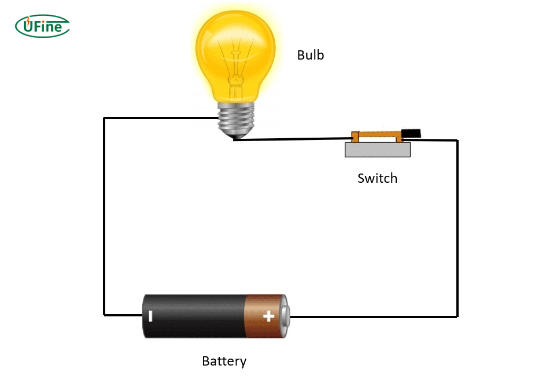
A circuit with battery power contains several essential components that work together to deliver energy from the battery to the device.
1 Battery: The power source
The battery provides the electrical energy for the circuit.
A battery converts chemical energy into electrical energy using electrochemical reactions. Most batteries consist of:
- Anode (negative electrode)
- Cathode (positive electrode)
- Electrolyte that allows ion movement
- Separator preventing internal short circuits
When connected in a battery circuit, these reactions create a voltage difference between the terminals. This voltage drives electrons through the circuit.
For example, lithium-ion batteries are widely used in electronics because they provide high energy density and stable voltage.
You can learn more about lithium battery types in our guide:
👉 A Comprehensive Guide to High Voltage Batteries
2 Load: The device using power
The load is the component that consumes electricity.
Common loads include:
- LED lights
- Electric motors
- Sensors
- Microcontrollers
- Heating elements
When current flows through the load, electrical energy converts into another form such as light, motion, heat, or computing power.
3 Conductive path: Wires and connectors
Conductors provide the pathway that allows electricity to move through the circuit.
Typical conductive elements include:
- Copper wires
- PCB traces
- Connectors
- Busbars
Low-resistance conductors ensure efficient energy transfer. High resistance wiring can cause heat buildup and energy loss.
4 Switches and control components
Switches allow users to open or close the battery circuit.
Common control components include:
- Mechanical switches
- Transistors
- Relays
- Resistors
- Diodes
These components help regulate voltage, control current, or protect the circuit from electrical spikes.
5 Protection components
Battery-powered circuits often include protection devices such as:
- Fuses
- Circuit breakers
- Protection ICs
- Battery management systems (BMS)
These components protect the battery and electronics from:
- Short circuits
- Overcurrent
- Overcharging
- Reverse polarity
Organizations such as the International Electrotechnical Commission define many electrical safety standards used in battery-powered electronics.
6 Measurement and monitoring devices
In advanced battery circuits, monitoring components help track system performance.
Examples include:
- Voltmeters
- Ammeters
- Multimeters
- Battery monitoring ICs
These tools measure voltage, current, and resistance, helping engineers diagnose problems in the circuit.
Part 2. How a battery in a circuit works
When a battery connects to a complete circuit, electrons begin moving through the conductive path.
The process works in several stages.
1 Electron flow
Electrons flow from the negative terminal of the battery toward the positive terminal through the external circuit.
This movement occurs because the battery creates a voltage difference, which pushes electrons through the circuit.
2 Conductive pathways
Wires or PCB traces form low-resistance paths that allow electrons to travel efficiently.
If the circuit path breaks, the circuit becomes open, and electricity stops flowing.
3 Interaction with the load
When electrons pass through the load, they transfer energy to the device.
Examples include:
- Lighting an LED
- Rotating a motor
- Running a microcontroller
The amount of energy delivered depends on the circuit’s voltage and current.
4 Completing the circuit
Electric current only flows when the circuit forms a closed loop.
In other words:
Battery → Wire → Load → Return wire → Battery
This loop allows electrons to circulate continuously.
5 Chemical reactions inside the battery
Inside the battery, electrochemical reactions release electrons at the anode and absorb them at the cathode.
These reactions maintain the voltage difference that keeps the circuit operating.
A detailed explanation of electrochemical cell behavior can be found through the U.S. Department of Energy energy education resources.
Part 3. Voltage, current, and resistance in battery circuits
Three key electrical parameters control how a battery circuit performs.
1 Voltage
Voltage is the electrical pressure that pushes electrons through the circuit.
Measured in volts (V), it represents the potential difference between two points.
Higher voltage generally allows more power delivery to the load.
2 Current
Current represents the rate of electron flow through the circuit.
It is measured in amperes (A).
Higher current means more energy flows through the load, but excessive current can damage components.
3 Resistance
Resistance is the opposition to electron flow.
Measured in ohms (Ω), resistance depends on materials, wire length, and components in the circuit.
Higher resistance reduces current.
4 Ohm’s law
The relationship between voltage, current, and resistance is described by:
V = I × R
This equation helps engineers calculate current draw and choose the right battery for a circuit.
5 Power in a battery circuit
Power describes how quickly energy is delivered to the load.
Higher voltage or higher current increases power output, but also increases heat and energy loss if resistance is high.
Part 4. Types of battery circuits
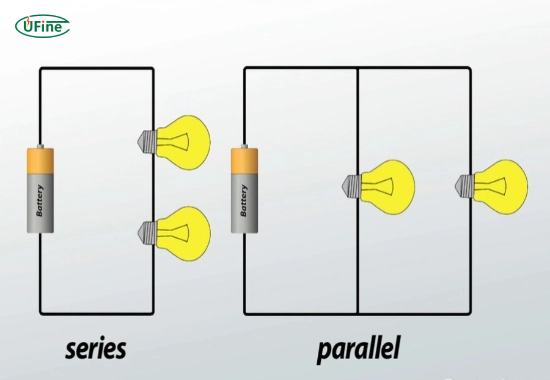
Battery circuits are usually designed using series or parallel configurations.
These configurations determine voltage output and current capacity.
1 Series battery circuits
In a series circuit, batteries or components connect end-to-end.
Example: Battery (+) → Battery (−) → next battery
Characteristics:
- Voltage adds together
- Current remains the same across components
- Useful when higher voltage is required
Example applications:
- Electric vehicles
- Power tools
- High-voltage battery packs
2 Parallel battery circuits
In a parallel circuit, batteries connect side-by-side.
All positive terminals connect together, and all negative terminals connect together.
Characteristics:
- Voltage remains constant
- Current capacity increases
- Improves system reliability
Example applications:
- Energy storage systems
- Backup power systems
- Portable electronics
Part 5. Series vs parallel battery circuits
| Feature | Series Circuit | Parallel Circuit |
|---|---|---|
| Voltage | Adds together | Same as one battery |
| Current | Same through all components | Shared across branches |
| Capacity | Same as one battery | Increases |
| Typical Use | High voltage devices | High current systems |
Part 6. Maintenance and troubleshooting of battery circuits
Proper maintenance helps prevent performance loss and electrical faults.
1 Regular inspection
Check battery circuits regularly for:
- Loose wires
- Corroded terminals
- Damaged connectors
- Burned components
Clean terminals if corrosion appears.
2 Monitor voltage
Measure battery voltage using a multimeter.
Unexpected voltage drops may indicate:
- Battery degradation
- Poor connections
- Excessive load
3 Proper charging practices
Use chargers that match the battery chemistry and voltage.
Incorrect charging can cause:
- Overheating
- Reduced lifespan
- Safety risks
4 Common circuit problems
Typical issues in circuits with battery power include:
| Problem | Cause | Solution |
|---|---|---|
| No power | Open circuit | Check wiring |
| Low voltage | Weak battery | Replace or recharge |
| Overheating | Excess current | Add protection components |
| Short circuit | Direct terminal contact | Install fuse or BMS |
Part 7. FAQ: Battery circuits
What is a battery eliminator circuit?
A battery eliminator circuit replaces a battery by providing a regulated DC power supply that mimics battery output. It is commonly used in laboratory testing or electronics powered directly from AC adapters.
How does a battery supply energy to a circuit?
A battery converts chemical energy into electrical energy. When connected to a circuit, chemical reactions release electrons, creating an electric current that powers the device.
Why are thick wires used in high-current battery circuits?
Thick wires have lower resistance, allowing large currents to flow without overheating. This is critical in systems like vehicle starter circuits or high-power battery packs.
Can a short circuit damage a battery?
Yes. A short circuit allows extremely high current to flow, which can generate heat, damage internal cells, or trigger battery failure.
How do batteries create voltage in a circuit?
Batteries create voltage through electrochemical reactions that produce a potential difference between two electrodes. This voltage pushes electrons through the external circuit.
Related Tags:

More Articles

JST vs Molex: The Right Battery Connector Choice
JST or Molex for your battery? Learn how connector selection affects current, voltage drop, reliability, and device performance.
Custom Battery Pricing: Costs Manufacturers Don’t Mention
A low battery quote may not be the final cost. Discover common hidden expenses that affect custom lithium battery projects.
Battery Wire Length: Hidden Cause of Power Loss
A longer battery wire can cause voltage drop, power loss, and unstable operation. Learn how wire length affects battery performance.
How Device Sleep Modes Affect Battery Life
Think sleep mode extends battery life? Learn why devices still drain power and how firmware, hardware, and batteries affect runtime.
LiPo Battery and PCB Design: Clearance, Insulation, and Placement
Learn how to optimize LiPo battery PCB clearance, insulation, placement, wiring, and thermal design—and avoid common integration mistakes.


