
- Key Takeaways
- Part 1. What is battery terminal corrosion?
- Part 2. Signs of battery terminal corrosion
- Part 3. What causes battery terminal corrosion?
- Part 4. Positive vs negative battery terminal corrosion
- Part 5. How to clean battery terminal corrosion?
- Part 6. How to prevent battery terminal corrosion?
- Part 7. Battery terminal corrosion FAQs
Have you noticed white powder, green buildup, or blue residue on your battery terminals? That is battery terminal corrosion. It can reduce electrical flow, make vehicles harder to start, and shorten battery life.
Understanding what causes battery corrosion and how to prevent it helps improve battery performance and reliability.
Key Takeaways
- Battery terminal corrosion usually appears as white, blue, or green buildup.
- Common causes include electrolyte leakage, overcharging, undercharging, aging batteries, and moisture exposure.
- Positive terminal corrosion often relates to acid vapor leakage.
- Negative terminal corrosion may indicate charging imbalance or poor connections.
- Cleaning corrosion early improves conductivity and battery performance.
- Protective coatings and routine maintenance help prevent future corrosion.
Part 1. What is battery terminal corrosion?
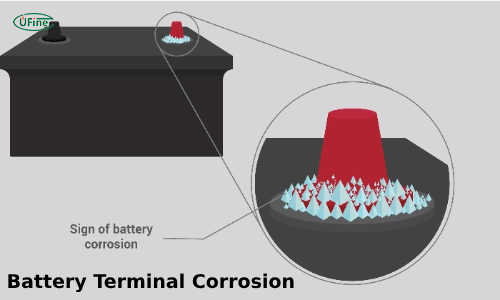
Battery terminal corrosion is chemical buildup that forms around battery posts and cable connections. People often describe it as:
- White powder on battery terminals
- Green corrosion on battery posts
- Blue residue around battery connectors
- White stuff on battery terminals
This buildup forms when battery chemicals react with terminal metals and surrounding air.
In lead-acid batteries, sulfuric acid and hydrogen gas are usually involved. Corrosion creates electrical resistance that reduces power flow.
Common symptoms include:
- Hard starting
- Slow engine cranking
- Dim headlights
- Weak charging performance
- Electrical problems
- Reduced battery life
Part 2. Signs of battery terminal corrosion
Watch for these warning signs.
-
White, Green, or Blue Powder
- The most obvious sign is visible buildup around battery terminals.
- White powder often appears on lead battery posts. Green or blue buildup usually develops on copper connectors.
-
Difficulty Starting the Vehicle
- Corrosion increases resistance and limits power delivery.
- Symptoms include:
- Slow cranking
- Clicking noises
- Intermittent starting failure
-
Electrical System Problems
- Battery post corrosion can affect:
- Headlights
- Power windows
- Dashboard electronics
- Charging performance
-
Battery Warning Light
- Battery warning indicators may signal charging system issues or corrosion buildup.
Part 3. What causes battery terminal corrosion?
Users commonly search:
- what causes battery terminal corrosion
- why do battery terminals corrode
- what causes corrosion on battery terminals
- what causes battery corrosion
The causes usually involve chemical reactions combined with environmental conditions.
-
Electrolyte Leakage
Electrolyte leakage is one of the biggest causes of battery terminal corrosion.
Lead-acid batteries contain sulfuric acid. Small leaks around battery seals or vents allow acid vapor to escape.
When acid reaches battery terminals, corrosion develops.
Leakage may occur because of:
- Battery aging
- Cracked housing
- Overfilled batteries
- Loose caps
- Manufacturing defects
This commonly explains:
What causes car battery corrosion on positive terminal?
Positive terminal corrosion often develops when acid vapor escapes and reacts with terminal metals.
-
Hydrogen Gas Release During Charging
Battery charging naturally produces hydrogen gas.
As gas escapes, chemical reactions occur around terminals and connectors.
Older batteries typically show more corrosion because internal seals degrade over time.
-
Overcharging
Overcharging increases electrolyte evaporation.
Excess charging voltage creates additional gas release and acid vapor buildup.
This commonly causes:
- Battery post corrosion
- White powder buildup
- Reduced battery lifespan
Charging system issues that contribute include:
- Faulty alternator
- Incorrect charger settings
- Battery management failures
For battery charging optimization, read our guide on:
-
Undercharging and Sulfation
Undercharging also contributes to battery problems.
Batteries left partially discharged can develop sulfate crystals.
This may increase resistance and worsen corrosion buildup.
Users often ask:
What causes negative battery terminal corrosion?
Negative terminal corrosion sometimes indicates:
- Undercharging
- Poor grounding
- Electrical resistance buildup
-
Battery Aging
Battery corrosion becomes more common as batteries get older.
Over time:
- Internal resistance increases
- Seals weaken
- Chemical stability declines
- Gas release increases
Most vehicle batteries last about 3–5 years under normal conditions.
If corrosion returns quickly after cleaning, battery replacement may be necessary.
-
Moisture and Environmental Exposure
Environmental factors accelerate battery corrosion.
Common contributors include:
- Humidity
- Rain exposure
- Dirt accumulation
- Road salt
- Extreme heat
- Large temperature changes
Road salt is especially aggressive in winter environments.
Proper battery storage also matters. Learn more in our guide:
-
Loose Battery Connections
Loose battery terminals increase resistance and localized heat.
Heat speeds oxidation and corrosion.
Check regularly for:
- Loose terminal bolts
- Poor cable connections
- Damaged battery connectors
If selecting battery connection systems for industrial packs, understanding battery terminal types can help improve long-term reliability.
Part 4. Positive vs negative battery terminal corrosion
Users often search:
what causes car battery corrosion on positive terminal / what causes negative battery terminal corrosion
The causes can differ.
| Corrosion Location | Common Causes | Recommended Check |
|---|---|---|
| Positive terminal | Acid leakage, overcharging | Charging system |
| Negative terminal | Undercharging, grounding issues | Electrical connections |
| Both terminals | Moisture, age, poor maintenance | Full battery inspection |
Terminal location alone does not confirm battery failure. Battery testing provides a more accurate diagnosis.
Part 5. How to clean battery terminal corrosion?
Users commonly search:
- clean battery terminal corrosion
- how to get corrosion off battery terminals
- how to remove battery corrosion
Follow these steps.
Wear Safety Protection
Use:
- Safety gloves
- Eye protection
Battery acid exposure can be dangerous.
Disconnect Battery Cables
Disconnect:
- Negative terminal first
- Positive terminal second
This reduces short circuit risk.
Make a Cleaning Solution
Mix:
- 1 tablespoon baking soda
- 1 cup water
Baking soda helps neutralize acid residue.
Scrub Corrosion Away
Use:
- Battery terminal brush
- Soft wire brush
- Old toothbrush
Remove visible corrosion carefully.
Dry Completely
Moisture speeds corrosion.
Dry terminals fully before reconnecting.
Apply Protection
Users often ask:
What to put on battery terminals to prevent corrosion?
Options include:
- Anti-corrosion spray
- Dielectric grease
- Petroleum jelly
- Terminal protection pads
Part 6. How to prevent battery terminal corrosion?
Preventive maintenance reduces battery problems.
-
Inspect Battery Terminals Regularly
- Check every 1–3 months for white powder, loose cables, acid leaks, and connector damage.
-
Keep Batteries Properly Charged
- Avoid overcharging and chronic undercharging. Proper charging reduces corrosion risk.
-
Use Protective Coatings
- Protective coatings help block moisture, salt exposure, and air contaminants.
-
Store Batteries Correctly
- Temperature and storage conditions affect battery health. For industrial batteries and energy storage systems, proper storage practices significantly improve service life.
Part 7. Battery terminal corrosion FAQs
Does battery terminal corrosion mean the battery is bad?
No. Minor corrosion does not automatically mean battery failure. However, repeated corrosion may indicate battery aging or charging issues.
Can corroded battery terminals still work?
Yes. Mild corrosion may still allow operation, but electrical performance usually declines.
What causes white powder on battery terminals?
White powder usually develops from chemical reactions involving battery acid vapor and terminal materials.
What causes corrosion on battery posts?
Battery post corrosion commonly results from electrolyte leakage, charging problems, moisture, and battery aging.
What causes battery corrosion in cars?
Vehicle battery corrosion often develops because of acid vapor leakage, environmental exposure, overcharging, undercharging, or loose terminal connections.
Related Tags:

More Articles

Can Battery Degradation Be Reversed on LFP Batteries?
Can LFP battery degradation be reversed? Learn what causes LFP degradation, how to read its degradation curve, recover apparent capacity, and slow aging.
What’s the Difference Between Volts and Amps? A Beginner’s Guide
Learn the difference between volts and amps, how voltage and amperage work together, and how to calculate watts and current with simple examples.
Double A vs Triple A Battery: Understanding Size, Capacity, and Compatibility
Compare AA vs AAA batteries by size, voltage, capacity, runtime, chemistry, and compatibility. Learn which battery fits your device and lasts longer.
The Ultimate Guide to Battery Terminal Adapters
Compare battery terminal adapters for top post, side post, stud, marine, and U1 batteries. Learn how to choose, install, and maintain them safely.
What Can a 12V 50Ah Lithium Battery Power? Real-World Applications Explained
Learn what a 12V 50Ah lithium battery can power, realistic runtimes, inverter limits, charging methods, and uses for RVs, camping, solar, and backup.


