- Part 1. What kind of batteries do quads use?
- Part 2. Do 4 wheelers have 6 or 12 volt batteries?
- Part 3. What size battery for a quad? (Quad battery size chart)
- Part 4. How long does a quad battery last?
- Part 5. How to replace a quad battery?
- Part 6. Maintenance & care
- Part 7. Common problems
- Part 8. Extended buying guide: choosing the best battery for a quad
- Part 9. Safety tips when handling quad batteries
- Part 10. FAQs
Part 1. What kind of batteries do quads use?
Most quads use 12V rechargeable batteries, but the specific chemistry and capacity vary based on engine displacement, climate, and riding style.
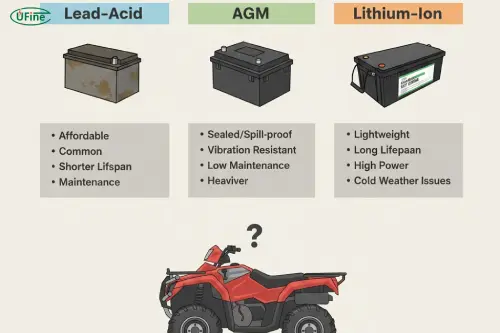
The most common battery types for quads:
AGM (Absorbent Glass Mat)- Maintenance-free
- Good vibration resistance
- Reliable in cold and hot weather
- Best for most riders
- Lightweight
- High energy density
- Long lifespan
- Faster charging
- More expensive, but ideal for performance quads
- Cheapest option
- Requires maintenance
- Less durable under vibration
- Used in older or very low-budget quads
How to choose the right battery
- Match the OEM voltage (almost always 12V)
- Check cold-cranking amps (CCA): Higher CCA = easier cold starts
- Match or exceed Ah rating for longer runtime
- Prefer AGM or Lithium for vibration-heavy off-road use
- Check physical size and terminal layout
If unsure, always check the user manual or battery label on your existing quad.
Part 2. Do 4 wheelers have 6 or 12 volt batteries?

Modern ATVs and quads almost always use 12V batteries.
Exceptions:
- Kids’ mini quads may use 6V or 12V sealed lead-acid packs
- Vintage models (pre-1990s) may use 6V systems
For any adult ATV or working quad, a 12-volt battery is standard.
Part 3. What size battery for a quad? (Quad battery size chart)
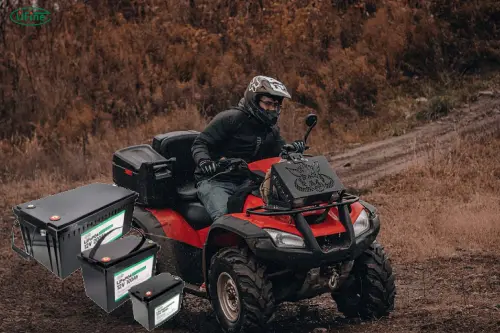
Quad battery sizing depends on engine displacement, manufacturer, and power accessories.
Quad Battery Size Chart (Common Models)
| Engine Size / Quad Type | Typical Battery Type | Voltage | Capacity (Ah) | CCA (Cold Cranking Amps) |
|---|---|---|---|---|
| 50cc – 110cc Youth Quad | YTX4L-BS / YTX5L-BS | 12V | 3–5 Ah | 40–80 CCA |
| 125cc – 200cc Utility Quad | YTX7A-BS / YTX9-BS | 12V | 6–8 Ah | 80–120 CCA |
| 250cc – 400cc Mid-Range Quad | YTX12-BS / YTX14-BS | 12V | 10–12 Ah | 150–200 CCA |
| 450cc – 700cc Sport Quad | YTX14-BS / YTX20HL-BS | 12V | 12–18 Ah | 200–300 CCA |
| 700cc+ Performance / Utility | YTX20, YTZ14, or Lithium equivalent | 12V | 14–20 Ah | 250–350+ CCA |
Pro Tip: Many riders upgrade to Lithium LiFePO4 batteries because they provide the same power at roughly ⅓ the weight
Part 4. How long does a quad battery last?
A quality quad battery typically lasts:
- AGM: 3–5 years
- Lithium LiFePO4: 5–8 years
- Lead-acid wet cell: 1–3 years
Factors that shorten battery life:
- Infrequent riding
- Long-term storage without charging
- High vibration trails
- Extreme temperatures
- Using accessories (lights, winches) without upgrading capacity
Part 5. How to replace a quad battery?
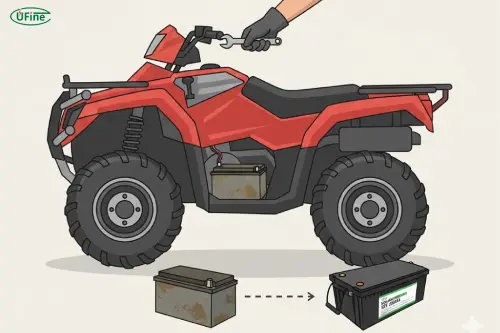
Replacing the battery in a quad is simple:
Tools Needed
- Screwdriver
- Wrench
- New battery (AGM or Lithium recommended)
Steps
- Turn off the quad and remove the key.
- Open the battery compartment (usually under the seat or front panel).
- Disconnect the negative (-) terminal first.
- Disconnect the positive (+) terminal.
- Remove the old battery.
- Place the new battery in the same orientation.
- Connect the positive (+) terminal.
- Connect the negative (-) terminal.
- Tighten and secure the battery strap.
- Start the quad to ensure proper installation.
Part 6. Maintenance & care
To maximize lifespan:
Do:
- Keep terminals clean and corrosion-free
- Use a battery tender during storage
- Keep the battery fully charged
- Store in a cool, dry environment
- Check connections monthly
Don’t:
- Let the quad sit for 2+ months without charging
- Use car chargers (risk of overcharging small batteries)
- Expose the battery to extreme heat
- Ignore early signs of failure
Part 7. Common problems
Here are the most frequent issues quad owners encounter:
1. Quad won’t start/clicking sound
Usually a weak or dead battery.
2. Battery drains quickly
Causes:
- Bad stator
- Parasitic draw
- Old battery losing capacity
3. Swollen or leaking battery
Indicates overcharging or internal damage—replace immediately.
4. Corroded terminals
Causes poor electrical contact and starting issues.
5. Not holding a charge
Typical for aging lead-acid batteries.
Part 8. Extended buying guide: choosing the best battery for a quad
When shopping for a battery, consider:
1. Voltage & compatibility
Must match OEM specs (usually 12V).
2. CCA (Cold Cranking Amps)
Higher CCA is better for cold weather.
3. Battery chemistry
- Lithium = premium, long life
- AGM = best value
- Lead-acid = budget
4. Brand reliability
Trusted brands include Yuasa, Ufine, Antigravity, Shorai, and NOCO.
5. Warranty period
Look for 1–3 years.
Part 9. Safety tips when handling quad batteries
- Always wear gloves and eye protection
- Avoid short-circuiting terminals
- Never charge lithium batteries with lead-acid chargers
- Dispose of old batteries at a recycling facility
- Keep batteries away from sparks and flames
Part 10. FAQs
1. Can I use a lithium battery in my quad?
Yes—most modern quads support Lithium LiFePO4 batteries, but ensure your charger is compatible.
2. How do I know if my quad battery is dead?
Slow cranking, dim lights, or voltage below 12.2V usually indicate a failing battery.
3. How often should I charge my quad battery?
Every 30 days if not riding, or keep it on a maintenance charger.
4. Can I jump-start a quad with a car?
Technically, yes, but risky. Use a jump pack instead.
5. Why does my quad battery keep dying?
Common reasons: bad stator, parasitic drain, or old/cheap battery.
Related Tags:

More Articles

고방전 배터리는 높은 전류와 발열로 배터리수명이 줄어듭니다. 구조적 한계, 사용 패턴, 충전 습관 등 실제 수명 단축 요인을 체계적으로 분석했습니다.
Capacitor vs Battery: What is the Difference?
Capacitor vs battery explained in detail. Learn the difference between capacitor and battery in energy storage, charging speed, lifespan, and real applications.
18650 Battery vs AA: Which Is Better for Your Device?
Compare 18650 vs AA batteries in capacity, voltage, rechargeability, and applications. Learn which battery type fits high-drain or everyday devices.
What is the Difference Between Battery Cell, Battery Control Module, and Battery Pack?
Compare battery cells, modules, and packs. Learn functions, design differences, control modules, and selection tips for EV, ESS, and industrial use.
How to Prevent LiPo Battery Explosion?
Can LiPo batteries explode or catch fire? Learn key causes of LiPo battery fires and proven charging, storage, and handling tips to reduce explosion risk.