- Part 1. What type of battery does a motorcycle need?
- Part 2. What is a LiFePO4 motorcycle battery?
- Part 3. How long can a LiFePO4 motorcycle battery last?
- Part 4. Voltage behavior at different C-Rates
- Part 5. Expected cycle life at different temperatures
- Part 6. Combined voltage vs. temperature and load
- Part 7. LiFePO4 vs traditional batteries
- Part 8. Key parameters to consider in a motorcycle battery
- Part 9. How to choose the right battery for your motorcycle
- Part 10. What charger should I use for a LiFePO4 motorcycle battery?
- Part 11. How to maintain a LiFePO4 motorcycle battery
- Part 12. Can I DIY a LiFePO4 motorcycle battery?
- Part 13. FAQs
Are you tired of wrestling with traditional bulky lead-acid batteries in your motorcycle? Consider a lithium phosphate LiFePO4 motorcycle battery. As the world shifts toward acquiring more sustainable and efficient energy sources, the motorcycle, an integral part of the transportation sector, is also a part of this positive change. Therefore, a LiFePO4 motorcycle battery also shapes the future of this two-wheeler means of transporter.
A LiFePO4 motorcycle battery has a nominal voltage of 12.8 volts with various capacities and cranking amps. Based on advanced technology, the battery easily provides 2000 to 8000 cycles with a lower weight-to-power ratio.
Part 1. What type of battery does a motorcycle need?
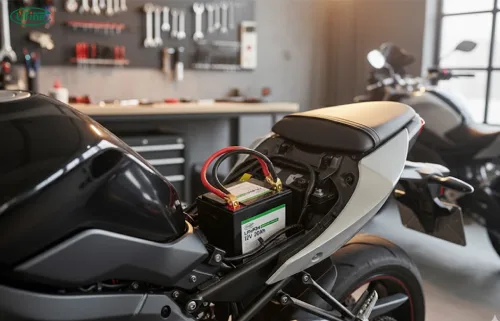
Motorcycles rely on batteries to start the engine, power lights, control electronics, and support accessories. Choosing the right battery is crucial for reliability and performance. A motorcycle battery should provide:
- Sufficient cranking power: To reliably start the engine in different conditions.
- Stable voltage output: Ensuring consistent operation of lights, ignition, and electronics.
- Durability: The ability to withstand vibrations, shocks, and extreme temperatures.
- Low maintenance: Preferably a battery that doesn’t require frequent checks or fluid refills.
- Compact and lightweight design: Especially important for handling and performance.
Historically, lead-acid batteries were the standard choice. However, they are heavy, have limited cycle life, and require regular maintenance. Today, LiFePO4 motorcycle batteries offer a modern alternative that addresses these issues.
Part 2. What is a LiFePO4 motorcycle battery?
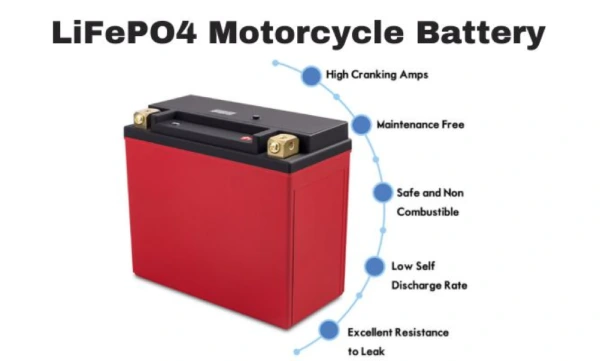
A LiFePO4 (Lithium Iron Phosphate) motorcycle battery is a type of lithium-ion battery that uses iron phosphate as the cathode material. It is designed specifically for motorcycles, scooters, and small vehicles, offering high energy density, lightweight design, and extended lifespan.
1 Structure
- Composed of four or more LiFePO4 cells connected in series (for 12.8V systems, four 3.2V cells).
- Integrated Battery Management System (BMS) in most modern models to protect against overcharge, over-discharge, short circuits, and thermal issues.
- Encased in a durable housing to resist vibrations and shocks common in motorcycles.
2 Principle
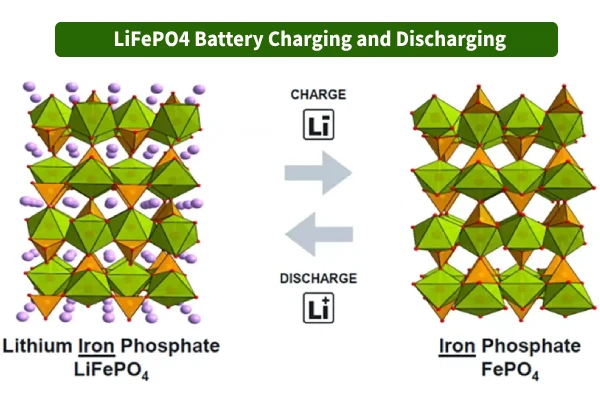
- LiFePO4 batteries store energy chemically in lithium ions. During discharge, lithium ions move from the anode to the cathode, releasing energy.
- During charging, lithium ions are driven back to the anode.
- The iron phosphate cathode provides high thermal stability and safety compared to traditional lithium-ion chemistries.
3 Advantages
- Long Lifespan: 2000–8000 cycles, or roughly 5–8 years in daily use.
- Lightweight: About 60% lighter than lead-acid batteries.
- Fast Charging: Supports high charge rates (1C–4C).
- Stable Voltage: Delivers consistent power to motorcycle electronics.
- High Safety: Lower risk of thermal runaway or explosion.
- Maintenance-Free: No need to top up fluids or check electrolyte levels.
4 Disadvantages
- Higher Initial Cost: 2–3 times more expensive than lead-acid batteries.
- Requires Compatible Charger: Cannot be charged with standard lead-acid chargers.
- Cold Temperature Performance: Reduced discharge performance below -10°C, though still safer than alternatives.
- DIY Complexity: Not recommended to build from scratch due to safety risks and BMS requirements.
Part 3. How long can a LiFePO4 motorcycle battery last?
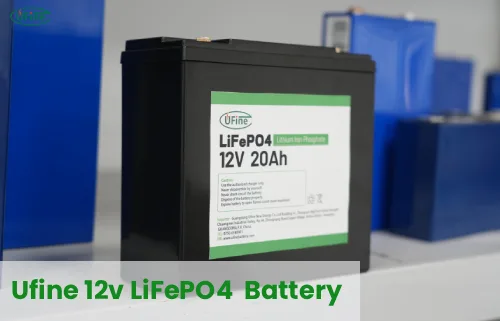
The lifespan of a LiFePO4 motorcycle battery depends on usage, environmental conditions, and charging habits. Key points:
- Cycle Life: 2000–8000 full charge/discharge cycles.
- Typical Use: 5–8 years for most riders; longer for light or seasonal use.
Factors Affecting Lifespan:
- Overcharging or deep discharging
- High ambient temperatures
- Poor storage or exposure to moisture
Best Practices: Use a compatible charger and follow partial charge cycles (40–80% rule) to maximize battery life.
Part 4. Voltage behavior at different C-Rates
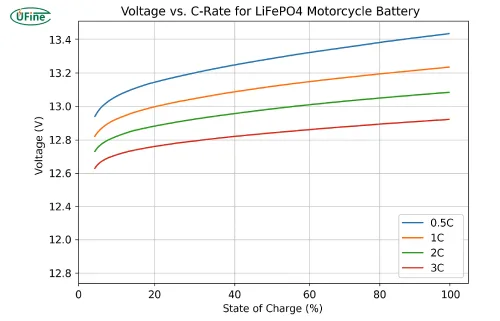
C-rate is an indicator that measures the charge and discharge rate of a battery. 1C means a complete discharge in 1 hour, 2C means a complete discharge in 0.5 hours, and so on. The voltage performance of LiFePO4 batteries at different C-rates is as follows:
| C-Rate | Initial Voltage (V) | Voltage at 50% SOC (V) | Voltage at 20% SOC (V) | Notes |
|---|---|---|---|---|
| 0.5C | 13.0 | 12.9 | 12.8 | Very stable, minimal voltage sag |
| 1C | 13.0 | 12.8 | 12.6 | Slightly more sag under load |
| 2C | 13.0 | 12.7 | 12.4 | Voltage drops faster, still stable for engine start |
| 3C | 12.9 | 12.6 | 12.2 | Noticeable sag, suitable for short bursts of high power |
| 4C | 12.8 | 12.5 | 12.0 | High load; only recommended for short duration or racing |
- LiFePO4 batteries maintain high voltage stability even at 2–3C discharge, far better than lead-acid.
- Voltage sag increases at very high C-rates, but most motorcycles rarely require sustained >3C discharge, making these batteries suitable for everyday and performance riding.
Part 5. Expected cycle life at different temperatures
Temperature significantly affects LiFePO4 battery lifespan. Below is a typical guide for cycle life under various ambient temperatures, assuming moderate discharge (1C, 50% depth of discharge):
| Ambient Temperature | Expected Cycle Life | Notes |
|---|---|---|
| 25°C (room temp) | 4000–5000 cycles | Optimal conditions |
| 0°C | 3500–4500 cycles | Slight reduction; performance stable |
| -10°C | 3000–4000 cycles | Reduced efficiency; cold start may need pre-heating |
| 40°C | 3000–4000 cycles | High heat accelerates chemical degradation |
| 50°C | 2000–2500 cycles | Significant lifespan reduction; avoid prolonged exposure |
Insights:
- Maintaining moderate temperatures during operation and storage maximizes lifespan.
- Extreme heat (>45°C) accelerates degradation, while extreme cold (-10°C or below) reduces discharge efficiency but does not damage the chemistry if properly charged.
Part 6. Combined voltage vs. temperature and load
To illustrate combined effects, the voltage under 1C, 2C, and 3C at different temperatures:
| Temperature | 1C Voltage (V) | 2C Voltage (V) | 3C Voltage (V) |
|---|---|---|---|
| 25°C | 12.8–13.0 | 12.7–12.9 | 12.6–12.8 |
| 0°C | 12.7–12.9 | 12.6–12.8 | 12.5–12.7 |
| -10°C | 12.6–12.8 | 12.5–12.7 | 12.3–12.6 |
| 40°C | 12.7–12.9 | 12.6–12.8 | 12.4–12.6 |
Analysis:
- Voltage remains relatively stable under normal discharge, making LiFePO4 highly reliable for motorcycles.
- High C-rate or extreme temperatures cause moderate sag, but not enough to significantly affect engine starting for properly sized batteries.
Part 7. LiFePO4 vs traditional batteries
When comparing LiFePO4 motorcycle batteries with traditional lead-acid batteries, LiFePO4 technology clearly outperforms in almost every critical metric: weight, lifespan, voltage stability, safety, fast charging, and maintenance. While the upfront cost is higher, the long-term benefits make LiFePO4 batteries an ideal choice for riders seeking reliable, high-performance, and low-maintenance power for their motorcycles.
Recommendation: For modern motorcycles with advanced electronics or frequent use, LiFePO4 batteries are the superior option. Riders who prioritize longevity, safety, and consistent performance will see significant benefits compared to traditional lead-acid batteries.
Analysis Table: LiFePO4 vs Lead-Acid
| Feature | Lead-Acid Battery | LiFePO4 Motorcycle Battery |
|---|---|---|
| Weight | 4–6 kg | 2–3 kg |
| Lifespan | 1–2 years / 200–500 cycles | 5–8 years / 2000–8000 cycles |
| Voltage Stability | Moderate | High |
| Fast Charging | Limited | Supported (1C–4C) |
| Maintenance | High | Low |
| Safety | Moderate (risk of leakage/explosion) | High (stable chemistry + BMS) |
| Environmental Impact | Toxic / needs careful recycling | Safer / easier to recycle |
Part 8. Key parameters to consider in a motorcycle battery
When selecting a motorcycle battery, focus on the following parameters:
- Voltage (V): Must match the motorcycle’s electrical system, usually 12V.
- Capacity (Ah): Determines how long the battery can power the motorcycle without recharge.
- Cold Cranking Amps (CCA): Important for reliable engine starts, especially in cold climates.
- Physical Size & Mounting: Ensure the battery fits your motorcycle’s battery compartment.
- Battery Management System (BMS): Protects against overcharging, over-discharging, short circuits, and overheating.
- Cycle Life: Indicates the expected lifespan in charge/discharge cycles.
- Weight: Impacts motorcycle handling and stability.
Part 9. How to choose the right battery for your motorcycle
To select the right battery:
- Check Compatibility: Refer to your motorcycle manual for size, voltage, and CCA requirements.
- Determine Usage Needs: Consider riding frequency, climate, and electrical accessory load.
- Select Battery Chemistry: For long life and low maintenance, LiFePO4 motorcycle batteries are recommended.
- Verify BMS: Ensure the battery includes a proper BMS for protection.
- Choose a Reputable Brand: Prioritize manufacturers with quality certifications and warranty support.
Part 10. What charger should I use for a LiFePO4 motorcycle battery?
LiFePO4 batteries require chargers specifically designed for lithium iron phosphate chemistry:
- Voltage Range: Typically 14.4V–14.6V for 12.8V systems.
- Charging Current: Follow the manufacturer’s recommended C-rate.
- Fast Charging: Supported by most LiFePO4 batteries, but ensure BMS can handle it.
- Avoid Lead-Acid Chargers: These can damage LiFePO4 batteries or reduce lifespan.
- Trickle Charging: LiFePO4 batteries tolerate prolonged float charging better than lead-acid but still avoid leaving at maximum voltage for extended periods.
Part 11. How to maintain a LiFePO4 motorcycle battery
LiFePO4 batteries are low-maintenance, but proper care maximizes lifespan:
- Partial Charge Cycles: Maintain battery between 40–80% whenever possible.
- Avoid Deep Discharge: Regularly discharging below 20% reduces cycle life.
- Temperature Management: Store in a cool, dry place; avoid direct sunlight or engine heat.
- Inspect Connections: Check terminals for corrosion and tightness.
- Use Compatible Charger: Prevent overvoltage and overheating.
Part 12. Can I DIY a LiFePO4 motorcycle battery?
While technically possible, building a LiFePO4 motorcycle battery from individual cells is not recommended for most riders due to:
- Safety risks (fire, explosion, or chemical exposure)
- Complexity of designing a proper BMS
- Need for precise cell balancing
- Liability concerns
For most users, purchasing a ready-made battery from a reputable manufacturer is the safest and most reliable option.
Part 13. FAQs
Can a LiFePO4 motorcycle battery replace any lead-acid battery?
Most motorcycles designed for 12V lead-acid batteries can use LiFePO4 equivalents, but check CCA and BMS compatibility.
Is it safe to leave a LiFePO4 battery unused for months?
Yes, store it partially charged (40–60%) in a cool, dry place to prevent capacity loss.
How does a BMS protect a LiFePO4 battery?
It prevents overcharge, over-discharge, short circuits, and thermal overload, ensuring safety and longer battery life.
Can LiFePO4 batteries handle high electrical loads like heated grips or additional lights?
Yes, as long as the battery’s Ah and CCA ratings are sufficient for your electrical accessories.
Do I need a special procedure for winter storage?
Avoid fully discharging and keep the battery above -10°C. Using a compatible LiFePO4 charger with trickle mode helps maintain optimal voltage.
Related Tags:

More Articles

Comparative Analysis: 14500 Battery Vs. 18650 Battery
Compare 14500 vs 18650 batteries by size, voltage, capacity, runtime, discharge current, charging, safety, and applications to choose the right cell.
12V Lithium-Ion What Voltage at Fully Charged and Why Your Battery Might Not Reach It
Check the 12V lithium battery voltage chart for 3S Li-ion and 4S LiFePO4. Learn full charge, resting voltage, charger limits, and fault checks.
LiFePO4 Voltage Chart Guide: Everything You Need to Know
Check the LiFePO4 voltage chart for 3.2V, 12V, 24V and 51.2V batteries. Compare SOC, charging voltage, cutoff limits and internal resistance.
Lithium Ion Cell Sizes: A Comprehensive Guide
Compare lithium ion cell sizes with a chart of dimensions, capacity ranges, cell types, applications, and key factors for selecting the right battery.
6 Volt Tractor Battery vs 12 Volt: Which One Fits Your Farm Equipment Best?
Compare 6V and 12V tractor batteries. Learn which voltage fits vintage or modern tractors, which specifications matter, and how to convert safely.