
- Part 1. Understanding 12V, 24V, and 48V battery systems
- Part 2. 12V vs 24V vs 48V quick comparison
- Part 3. Power and efficiency differences
- Part 4. Wiring and cable size comparison
- Part 5. Battery chemistry comparison
- Part 6. Applications and real-world use cases
- Part 7. System compatibility considerations
- Part 8. Upgrade path and future expansion
- Part 9. Which voltage should you choose?
- Part 10. FAQs
Choosing between 12V, 24V, and 48V lithium batteries isn’t just a technical decision — it directly affects efficiency, cost, scalability, and long-term performance.
If you’re designing a solar system, upgrading an RV, building an energy storage solution, or selecting batteries for industrial equipment, voltage matters more than most people realize.
And here’s the thing: there is no universally “best” voltage.
The right choice depends on how you plan to use your system, how much power you need, and whether you expect to expand in the future.
This guide breaks down everything — from performance and efficiency to wiring, compatibility, battery chemistry, and upgrade paths — so you can make a confident decision.
Key takeaways
- Higher voltage systems deliver more power with lower current and less heat
- 12V systems are simpler and ideal for small setups and portable applications
- 24V systems offer a balance between efficiency and cost
- 48V systems are best for large solar, home storage, and high-power applications
- Higher voltage reduces cable size, installation cost, and energy loss
- Choosing the right voltage now makes future system expansion much easier
Part 1. Understanding 12V, 24V, and 48V battery systems
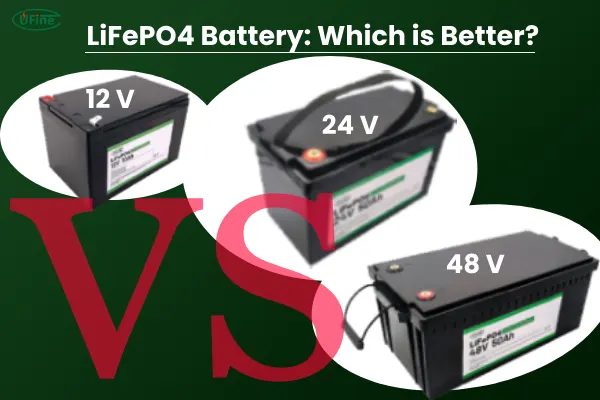
Before comparing performance, it’s helpful to understand what these voltage ratings actually mean.
A 12V lithium battery system typically consists of four LiFePO4 cells connected in series. When you move to 24V, you’re essentially doubling that configuration. A 48V system goes even further, combining multiple cells to achieve higher voltage output.
From a practical perspective, voltage determines how much current your system needs to deliver the same amount of power. And this is where things start to get interesting.
For example, a 1000W load behaves very differently depending on system voltage:
- 12V system → high current demand
- 24V system → moderate current demand
- 48V system → low current demand
Lower current means less heat, smaller cables, and better efficiency. That’s why higher-voltage systems are increasingly popular in modern lithium battery applications.
When you start designing a lithium battery system, one of the most important steps is understanding how cells are configured in series or parallel, because it directly affects voltage, capacity, and overall system stability. You can explore a complete step-by-step explanation in our guide on how to connect lithium batteries in series and parallel.
Part 2. 12V vs 24V vs 48V quick comparison
| Feature | 12V Lithium Battery | 24V Lithium Battery | 48V Lithium Battery |
|---|---|---|---|
| Typical system size | Small systems | Medium systems | Large systems |
| Typical capacity range | 50Ah–300Ah | 50Ah–200Ah | 50Ah–200Ah |
| Power capability | Low to moderate | Moderate to high | High power applications |
| Current required (1000W load) | ~83A | ~42A | ~21A |
| Efficiency | Lower (more current loss) | Moderate | Highest efficiency |
| Cable thickness | Thick cables required | Medium cables | Thinner cables |
| Installation difficulty | Easy | Moderate | More complex |
| System expansion | Limited scalability | Good scalability | Excellent scalability |
| Common applications | RV, boats, portable power | Off-grid systems, telecom | Solar storage, home ESS |
| Inverter compatibility | Widely available | Widely available | Increasingly standard |
| Charging speed | Slower | Moderate | Faster charging capability |
| Heat generation | Higher | Moderate | Lower |
| Energy loss | Higher | Moderate | Lower |
| System cost (small system) | Lowest | Moderate | Higher upfront |
| System cost (large system) | Higher long-term | Balanced | Most cost-effective |
| Safety level | Very safe (low voltage) | Safe | Still safe but higher voltage |
| Battery configuration | 4 cells (LiFePO4) | 8 cells (LiFePO4) | 16 cells (LiFePO4) |
| Typical applications | RV, marine, small solar | Off-grid, backup power | Solar ESS, industrial, telecom |
| Future upgrade flexibility | Limited | Good | Best for expansion |
While this table gives a quick overview, the real differences become clearer when you look at performance, wiring, and long-term system design.
Part 3. Power and efficiency differences
Higher voltage systems are naturally more efficient. This isn’t marketing — it’s basic electrical physics.
When you increase voltage, current decreases for the same power level. Lower current reduces resistance losses in cables and components.
This becomes especially important in larger systems.
For example, running a 2000W inverter:
- A 12V system pulls very high current and generates more heat
- A 24V system performs better but still has moderate losses
- A 48V system runs cooler and more efficiently
This is one of the main reasons why professional solar installers often recommend 48V systems for home energy storage.
That advantage becomes even more noticeable as system size grows.
Part 4. Wiring and cable size comparison
Wiring is often overlooked, but it has a huge impact on installation cost and performance.
Higher current requires thicker cables. Thicker cables are more expensive, harder to install, and increase energy loss.
| Power Load | 12V Current | 24V Current | 48V Current |
|---|---|---|---|
| 1000W | ~83A | ~42A | ~21A |
| 2000W | ~167A | ~83A | ~42A |
This difference dramatically affects:
- Cable cost
- Installation difficulty
- Heat generation
- System efficiency
Over time, lower wiring losses can make a 48V system more cost-effective, even if the initial investment is higher.
Part 5. Battery chemistry comparison
Voltage alone doesn’t tell the full story. Battery chemistry also plays a major role in performance, lifespan, and cost.
Most modern 12V, 24V, and 48V systems use lithium iron phosphate (LiFePO4) batteries because they offer better safety, longer lifespan, and stable voltage output.
Compared to traditional lead-acid batteries, lithium batteries provide:
- Higher energy density
- Longer cycle life
- Faster charging
- Better efficiency
Lithium iron phosphate batteries also operate more safely under high-power conditions, which is especially important in 48V systems.
As a result, 48V LiFePO4 systems are now widely used in:
- Home energy storage
- Solar battery banks
- Telecom systems
- Industrial backup power
When comparing different battery system designs, it also helps to understand how lithium batteries differ from traditional energy storage technologies. You can explore this in our detailed comparison of lead acid vs lithium ion batteries.
Part 6. Applications and real-world use cases
In real-world applications, voltage choice usually depends on system size and power requirements.
A 12V system works well when you’re dealing with smaller loads — RV lighting, portable power stations, small solar setups, or marine electronics.
As you move to medium-sized systems, 24V becomes more attractive. It offers better efficiency without significantly increasing complexity. Many off-grid cabins and telecom systems use 24V setups.
But when you’re working with large solar systems, home battery storage, or high-power inverters, 48V systems quickly become the preferred choice. They handle higher loads more efficiently and make future expansion easier.
This progression — from 12V to 24V to 48V — often reflects how power needs grow over time.
Part 7. System compatibility considerations
Another factor you shouldn’t ignore is compatibility.
Your battery voltage must match other components in your system, including:
- Inverter
- Solar charge controller
- Charger
- DC loads
Switching voltage often means replacing multiple components. For example, upgrading from 12V to 48V typically requires a new inverter and charge controller.
Because of this, many users choose 48V from the beginning, especially if they expect system expansion.
48V systems are also becoming more common in modern hybrid inverters and solar energy storage solutions, making them easier to integrate.
Part 8. Upgrade path and future expansion
Thinking about future expansion now can save you time and money later.
Many users start with 12V because it’s simple and affordable. However, as power demands increase, they often realize the system has limitations.
Upgrading from 12V to 24V or 48V is possible, but it usually involves replacing key components. That makes the transition more expensive than starting with a higher voltage.
If you expect your system to grow — adding solar panels, increasing storage capacity, or powering more equipment — starting with 24V or 48V can be a smarter long-term strategy.
Planning ahead helps avoid unnecessary upgrades and improves system flexibility.
Part 9. Which voltage should you choose?
Your final decision depends on your specific use case, power demand, and future plans.
If you’re running a small system and want something simple, 12V remains a practical choice.
If you’re looking for better efficiency without going fully industrial, 24V offers a balanced option.
But if you’re building a larger system or planning for expansion, 48V often delivers the best long-term value.
In many modern installations, 48V systems are becoming the standard — not because they’re always necessary, but because they provide flexibility, efficiency, and scalability.
Part 10. FAQs
1. Can I mix 12V, 24V, and 48V batteries in one system?
No, you should not mix different voltage systems directly. It can cause imbalance, inefficient charging, and potential damage to the battery management system (BMS).
2. Does higher voltage mean longer battery lifespan?
Not directly. Voltage itself does not determine lifespan. However, higher voltage systems often run with lower current, which reduces stress and heat — indirectly helping longevity.
3. Can I convert a 12V system to 24V or 48V later?
Yes, but it usually requires replacing major components like the inverter, charge controller, and rewiring the system. It is not a simple plug-and-play upgrade.
4. Which voltage is better for off-grid solar systems?
It depends on system size. 12V works for small setups, 24V for medium off-grid systems, and 48V is preferred for larger residential or commercial solar storage.
5. Why do most home solar systems use 48V batteries?
Because 48V systems are more efficient for high-power loads, reduce energy loss in wiring, and integrate better with modern hybrid inverters.
Related Tags:

More Articles

JST vs Molex: The Right Battery Connector Choice
JST or Molex for your battery? Learn how connector selection affects current, voltage drop, reliability, and device performance.
Custom Battery Pricing: Costs Manufacturers Don’t Mention
A low battery quote may not be the final cost. Discover common hidden expenses that affect custom lithium battery projects.
Battery Wire Length: Hidden Cause of Power Loss
A longer battery wire can cause voltage drop, power loss, and unstable operation. Learn how wire length affects battery performance.
How Device Sleep Modes Affect Battery Life
Think sleep mode extends battery life? Learn why devices still drain power and how firmware, hardware, and batteries affect runtime.
LiPo Battery and PCB Design: Clearance, Insulation, and Placement
Learn how to optimize LiPo battery PCB clearance, insulation, placement, wiring, and thermal design—and avoid common integration mistakes.


