
- Part 1. Alkaline battery types
- Part 2. Alkaline battery voltage chart
- Part 3. Alkaline battery voltage curve
- Part 4. AA battery voltage explained
- Part 5. How to check the voltage of alkaline batteries?
- Part 6. How low can alkaline battery voltage be useful?
- Part 7. Why battery voltage drops during discharge
- Part 8. What’s the voltage difference between D batteries and AA batteries
- Part 9. Alkaline vs lithium battery voltage
- Part 10. FAQs
Alkaline batteries power many of our everyday devices, from flashlights to remotes and toys. But how much voltage do these batteries really provide? Whether you’re curious about the types of alkaline batteries, the voltage curve, or how to check battery voltage, understanding alkaline battery voltage is important for both efficient use and replacement. In this guide, we will explore the maximum and minimum voltages of different alkaline batteries, the voltage curve characteristics, and how to check the voltage to ensure you’re getting the most out of your battery.
Part 1. Alkaline battery types

Alkaline batteries come in a variety of sizes and forms, but they are all designed to provide a specific voltage for various devices. Understanding these types can help you choose the right battery for your needs.
Alkaline batteries are classified into different types primarily based on their size and voltage. The most common types include:
- AA Alkaline Battery: This is the most commonly used size in household devices. The nominal voltage is 1.5V.
- AAA Alkaline Battery: A smaller version of the AA, often used in smaller devices like remotes or flashlights. Its nominal voltage is also 1.5V.
- 9V Alkaline Battery: Often used in smoke detectors and other specialized applications. Its nominal voltage is 9V.
- C and D Alkaline Batteries: These larger batteries are used in more power-hungry devices like toys and flashlights. They also provide 1.5V.
AA vs C vs D battery: A Comprehensive Comparison
While these alkaline batteries all provide 1.5V nominal voltage, the exact voltage can vary depending on the battery’s size and charge state.
Part 2. Alkaline battery voltage chart
Let’s start with the most common question: what is the voltage of an alkaline battery?
For standard household alkaline cells, the nominal voltage is 1.5 volts per cell. This applies to AA, AAA, C, and D batteries. However, nominal voltage is only the “rated” value used for classification. In real use, the actual voltage changes constantly.
A fresh battery right out of the package usually measures higher than 1.5V. As the battery discharges, voltage slowly drops until the device can no longer operate reliably.
Here is a practical alkaline battery voltage chart:
| Battery Type | Nominal Voltage | Fresh Voltage | Typical Replacement Voltage |
|---|---|---|---|
| AA | 1.5V | 1.55–1.65V | 1.0V |
| AAA | 1.5V | 1.55–1.65V | 1.0V |
| C | 1.5V | 1.55–1.65V | 0.9–1.0V |
| D | 1.5V | 1.55–1.65V | 0.9–1.0V |
| 9V | 9V | 9.4–9.6V | 6–7V |
This explains why a brand-new AA battery voltage often looks “higher than expected.” It is normal.
According to battery testing guidance from the U.S. Department of Energy and manufacturer specifications, voltage under load matters more than open-circuit voltage because real devices pull current during operation, which causes voltage drop.
1 Alkaline battery maximum voltage
The maximum voltage of an alkaline battery refers to the peak voltage the battery can deliver when fully charged.
- AA and AAA Alkaline Batteries: When fully charged, these batteries typically provide a 1.6V peak voltage. This is the highest voltage you’ll see when the battery is fresh out of the pack.
- 9V Alkaline Battery: A fully charged 9V battery can provide up to 9.6V, which is the maximum voltage it can deliver before the voltage starts to drop.
- C and D Alkaline Batteries: These larger batteries also provide a peak voltage of 1.6V when fully charged, just like AA and AAA.
It’s important to note that the maximum voltage only occurs when the battery is new or just fully charged. Over time, as the battery discharges, the voltage will gradually decrease.
2 Alkaline battery minimum voltage
The minimum voltage refers to the point at which the battery’s voltage is too low to effectively power a device. At this stage, the battery is usually considered “dead,” although it might still hold a small charge.
- AA and AAA Alkaline Batteries: The minimum voltage for these batteries is typically around 0.9V. Below this point, they are generally no longer able to effectively power most devices.
- 9V Alkaline Battery: For a 9V battery, the minimum voltage is usually around 6V. Once it falls below this threshold, the battery won’t be able to power devices like smoke detectors.
- C and D Alkaline Batteries: Like AA and AAA, these larger batteries also have a minimum voltage around 0.9V. When the voltage drops below this level, they can no longer power high-drain devices effectively.
Remember that while a battery can still hold some voltage below the minimum, it’s no longer useful for most tasks.
Part 3. Alkaline battery voltage curve
The voltage curve of an alkaline battery shows how its voltage changes over time as it discharges. This curve is important to understand because it affects how long the battery can power your device. 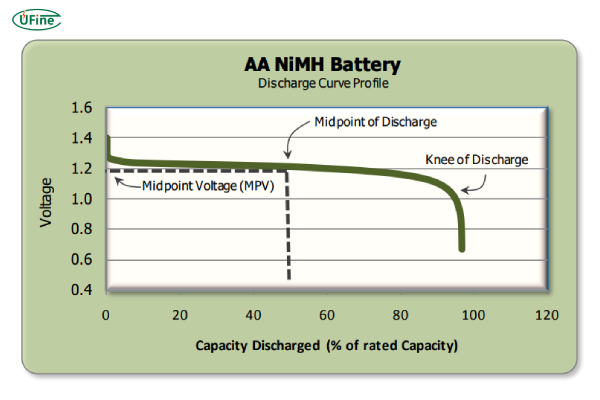
Characteristics of the Alkaline Battery Voltage Curve:
- Initial Drop: When first used, the voltage of an alkaline battery tends to drop slightly from its peak (around 1.6V) within the first few hours of use.
- Gradual Decline: After the initial drop, the voltage remains fairly stable for a large portion of the battery’s life. During this phase, the battery can still power most devices effectively.
- Rapid Decline: As the battery nears depletion, the voltage drops more sharply. This is when you’ll notice devices starting to lose power or fail to turn on.
- End-of-Life: Once the battery voltage falls below its minimum voltage (0.9V to 1V for AA/AAA, 6V for 9V), it can no longer provide reliable power.
Understanding this curve is key to managing battery life and knowing when to replace your alkaline battery before it completely drains.
Part 4. AA battery voltage explained
Among all battery types, AA battery voltage is searched the most—and for good reason. AA batteries power everything from TV remotes and toys to wireless mice and emergency flashlights.
But many people ask the same thing:
“If my AA battery reads 1.2V, is it dead?”
Not necessarily.
This depends on the device.
A wall clock with a very low power draw may still run on 1.1V. A digital camera, on the other hand, may stop working at 1.25V because it needs higher current and stable voltage under load.
That is why “minimum voltage for AA battery” is not a fixed number.
Here is a useful reference:
| AA Battery Voltage Reading | Condition |
|---|---|
| 1.55V–1.65V | New / fresh |
| 1.35V–1.50V | Good working condition |
| 1.10V–1.30V | Weak but may still work |
| Below 1.0V | Usually should be replaced |
This is also why testing batteries without a load can be misleading. A battery may look fine on a multimeter but fail instantly inside a high-drain device.
Part 5. How to check the voltage of alkaline batteries?
Knowing how to check the voltage of an alkaline battery can help you avoid using batteries that are too low to be effective.
Using a Multimeter:
- Set the multimeter to DC voltage mode.
- Place the red probe on the positive terminal of the battery and the black probe on the negative terminal.
- The multimeter will display the voltage. If it shows 1.5V (or higher), the battery is good. If it shows below 1.0V for AA/AAA, or below 6V for a 9V battery, it’s time to replace it.
Using a Battery Tester:
Battery testers are inexpensive devices designed specifically to measure the voltage of batteries. Simply insert the alkaline battery into the tester, and it will show you the voltage on a scale, often with a color-coded indicator.
Checking the voltage regularly can help you determine whether it’s time to replace the battery before your device starts losing power.
Part 6. How low can alkaline battery voltage be useful?
So, how low can an alkaline battery voltage go before it’s no longer useful? The general rule is:
- AA and AAA Batteries: Once the voltage drops below 1.0V, you’ll likely notice a drop in performance, and the battery is no longer efficient. At 0.9V or lower, it’s usually time to replace the battery.
- 9V Batteries: When the voltage drops below 6V, a 9V alkaline battery is generally not useful for most devices. It’s time to replace it.
- C and D Batteries: These larger batteries follow a similar pattern to AA and AAA. Below 1.0V, they won’t be useful for most tasks.
Part 7. Why battery voltage drops during discharge
Voltage drop is not just about “running out of power.” Several physical factors are involved.
First, the chemical reaction inside an alkaline cell becomes less efficient over time. As zinc and manganese dioxide are consumed, the battery’s ability to maintain voltage decreases.
Second, internal resistance rises.
This is especially important. As resistance increases, the battery loses more voltage whenever current flows. That is why old batteries often fail in high-drain devices first.
Temperature also plays a major role.
Cold weather slows electrochemical reactions, which is why outdoor sensors, flashlights, and emergency devices often show weaker performance in winter. A battery that seems dead outside may recover slightly at room temperature.
Finally, battery age matters—even unused batteries slowly degrade during storage.
So when someone says, “This battery still reads 1.3V, why won’t it work?” the answer is often internal resistance, not just voltage.
Part 8. What’s the voltage difference between D batteries and AA batteries
This is one of the most misunderstood battery questions.
Surprisingly, there is no real voltage difference.
Both AA and D alkaline batteries use the same nominal voltage: 1.5V.
So why do D batteries last so much longer?
Because voltage and capacity are completely different things.
Think of voltage like water pressure and capacity like tank size.
AA and D batteries have the same pressure, but the D battery has a much larger tank.
A typical alkaline AA battery may offer around 2,000–3,000 mAh depending on load conditions, while a D battery can provide 12,000–18,000 mAh or even more.
That is why devices like portable radios, large flashlights, and industrial equipment often use D cells—they need longer runtime, not higher voltage.
So if someone asks, “What’s the voltage difference between D batteries and AA batteries?” the better answer is:
The voltage is the same, but the runtime is dramatically different.
Part 9. Alkaline vs lithium battery voltage
This is where many buyers start comparing options.
Alkaline batteries are inexpensive, widely available, and ideal for low-to-medium drain devices. But lithium batteries—especially lithium iron phosphate (LiFePO4) systems—perform very differently.
Primary lithium AA batteries usually have a higher starting voltage and much better performance in extreme temperatures. Rechargeable lithium systems go even further, offering longer cycle life and more stable discharge performance.
For example, alkaline voltage gradually declines during use, while lithium batteries often maintain a flatter discharge curve. This means your device performs more consistently instead of slowly weakening over time.
That is why backup power systems, solar storage, RV batteries, and marine applications increasingly move toward lithium solutions rather than traditional alkaline chemistry.
For simple household use, alkaline still makes sense. For long-term energy storage and deep cycling, lithium is often the smarter investment.
Part 10. FAQs
-
How do I know when my alkaline battery is dead?
When the voltage drops below the minimum voltage (around 0.9V for AA/AAA, 6V for 9V), the battery can no longer power your device effectively, signaling it’s time to replace it. -
Can an alkaline battery still work if the voltage is low?
It can still work for low-power devices, but performance will be unreliable, and it’s likely to fail soon. If you notice devices not functioning properly, replace the battery. -
How can I prolong the life of my alkaline battery?
To get the most out of your alkaline battery, avoid draining it completely, store it in a cool, dry place, and remove it from devices that aren’t in use for extended periods. -
Are 9V alkaline batteries more powerful than AA batteries?
Yes, a 9V battery delivers 9 volts of power compared to the 1.5V of an AA battery. However, AA batteries are more common for household devices, while 9V batteries are used in specialized devices like smoke detectors. -
Can I use a multimeter to measure the voltage of a 9V battery?
Yes! A multimeter can easily measure the voltage of a 9V battery. Just set the multimeter to DC voltage and check the reading. If it’s below 6V, the battery is no longer useful.
Related Tags:

More Articles

JST vs Molex: The Right Battery Connector Choice
JST or Molex for your battery? Learn how connector selection affects current, voltage drop, reliability, and device performance.
Custom Battery Pricing: Costs Manufacturers Don’t Mention
A low battery quote may not be the final cost. Discover common hidden expenses that affect custom lithium battery projects.
Battery Wire Length: Hidden Cause of Power Loss
A longer battery wire can cause voltage drop, power loss, and unstable operation. Learn how wire length affects battery performance.
How Device Sleep Modes Affect Battery Life
Think sleep mode extends battery life? Learn why devices still drain power and how firmware, hardware, and batteries affect runtime.
LiPo Battery and PCB Design: Clearance, Insulation, and Placement
Learn how to optimize LiPo battery PCB clearance, insulation, placement, wiring, and thermal design—and avoid common integration mistakes.


