- Part 1. What is a 3.7V battery charger?
- Part 2. 3.7V battery voltage and charging process
- Part 3. 3.7V charger types
- Part 4. How to choose the right 3.7V charger
- Part 5. 3.7V battery charging current guide
- Part 6. How long does it take to charge a 3.7V battery?
- Part 7. Charger vs power supply
- Part 8. Charger IC and BMS protection
- Part 9. Can you charge multiple 3.7V batteries together?
- Part 10. FAQs
According to the International Energy Agency (IEA), the global lithium-ion battery market exceeded $150 billion in 2025, with lithium-ion battery deployment growing rapidly across transportation, energy storage, and electronic applications.
Among different lithium battery specifications, the 3.7V lithium battery is one of the most widely used options because it offers a good balance between energy density, size, and performance. However, many users are confused about one important question:
If a battery is rated at 3.7V, why does it need a 4.2V charger?
The answer is that 3.7V is the nominal voltage, not the charging voltage. A typical 3.7V lithium-ion or lithium polymer battery reaches approximately 4.2V when fully charged, which means you need a charger designed specifically for lithium batteries.
Key takeaways
- A 3.7V lithium battery is normally charged to 4.2V, not 3.7V.
- A standard 5V USB adapter cannot charge a 3.7V battery directly without a charging circuit.
- 3.7V Li-ion and LiPo batteries usually require a constant current/constant voltage (CC/CV) charging method.
- The correct charging current depends on battery capacity, chemistry, and manufacturer specifications.
- A charger and a power supply perform different functions and should not be used interchangeably.
- A battery protection system such as BMS helps prevent overcharge, over-discharge, and short circuits.
Part 1. What is a 3.7V battery charger?
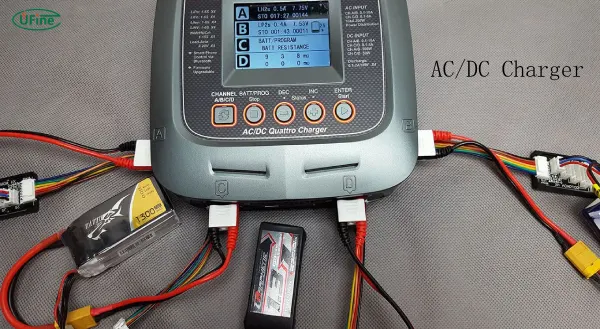
A 3.7V battery charger is a charging device designed for rechargeable lithium batteries with a nominal voltage of 3.7V.
These batteries usually include:
- Lithium-ion cylindrical cells, such as 18650 batteries
- Lithium polymer (LiPo) pouch cells
- Rechargeable lithium batteries used in portable electronics
A common misunderstanding is that a 3.7V charger outputs exactly 3.7V. In reality, lithium batteries require a controlled charging voltage that is higher than their nominal voltage.
For most 3.7V lithium batteries:
- Nominal voltage: 3.7V
- Fully charged voltage: 4.2V
- Recommended charging method: CC/CV charging
A proper lithium battery charger controls both:
- Charging voltage
- Charging current
This prevents the battery from receiving excessive energy during charging.
Unlike simple power adapters, lithium battery chargers actively monitor charging conditions and gradually reduce current when the battery approaches full capacity.
Part 2. 3.7V battery voltage and charging process
Understanding the difference between battery voltage and charging voltage is the key to choosing the correct charger.
A 3.7V lithium battery does not maintain exactly 3.7V during operation. Its voltage changes depending on its state of charge.
| Battery condition | Approximate voltage | Explanation |
|---|---|---|
| Fully charged | 4.2V | Maximum charging voltage |
| Normal operating range | 3.6V-3.9V | Typical working voltage |
| Nominal voltage | 3.7V | Rated battery voltage |
| Low battery | 3.0V-3.3V | Battery needs charging |
| Over-discharged | Below 2.5V-3.0V | Possible battery damage |
The term 3.7V refers to the average operating voltage of the battery, not the voltage required to charge it.
For example:
A 3.7V 2000mAh LiPo battery:
- Starts charging at around 3.0V-3.7V depending on its condition
- Gradually increases toward 4.2V
- Stops charging when it reaches approximately 4.2V
Why does a 3.7V battery charge to 4.2V?
Many people search:
Can you charge a 3.7V battery with a 4.2V charger?
The answer is yes, if the charger is specifically designed for 3.7V lithium batteries.
The reason is simple:
3.7V = nominal voltage
4.2V = maximum charging voltage
Lithium-ion chemistry requires a higher voltage during charging to store energy inside the battery.
A charger that stops at only 3.7V would not fully charge the battery, resulting in:
- Lower capacity
- Shorter runtime
- Poor battery performance
However, you should not use a random 4.2V power source because lithium batteries require controlled charging current. A proper lithium charger regulates the charging process instead of simply applying voltage.
Understanding the correct charging process is essential for maintaining lithium battery performance. For more details, check this guide on how to charge lithium-ion batteries.
Part 3. 3.7V charger types
3.7V battery chargers are available in different forms depending on the application.
1 USB 3.7V battery charger
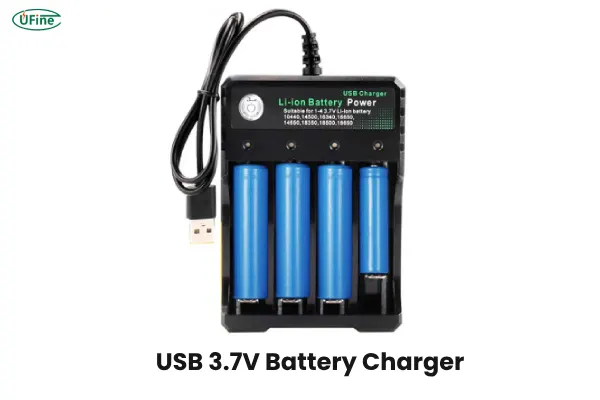
USB chargers are among the most common charging solutions because USB power sources are widely available.
Typical applications include:
- Wearable electronics
- Portable devices
- DIY electronics
- Small consumer products
A USB-based 3.7V battery charging system usually includes:
- USB input connector
- Charging IC
- Protection circuit
- Battery connector
Advantages:
- Easy power access
- Compact design
- Low-cost implementation
However, the USB port itself does not determine the charging method. The charging circuit inside the device is responsible for safely charging the battery.
2 Dedicated lithium battery charger
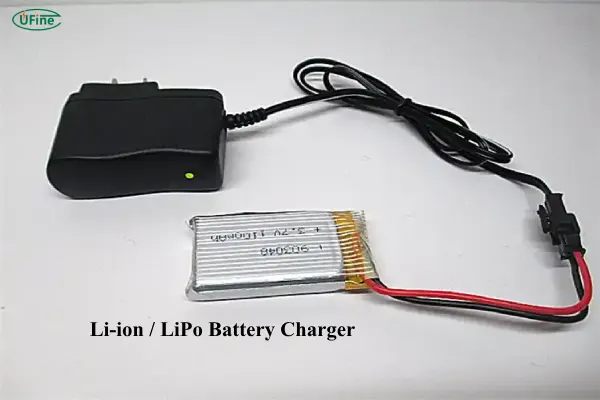
A dedicated lithium charger is designed specifically for rechargeable lithium cells.
Features may include:
- Adjustable charging current
- Battery status monitoring
- Temperature detection
- Overcharge protection
These chargers are commonly used for:
- 18650 lithium batteries
- LiPo pouch batteries
- Portable power equipment
3 Charging IC solution
For product developers, the charger is often integrated directly into the device through a charging IC.
A charging IC manages:
- Input voltage regulation
- Charging current control
- CC/CV transition
- Charging termination
Common charging IC solutions are widely used in consumer electronics because they allow manufacturers to create smaller and more efficient charging designs.
Selecting a charger requires considering battery voltage, capacity, charging current, and protection features. Read our guide on choosing a lithium battery charger for more details.
Part 4. How to choose the right 3.7V charger
Choosing the correct 3.7V charger requires more than checking voltage.
You should consider several factors:
Battery chemistry
Not all rechargeable batteries use the same charging requirements.
Common examples:
| Battery type | Nominal voltage | Full charge voltage | Charger requirement |
|---|---|---|---|
| Li-ion battery | 3.6V-3.7V | 4.2V | Single-cell lithium charger |
| LiPo battery | 3.7V | 4.2V | LiPo-compatible charger |
| LiFePO4 battery | 3.2V | 3.65V | Different charger profile |
A charger designed for a 3.7V Li-ion battery should not automatically be used for other lithium chemistries.
Battery capacity
Battery capacity affects the recommended charging current.
For example:
- 500mAh battery
- 2000mAh battery
- 5000mAh battery
may all have a 3.7V rating, but they require different charging currents.
Using excessive charging current can increase heat generation and reduce battery lifespan.
Charging current
The charging current is usually measured in amps (A) or milliamps (mA).
A common guideline is around 0.5C charging current.
For example:
A 2000mAh battery:
2000mAh × 0.5C = 1000mA
A charger providing around 1A charging current may be suitable depending on the battery specifications.
However, the recommended charging current should always follow the battery manufacturer’s specifications.
Input power requirement
The charger input also matters.
Common options include:
- 5V USB input
- 9V or 12V DC input
- AC wall adapter input
For portable products, 5V USB charging is popular because it works with common adapters, power banks, and computer USB ports.
Part 5. 3.7V battery charging current guide
Charging current directly affects charging speed and battery performance.
A higher charging current does not always mean better charging. The battery must be designed to support faster charging rates.
| Battery capacity | Typical charging current |
|---|---|
| 100mAh | 50mA |
| 500mAh | 250mA |
| 1000mAh | 500mA |
| 2000mAh | 1A |
| 5000mAh | 2.5A |
These values are general examples based on approximately 0.5C charging.
The actual charging current depends on:
- Battery chemistry
- Cell design
- Temperature
- Manufacturer specifications
- Expected battery lifetime
For high-capacity or fast-charging lithium batteries, the charging current may be higher, but the charger and battery must be designed together.
Part 6. How long does it take to charge a 3.7V battery?
Charging time depends mainly on:
- Battery capacity
- Charger current
- Charging efficiency
- Charging profile
A simple estimation formula is:
Charging time ≈ Battery capacity ÷ Charging current × 1.2
Example:
A 3000mAh battery charged with a 1000mA charger:
3000 ÷ 1000 × 1.2
≈ 3.6 hours
The reason the calculation includes an additional factor is that lithium charging is not 100% efficient and the final constant voltage stage takes additional time.
During the CC stage, the battery charges relatively quickly. When the battery reaches approximately 4.2V, the charger enters the CV stage, where charging current gradually decreases until charging is complete.
Part 7. Charger vs power supply
Many people use the terms charger, adapter, and power supply interchangeably, but they are not the same.
Understanding the difference is important when working with 3.7V lithium batteries.
A power supply mainly provides a fixed electrical output. Its job is to deliver voltage and current to a device.
A battery charger, however, is designed to manage the charging process by controlling:
- Charging voltage
- Charging current
- Charging stages
- Charge termination
For example:
A 5V USB adapter can provide power, but it cannot safely charge a 3.7V lithium battery by itself.
A lithium battery charger adds the necessary charging control circuit between the power source and the battery.
| Device | Main function | Can it charge a 3.7V battery directly? |
|---|---|---|
| USB power adapter | Provides 5V power output | No |
| DC power supply | Provides fixed voltage output | Usually no |
| Lithium battery charger | Controls CC/CV charging process | Yes |
| Charging IC module | Integrated charging control solution | Yes |
A proper lithium charger must accurately control charging voltage because lithium batteries have strict voltage limits. Incorrect voltage control can prevent the battery from reaching full capacity or reduce battery lifespan.
Part 8. Charger IC and BMS protection
For many electronic products, the charging system is not a separate external charger. Instead, the charging function is integrated into the product using a battery charging IC.
A charging IC is a semiconductor component that manages the charging process between the power source and the battery.
Typical charging IC functions include:
- Input voltage regulation
- Constant current charging
- Constant voltage charging
- Charging termination
- Temperature monitoring
- Battery status detection
A typical charging structure looks like this:
USB / DC input
↓
Charging IC
↓
Protection circuit
↓
3.7V lithium battery
Charger IC vs BMS
Although charging ICs and battery management systems (BMS) both improve battery safety, they serve different purposes.
| Function | Charger IC | BMS |
|---|---|---|
| Controls charging current | ✓ | Sometimes |
| Controls charging voltage | ✓ | Sometimes |
| Prevents overcharge | ✓ | ✓ |
| Prevents over-discharge | ✗ | ✓ |
| Protects against short circuit | Limited | ✓ |
| Cell balancing | ✗ | ✓ |
The charger mainly manages the charging process, while the BMS protects the battery during charging, discharging, and abnormal conditions.
For single-cell 3.7V lithium batteries, a protection circuit is often integrated into the battery pack. For multi-cell battery packs, a more advanced BMS may be required.
A properly designed lithium charging system usually combines accurate charging control with appropriate protection features. Lithium-ion chargers commonly use CC/CV charging because it provides controlled current during the early stage and precise voltage regulation near full charge.
Part 9. Can you charge multiple 3.7V batteries together?
Whether you can charge multiple 3.7V batteries with one charger depends on how the batteries are connected.
There are two common configurations:
Parallel connection
When two or more 3.7V batteries are connected in parallel:
- Voltage remains 3.7V
- Capacity increases
- Charging voltage remains 4.2V
Example:
Two 3.7V 2000mAh batteries connected in parallel:
- Voltage: 3.7V
- Total capacity: 4000mAh
A charger designed for a single 3.7V lithium battery may work only if the charging current is suitable for the increased capacity.
Series connection
When batteries are connected in series:
- Voltage increases
- Capacity remains similar
Example:
Two 3.7V batteries connected in series:
- Voltage: 7.4V
- Full charge voltage: 8.4V
A normal 3.7V battery charger cannot charge this configuration.
You need a charger designed for the total battery voltage.
| Battery connection | Nominal voltage | Full charge voltage | Required charger |
|---|---|---|---|
| One 3.7V cell | 3.7V | 4.2V | Single-cell lithium charger |
| Two cells parallel | 3.7V | 4.2V | Higher-current single-cell charger |
| Two cells series | 7.4V | 8.4V | Two-cell lithium charger |
Before connecting multiple batteries together, the cells should have compatible specifications, including:
- Same chemistry
- Similar capacity
- Similar voltage level
- Suitable protection design
Part 10. FAQs
Does charging a 3.7V battery faster reduce its lifespan?
Fast charging can reduce battery lifespan if the charging current exceeds the battery’s recommended limit. A suitable charging rate helps balance charging speed, heat generation, and long-term battery performance.
What charger connector is used for 3.7V lithium batteries?
The connector depends on the device and battery design. Common options include USB-C, Micro USB, JST connectors, and custom connectors used in compact electronic products.
Can I replace my 3.7V battery charger with another brand?
Yes, as long as the replacement charger matches the battery’s voltage, charging method, current requirements, connector type, and protection specifications. Compatibility should be checked before use.
Related Tags:

More Articles
10440 Battery Guide: Size, Voltage, Capacity, Uses & More
Understand 10440 batteries better—size, voltage, safety, and how they compare to AAA. Find the best fit for your high-performance devices.
Top 10 3.7V Li-ion Battery Recommendations
Are you looking for a reliable 3.7V Li-ion battery for various devices? Find a detailed guide with the top 10 3.7V Li-ion battery recommendations to help you.
Headphone Battery Comparison for Bluetooth Headphones: 10 Options and Selection Guide
Compare 10 headphone battery options for Bluetooth devices by capacity, size, voltage, connector, supplier role, compatibility, and price factors.
Speaker Battery Guide: 10 Bluetooth Speaker Battery Options Compared
Compare 10 speaker battery options by voltage, capacity, chemistry, connector and fit, including 2000mAh and 10000mAh Bluetooth speaker batteries.
Is Battery Acid Dangerous? How to Prevent & Clean It
Found strange liquid or crystals near a battery? Discover what battery acid looks like, why batteries leak, and how to safely handle corrosion.