
- Key Takeaways
- Part 1. What is a lithium ion forklift battery?
- Part 2. Lithium ion vs. lead-acid forklift batteries: key differences
- Part 3. Benefits of lithium ion forklift batteries
- Part 4. Disadvantages of lithium ion forklift batteries
- Part 5. Charging lithium ion forklift batteries
- Part 6. Maintenance of lithium ion forklift batteries
- Part 7. Cost of lithium ion forklift batteries
- Part 8. Which operations benefit most from lithium ion forklift batteries?
- Part 9. FAQs about forklift lithium ion battery
Lithium ion forklift batteries are changing how warehouses and distribution centers operate. They charge faster, last longer, and need less maintenance than traditional lead-acid batteries. Whether you are evaluating a switch or selecting your first electric forklift power source, this guide covers everything you need to make the right decision.
Key Takeaways
- Lithium ion forklift batteries charge fully in 1–2 hours and support opportunity charging during breaks.
- They last 2,000–5,000 cycles — 2 to 4 times longer than lead-acid alternatives.
- No watering, no equalization, no dedicated charging room required.
- Upfront cost is higher ($17,000–$25,000), but total cost of ownership is typically lower.
- Built-in BMS protects against overcharge, overheating, and short circuits.
Part 1. What is a lithium ion forklift battery?
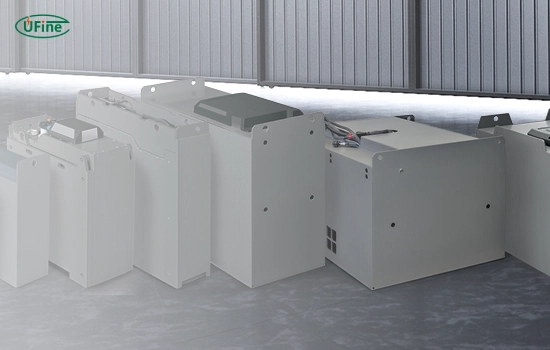
A lithium ion forklift battery is a rechargeable power source that uses lithium ions to store and release energy. It replaces traditional lead-acid batteries in electric forklifts, offering higher performance in a more compact and manageable package.
These batteries are used in counterbalance forklifts, reach trucks, pallet jacks, order pickers, and other material handling equipment. They are especially common in multi-shift operations, cold storage facilities, and high-throughput warehouses.
How does a lithium ion forklift battery work?
During charging, lithium ions move from the cathode to the anode and are stored there. During discharge, the ions flow back from the anode to the cathode, releasing electrical energy to power the forklift motor and controls.
A built-in Battery Management System (BMS) continuously monitors cell voltage, temperature, and current. It protects the pack from overcharging, deep discharge, and thermal events. This makes lithium ion batteries both safer and more reliable than older battery chemistries.
Part 2. Lithium ion vs. lead-acid forklift batteries: key differences
Understanding the core differences helps you choose the right battery for your operation. Here is a direct comparison:
| Feature | Lithium Ion Battery | Lead-Acid Battery |
|---|---|---|
| Energy Density | High — more power in less space | Low — bulkier for the same output |
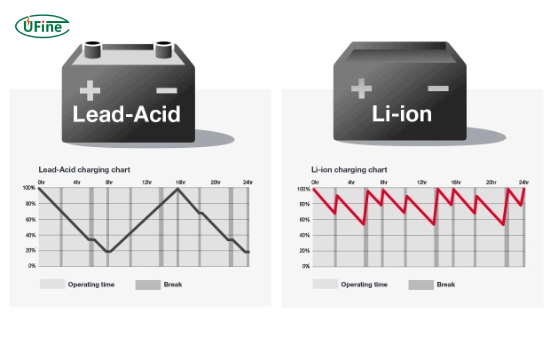
| Charging Time | 1–2 hours (full charge) | 6–8 hours (full charge) |
| Cycle Life | 2,000–5,000 cycles | 1,000–1,500 cycles |
| Maintenance | Minimal — no watering or equalization | Regular watering and equalization needed |
| Opportunity Charging | Yes — safe and recommended | No — damages battery chemistry |
| Fumes / Emissions | None during operation | Hydrogen gas emitted during charging |
| Initial Cost | $17,000–$25,000 | $2,000–$6,000 |
| Temperature Tolerance | Moderate — needs care in extremes | Better in wide temperature ranges |
| Total Cost of Ownership | Lower over time | Higher due to maintenance and replacement |
For operations running two or three shifts per day, the speed and low maintenance of a lithium forklift battery almost always produces a better return on investment than lead-acid alternatives.
Part 3. Benefits of lithium ion forklift batteries
- Faster charging and opportunity charging
- A lithium ion forklift battery reaches a full charge in 1–2 hours.
More importantly, it supports opportunity charging — plugging in during breaks, meal times, or shift changes for a partial top-up.
This eliminates the need for battery swaps and keeps forklifts running continuously across shifts.
- A lithium ion forklift battery reaches a full charge in 1–2 hours.
- Longer service life
- Most lithium ion batteries used in forklifts deliver 2,000 to 5,000 charge cycles before performance degrades significantly.
A lead-acid battery typically lasts 1,000 to 1,500 cycles.
Over a 5–7 year operational period, you may replace a lead-acid battery two or three times while the lithium battery is still in service.
- Most lithium ion batteries used in forklifts deliver 2,000 to 5,000 charge cycles before performance degrades significantly.
- No maintenance downtime
- Lead-acid batteries require weekly watering, monthly equalization charges, and periodic terminal cleaning.
Lithium ion batteries need none of this.
The BMS handles cell balancing automatically.
This saves labor hours and reduces the risk of battery damage from improper maintenance.
- Lead-acid batteries require weekly watering, monthly equalization charges, and periodic terminal cleaning.
- No dedicated charging room
- Lead-acid batteries emit hydrogen gas during charging, which requires a ventilated charging room with safety equipment.
Lithium ion forklift batteries produce no harmful emissions.
They can be charged on the warehouse floor, freeing up space and reducing infrastructure costs.
- Lead-acid batteries emit hydrogen gas during charging, which requires a ventilated charging room with safety equipment.
- Consistent power output
- Lithium ion batteries deliver stable voltage throughout the discharge cycle.
Lead-acid batteries lose voltage as they discharge, which causes forklifts to slow down and perform less reliably toward the end of a shift.
With lithium, the forklift performs the same at 80% charge as it does at 20%.
- Lithium ion batteries deliver stable voltage throughout the discharge cycle.
- Improved safety
- No acid spills, no toxic fumes, and no hydrogen gas buildup.
The sealed design and integrated BMS make lithium ion batteries significantly safer for operators and facilities.
They comply with OSHA indoor air quality requirements without additional ventilation systems.
- No acid spills, no toxic fumes, and no hydrogen gas buildup.
Part 4. Disadvantages of lithium ion forklift batteries
- Higher upfront cost
- The purchase price of a lithium ion forklift battery — typically $17,000 to $25,000 — is 3 to 5 times higher than a comparable lead-acid battery.
For small fleets or low-usage operations, the payback period may be long.
A total cost of ownership analysis is recommended before switching.
- The purchase price of a lithium ion forklift battery — typically $17,000 to $25,000 — is 3 to 5 times higher than a comparable lead-acid battery.
- Temperature sensitivity
- Lithium ion cells perform best between 0°C and 45°C (32°F to 113°F).
In freezer warehouses operating below -20°C, battery capacity can drop noticeably.
Some manufacturers offer heated battery enclosures designed for cold storage applications.
Always check the operating temperature specification before purchasing for cold-chain environments.
- Lithium ion cells perform best between 0°C and 45°C (32°F to 113°F).
- Charger compatibility
- Lithium ion batteries require chargers specifically designed for their chemistry and voltage profile.
Existing lead-acid chargers cannot be used.
This is an additional cost to budget for when switching fleets.
- Lithium ion batteries require chargers specifically designed for their chemistry and voltage profile.
Part 5. Charging lithium ion forklift batteries
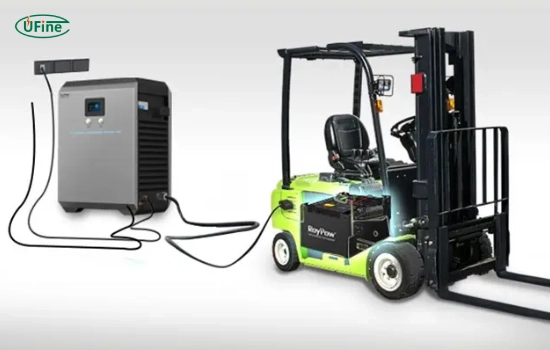
Charging a lithium ion forklift battery is simpler than charging lead-acid, but a few rules still apply:
- Use a compatible charger: Always match the charger to the battery’s voltage and current specifications. Using an incorrect charger voids the warranty and can damage the cells.
- Opportunity charging is safe: Unlike lead-acid, partial charges do not harm lithium ion batteries. Plug in whenever the forklift is idle — during breaks, at shift change, or between tasks.
- No cooling period needed: Lithium ion batteries can go back into service immediately after charging. There is no mandatory rest period.
- Avoid charging in extreme heat: Do not charge when ambient temperature exceeds 45°C (113°F) or when the battery pack itself is hot from prolonged heavy use. Allow 10–15 minutes to cool if needed.
- Do not fully discharge regularly: Try to keep the battery above 20% state of charge during normal operation. The BMS will cut off power before damage occurs, but frequent deep discharges shorten cycle life.
For fleets running three shifts, a single lithium ion battery per forklift is typically sufficient. Lead-acid operations often keep 2–3 spare batteries per truck to cover shift rotations — a cost and space burden that lithium eliminates.
Part 6. Maintenance of lithium ion forklift batteries
Lithium ion forklift batteries are largely maintenance-free compared to lead-acid, but basic care extends their service life:
- Check the state of charge regularly: Most modern lithium batteries have a display or connect to a fleet management system. Monitor daily usage to spot unusual discharge patterns early.
- Keep connectors clean: Inspect and clean battery connectors every 3–6 months to prevent resistance buildup and heat generation.
- Store correctly when idle: If a battery will not be used for more than 30 days, store it at 40–60% charge in a dry location between 10°C and 30°C (50°F to 86°F). Do not store fully charged or fully depleted.
- Monitor end-of-life signs: When runtime per shift drops by more than 20% from the original baseline, or when charging time increases significantly, the battery may be reaching the end of its useful life. Plan for replacement before failure.
- Follow manufacturer guidelines: Each manufacturer sets specific maintenance intervals. Refer to the product manual for your battery model.
For more detailed guidance, see our article on how to properly maintain a lithium battery.
Part 7. Cost of lithium ion forklift batteries
A lithium ion forklift battery typically costs between $17,000 and $25,000 per unit, depending on voltage (24V, 36V, 48V, 80V), capacity (kWh), and brand. Here is how the total cost of ownership compares over a 7-year period for a single forklift:
| Cost Factor | Lithium Ion | Lead-Acid |
|---|---|---|
| Purchase price (per battery) | $17,000–$25,000 | $2,000–$6,000 |
| Batteries needed (7 years) | 1 | 2–3 |
| Maintenance labor cost | Low | High (watering, equalization) |
| Charging infrastructure | Standard outlet or dedicated charger | Ventilated charging room required |
| Estimated 7-year total | $20,000–$28,000 | $18,000–$30,000+ |
The break-even point depends on fleet size, shift intensity, and local energy costs. High-utilization operations — two or more shifts per day — typically see a positive ROI within 2–3 years. For lower-usage fleets, the payback period may extend to 4–5 years.
According to the U.S. Department of Energy, electric forklifts with advanced battery systems can reduce energy and maintenance costs significantly compared to internal combustion or aging battery technologies.
Part 8. Which operations benefit most from lithium ion forklift batteries?
Lithium ion forklift batteries deliver the strongest return in the following environments:
- Multi-shift warehouses: Fast charging and no battery swap requirement keep forklifts running across 2–3 shifts with a single battery.
- E-commerce fulfillment centers: High cycle frequency and consistent performance demands align well with lithium ion strengths.
- Food and beverage distribution: No fumes, no acid risk, and sealed design suit regulated, clean environments.
- Cold storage (above -10°C): Lithium ion performs well in moderately cold environments with proper battery selection.
- Facilities with limited charging space: No dedicated charging room needed saves square footage.
Lead-acid batteries may still make sense for single-shift operations with long charging windows overnight, small fleets with tight capital budgets, or operations in extreme temperature ranges beyond lithium’s rated specs.
Learn more about choosing the right battery for your application in our lithium vs. lead-acid battery comparison guide.
Part 9. FAQs about forklift lithium ion battery
Do forklifts use lithium ion batteries?
Yes. Most modern electric forklifts — including counterbalance trucks, reach trucks, and pallet jacks — support lithium ion batteries. They are the preferred choice for multi-shift and high-throughput operations.
How much does a lithium ion forklift battery cost?
Typically $17,000–$25,000 per unit, depending on voltage (24V–80V) and capacity. The upfront cost is higher than lead-acid, but total cost of ownership is usually lower due to longer lifespan and near-zero maintenance.
How long does a lithium ion forklift battery last?
2,000–5,000 charge cycles, or roughly 5–10 years under normal use. That is 2 to 4 times longer than a comparable lead-acid battery.
Can you opportunity charge a lithium ion forklift battery?
Yes. Lithium ion batteries can be safely topped up during any idle period — breaks, shift changes, or short pauses. Partial charging does not reduce cycle life, unlike lead-acid batteries.
Are lithium ion forklift batteries safe?
Yes, they are sealed, do not emit toxic fumes, and include safety features to prevent overcharging and short circuits.
Related Tags:

More Articles
Are Lithium Wheelchair Batteries Really Better?
Compare lithium vs SLA wheelchair batteries, real driving range, lifespan, charging issues, and upgrade mistakes to avoid.
What Is a Battery Warranty? Everything You Need to Know
Learn what a battery warranty covers, common exclusions, warranty terms, and how to claim coverage for lithium, EV, and industrial batteries.
3V Lithium Battery Explained: Which Type Do You Need?
From CR2032 to CR123A, explore why 3V lithium batteries dominate modern electronics and how to choose the right one.
Learn how lithium pouch cells work, their types, advantages, applications, and how to choose the right lithium pouch cell supplier.
How to Check Car Battery Life?
Learn how to check car battery life, voltage, and battery health. Includes battery lifespan chart, warning signs, testing methods, and maintenance tips.


