
- Part 1. 2200 mAh battery chemistry
- Part 2. Rechargeable and non-rechargeable 2200mAh battery types
- Part 3. How long does a 2200mAh battery last?
- Part 4. Cycle life of a 3.7V 2200 mAh lithium battery
- Part 5. How many hours can a 3.7V 2200mAh lithium battery run?
- Battery Run Time
- Part 6. What is the charging time of a 3.7V 2200mAh lithium battery?
- Battery Charge Time
- Part 7. Is a 2200mAh power bank still useful?
- Part 8. Fast charging vs slow charging: what’s the impact?
- Part 9. Is a 2200mAh battery enough for your device?
- Part 10. How to extend the life of a 2200mAh battery?
- Part 11. FAQs
Ever wondered why your wireless earbuds last all day, but your smartphone dies by noon? The answer lies in battery capacity—specifically, the 2200 mAh battery powering many of our everyday gadgets.
But how much do you really know about these compact energy sources?
In this in-depth guide, we’ll break down everything—from the chemistry behind 2200 mAh batteries to real-world performance, charging best practices, and proven ways to extend battery life.
Key takeaways
- A 2200mAh battery can last anywhere from 2 to 20+ hours depending on power consumption.
- Device efficiency matters just as much as battery capacity.
- Charging time usually ranges from 2 to 5 hours depending on charger output.
- A 2200mAh power bank typically cannot fully charge most modern smartphones.
- Genuine 2200mAh lithium-ion batteries often outperform fake “high-capacity” cells.
- Temperature, battery age, and discharge rate all affect real-world runtime.
Part 1. 2200 mAh battery chemistry
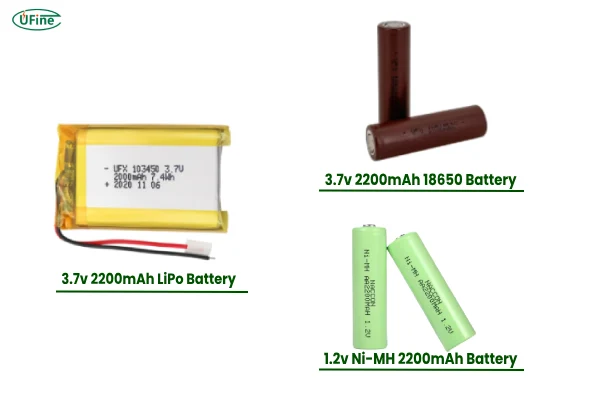
Not all batteries are created equal. The chemical composition determines performance, safety, and lifespan.
Lithium-Ion (Li-ion) – The Industry Standard
-
Why it dominates: High energy density, lightweight, and rechargeable.
-
Common uses: Smartphones, tablets, laptops, power banks.
-
Downsides: Degrades faster if frequently fully discharged.
Lithium Polymer (LiPo) – Flexible & Safer
-
Key advantage: No rigid casing, allowing ultra-thin designs (think smartwatches).
-
Safety feature: Less prone to leakage compared to Li-ion.
-
Trade-off: Slightly lower energy density.
Nickel-Metal Hydride (NiMH) – The Older Alternative
-
Still used in: Older electronics, some rechargeable AA/AAA batteries.
-
Problem: “Memory effect” reduces capacity if not fully discharged.
Which one is in your 2200 mAh battery?
Most likely Li-ion or LiPo—these are the go-to choices for modern portable electronics.
Lithium-ion vs. Nickel-metal Hydride vs. Solid-state Battery: Which is Better?
Part 2. Rechargeable and non-rechargeable 2200mAh battery types
Let’s break it down further.
Rechargeable 2200mAh Batteries
- Can be used multiple times
- Common chemistries: Li-ion, LiPo, NiMH, LiFePO4
- Cost-effective (can be reused 300-500+ times)
- Eco-friendly (less waste than disposables)
- Ideal for: Daily-use devices like Bluetooth earbuds, drones, and small power banks.
Non-Rechargeable 2200mAh Batteries
- Single use
- Common chemistries: Alkaline, Lithium Primary (Li-SOCl₂)
- Use cases: Remote controls, emergency lights, certain sensors
- Single-use, found in some medical devices or emergency equipment.
- Rarely in 2200 mAh size—alkaline batteries usually max out at lower capacities.
Bottom line: If your device has a 2200 mAh battery, it’s almost certainly rechargeable.
Part 3. How long does a 2200mAh battery last?
The most common way to estimate runtime is with a simple formula:
Battery Life (hours)=Battery Capacity (mAh)/Device Current Draw (mA)
In theory, this formula is straightforward. In reality, battery efficiency losses usually reduce runtime somewhat.
Still, it gives a useful estimate.
Here’s a realistic breakdown:
| Device Power Consumption | Estimated Runtime |
|---|---|
| 100mA | Around 22 hours |
| 220mA | Around 10 hours |
| 500mA | Around 4.4 hours |
| 1000mA | Around 2.2 hours |
Now picture two different situations.
Imagine you’re hiking in the mountains with a compact LED lantern powered by a 2200mah lithium ion battery. Because the lantern consumes very little current, it could easily last through multiple nights.
But if you use that same battery in a small RC car or a portable heating device, the runtime may suddenly feel short and frustrating.
That contrast is important because many buyers judge batteries without considering the actual power demands of the device.
Part 4. Cycle life of a 3.7V 2200 mAh lithium battery
What Is a “Cycle”?
A full cycle = Using 100% of the battery’s capacity (e.g., 100% → 0% once, or 80% → 30% twice).
How Many Cycles Can You Expect?
-
Standard Li-ion: 300-500 cycles before capacity drops to ~80%.
-
High-quality LiPo: Up to 800 cycles with proper care.
For a 3.7V 2200mAh lithium battery, the average cycle life is:
- 300 to 500 full charge cycles for standard Li-ion
- 500 to 800+ cycles for LiFePO4
- 200 to 300 cycles for older chemistries or poor-quality cells
Over time, even if you charge it properly, the battery’s performance drops. By the 500th cycle, it may only hold around 80% of its original capacity. But with proper care, you can stretch its life further. (More on that below!)
What Kills Battery Life Faster?
- Deep discharges (regularly draining to 0%)
- High temperatures (leaving your phone in a hot car)
- Fast charging all the time (creates excess heat)
Pro Tip: Keep your battery between 20%-80% for maximum longevity.
Part 5. How many hours can a 3.7V 2200mAh lithium battery run?
The running time of a 2200mAh battery depends entirely on what device it’s powering.
Here’s how to calculate it:
Formula:
Battery Life (hours) = Capacity (mAh) ÷ Load Current (mA)
So, if your device draws 220mA, then:
2200 ÷ 220 = 10 hours
But real-world conditions (temperature, efficiency, voltage drops) can affect this. Always consider a margin.
Practical Examples:
| Device | Power Draw (mA) | Estimated Runtime |
|---|---|---|
| Bluetooth Earbuds | 50 mA | 44 hours |
| Smartwatch | 100 mA | 22 hours |
| Smartphone (idle) | 300 mA | 7.3 hours |
| Smartphone (gaming) | 800 mA | 2.75 hours |
A 2200 mAh battery might last all day in a smartwatch but only 2-3 hours in a power-hungry smartphone.
Estimate battery runtime with our online tools:
Part 6. What is the charging time of a 3.7V 2200mAh lithium battery?
Charging time depends on the charger output and battery input limit.
Standard Charging (0.5A – 1A)
-
0.5A charger: ~5 hours (slow but safest)
-
1A charger: ~2.5 hours (balanced speed & safety)
Fast Charging (2A+)
-
2A charger: ~1.5 hours (faster but generates heat)
-
Quick Charge 3.0/PD: Even faster, but reduces long-term lifespan.
Basic Formula:
Charging Time = Battery Capacity ÷ Charging Current
So with a 1A charger:
2200mAh ÷ 1000mA = 2.2 hours
With a 0.5A charger, it’s 4.4 hours.
But, to protect the battery and extend its life, most chargers use a constant current / constant voltage (CCCV) charging method, which adds about 10–20% extra time for the final trickle charge phase.
So real-world charging times are:
- 1A charger → 2.5 to 3 hours
- 0.5A charger → 4.5 to 5 hours
Golden Rule: If you’re not in a hurry, slow charging is better for battery health.
Estimate battery charging time with our online tools:
Part 7. Is a 2200mAh power bank still useful?
A decade ago, a 2200mAh power bank felt practical and portable.
Today, smartphone batteries are dramatically larger. Many phones now exceed 4500mAh or even 5000mAh capacities, which changes expectations entirely.
As a result, a 2200 power bank how many charges question usually leads to disappointing math.
Most modern phones cannot even receive one complete charge from a 2200mAh power bank because energy is lost during voltage conversion.
Typically:
- A 5000mAh smartphone may receive only about 30–40% charge.
- A 3000mAh phone may receive roughly half to two-thirds of a charge.
Still, that does not mean 2200mAh power banks are useless.
In real-life situations, portability often matters more than raw capacity.
For example, someone commuting daily may simply want enough backup power to keep wireless earbuds, a smartwatch, or a GPS tracker alive during emergencies. In those situations, a tiny lightweight power bank can actually feel more convenient than carrying a heavy high-capacity model.
Sometimes “enough” matters more than “maximum.”
Part 8. Fast charging vs slow charging: what’s the impact?
Here’s the truth:
Fast Charging Pros:
- Quicker turnaround time
- Convenient when you’re in a rush
Fast Charging Cons:
- More heat = more wear
- Shortens battery life over time
- Can stress battery chemistry
Slow Charging Pros:
- Less heat
- Gentler on cells
- Prolongs overall lifespan
If you’re not in a rush, slow charging is always better. Many manufacturers recommend charging at 0.5C (half the capacity). For a 2200mAh battery, that’s 1.1A.
Part 9. Is a 2200mAh battery enough for your device?
That depends on your device’s power consumption and how long you need it to run.
Devices Where 2200 mAh Shines
Wireless Earbuds (20+ hours playback)
Fitness Trackers (5-7 days per charge)
Small Power Banks (enough for one full smartphone charge)
Devices That Need More Power
Smartphones (modern flagships need 4000+ mAh)
Tablets (5000+ mAh for decent screen time)
High-Drain Gadgets (drones, handheld gaming devices)
Key Takeaway: A 2200 mAh battery is perfect for low-power wearables but too small for power-hungry devices.
Part 10. How to extend the life of a 2200mAh battery?
Want to get the most out of your battery? Follow these tips:
- Avoid overcharging. Unplug once it hits 100%.
- Don’t drain to 0%. Try to recharge at around 20–30%.
- Avoid extreme heat or cold. Store between 10°C to 25°C (50°F to 77°F).
- Use the correct charger. Don’t over-amp it.
- Store with ~50% charge if unused for weeks.
- Avoid fast charging unless needed. Gentle is better.
- Use a battery management system (BMS) if your application is power-sensitive.
Part 11. FAQs
Can a 2200mAh battery run a fan?
Yes, a 2200mAh battery can run a small portable fan, but runtime depends on fan speed and power consumption. Low-speed USB fans may last 4–6 hours, while high-speed models drain the battery much faster.
Is 2200mAh enough for emergency backup power?
For small electronics, yes. A 2200mAh battery works well for emergency LED lights, Bluetooth earbuds, GPS trackers, or temporary phone backup. However, it is usually not enough for multiple smartphone charges.
Why does my 2200mAh battery drain so quickly?
Fast battery drain may happen because of aging cells, high device power consumption, cold weather, background activity, or poor-quality chargers. Older lithium-ion batteries naturally lose capacity over time.
What voltage is a typical 2200mAh lithium-ion battery?
Many 2200mAh lithium-ion batteries, especially 18650 cells, operate at a nominal voltage of 3.7V. Fully charged voltage is usually around 4.2V.
Related Tags:

More Articles

Comparative Analysis: 14500 Battery Vs. 18650 Battery
Compare 14500 vs 18650 batteries by size, voltage, capacity, runtime, discharge current, charging, safety, and applications to choose the right cell.
12V Lithium-Ion What Voltage at Fully Charged and Why Your Battery Might Not Reach It
Check the 12V lithium battery voltage chart for 3S Li-ion and 4S LiFePO4. Learn full charge, resting voltage, charger limits, and fault checks.
LiFePO4 Voltage Chart Guide: Everything You Need to Know
Check the LiFePO4 voltage chart for 3.2V, 12V, 24V and 51.2V batteries. Compare SOC, charging voltage, cutoff limits and internal resistance.
Lithium Ion Cell Sizes: A Comprehensive Guide
Compare lithium ion cell sizes with a chart of dimensions, capacity ranges, cell types, applications, and key factors for selecting the right battery.
6 Volt Tractor Battery vs 12 Volt: Which One Fits Your Farm Equipment Best?
Compare 6V and 12V tractor batteries. Learn which voltage fits vintage or modern tractors, which specifications matter, and how to convert safely.


