
- Part 1. What is the real difference between NiMH and lithium 7.2V battery and charger systems?
- Part 2. Can devices designed for a 7.2V NiMH battery and charger use lithium directly?
- Part 3. How voltage behavior changes after replacing a 7.2V battery and charger with lithium?
- Part 4. How discharge current changes when upgrading a 7.2V battery and charger to lithium?
- Part 5. Can you continue using the original 7.2V NiMH charger after upgrading to lithium?
- Part 6. How runtime changes after replacing a 7.2V battery and charger with lithium?
- Part 7. What mechanical changes are required when upgrading a 7.2V battery and charger?
- Part 8. How safety design changes after upgrading a 7.2V battery and charger to lithium?
- Part 9. When is upgrading a 7.2V battery and charger to lithium technically NOT recommended?
- Part 10. How upgrading from NiMH to lithium changes total 7.2V battery and charger cost?
- Part 11. When is a custom lithium 7.2V battery and charger upgrade the best solution?
- Part 12. How to upgrade your 7.2V battery and charger safely step by step?
- Part 13. FAQ – Replacing a 7.2V NiMH battery and charger with lithium
Why so many users want to upgrade their 7.2V battery and charger?
If you are searching for a way to replace a 7.2V NiMH battery and charger with lithium, you are likely facing one of these real problems:
- Your NiMH battery runtime is too short
- Charging takes too long
- Battery weight is limiting your product performance
- Replacement frequency is too high
- Your device is being redesigned for higher efficiency
On paper, both systems are labeled 7.2V battery and charger, but in reality, NiMH and lithium behave completely differently.
This guide explains:
- ✅ Whether your 7.2V system can be upgraded safely
- ✅ What technical changes are required
- ✅ What risks must be avoided
- ✅ And when a lithium upgrade actually makes financial sense
Part 1. What is the real difference between NiMH and lithium 7.2V battery and charger systems?
Before upgrading, you must understand that a “7.2V” label does not mean the same electrical behavior.
| Parameter | 7.2V NiMH battery and charger | 7.2V lithium battery and charger |
|---|---|---|
| Nominal voltage | 7.2V (6 × 1.2V cells) | 7.4V (2 × 3.7V cells) |
| Full charge voltage | ~8.4–9.0V | 8.4V |
| Discharge efficiency | Low–medium | High |
| Energy density | Low | High |
| Charging speed | Slow | Fast |
| Cycle life | 300–500 cycles | 800–1500+ cycles |
This is why many users first compare both systems in detail here:
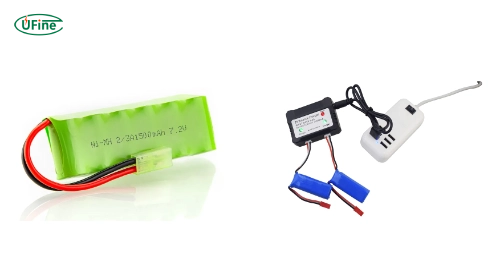
NiMH vs lithium 7.2V battery and charger
Part 2. Can devices designed for a 7.2V NiMH battery and charger use lithium directly?
Short answer: sometimes yes, often no — without redesign.
You must check four key compatibility points before upgrading:
- Voltage tolerance of your device
- Discharge current requirement
- Charging interface design
- Battery compartment size
Even a small mismatch in any of these can cause:
- Controller damage
- Overcurrent failure
- Battery swelling
- BMS shutdown
- Safety incidents
This is why lithium replacement is not just a “plug-and-play battery swap”.
Part 3. How voltage behavior changes after replacing a 7.2V battery and charger with lithium?
NiMH voltage drops smoothly under load.
Lithium voltage stays high and flat until near depletion.
This creates two effects:
- ✅ Stronger device performance at start
- ⚠️ Higher electrical stress on motors and controllers
If your system was designed with a tight upper voltage margin, lithium could push it beyond safe limits.
Part 4. How discharge current changes when upgrading a 7.2V battery and charger to lithium?
Lithium batteries can deliver 2–5× higher peak current than NiMH.
This is good for:
- Power tools
- Motors
- Robotics
- AGVs
But dangerous for:
- Thin wiring
- Weak connectors
- Old PCBs
- Underrated switches
A safe upgrade requires:
- Proper BMS current rating
- Reinforced nickel connections
- Verified thermal management
Part 5. Can you continue using the original 7.2V NiMH charger after upgrading to lithium?
No — this is one of the most dangerous mistakes.
NiMH charger logic:
- Delta-V detection
- Trickle charging
- No strict voltage cutoff
Lithium charger requirements:
- Precise CC/CV control
- Exact 8.4V cutoff
- Temperature feedback
- Multi-layer protection
Using a NiMH charger on lithium can lead to:
- Overcharging
- Thermal runaway
- Fire hazard
A lithium upgrade always requires a matched lithium charger.
Part 6. How runtime changes after replacing a 7.2V battery and charger with lithium?
Even with the same mAh rating, lithium delivers:
- Longer usable runtime
- Higher voltage stability
- More consistent output
Example:
| Chemistry | Capacity | Usable runtime |
|---|---|---|
| NiMH | 3000 mAh | ~70% usable |
| Lithium | 3000 mAh | ~90–95% usable |
If you want to calculate correct runtime before upgrading, see:
7.2V battery and charger capacity guide
Part 7. What mechanical changes are required when upgrading a 7.2V battery and charger?
Lithium packs usually require:
- New battery enclosure
- New connector type
- Better vibration resistance
- Physical shock protection
In some devices, the lithium pack becomes:
- Smaller
- Lighter
- Easier to integrate
But in others, custom housing is mandatory.
Part 8. How safety design changes after upgrading a 7.2V battery and charger to lithium?
NiMH relies mainly on:
- Cell self-stability
- Basic thermal cutoffs
Lithium requires a full BMS with:
- Overcharge protection
- Overdischarge protection
- Overcurrent protection
- Short-circuit protection
- Temperature protection
This safety structure is non-optional in professional lithium systems.
Part 9. When is upgrading a 7.2V battery and charger to lithium technically NOT recommended?
Lithium upgrade is usually not recommended when:
- Your device is extremely voltage-sensitive
- Load current is extremely low
- Budget is extremely limited
- Device lifespan is short-term
- Workspace regulations forbid lithium
In these cases, high-quality NiMH may still be the correct solution.
Part 10. How upgrading from NiMH to lithium changes total 7.2V battery and charger cost?
Upgrading increases:
- Battery unit price
- Charger cost
- Engineering cost
But reduces:
- Replacement frequency
- Downtime
- Maintenance
- Shipping weight
For full pricing logic, see:
7.2V battery and charger pricing guide
In many projects, lithium becomes 30–50% cheaper over 2–3 years.
Part 11. When is a custom lithium 7.2V battery and charger upgrade the best solution?
Custom lithium upgrade is ideal when you need:
- High discharge current
- Tight installation space
- Long lifecycle
- Medical or industrial certification
- Export compliance
Standard off-the-shelf lithium packs often cannot meet these requirements safely.
Part 12. How to upgrade your 7.2V battery and charger safely step by step?
A safe lithium upgrade process includes:
- Load current analysis
- Voltage tolerance testing
- Runtime target definition
- BMS parameter matching
- Charger selection
- Mechanical structure design
- Safety validation testing
Skipping any of these steps creates hidden long-term risks.
Part 13. FAQ – Replacing a 7.2V NiMH battery and charger with lithium
Can I just swap the battery without changing the charger?
No. NiMH chargers are incompatible and unsafe for lithium charging.
Will lithium always give me longer runtime?
Yes, in almost all real-world applications at the same mAh.
Is lithium always lighter than NiMH?
Yes, typically 40–60% lighter at the same energy level.
Does lithium always last longer than NiMH?
Yes, lithium usually offers 2–3× the cycle life.
Related Tags:

More Articles
Capacitor vs Battery: What is the Difference?
Capacitor vs battery explained in detail. Learn the difference between capacitor and battery in energy storage, charging speed, lifespan, and real applications.
18650 Battery vs AA: Which Is Better for Your Device?
Compare 18650 vs AA batteries in capacity, voltage, rechargeability, and applications. Learn which battery type fits high-drain or everyday devices.
What is the Difference Between Battery Cell, Battery Control Module, and Battery Pack?
Compare battery cells, modules, and packs. Learn functions, design differences, control modules, and selection tips for EV, ESS, and industrial use.
How to Prevent LiPo Battery Explosion?
Can LiPo batteries explode or catch fire? Learn key causes of LiPo battery fires and proven charging, storage, and handling tips to reduce explosion risk.
Aluminium Ion Battery vs Lithium-Ion: A Detailed Comparison
Compare aluminium ion battery vs lithium-ion battery in energy density, charging speed, safety, cost, and uses. A practical guide for engineers and buyers.


