
- Part 1. Global energy storage battery market overview (2025 data)
- Part 2. Supply chain concentration among battery manufacturers
- Part 3. Top global battery manufacturers in energy storage (2025 structure)
- Part 4. Utility-scale storage drives market growth
- Part 5. Small-scale storage market remains resilient
- Part 6. Regional market structure and global competition
- Part 7. Lithium cell manufacturers' competitive dynamics
- Part 9. Top LFP battery manufacturers
- Part 10. 2026 market outlook
- Part 11. FAQs
Key takeaways
- In 2025, global energy storage cell shipments reached 612.39 GWh, growing nearly 95% year-on-year
- The battery industry remains highly concentrated, with top battery manufacturers accounting for most global shipments
- CATL, BYD, EVE Energy, CALB, and other Chinese companies continue to dominate the global energy storage market
- The competitive landscape among lithium cell manufacturers is expanding beyond EV into utility-scale and residential storage
- If you are searching for battery companies or battery manufacturers, energy storage has become the most important growth driver in 2025–2026
- The market is shifting from EV-only growth to a dual-engine structure: EV + energy storage
Part 1. Global energy storage battery market overview (2025 data)
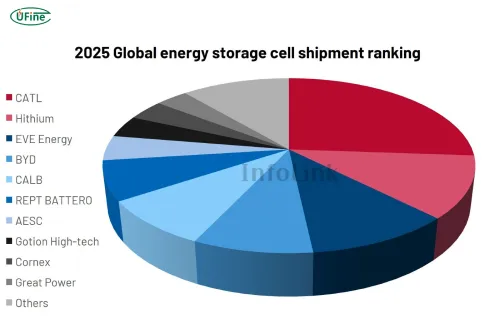
According to InfoLink Consulting’s Global Energy Storage Supply Chain Database, global energy storage cell shipments reached 612.39 GWh in 2025, representing a 94.59% year-on-year increase.
This rapid growth shows that the battery industry is no longer driven only by electric vehicles. Instead, energy storage systems (ESS) have become a core structural driver of demand for global battery manufacturers.
During 2025, the market showed strong quarterly growth, with Q4 shipments exceeding 200 GWh, indicating sustained demand momentum across global energy storage projects.
BYD Blade Battery Comprehensive Guide
Part 2. Supply chain concentration among battery manufacturers
The global energy storage market continues to be highly concentrated.
In 2025, the industry concentration (CR10) remained at approximately 88.8%, meaning that the top 10 battery manufacturers controlled nearly 90% of global shipments.
The top six companies alone (CR6) accounted for around 75% of the market, showing that the industry is still dominated by a small number of large-scale players.
This structure is important if you are analyzing battery companies or lithium cell manufacturers, because it shows:
- Market leadership is highly stable at the top
- Mid-tier players are gradually expanding
- Competition is intensifying in the middle segment
Part 3. Top global battery manufacturers in energy storage (2025 structure)
The leading battery manufacturers in the energy storage market include:
Energy storage battery manufacturers ranking (structure-based)
| Rank group | Company | Role in market | Segment strength |
|---|---|---|---|
| Tier 1 | CATL | Global leader | Utility + large-scale storage |
| Tier 1 | Hithium | Fast-growing challenger | Utility-scale storage |
| Tier 1 | EVE Energy | Diversified leader | ESS + cylindrical |
| Tier 1 | BYD | Integrated player | EV + ESS |
| Tier 1 | CALB | Expanding producer | Large-scale storage |
| Tier 2 | REPT BATTERO | Emerging competitor | Utility storage |
| Tier 2 | Great Power | Residential focus | Small-scale storage |
| Tier 2 | LG Energy Solution | Global OEM supplier | Overseas ESS |
This structure shows that the competitive landscape among battery manufacturers is no longer static, but evolving rapidly due to energy storage demand.
Part 4. Utility-scale storage drives market growth
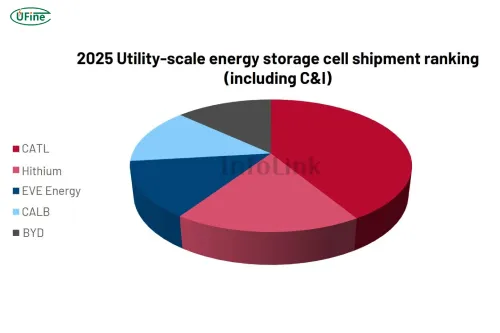
Utility-scale storage is the largest and fastest-growing segment of the battery industry.
In 2025, global utility-scale storage shipments reached 556.74 GWh, growing 96.73% year-on-year.
The top five companies in this segment were:
- CATL
- Hithium
- EVE Energy
- CALB
- BYD
These companies dominate large-scale grid applications, which require high-capacity, long-life battery systems.
Technology shift in utility-scale storage
The industry is also transitioning toward larger cell formats:
- 500Ah+ cells becoming mainstream
- 587Ah / 588Ah formats emerging
- Expected penetration >15% by 2026
This shift significantly affects demand for lithium cell manufacturers, as production is moving toward higher-capacity standardized formats.
Part 5. Small-scale storage market remains resilient
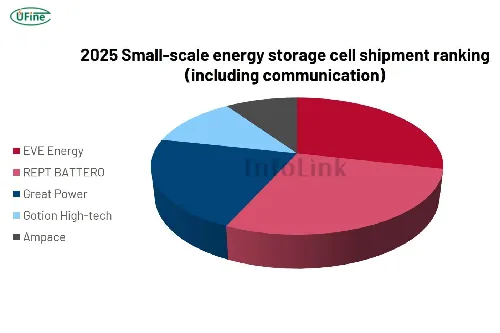
Small-scale storage (including residential and commercial applications) reached 55.65 GWh in 2025, growing 75.54% year-on-year.
Unlike utility-scale storage, this segment shows more diversified competition among battery companies.
Top players include:
- EVE Energy
- REPT BATTERO
- Great Power
A key structural shift is occurring:
- 100Ah cells are gradually being replaced
- 314Ah cells are becoming the new mainstream format
- Cost efficiency is the main driver of this transition
This change will reshape product strategies for many battery manufacturers in the residential segment.
Part 6. Regional market structure and global competition
In 2025, non-China energy storage shipments reached 299.79 GWh, accounting for approximately 49% of global shipments.
In the second half of 2025, non-China markets exceeded China for the first time in history, reaching 51.3% share.
This shows that global battery manufacturers are now competing in a more geographically balanced market.
Key trends include:
- Rapid expansion of US and European energy storage projects
- Increasing localization policies
- Gradual recovery of Korean manufacturers in overseas markets
However, Chinese battery companies still maintain strong leadership in global supply chains.
Part 7. Lithium cell manufacturers’ competitive dynamics
The competitive landscape among lithium cell manufacturers is evolving rapidly.
Key industry dynamics include:
- Strong dominance of top-tier manufacturers remains stable
- Mid-tier companies are expanding through the energy storage demand
- Pricing cycles fluctuate due to supply-demand imbalance
- New technologies, such as large-format cells, are reshaping production
This indicates that the industry is still in a growth phase rather than full maturity.
Part 9. Top LFP battery manufacturers
LFP technology is now the dominant chemistry in energy storage systems.
Leading LFP battery manufacturers include:
- CATL
- BYD
- EVE Energy
- CALB
- REPT BATTERO
These companies are driving the global transition toward safer and more cost-efficient battery systems.
Part 10. 2026 market outlook
From a 2026 perspective, the battery industry is expected to follow three major trends:
- Leading battery manufacturers will maintain stable dominance
- Mid-tier competition will intensify significantly
- Energy storage will continue to drive over 50% of incremental demand
InfoLink also projects that global energy storage shipments will continue to grow strongly, supported by large-scale renewable energy integration and grid modernization projects.
Part 11. FAQs
1. What is the difference between EV battery manufacturers and energy storage battery manufacturers?
EV battery manufacturers focus on high-energy-density batteries for transportation, while energy storage manufacturers prioritize long cycle life, safety, and cost efficiency for grid and residential systems. Many leading companies now operate in both segments, but their product design priorities are very different.
2. Which country has the strongest battery manufacturing supply chain?
China currently has the most complete battery manufacturing supply chain in the world, covering raw materials, lithium refining, cell production, and system integration. This vertical structure gives Chinese battery manufacturers a high cost and scale advantage.
3. What are the fastest-growing segments in the battery industry?
Energy storage systems (especially utility-scale storage) and LFP-based batteries are currently the fastest-growing segments. These areas are expanding faster than traditional EV battery demand due to renewable energy integration.
4. Why are LFP batteries replacing traditional lithium-ion batteries?
LFP batteries are replacing many traditional chemistries because they offer lower cost, better thermal stability, and longer lifecycle performance. This makes them ideal for large-scale storage and mass-market EV applications.
Related Tags:

More Articles
Buck vs. Boost vs. Buck-Boost Converter: Which Is Best for Battery?
Not sure which converter your battery-powered device needs? Compare Buck, Boost, and Buck-Boost designs and discover what affects voltage stability and runtime.
How to Match 18650 Cells for a Reliable Battery Pack?
Building an 18650 battery pack? Learn how to compare cell capacity, voltage, and internal resistance to avoid mismatches and improve reliability.
Why Do 18650 Battery Packs Get Hot During Discharge?
Is your 18650 battery pack overheating under load? Learn what causes excess heat, how to spot dangerous symptoms, and what to do next.
18650 Battery BMS: How to Get the Specs Right
Learn how to choose a BMS for an 18650 battery pack. Compare voltage, current ratings, protection features, and balancing before you buy.
Why Does My Ring Camera Battery Drain So Fast or Stop Charging?
Is your Ring camera battery draining fast or not charging? Discover common causes, practical fixes, and when to replace the battery.


