Popular Choice
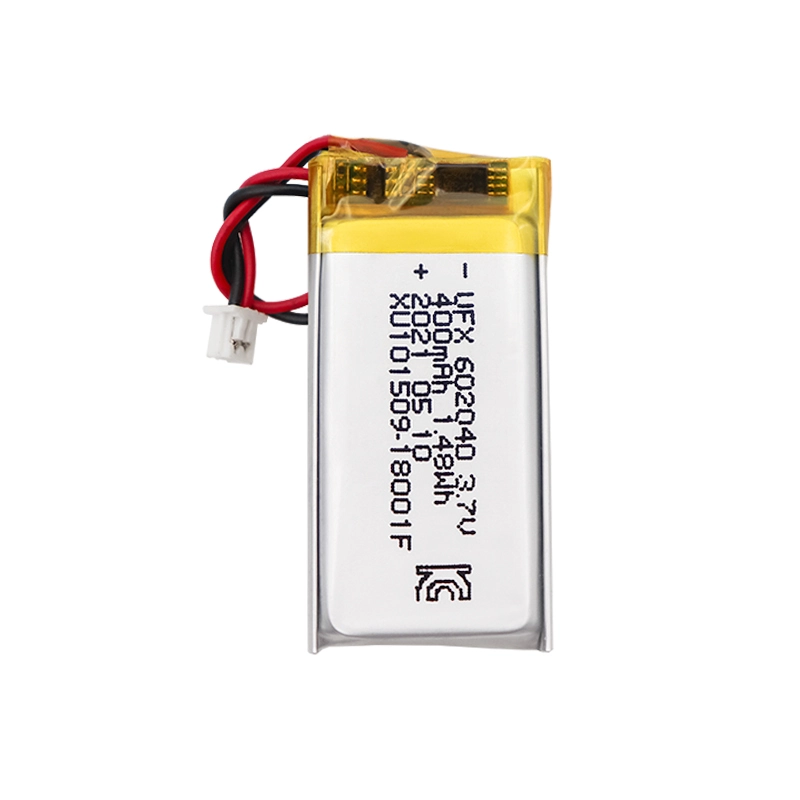
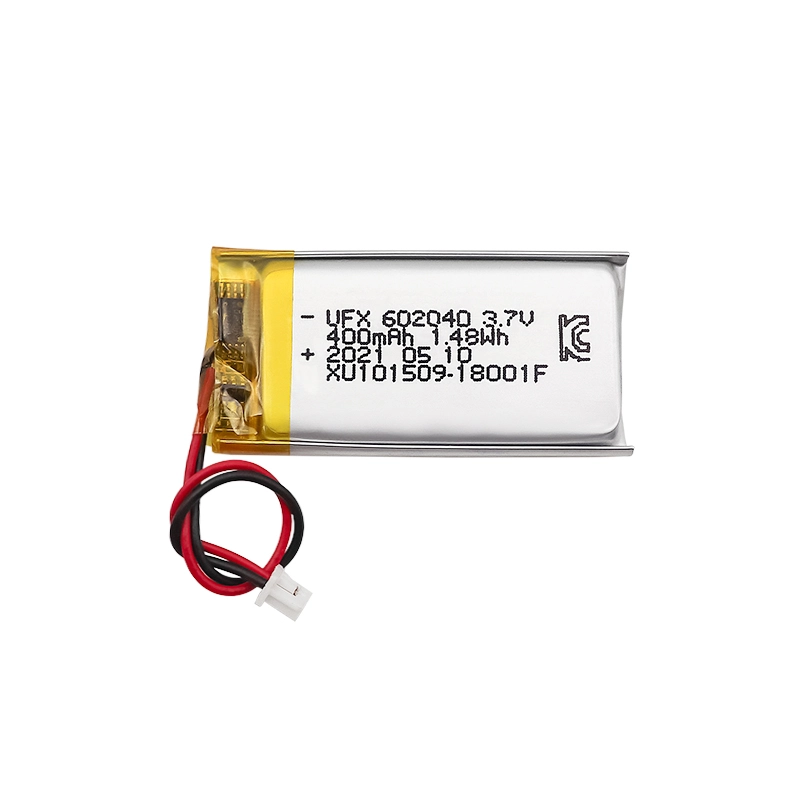
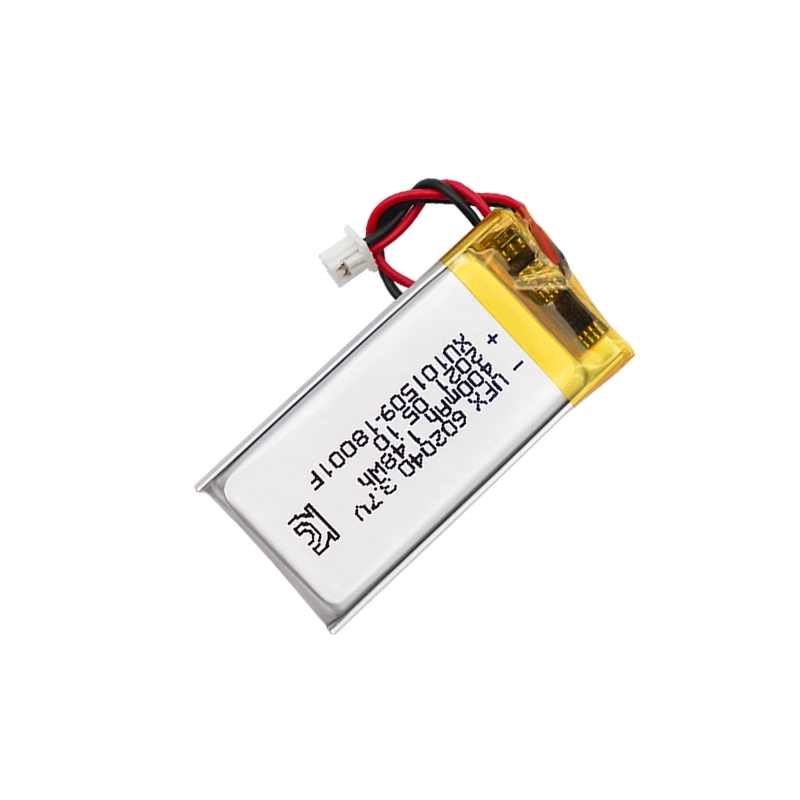
602040 3.7V 400mAh LiPo Battery for Compact Electronics


- 16 Years Experience
- 200+ Certifications
- 1000+ Customers
- 7X24 Customer Support
-
Product Details
-
Specs
-
Content
-
FAQs

9g Weight Ultra-Compact 602040 LiPo Battery
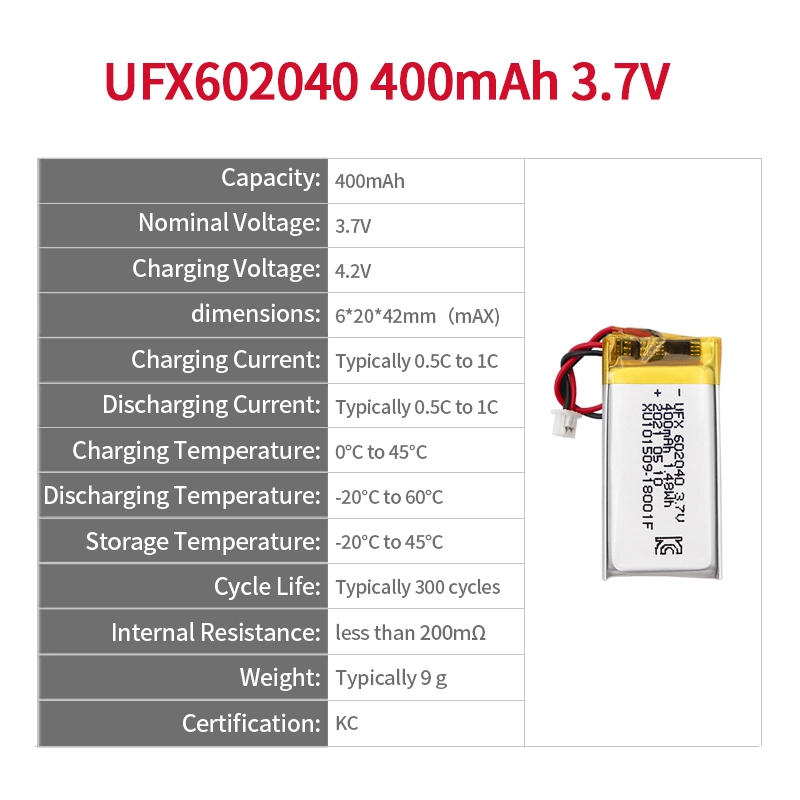
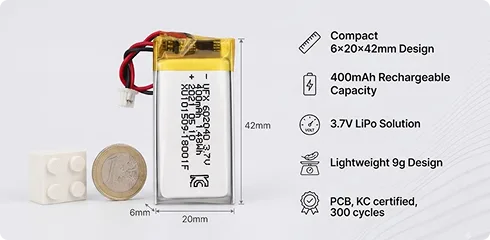
The UFX602040 battery features a compact 6×20×42mm design and lightweight 9g structure, making it ideal for space-constrained portable electronics.
Test Curves of 3.7 V 602040 Battery
Take a closer look at the 3.7 V 602040 battery test curves—see the stability and performance you can trust for all your power needs!
- Cycle Life
- Self-Discharge
- Discharge Rate
- Temp Performance
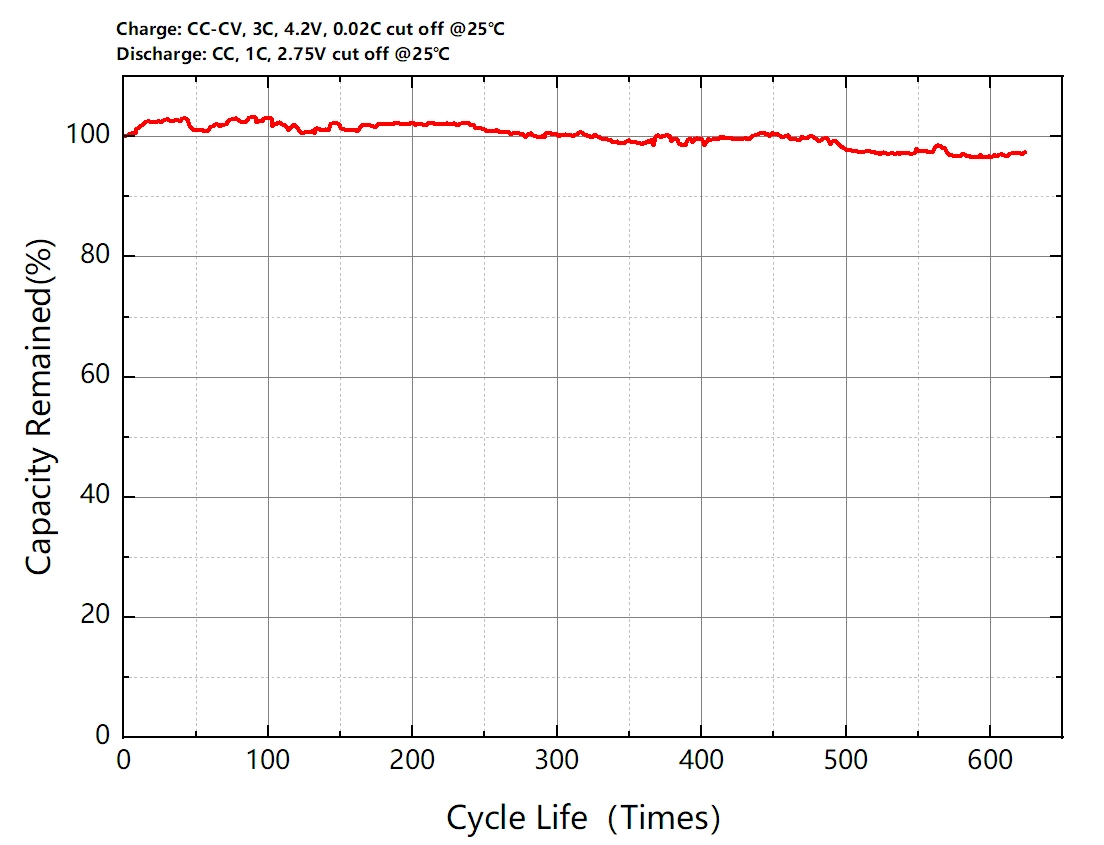
300+ Cycle Life
Excellent durability under 3C charge and 1C discharge conditions, maintaining around 97% capacity after 300+ cycles.
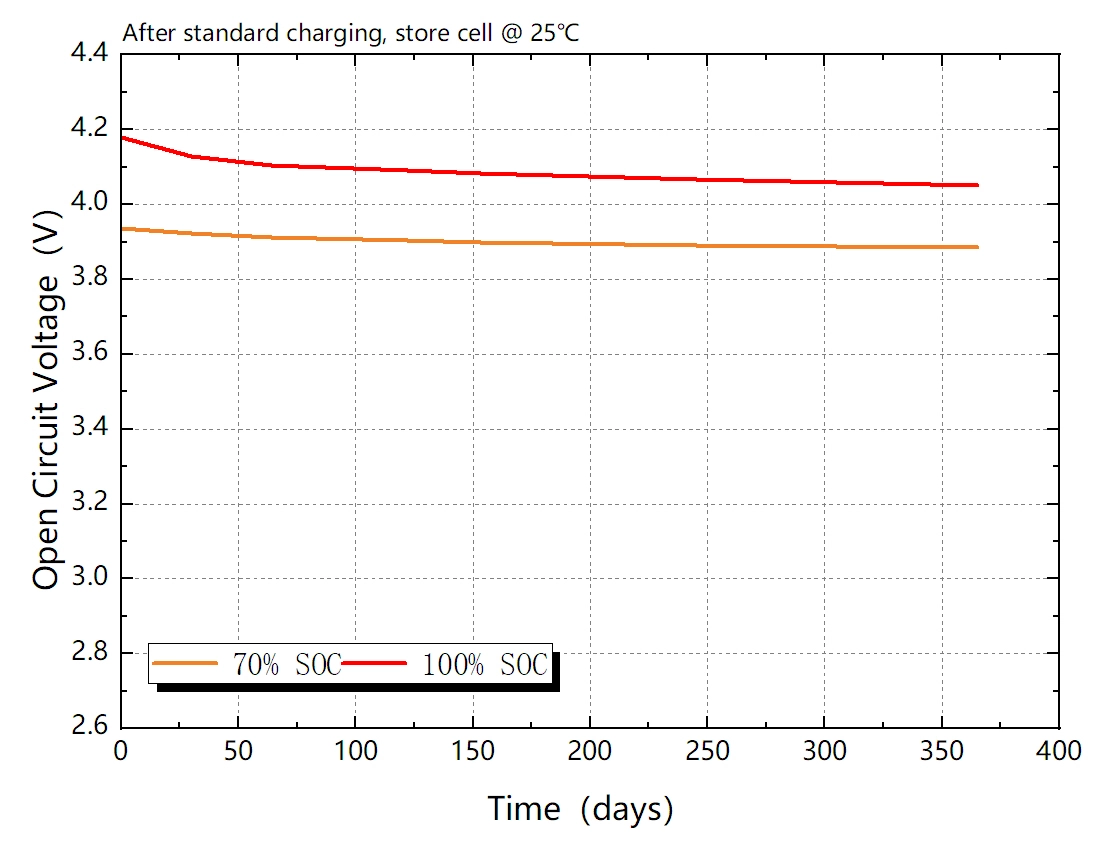
365-Day Storage Stability
Minimal self-discharge at 25°C over 365 days, with voltage stabilizing near 4.05V at 100% SOC and 3.88V at 70% SOC.
Learn More About Discharge Rate 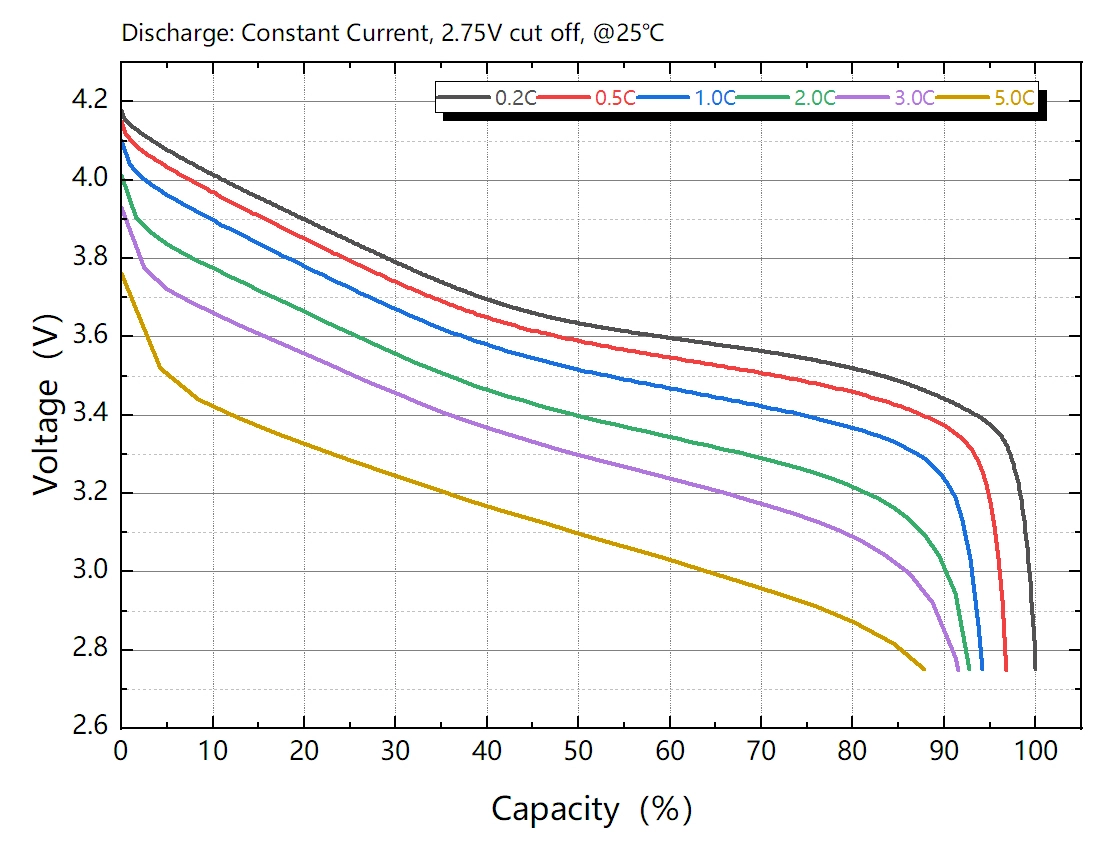
0.2C–5.0C Discharge Rate
Higher discharge rates slightly reduce the voltage plateau and available capacity. The 602040 battery maintains stable performance, retaining around 88% capacity even at a high 5.0C discharge rate.
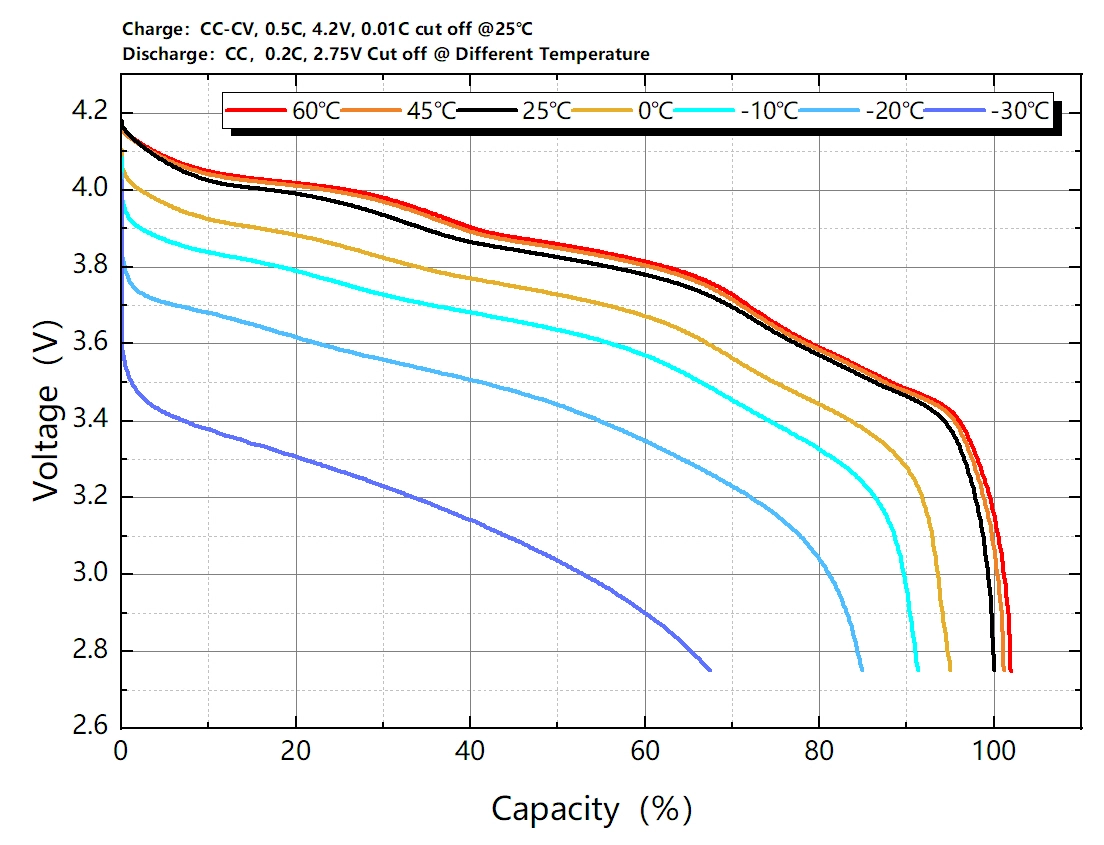
-30°C to 60°C Thermal Impact
The 602040 battery delivers reliable performance across a wide temperature range. Lower temperatures reduce capacity, retaining around 68% capacity at -30°C compared with 100% capacity at 25°C–60°C.
Reliable 3.7V 400mAh Rechargeable Power
The 602040 LiPo battery delivers reliable energy output with a compact capacity-to-size balance.
- 400mAh Capacity – Reliable power for portable devices
- 3.7V Nominal Voltage – 4.2V charging support
- Low Internal Resistance Less 200mΩ – Efficient energy delivery
- Up to 300 Cycles – Long-lasting rechargeable performance
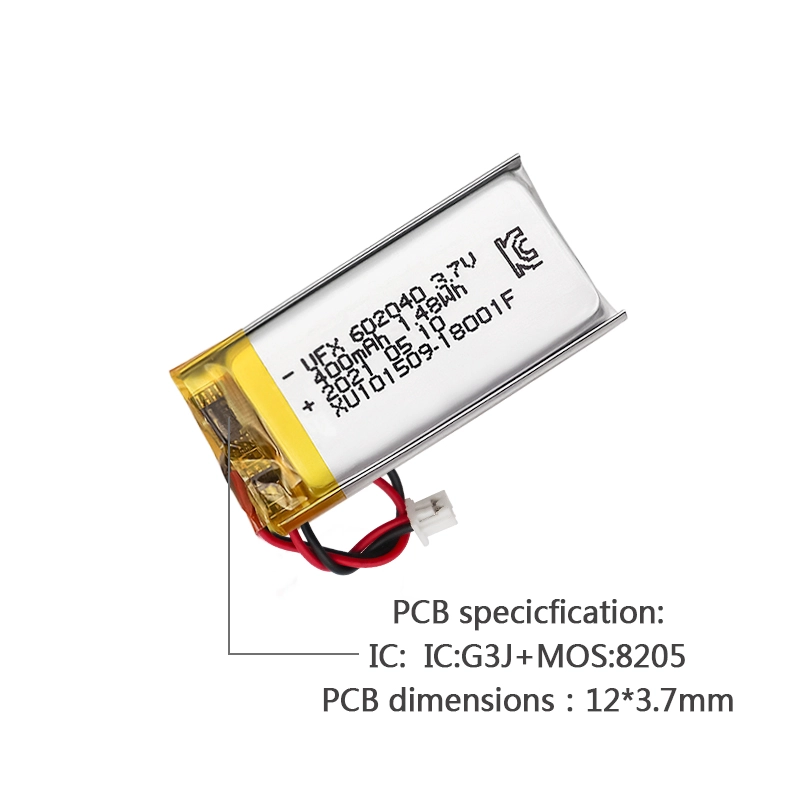
Integrated PCB Protection for Safety
The built-in protection circuit improves battery reliability by helping prevent common charging and discharging risks.
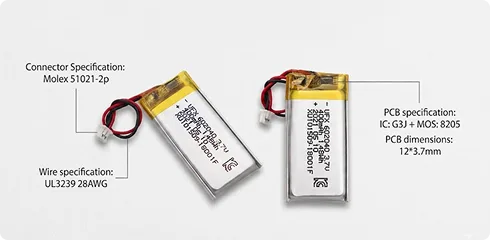
Flexible Connector & Customization Options
Designed for custom electronics, the 602040 lithium polymer battery supports flexible configurations to meet different product requirements.
Request Custom Solution 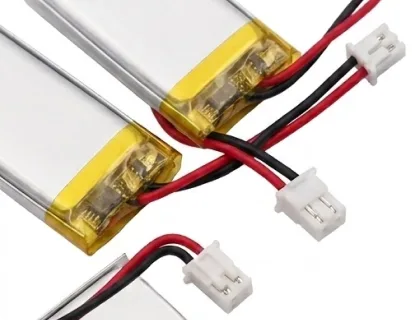
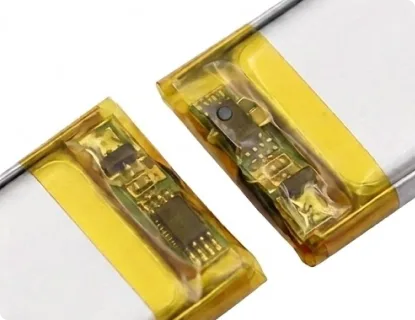
What We Custom and How
At Ufine, we know that one size doesn't fit all, especially when it comes to battery needs. That's why we specialize in custom battery solutions.
- Battery Chemistries: We build with Lithium, Polymer, LiFePO4, and 18650 cells.
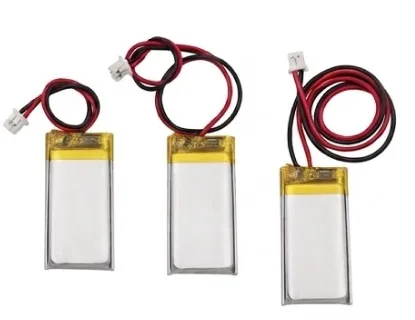
- Custom Specs: We customize size, voltage, capacity, and shape to fit your needs.
- Connectors: Get the perfect fit with JST, Molex, XT series, and more.
- Performance: Our batteries handle discharge rates from 0.2C to 25C.
- Temperature: They're designed to operate from -40°C to 80°C.
-
01Enquiry and Design: Contact us with requirements. The technical team creates tailored designs.
-
02Sampling and Sample Testing: Receive customized battery samples for evaluation within two days.
-
03Confirmation and Production: Finalize specifications, sign the production contract, and pay a 30% deposit.
-
04Delivery and Shipping: Make final payment, and arrange safe and efficient delivery.
Recommended 3.7V LiPo Batteries
Explore similar 3.7V lithium polymer batteries with different capacities and dimensions. These battery options provide flexible power solutions for wearables, IoT devices, portable electronics, and other compact applications.
| Recommended Products | Voltage | Model | Capacity | Size (mm) |
|---|---|---|---|---|
| Compact LiPo Battery | 3.7V | 702535 | 600mAh | 7 × 25 × 37 |
| Compact LiPo Battery | 3.7V | 702525 | 350mAh | 7 × 25 × 27 |
| Compact LiPo Battery | 3.7V | 552826 | 450mAh | 5.5 × 28 × 28 |
| Standard LiPo Battery | 3.7V | 672330 | 450mAh | 6.7 × 23 × 32 |
| Compact LiPo Battery | 3.7V | 702527 | 380mAh | 7 × 25 × 29 |
| Compact LiPo Battery | 3.7V | 902128 | 500mAh | 9 × 21 × 30 |
| Ultra Thin LiPo Battery | 3.7V | 402248 | 400mAh | 4 × 22 × 48 |
Battery Specification
-
1. Mechanical Characteristics
Cell 602040 PCM Yes NTC No Weight appr. 9g Configuration 1S1P -
2. Electrical Specification
Capacity 400mAh Nominal Voltage 3.7V Energy 1.48Wh Internal Resistance less than 200mΩ Max. Charge Voltage 4.2V Discharge Cut Off 2.75V Max. Charge Current 400mA Max. Discharge Current 400mA Standard Charge Current 200mA Standard Discharge Current 200mA Charging Temperature 0℃ to 45℃ Discharging Temperature -20℃ to 60℃ Storage Temp.Range 1 year at -20℃ to +30℃ 3 mos. at -20℃ to +45℃ 1 mo. at -20℃ to +60℃ Cycle life 100 cycles ≥92% 300 cycles ≥88% 500 cycles ≥80% -
3. Cell protection
Overcharge Detection 4.28V ±50mV (80 to 200msec delay, release 4.08V ±50mV) Overdischarge Detection 2.4V ±100mV (40 to 120msec. delay, release 3.0V ±100mV) Overcurrent Detection 2.5A to 4.5A (5 to 10msec. delay) Short protection Yes
Part 1. Common Design Challenges When Integrating a 602040 Battery
Although the 602040 battery is designed for space-limited applications, successful integration requires careful consideration of mechanical design, electrical requirements, and safety factors. Engineers need to evaluate battery placement, power requirements, and operating conditions during the early design stage.
Limited Installation Space
One of the main challenges in compact electronic design is finding enough internal space for the battery. The 602040 LiPo battery features a compact 6 × 20 × 42mm size, but engineers still need to consider thickness tolerance, wire routing, connector positioning, and surrounding components.
-
Compact dimensions help maximize internal space for portable products.
-
Flexible wire and connector options simplify battery installation.
-
Proper battery placement helps prevent mechanical stress on the pouch cell.
For space-constrained products, battery integration should be planned during the early development stage to ensure sufficient installation clearance and reliable long-term performance.
Balancing Battery Size and Runtime
A smaller battery reduces product size and weight but also limits available energy storage. Engineers need to balance battery capacity with device power consumption to achieve the required operating time.
The 400mAh capacity of the 602040 battery is suitable for compact devices with moderate power requirements. The correct battery selection depends on factors such as current consumption, usage frequency, and expected runtime.
-
Low-power wearable devices can benefit from compact 400mAh capacity.
-
Higher power applications may require larger capacity battery solutions.
-
Battery capacity should match the device’s operating conditions.
Managing Temperature and Operating Conditions
Battery performance can be affected by charging and discharging temperatures. Extreme environments may reduce available capacity, efficiency, and battery lifespan.
When integrating a 602040 lithium polymer battery, designers should evaluate:
-
Charging temperature requirements
-
Discharging temperature range
-
Heat generated by nearby electronic components
-
Actual product operating environment
Proper thermal management helps maintain stable battery performance and improves product reliability throughout its service life.
Selecting the Right Protection Circuit
A lithium polymer battery requires an appropriate protection circuit to ensure safe operation. The PCM/PCB protection system helps prevent overcharging, over-discharging, and short-circuit risks.
-
Protection design matched with charging and discharge requirements.
-
Improves battery safety and operational reliability.
-
Helps extend battery service life under normal usage conditions.
Part 2. 3.7V 400mAh Battery 602040 Applications
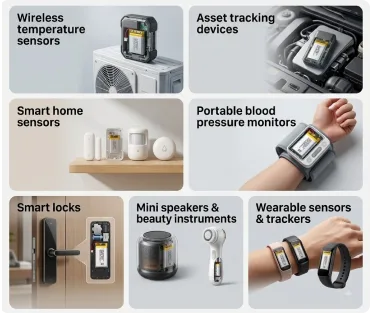
The compact size and balanced capacity of the 602040 3.7V 400mAh LiPo battery make it suitable for a wide range of portable electronic applications. It is ideal for products where space efficiency, lightweight design, and reliable rechargeable power are important.
-
Wearable Electronics – Smart watches, fitness trackers, and compact wearable devices.
-
IoT Devices – Sensors, smart modules, and connected electronic products.
-
Portable Consumer Electronics – Small handheld devices and rechargeable gadgets.
With flexible customization options for connectors, wires, and PCB protection, the 602040 battery can be adapted to different product requirements.
Part 3. How Long Does a LiPo 400mAh Battery Last?
Battery runtime depends on the device’s power consumption rather than capacity alone. A 400mAh lithium polymer battery can provide different operating times depending on the current required by the application.
The basic calculation method is:
Battery Runtime (hours) = Battery Capacity (mAh) ÷ Device Current Consumption (mA)
For example:
-
A device using 40mA current may run for approximately 10 hours with a 400mAh battery.
-
A device using 100mA current may run for approximately 4 hours.
-
A device using 200mA current may run for approximately 2 hours.
These values are theoretical estimates. Actual runtime may vary depending on device efficiency, operating environment, discharge conditions, and battery characteristics.
Factors Affecting 400mAh Battery Life
-
Device Power Consumption – Lower current demand allows longer operating time with the same battery capacity.
-
Operating Temperature – Suitable temperatures help maintain battery efficiency and available capacity.
-
Charging and Discharging Conditions – Proper charging methods help preserve battery performance over time.
-
Battery Aging – Capacity gradually decreases after repeated charge and discharge cycles.
Part 4. Key Battery Parameters to Consider
Selecting the right LiPo battery requires understanding important specifications such as voltage, capacity, size, discharge capability, and cycle life. These parameters directly affect device performance and battery reliability.
Voltage
The 602040 battery uses a 3.7V nominal voltage and 4.2V charging voltage. The battery voltage must match the device’s power management system to ensure safe and stable operation.
Capacity
Battery capacity is measured in milliampere-hours (mAh), which indicates the amount of energy the battery can store. The 400mAh capacity provides a practical solution for compact devices requiring moderate runtime.
-
Device current consumption
-
Expected operating time
-
Usage frequency
-
Product size limitations
Size and Weight
For portable electronics, battery dimensions and weight are critical design factors. The 602040 format provides a compact solution while maintaining useful capacity.
-
Battery length
-
Battery width
-
Battery thickness
-
Total product weight
Discharge Current
The battery must support the device’s normal operating current and peak power requirements. Proper discharge capability helps maintain stable voltage output during use.
Cycle Life
Cycle life refers to the number of complete charge and discharge cycles a battery can provide before capacity decreases significantly. The 602040 battery typically supports up to 300 charge cycles depending on usage conditions.
-
Charging conditions
-
Operating temperature
-
Discharge rate
-
Battery quality
Part 5. Connector, Wire, and Charger Selection
Battery integration involves more than selecting the battery cell itself. Choosing the right connector, wire configuration, and charging system is essential for ensuring reliable performance and safe operation.
Connector Selection
Different electronic products require different connector solutions depending on installation space, current requirements, and device structure. A suitable connector helps simplify assembly and improves overall product reliability.
-
Connector size and installation space
-
Current rating requirements
-
Connection reliability and durability
-
Compatibility with device design
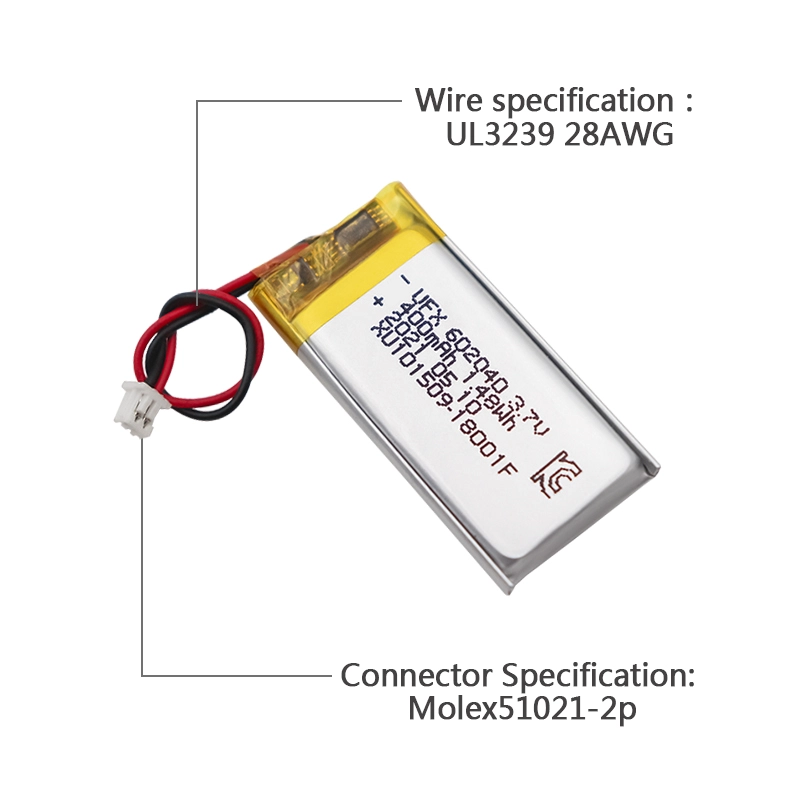
The 602040 battery supports flexible connector customization, including Molex and other connector options, allowing easier integration into different electronic products.
Wire Selection
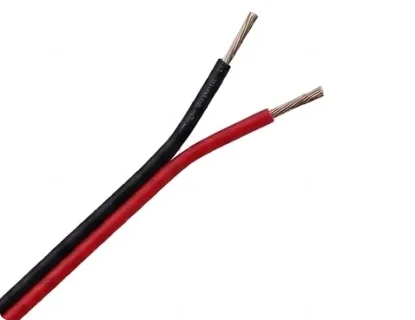
Wire specifications directly affect electrical performance and mechanical installation. Engineers should consider wire diameter, length, flexibility, and current capacity when designing battery connections.
-
UL-certified wire options for improved safety and reliability.
-
Customized wire lengths to fit different product structures.
-
Flexible wiring solutions for compact electronic devices.
Charger Compatibility
A LiPo battery charger must match the battery’s charging requirements. For a standard 3.7V lithium polymer battery, the charging voltage is typically 4.2V.
-
Correct 4.2V charging voltage
-
Suitable charging current
-
Compatible charging IC
-
Proper battery management system
Using the correct charger helps maintain battery performance, extend cycle life, and improve overall product safety.
Explore Common Types of Lipo Battery ConnectorsPart 6. Why Battery Certifications Matter
Battery certifications help verify safety, reliability, and compliance with international requirements. For product developers, certified battery solutions can reduce risks during design, testing, transportation, and commercialization.
Ensuring Battery Safety
Certifications demonstrate that lithium batteries have passed specific safety evaluations. They help ensure reliable performance during charging, daily operation, and international transportation.
Common Battery Certifications
-
KC Certification – Demonstrates compliance with Korean safety requirements for lithium battery products.
-
UL Certification – Verifies battery safety performance based on recognized industry standards.
-
UN38.3 Testing – Confirms lithium battery compliance with transportation safety requirements.
Supporting Product Development
Using certified battery solutions helps companies improve product development efficiency and reduce compliance risks.
-
Reduce certification risks during product development.
-
Improve product reliability and customer confidence.
-
Simplify global compliance processes.
Part 7. Maintenance and Safety
Proper maintenance and safe handling practices help maximize battery lifespan and ensure reliable operation throughout the product lifecycle.
Proper Charging Practices
To maintain the performance of the 602040 3.7V 400mAh LiPo battery:
-
Use a compatible LiPo charger with the correct charging voltage.
-
Avoid overcharging or excessive discharge.
-
Avoid charging under extreme temperature conditions.
-
Follow recommended charging specifications.
Storage Recommendations
When storing lithium polymer batteries for extended periods:
-
Keep batteries in a dry and clean environment.
-
Avoid extreme heat or cold conditions.
-
Prevent physical damage to the battery pouch.
-
Store batteries at an appropriate charge level.
Safe Handling
Lithium polymer batteries should always be handled carefully to maintain safety and reliability. Avoid:
-
Puncturing, crushing, or damaging the battery pouch.
-
Short-circuiting battery terminals.
-
Exposing batteries to water or extreme environments.
-
Unauthorized battery modifications.
Following proper charging, storage, and handling practices helps maintain stable battery performance and extends the service life of the 602040 3.7V 400mAh lithium polymer battery.
FAQs
-
Can I replace a different LiPo battery with a 602040 battery?
Yes, a 602040 LiPo battery can replace another lithium polymer battery if the voltage, dimensions, capacity requirements, and connector configuration are compatible. Before replacement, confirm the battery size, charging system, protection circuit, and current requirements to ensure safe operation. -
Can the capacity of a 602040 battery be customized?
Yes. The capacity of a 602040 lithium polymer battery can be customized based on product requirements. However, capacity changes may affect battery thickness, weight, charging specifications, and overall dimensions, so customization should be evaluated according to available installation space. -
How should I choose the right battery capacity for my device?
The required battery capacity depends on device power consumption, expected operating time, installation space, and charging frequency. A higher-capacity battery provides longer runtime but may require a larger physical size. Selecting the right capacity requires balancing performance and product design requirements. -
Can the connector position of a 602040 battery be customized?
Yes. The connector type, wire length, and cable position of a 602040 battery can be customized according to device structure and assembly requirements. Custom configurations improve installation efficiency and ensure compatibility with the final product design.
Ready to Power Your Project?
We’ll help you design the perfect power source — tailored to your voltage, capacity, size, C-rate, and performance needs.
Contact Us NowWhat Our Customers Are Saying
We love hearing from you! Your experiences help us improve and inspire others. Check out what our happy customers have to say about our lithium batteries—share your thoughts with us too!









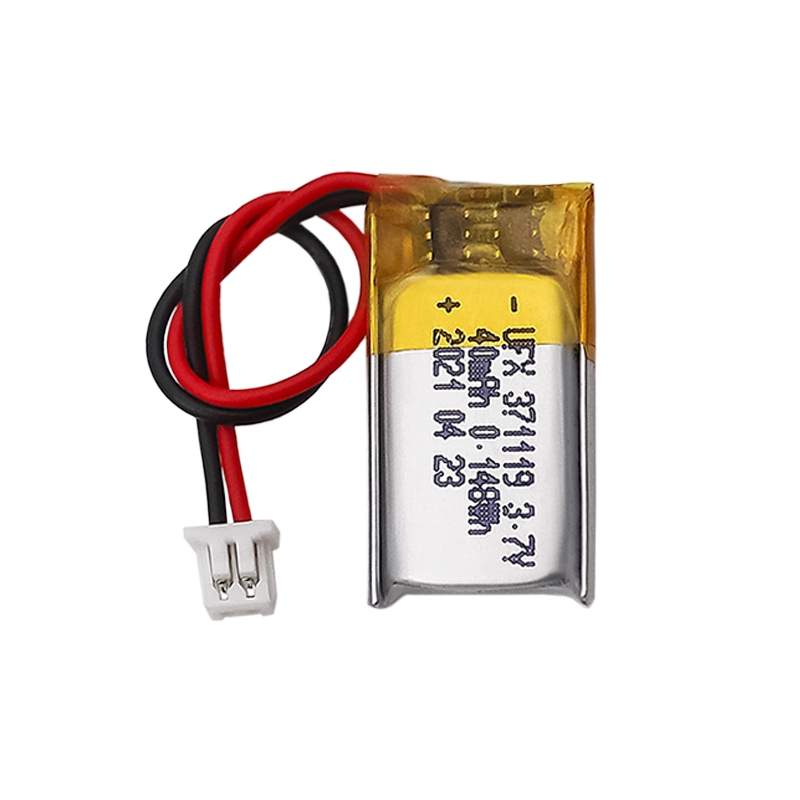
Latest Articles
About Lithium Battery Industry News
Glucometer Battery Types, Sizes and 10 Options Compared
Compare glucometer battery types, sizes and compatibility, including CR2032, AAA and rechargeable options, plus replacement and price guidance.
2026-8-11 Ufine
14500 Battery 3.7V Li-Ion Rechargeable: Options, Compatibility, and Buying Guide
Compare 14500 battery 3.7V Li-ion rechargeable options by capacity, size, charging and protection, plus what to verify before buying near you.
2026-8-11 Ufine
18650 Button Top Battery Guide: 10 Options Compared
Compare 18650 button top battery options by terminal type, protection, size and discharge needs, with practical tips for choosing the right battery.
2026-8-11 Ufine