
- Part 1. What is UL 9540 listing?
- Part 2. What is UL 9540A testing?
- Part 3. UL 9540 vs UL 9540A comparison
- Part 4. The difference between UL listed and UL recognized
- Part 5. Why battery systems fail UL 9540A
- Part 6. Designing a UL 9540-compliant battery system
- Part 7. Certification strategy: how to save time and cost
- Part 8. Pre-certification engineering checklist
- Part 9. UL 9540 in real-world deployment
- Part 10. UL 9540 and global standards
- Part 11. FAQs
Over the past decade, lithium-ion batteries have moved far beyond consumer electronics into grid-scale energy storage, residential backup systems, and EV infrastructure.
However, several high-profile battery fire incidents exposed a critical gap:
Passing traditional cell-level safety standards did not guarantee system-level safety.
That’s where UL 9540 comes in.
Today, if you want to deploy an energy storage system in the U.S. or Canada, UL 9540 is often not just recommended—it’s effectively mandatory due to requirements from:
- AHJs (Authorities Having Jurisdiction)
- Fire codes such as NFPA 855
- Insurance providers
But the real challenge is this:
Most failures don’t happen at the certification stage—they happen because the system was never designed for UL 9540 in the first place.
Key Takeaways
- UL 9540 is a system-level safety certification required for deploying energy storage systems (ESS) in North America.
- UL 9540A is a multi-level fire propagation test method, not a certification, but often the most critical hurdle in passing UL 9540.
- The biggest failure risks are thermal runaway propagation, poor system integration, and inadequate BMS response.
- Battery chemistry, enclosure design, and thermal management strategy directly determine certification success.
- Designing for compliance early can reduce certification cost by 30–50% and avoid multiple redesign cycles.
Part 1. What is UL 9540 listing?
UL 9540 is often misunderstood as a “battery certification.” In reality, it is a system integration safety standard.
UL 9540 is a safety standard developed by Underwriters Laboratories (UL) that applies to energy storage systems (ESS). The standard sets requirements for the design, construction, and performance of these systems to ensure they are safe and reliable for use in residential, commercial, and industrial applications.
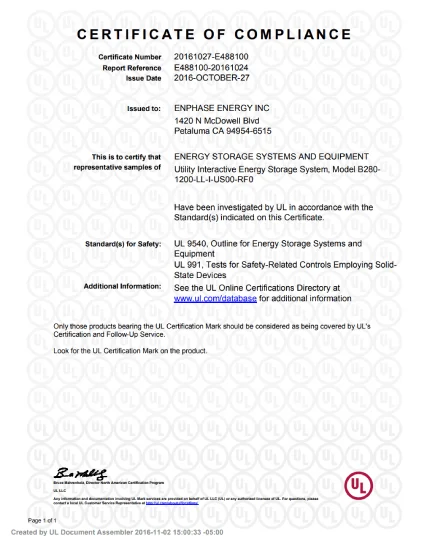
When a product is UL 9540 listed, it means that the product has been tested and meets the safety standards set by UL. This includes testing for electrical safety, fire safety, mechanical safety, and more. It ensures that the energy storage system can perform as intended without posing a risk to users or the environment.
In short, UL 9540 listing verifies that an energy storage system has passed rigorous safety tests, offering peace of mind to manufacturers, installers, and consumers alike.
1 What UL 9540 Actually Covers
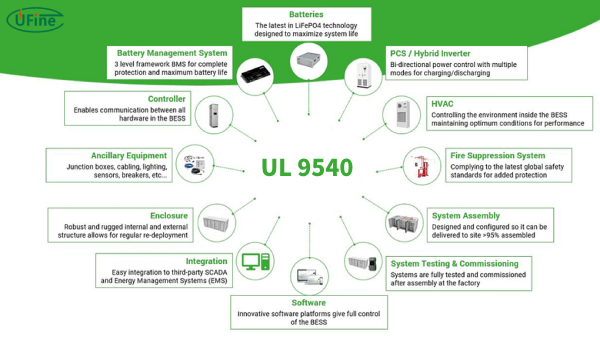
A UL 9540 evaluation includes:
- Battery cells, modules, and packs
- Battery Management System (BMS)
- Power conversion system (PCS/inverter)
- Thermal management system
- Mechanical enclosure
- Installation configuration
This means even if your battery cells are fully certified, your system can still fail UL 9540.
2 Core Objective
The standard ensures that the system:
- Operates safely under normal conditions
- Detects and mitigates failures
- Prevents fire escalation and explosion risks
- Protects users, property, and first responders
3 Requirements for UL 9540 certification
To obtain UL 9540 certification, energy storage systems must meet specific requirements that cover various safety aspects. These include:
- Electrical Safety: Ensuring that the system does not pose any electrical hazards, such as short circuits or overloads.
- Fire Safety: Systems must be designed to resist fire hazards and include features that prevent fires from spreading.
- Mechanical Safety: The system must be physically robust and capable of withstanding environmental stresses, such as vibrations and temperature fluctuations.
- Performance Standards: The system must demonstrate reliable performance in normal operating conditions, including during charging and discharging cycles.
Manufacturers must submit their products to UL for testing and evaluation. The process can be lengthy and rigorous, but the end result is a certification that guarantees the system meets high safety standards.
4 How to get UL certified?
Getting UL certified is a multi-step process that involves product testing, documentation, and ongoing compliance. Here’s how it works:
- Submit a Product for Evaluation: Manufacturers need to submit their energy storage systems to UL for testing. This includes providing detailed product specifications and design documents.
- Undergo Testing: UL will perform various tests, including electrical, mechanical, and fire safety tests, to ensure the product meets the UL 9540 standard.
- Certification Decision: If the product passes the tests, UL will issue a UL Listing for the product. This means the product is certified for sale and use.
- Ongoing Compliance: Once certified, the manufacturer must continue to meet UL’s ongoing requirements. This may include periodic inspections or additional testing as needed.
The process can be time-consuming, but UL certification helps to ensure that the product is safe, reliable, and ready for the market.
Part 2. What is UL 9540A testing?
UL 9540A is a test procedure specifically designed to evaluate the thermal runaway and fire safety characteristics of energy storage systems, particularly lithium-ion batteries. This testing simulates worst-case scenarios, such as battery fires or failures, to ensure that the system behaves safely in extreme conditions.
UL 9540A testing involves subjecting the energy storage system to high temperatures, overcharging, and other stress conditions to see how the system responds. It’s a comprehensive test that helps prevent fires and explosions by identifying potential safety hazards.
For manufacturers, passing UL 9540A testing is a critical step toward obtaining UL 9540 certification. It’s an extra layer of assurance that ensures the system can handle emergency situations safely.
15 FAQs About Battery Manufacturing Safety Testing
What Makes UL 9540A So Critical
UL 9540A is not about whether a battery fails—it assumes it will fail.
Instead, it answers a more important question:
What happens after failure begins?
Four Levels of UL 9540A Testing
UL 9540A testing is performed progressively:
1. Cell Level
- Initiate thermal runaway in a single cell
- Measure heat release, gas composition
2. Module Level
- Evaluate propagation between cells
- Identify whether failure spreads
3. Unit Level
- Test full battery pack behavior
- Assess enclosure impact
4. Installation Level
- Simulate real-world deployment
- Evaluate fire suppression and spacing requirements
Key Metrics Measured
- Peak temperature
- Heat release rate (HRR)
- Flame duration
- Gas toxicity and flammability
- Propagation speed
These results are often used by engineers and fire authorities to define safe installation distances and mitigation strategies.
Part 3. UL 9540 vs UL 9540A comparison
While UL 9540 and UL 9540A are closely related, they serve different purposes. Here’s how they differ:
-
UL 9540: This is the overall safety standard for energy storage systems, covering the performance, installation, and general safety of the system. It’s the umbrella certification that most energy storage products aim for.
-
UL 9540A: This is a specific test procedure under UL 9540, focused primarily on the thermal performance and fire safety of the system. It’s an in-depth evaluation that helps manufacturers identify any fire or explosion risks associated with their systems.
In essence, UL 9540 is the broader safety standard, while UL 9540A is a more detailed test that ensures the system is safe under extreme conditions.
| Dimension | UL 9540 | UL 9540A |
|---|---|---|
| Role | Certification | Test method |
| Focus | System safety | Fire behavior |
| Output | UL Listing | Engineering data |
| Used by | Regulators & market | Engineers & AHJs |
| Timing | Final certification | Pre-certification testing |
Think of UL 9540A as the engineering foundation, and UL 9540 as the final approval.
Part 4. The difference between UL listed and UL recognized
When it comes to UL certification, it’s important to understand the difference between UL listed and UL recognized.
-
UL Listed: This means the product has been tested and approved by UL for safety. It’s a more comprehensive certification that ensures the product meets all applicable safety standards and is safe for its intended use.
-
UL Recognized: This means that a component within a product (e.g., a specific battery or inverter) has been evaluated by UL, but the entire system has not been tested. UL Recognized is often used for components that are part of a larger system, but it doesn’t mean the whole product is UL approved.
In short, UL Listed refers to a complete product that meets all safety standards, while UL Recognized refers to components that have been evaluated but not fully certified.
Part 5. Why battery systems fail UL 9540A
1. Thermal Runaway Propagation
The most common failure scenario:
- One cell fails
- Heat spreads to adjacent cells
- Chain reaction occurs
This is especially problematic in:
- High energy density designs
- Poorly ventilated enclosures
2. Inadequate Thermal Management
Design flaws include:
- No heat dissipation pathways
- Over-reliance on passive cooling
- Lack of thermal barriers
Even small design oversights can lead to exponential heat buildup.
3. Weak BMS Strategy
A BMS that only monitors but does not act quickly is insufficient.
Critical failures:
- Delayed shutdown
- Sensor inaccuracies
- Lack of redundancy
4. Mechanical Design Issues
- Tight cell packing
- Flammable enclosure materials
- Poor venting design
Mechanical design is often underestimated but heavily impacts UL 9540A results.
Part 6. Designing a UL 9540-compliant battery system
Battery Chemistry Selection
| Chemistry | Safety | UL 9540A Difficulty |
|---|---|---|
| LFP | High | Low |
| NMC | Medium | High |
| LTO | Very High | Very Low |
This is why many ESS systems are shifting toward LFP.
Thermal Management Strategies
- Air cooling vs liquid cooling
- Phase change materials (PCM)
- Heat shielding between modules
Best practice:
Design for failure containment, not just cooling.
Propagation Prevention Techniques
- Fire-resistant separators
- Module-level isolation
- Intumescent materials
Advanced BMS Features
- Real-time thermal modeling
- Fault prediction algorithms
- Multi-level protection triggers
Part 7. Certification strategy: how to save time and cost
Typical Certification Flow
- Concept design review
- Pre-testing (internal or third-party)
- UL 9540A testing
- Design iteration
- Full UL 9540 evaluation
- Factory inspection
- Listing approval
Cost Optimization Tips
- Perform internal thermal propagation tests early
- Use previously certified components
- Avoid redesign after module-level failure
Each failed test cycle can cost $10k–$50k+ and months of delay.
Part 8. Pre-certification engineering checklist
Before going to UL:
- Cell certification verified
- Thermal runaway tested internally
- BMS response validated
- Enclosure fire resistance confirmed
- Venting and gas management designed
Treat this as your “go/no-go gate” before spending on certification.
Part 9. UL 9540 in real-world deployment
Where It Matters Most
- Residential battery storage
- Commercial ESS
- Utility-scale storage
- Solar + storage integration
Role of AHJs
Authorities Having Jurisdiction use UL 9540A data to:
- Approve installations
- Define spacing rules
- Determine fire suppression needs
Passing UL 9540 does not guarantee installation approval without proper UL 9540A data.
Part 10. UL 9540 and global standards
UL 9540 is often combined with:
- UL 1973 → battery safety
- IEC 62619 → international compliance
- NFPA 855 → installation safety
Leading manufacturers design for multi-standard compliance from day one.
Part 11. FAQs
1. Does UL 9540 apply to both residential and commercial energy storage systems?
Yes, UL 9540 applies to both residential and commercial ESS. However, larger commercial or utility-scale systems usually face stricter scrutiny, especially regarding UL 9540A fire propagation data and installation safety requirements.
2. What is a UL 9540 listing and why is it important?
A UL 9540 listing means your energy storage system has been tested and certified to meet safety standards. It is often required by regulators, insurers, and project developers before installation approval.
3. Can UL 9540 certification be transferred between different battery system designs?
No, UL 9540 certification is specific to a particular system design. Even small changes in battery configuration, enclosure, or BMS can require re-evaluation or additional testing.
4. Is UL 9540 required for exporting batteries outside North America?
Not necessarily. UL 9540 is mainly required for the U.S. and Canadian markets. Other regions may rely more on IEC standards, but UL certification can still improve global credibility.
5. What documentation is required for UL 9540 certification?
Manufacturers typically need detailed system schematics, component certifications, BMS logic descriptions, thermal analysis reports, and test data to support the evaluation.
Related Tags:

More Articles

Best 5 Riding Lawn Mower Battery Manufacturers
Looking for the best riding mower battery? Compare top battery brands by lifespan, maintenance, price, and performance.
All You Need to Know About CB Certification for Lithium Batteries
Learn what CB certification and the IECEE CB Scheme mean for lithium batteries. Explore requirements, testing, benefits, and global market access.
How to Choose the Right 3S LiPo Battery 5000mAh for Your RC Hobby Projects?
Learn how to choose the best 3S LiPo battery 5000mAh for RC cars, drones, boats, and planes. Compare C ratings, runtime, connectors, charging, and safety tips.
Comparing Semi Truck Batteries vs. Truck Batteries
Compare semi truck batteries and truck batteries by size, CCA, lifespan, and battery type. Learn how to choose the right truck battery for your vehicle.
Top 10 Flat Lithium Ion Battery Options for Compact Devices
Explore top flat lithium ion battery options, key specifications, and selection factors for compact electronics, medical devices, and energy storage systems.


