- Key Takeaways
- Part 1. What are the battery charging voltage and discharging voltage?
- Part 2. How voltage changes during charging and discharging
- Part 3. Charging and discharging voltage of common battery typess
- Part 4. How can you know the correct charging or discharging voltage?
- Part 5. Why does the battery voltage change when charging and discharging lithium batteries?
- Part 6. What effect does the voltage change of lithium-Ion batteries have on battery performance?
- Part 7. What are the limiting charging voltage and limiting discharging voltage?
- Part 8. What is floating charge voltage?
- Part 9. Difference between nominal voltage and charging voltage
- Part 10. Other key parameters of charging and bischarging
- Part 11. Final words
- Part 12. FAQs
In the world of batteries, one of the most important aspects of their operation is understanding charging voltage and discharging voltage. These terms are essential for anyone looking to maximize the lifespan and performance of their batteries. Whether you’re using lithium-ion batteries, AA batteries, or even car batteries, the concept of voltage plays a critical role in how these power sources work.
In this article, we’ll explore what charging and discharging voltage are, how they affect the performance of batteries, and why they fluctuate during use. By the end of this guide, you’ll have a clear understanding of these terms, as well as how to manage your battery’s voltage to optimize its efficiency.
Key Takeaways
- Charging voltage and discharging voltage are not fixed values—they change with state of charge, load, and temperature.
- Overcharging or over-discharging a battery is one of the fastest ways to shorten its life.
- Lithium batteries are especially sensitive to voltage limits compared to lead-acid or NiMH batteries.
- Understanding voltage curves helps you choose the right charger, cutoff voltage, and protection strategy.
Part 1. What are the battery charging voltage and discharging voltage?
Charging voltage refers to the voltage applied to a battery to recharge it. It is typically higher than the battery’s nominal voltage, as the battery must overcome internal resistance and the potential to store more energy.
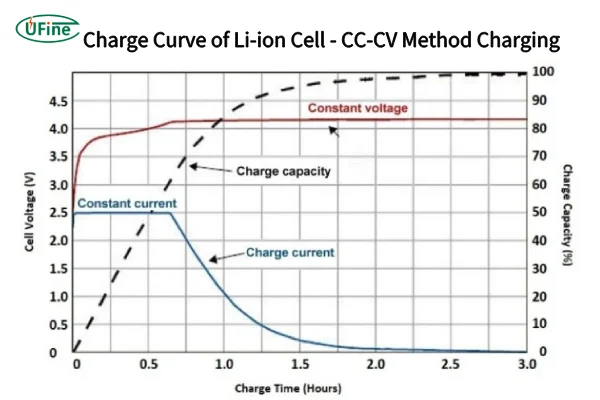
Discharging voltage, on the other hand, is the voltage that a battery provides while it is supplying power to a device. As a battery discharges, its voltage gradually decreases until it reaches a level where it can no longer supply sufficient power.
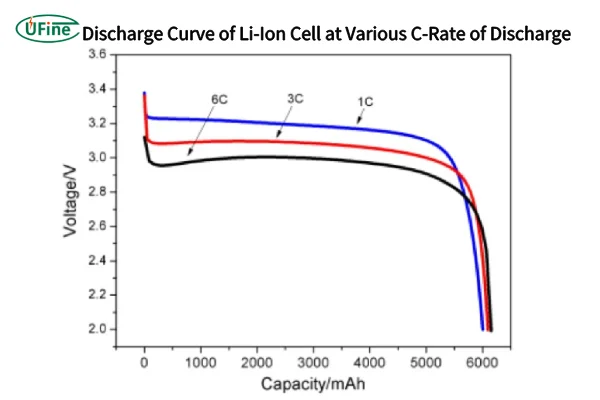
These voltages are crucial because they determine how effectively a battery charges and discharges, as well as its overall health. Too high or too low of a charging voltage can shorten a battery’s lifespan or even cause it to fail prematurely.
How to Read Lithium Battery Discharge Curve and Charging Curve?
Part 2. How voltage changes during charging and discharging
Here’s the key idea many people miss:
Voltage is not a single number—it’s a range that shifts continuously during charging and discharging.
For lithium-ion cells, this behavior is usually described by charging and discharging curves, especially under the CC–CV (Constant Current–Constant Voltage) charging method.
When you charge or discharge a battery, several things happen at the same time:
- Internal resistance causes temporary voltage rise or drop under load
- Electrochemical reactions shift the equilibrium voltage
- State of charge (SOC) directly affects measured voltage
- Temperature alters ion mobility inside the cell
That’s why you might measure 4.15 V at rest, but see 4.25 V during charging—or only 3.4 V under heavy discharge.
Part 3. Charging and discharging voltage of common battery typess
Table 1: Typical Charging and Discharging Voltage Ranges
| Battery Type | Charging Voltage | Discharging Voltage |
|---|---|---|
| Lead-acid (12 V) | 14.4–14.7 V | 11.8–12.0 V |
| Lithium-ion (Li-ion) | 4.2 V per cell | 3.0–3.2 V per cell |
| NiMH | ~1.45 V per cell | ~1.0 V per cell |
| NiCd | ~1.45 V per cell | ~1.0 V per cell |
| Alkaline (primary) | Not rechargeable | ~0.9 V (empty) |
Different types of batteries have specific charging and discharging voltage ranges. Here’s an overview of the charging and discharging voltages for some of the most commonly used batteries:
-
Lead-Acid Batteries
- Charging Voltage: Typically around 14.4 to 14.7V
- Discharging Voltage: Usually 11.8V to 12.0V (for a 12V battery)
-
Lithium-Ion (Li-ion) Batteries
- Charging Voltage: Typically 4.2V per cell (for a 3.7V nominal cell)
- Discharging Voltage: Typically 3.0V to 3.2V per cell (for a 3.7V nominal cell)
-
Nickel-Metal Hydride (NiMH) Batteries
- Charging Voltage: Typically 1.45V per cell
- Discharging Voltage: Typically 1.0V per cell
-
Nickel-Cadmium (NiCd) Batteries
- Charging Voltage: Typically 1.45V per cell
- Discharging Voltage: Typically 1.0V per cell
-
Alkaline Batteries (Non-Rechargeable)
- Charging Voltage: Not recommended to charge, but usually around 1.5V when fresh
- Discharging Voltage: Typically 0.9V when fully discharged
Choosing the right battery type is crucial—our comparison of lithium, NiMH, and NiCd batteries for solar lights can help you pick the best option.
Part 4. How can you know the correct charging or discharging voltage?
To know the charging voltage and discharging voltage of a battery, you can either refer to the battery’s datasheet or measure it using a multimeter.
-
Datasheets: Most reputable battery manufacturers provide detailed datasheets that outline the recommended charging and discharging voltages for each type of battery. This is often the most reliable source of information.
-
Multimeter: You can measure the discharging voltage by connecting the multimeter probes to the positive and negative terminals of the battery while it’s under load (i.e., supplying power to a device). For charging voltage, you can measure the voltage across the battery terminals while it’s being charged.
If you want to measure charging and discharging voltage accurately, follow our simple steps to test a lithium battery with a multimeter.
It’s important to follow manufacturer guidelines to avoid damaging the battery or shortening its lifespan.
Part 5. Why does the battery voltage change when charging and discharging lithium batteries?
When lithium-ion batteries are charged and discharged, their voltage fluctuates due to several factors:
-
Internal Resistance: As the battery discharges, internal resistance within the battery causes the voltage to drop. Conversely, during charging, the battery’s internal resistance increases, which may cause a temporary rise in voltage.
-
Chemical Reactions: The process of charging and discharging involves the movement of lithium ions between the anode and cathode. As these ions move, the voltage fluctuates due to the chemical reactions occurring inside the battery.
-
State of Charge: The voltage of a lithium-ion battery increases as it charges and decreases as it discharges. The voltage reaches a peak (usually 4.2V per cell) when fully charged and drops to around 3.0V per cell when it’s almost empty.
-
Temperature Effects: Temperature can also affect the voltage. In colder temperatures, the battery may exhibit lower voltage during discharge, while excessive heat during charging can cause the voltage to rise beyond normal levels.
Part 6. What effect does the voltage change of lithium-Ion batteries have on battery performance?
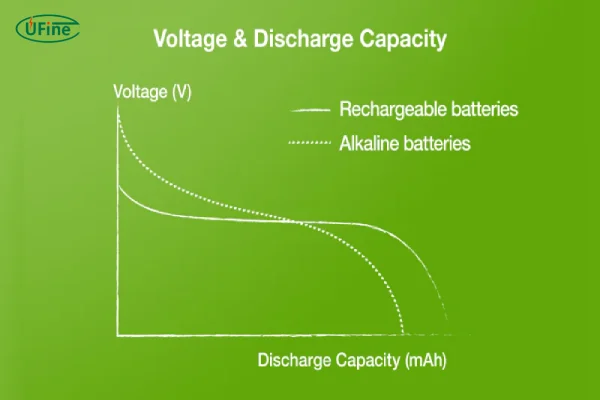
The fluctuation of voltage during the charging and discharging cycle can have a significant impact on the performance and longevity of lithium-ion batteries:
-
Capacity Loss: Repeatedly discharging a lithium-ion battery to a very low voltage (e.g., below 3.0V per cell) can cause the battery’s capacity to decrease over time. Likewise, charging above 4.2V per cell can lead to thermal runaway or damage to the battery’s internal structure.
-
Cycle Life: Lithium-ion batteries have a finite number of charge-discharge cycles, and extreme voltage changes can reduce the number of cycles a battery can endure. For optimal lifespan, it’s best to keep the voltage within a safe range, generally between 3.2V and 4.1V per cell.
-
Efficiency: If a battery is charged too quickly (with too high of a charging voltage), it can result in heat generation, leading to inefficiencies in energy storage and potential damage.
Table 2: Voltage Limits and Their Impact on Li-ion Batteries
| Voltage Condition | Long-Term Impact |
|---|---|
| >4.25 V | Increased risk, faster aging |
| 4.1–4.2 V | Full capacity, normal aging |
| 3.2–4.0 V | Optimal lifespan |
| <3.0 V | Permanent capacity loss |
This is why many EVs and energy storage systems never charge to 100% or discharge to 0%.
Part 7. What are the limiting charging voltage and limiting discharging voltage?
To maintain the health of a battery, it’s essential to adhere to the limiting charging voltage and limiting discharging voltage:
-
Limiting Charging Voltage: For lithium-ion batteries, the maximum charging voltage is usually 4.2V per cell. Charging above this voltage can cause internal damage, increase the risk of overheating, and reduce battery life.
-
Limiting Discharging Voltage: For lithium-ion batteries, discharging below 3.0V per cell is typically considered unsafe. Doing so can damage the battery’s internal structure and significantly reduce its capacity. For other types of batteries, the limiting voltage will vary (e.g., 1.0V for NiMH or NiCd).
Adhering to these limits ensures that the battery operates efficiently and has a longer life span.
Part 8. What is floating charge voltage?
Floating charge voltage is a maintenance voltage, mainly used for lead-acid batteries.
Once fully charged, the charger reduces voltage slightly to maintain capacity without overcharging. For example:
- Full charge: ~14.4 V
- Float charge: ~13.5 V
Lithium batteries generally do not use float charging, which is another common source of system design errors.
Part 9. Difference between nominal voltage and charging voltage
Nominal voltage is a label, not a real-time value.
- A lithium-ion cell is called “3.7 V nominal”
- But in reality, it operates from about 3.0 V to 4.2 V
Charging voltage is intentionally higher to drive current into the battery. Confusing these two values often leads to incorrect charger selection.
Part 10. Other key parameters of charging and bischarging
When working with batteries, it’s essential to consider other key parameters to ensure safe and efficient operation:
-
Charge Current: The rate at which the battery is charged, typically expressed in amperes (A). Charging too quickly can damage the battery, while slow charging is generally safer.
-
Discharge Current: The rate at which the battery discharges, typically measured in amperes (A). High discharge currents can cause voltage sag and shorten battery life.
-
State of Charge (SOC): A measure of the battery’s current charge level, typically expressed as a percentage (0% to 100%).
-
State of Health (SOH): A measure of the battery’s overall health, which can be influenced by factors like cycle count and temperature.
-
Temperature: Both charging and discharging performance are affected by temperature. High temperatures can cause overcharging, while low temperatures can reduce the discharge capacity.
-
Voltage Cutoff: The voltage level at which the battery is considered empty, typically around 3.0V for lithium-ion cells.
-
Charge/Discharge Efficiency: The ratio of energy stored during charging to energy released during discharging. High efficiency means less energy is lost in the form of heat.
To better understand how voltage affects your battery’s overall performance, check out our guide on Battery State of Charge (SOC) and Battery State of Health (SOH).
Part 11. Final words
Understanding charging and discharging voltage isn’t just theory—it’s the foundation of safe, efficient battery use, especially for lithium-ion systems.
If you manage voltage correctly, you get longer cycle life, better performance, and fewer failures. If you ignore it, even the best battery cells won’t save your system.
Whether you’re designing battery packs, selecting chargers, or simply trying to extend battery life, voltage management is where everything starts.
Part 12. FAQs
Can I safely mix batteries with different charge voltages?
Mixing batteries with different voltage ratings can cause imbalance, overheating, and capacity loss. Always match type and voltage.
Why does my fully charged battery drop voltage quickly?
Rapid voltage drop may indicate high self-discharge, poor cell quality, or temperature effects. It’s not always a measurement error.
Is it okay to use a fast charger on all battery types?
No. Fast charging generates heat and can damage sensitive chemistries like Li-ion. Always check manufacturer guidelines.
Can temperature extremes change my battery’s discharge voltage?
Yes. Cold temperatures reduce voltage and capacity, while excessive heat can increase voltage temporarily but stress the battery.
Do smart chargers automatically prevent overcharging?
Most smart chargers monitor voltage and current, cutting off when limits are reached. But always verify specs before leaving a battery unattended.
Are voltage meters accurate for all battery types?
Not always. High discharge currents, internal resistance, and temperature can cause momentary voltage fluctuations, giving misleading readings.
Related Tags:

More Articles

Battery Calibration: Why Is Your Battery % Wrong?
Is your battery percentage inaccurate? Learn how battery calibration works, when you need it, and how to fix unexpected battery drops.
Battery Calibration Guide: Fix SOC Errors in Lithium Systems
SOC accuracy problems can reduce device reliability. Learn how battery calibration, BMS, and fuel gauge optimization improve lithium battery performance.
How Internal Resistance Limits LiPo Battery Performance
Your LiPo Battery may have enough capacity but still fail under load. Discover how Internal Resistance causes voltage sag, heat, and power loss.
What Engineers Can Learn From a Discharge Curve for LithiumBattery?
What can a discharge curve for lithium ion battery tell engineers? Learn how voltage, C-rate, temperature, and capacity affect real-world performance.