
- Key takeaways
- Part 1. What is lithium hexafluorophosphate (lifp6)?
- Part 2. Why lifp6 dominates lithium-ion batteries
- Part 3. Limitations of lifp6 electrolytes
- Part 4. Alternative electrolyte salts and their trade-offs
- Part 5. Sodium chloride (nacl) in sodium-ion battery electrolytes
- Part 6. Lifp6 vs nacl: engineering comparison
- Part 7. Application scenarios of lifp6 and nacl battery electrolytes
- Part 8. Innovations in lifp6 and nacl battery electrolytes
- Part 9. Future outlook: beyond lifp6 and nacl
- Part 10. FAQs on lifp6 and nacl battery electrolytes
Lithium hexafluorophosphate (LiPF6) and sodium chloride (NaCl) are two electrolyte-related materials used in modern energy storage systems. LiPF6 is the standard salt in lithium-ion batteries, while NaCl is being explored for sodium-ion battery electrolytes.
Understanding how they work helps explain key trends in battery development, including cost reduction, safety improvement, and the shift toward more abundant raw materials.
Key takeaways
- LiPF6 is the dominant electrolyte salt in commercial lithium-ion batteries
- It offers high ionic conductivity but requires strict moisture control
- NaCl supports low-cost, safer sodium-ion battery systems
- Sodium-ion technology is still developing but promising for grid storage
- Both materials reflect the shift toward diversified battery chemistries
Part 1. What is lithium hexafluorophosphate (lifp6)?
Lithium hexafluorophosphate (LiPF6) is an inorganic lithium salt with the formula LiPF6. It is dissolved in organic carbonate solvents such as ethylene carbonate (EC) or dimethyl carbonate (DMC) to form the electrolyte of most lithium-ion batteries.
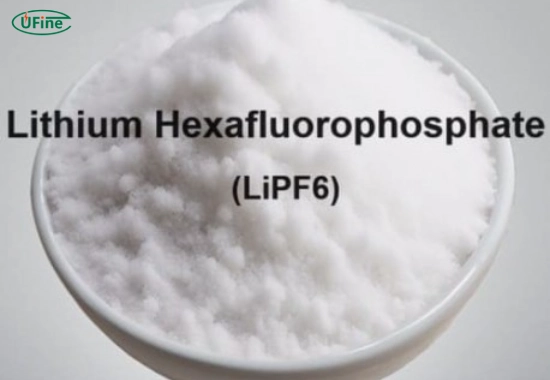
Once dissolved, LiPF6 dissociates into:
- Li⁺ (lithium ions) → active charge carriers
- PF₆⁻ (hexafluorophosphate ions) → stabilizing counter ions
These lithium ions move between the cathode and anode during charge and discharge cycles, enabling energy storage.
Why lifp6 works well in batteries
- High ionic conductivity (~10 mS/cm in carbonate electrolytes)
- Compatible with graphite anodes and high-voltage cathodes
- Supports stable solid-electrolyte interphase (SEI) formation
Learn more about electrolyte systems in our guide
Part 2. Why lifp6 dominates lithium-ion batteries
LiPF6 remains the industry standard because it balances performance, cost, and manufacturability better than alternatives.
1. High Ionic Conductivity
LiPF6 enables fast lithium-ion transport, supporting high power output in EVs and fast-charging devices.
2. Stable SEI Layer Formation
During the first cycles, LiPF6 helps form a protective solid electrolyte interphase (SEI) on graphite anodes. This layer prevents continuous electrolyte decomposition and improves cycle life.
3. High Voltage Compatibility
LiPF6 works efficiently in the 3–4.5V range, making it suitable for:
- NMC (Nickel Manganese Cobalt) cathodes
- LCO (Lithium Cobalt Oxide) systems
Key Limitation
Despite its performance, LiPF6 is highly sensitive to moisture and heat. At elevated temperatures, it can decompose and generate HF (hydrofluoric acid), which is hazardous and corrosive.
Part 3. Limitations of lifp6 electrolytes
Although widely used, LiPF6 has several technical drawbacks:
- Thermal instability above ~60°C
- Moisture sensitivity (requires ultra-dry manufacturing)
- HF formation risk during decomposition
- Safety and handling challenges in production
These limitations drive research into alternative electrolyte salts and hybrid systems.
Part 4. Alternative electrolyte salts and their trade-offs
Researchers are actively developing substitutes for LiPF6, but each has performance constraints.
LiTFSI (Lithium bis(trifluoromethanesulfonyl)imide)
- High thermal stability
- Poor compatibility with aluminum current collectors
LiBOB (Lithium bis(oxalate)borate)
- Good SEI formation
- Lower solubility → reduced conductivity
LiDFOB
- Improved thermal stability
- Higher cost and limited large-scale adoption
👉 Conclusion: LiPF6 remains dominant because no alternative currently matches its overall cost-performance balance.
Part 5. Sodium chloride (nacl) in sodium-ion battery electrolytes
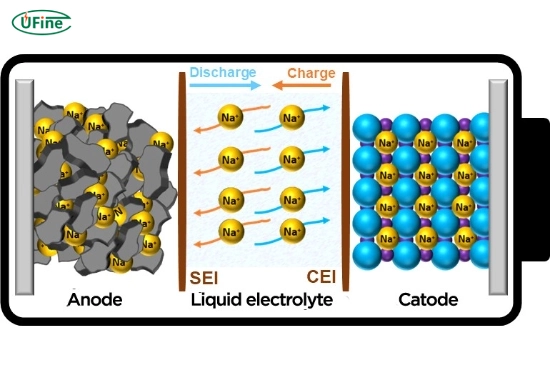
Sodium chloride (NaCl), commonly known as table salt, is gaining attention in sodium-ion battery research, particularly for aqueous electrolyte systems.
In water-based electrolytes, NaCl dissociates into:
- Na⁺ (sodium ions)
- Cl⁻ (chloride ions)
These ions support reversible electrochemical reactions in sodium-ion battery systems.
Advantages of nacl-based electrolytes
- Extremely low cost and abundant supply
- Safer, non-flammable aqueous chemistry
- Environmentally friendly and easy to source
Key limitations
- Lower energy density than lithium-ion systems
- Narrow voltage window (~2V due to water stability limits)
- Slower ion diffusion compared to Li⁺
Part 6. Lifp6 vs nacl: engineering comparison
| Parameter | LiPF6 (Lithium-ion) | NaCl (Sodium-ion) |
|---|---|---|
| Ionic conductivity | ~10 mS/cm | ~1–2 mS/cm |
| Voltage window | 3–4.5V | ~1.5–2.5V |
| Energy density | 250–300 Wh/kg | 100–150 Wh/kg |
| Safety | Flammable electrolyte system | Aqueous, non-flammable |
| Raw material cost | High | Extremely low |
| Commercial maturity | Fully commercialized | Early-stage / pilot |
Part 7. Application scenarios of lifp6 and nacl battery electrolytes
LiPF6-Based Lithium-Ion Batteries
- Electric vehicles (EVs)
- Consumer electronics
- Aerospace systems
- High-performance energy storage
NaCl-Based Sodium-Ion Systems
- Grid energy storage
- Renewable energy buffering (solar/wind)
- Stationary backup power systems
- Low-cost industrial storage
Part 8. Innovations in lifp6 and nacl battery electrolytes
LiPF6 Electrolyte Improvements
- Additives like FEC improve SEI stability
- Water scavengers reduce HF formation
- Solid-state hybrid electrolytes improve safety
NaCl System Enhancements
- Water-in-salt electrolytes expand voltage window
- Hybrid NaCl + NaFSI systems improve cycle life
- Polymer-based confinement improves stability
Part 9. Future outlook: beyond lifp6 and nacl
The future of battery electrolytes is moving toward:
- Solid-state electrolytes
- Hybrid lithium-sodium systems
- Safer, low-toxicity chemistries
- Reduced reliance on fluorinated compounds
These developments aim to balance energy density, safety, and sustainability across applications.
Part 10. FAQs on lifp6 and nacl battery electrolytes
What is lithium hexafluorophosphate (LiPF6) used for?
LiPF6 is the primary electrolyte salt in lithium-ion batteries, enabling lithium-ion transport between electrodes.
Why is LiPF₆ widely used in batteries?
It offers high ionic conductivity, stable SEI formation, and good compatibility with high-voltage cathodes.
Is NaCl used in lithium-ion batteries?
No. NaCl is mainly used in sodium-ion battery research and aqueous electrolyte systems, not lithium-ion batteries.
What are the main disadvantages of NaCl batteries?
They have lower energy density and limited voltage range compared to lithium-ion batteries.
Will sodium-ion batteries replace lithium-ion batteries?
Not fully. Sodium-ion systems are expected to complement lithium-ion batteries, especially in grid storage applications.
Related Tags:

More Articles

The Ultimate Guide to Battery Posts and Battery Terminals
Learn battery post and battery terminal types, identify positive and negative terminals, clean corrosion, and maintain reliable battery connections safely.
18650 High Drain Battery: A Comprehensive Guide
Learn how an 18650 high drain battery works, its discharge ratings, applications, safety tips, and how to choose the right high drain 18650 battery.
How to Choose the Right Battery for Blower?
Choosing the right blower battery? Learn voltage, Ah, battery type, and compatibility to pick the best battery for leaf blower performance and runtime.
A gravity battery stores electricity using gravitational energy. Learn how it works, key components, benefits, applications, and real-world projects.
The Battery Terminal Blues: Understanding Corrosion and How to Fix It
Tired of a sluggish car? Battery terminal corrosion can be the culprit. Learn what causes it, how to identify it, and simple steps to prevent and fix this common problem.


