
- Key Takeaways
- Part 1. Learn about lithium battery charging
- Part 2. Lithium-ion battery charging methods
- Part 3. Advanced charging modes (when cc‑cv isn’t enough)
- Part 4. Lithium ion battery charging circuit design essentials
- Part 5. Charging different lithium chemistries
- Part 6. Battery charging safety tips
- Part 7. Common charging mistakes and how to avoid them
- Part 8. FAQs
Key Takeaways
- Charging method matters — it directly affects battery life, performance, and safety.
- CC‑CV (constant current + constant voltage) is the industry standard for lithium battery charging.
- Different lithium chemistries (Li‑ion, LiFePO4, LiPo) have unique charging requirements.
- A good charging circuit balances speed, efficiency, and battery health.
Whether you’re a hardware engineer designing battery management systems, a product developer optimizing battery life, or simply someone curious about lithium battery charging, this deep dive will give you a practical roadmap — from basic principles to circuit design, common modes, safety tips, and advanced techniques.
Let’s start with the foundational question:
Part 1. Learn about lithium battery charging
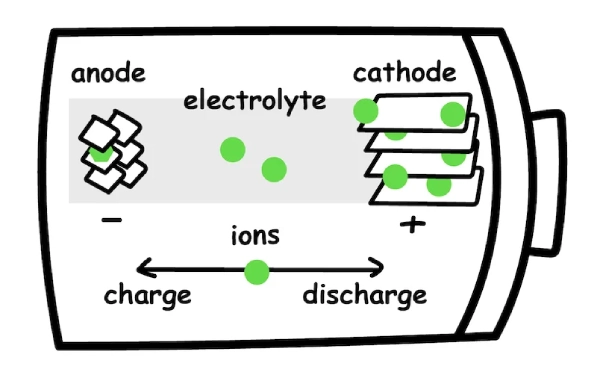
Before we explore different modes, let’s agree on some basic principles of lithium ion battery charging.
voltage and current are not the same
In battery charging, we deal primarily with:
- voltage (V): the electrical potential pushing current into the cell.
- current (A): the rate at which electrons flow into the battery.
You can think of voltage like the pressure of a water hose, and current like the flow rate of water.
Too high voltage is dangerous. Too low current may make charging painfully slow. The sweet spot depends on your battery’s chemistry and design.
typical charging voltages
Different lithium chemistries have different optimal voltages:
- Li‑ion (common 18650 cells): ~4.2 V per cell
- High voltage Li‑ion: ~4.35 V per cell
- LiFePO4: ~3.65 V per cell
Using incorrect voltages not only reduces capacity but can seriously damage cells.
Although lithium batteries have the advantages of high capacity and long life, they require special attention when charging and discharging. All rechargeable lithium batteries must be equipped with a “charge and discharge management IC” to limit the charging and discharging voltage to ensure that the safe voltage is not exceeded and the battery explodes. When the battery voltage is lower than 2.5V, the output is cut off to avoid shortening the battery life.
In addition to over-discharge, lithium batteries are not suitable for high-current discharge. The high current discharge will reduce the discharge time. Therefore, lithium battery manufacturers should regulate the maximum discharge current of this product. It should be less than the maximum discharge current during use.
Lithium batteries have very high requirements for charging quality. A sophisticated charging circuit is required to ensure charging safety.
In particular, the accuracy of the termination voltage is required to be within 1% of the rated value (for example, for charging a 4.2V lithium-ion battery, the tolerance is ±0.042V). Overvoltage charging may cause permanent damage to lithium batteries or even cause the battery to explode.
The charging current of a lithium battery should be selected according to the specifications of the lithium battery manufacturer.
In addition, not all lithium battery charging uses constant current charging; it also uses constant voltage mode charging. So, the actual charging time is about 2.5 hours. The charging temperature of a lithium battery is in the range of 0℃~60℃. If the charging current is too high, the temperature will be too high, which will damage the battery and cause an explosion. Therefore, when charging with a high current, the battery’s temperature needs to be detected. To ensure safety, it can stop charging when the set charging temperature is exceeded.
In addition, the lithium battery charger circuit has a set current limiting resistor. This ensures that the charging current does not exceed the set limit current.
Part 2. Lithium-ion battery charging methods
At present, lithium battery chargers often use the three-stage charging method. Namely Pre-Charging Mode, Fast Charging Mode, and Constant Voltage Mode. The terminal discharge voltage of lithium-ion batteries is 2.5V.
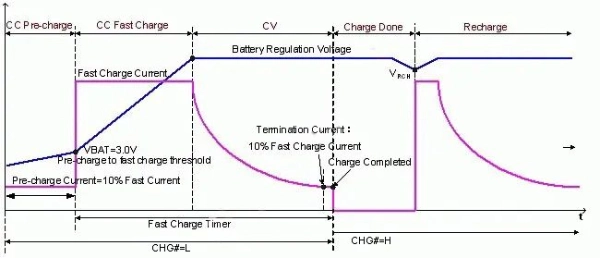
1. Pre-Charging Mode
A well-designed lithium battery charger can rescue and repair over-discharged batteries. That is, preprocessing is performed before formal charging.
Check the battery voltage before charging: if the battery voltage is greater than 3V, charge as normal. Suppose the battery voltage is lower than 3V. In that case, it is charged with a small current (about 10% Pre-Charging Mode), called Pre-Charging Mode, so that the passivation film dissolved in a deep discharge state can be restored.
In addition, when the battery is over-discharged, part of the copper metal may be released and cause a short circuit at the anode. At this time, forced charging with a high current will cause the battery to overheat. Pre-Charging Mode can avoid this phenomenon. After charging to 3V, press Fast Charging Mode to charge.
2. Fast Charging Mode
When the battery voltage exceeds 3V, charge according to Fast Charging Mode (as shown in the figure, taking a 4.2V lithium battery as an example). Just start charging in the Fast Charging Mode. At this time, the battery voltage rises at a faster slope.
As battery power storage increases, the battery voltage rise slope gradually decreases. When it rises to close to 4.2V, Fast Charging Mode ends. The charger changes to 4.2 V Constant Voltage Mode for charging.
In Constant Voltage Mode, the voltage is almost unchanged, but the charging current decreases. The timer is activated when the charging current drops to a certain value. After counting time expires, the charging ends, and the charging process is completed.
3. Constant Voltage Mode
Constant Voltage Mode’s output voltage regulation accuracy is important for maximizing lithium battery capacity and extending battery life.
When the battery voltage regulation is lower than 4.2V, the battery may be undercharged. Although it does not affect the life of the battery, it does reduce the battery capacity. For example, as long as insufficient charging reaches 1% of the total voltage, the battery storage capacity will be reduced by 8%.
On the other hand, if the battery voltage regulation is too high, it will cause the battery to be overcharged, shorten its service life, and even cause danger.
To ensure the safety of lithium battery charging, the ambient temperature when starting charging must be between 0°C and 45°C. Charging at lower temperatures results in the formation of more metallic lithium, which can lead to increased battery impedance and degradation. Charging in a high-temperature environment will increase the reaction between lithium ions and electrolytes and accelerate battery degradation.
Here’s a simplified sketch of how current and voltage change:
| Stage | Behavior | Purpose |
|---|---|---|
| CC | Voltage ↑, Current fixed | Quick energy delivery |
| CV | Voltage fixed, Current ↓ | Safely top off without stress |
This gradual tapering helps protect the battery and maximize usable capacity.
To better understand how voltage and current behave during charging, you can check our lithium battery discharge and charging curve guide for detailed charts and explanations.
Part 3. Advanced charging modes (when cc‑cv isn’t enough)
Now let’s talk about some less common but sometimes useful modes:
pulse charging
Instead of a smooth constant current, some systems deliver short bursts of charge followed by rest intervals.
Pulse charging can:
- reduce polarization
- increase efficiency
- slightly improve charge acceptance
However, it’s not a magic bullet. Pulse schemes need careful tuning, and most consumer lithium systems stick with CC‑CV.
trickle charging? not really
With older chemistries like NiMH, trickle charging (tiny current after full charge) can top up batteries safely. But for lithium batteries, trickle is generally not recommended. Lithium cells don’t like being held at full charge with small currents — it accelerates aging.
fast charging (higher c‑rates)
If you want to charge a battery faster, you might raise the charging current — e.g., from 0.5C to 1C or even 2C.
- C‑rate refers to charging current relative to capacity (e.g., 1C into a 2000 mAh cell means 2 A).
- Fast charging is great — if the cell and system can handle it.
But be careful: higher currents generate more heat and stress the battery. Not all lithium cells support aggressive fast charging.
This is where battery management systems (BMS) pay off — they monitor temperature, voltage, and current to make fast charging safe.
If you’re curious about speeding up charging safely, see our fast charging technology and BMS overview for practical tips and design considerations.
Part 4. Lithium ion battery charging circuit design essentials
Concepts are great — but you need hardware that implements them.
A typical charging circuit has:
- Charging controller/IC
- Protection IC / BMS
- Passive components (resistors, capacitors)
- Power path (input port, USB, adapter, etc.)
common charging IC examples
Here are some ICs you’ll often encounter in lithium charging designs:
| IC | Typical Use | Strength |
|---|---|---|
| TP4056 | Single‑cell Li‑ion USB charging | Simple, low cost |
| MCP73831 | Microcontroller‑friendly charging | Compact |
| BQ24072 | Power path + charging | Good for systems that run while charging |
These chips implement CC‑CV internally, handle charge termination, and often integrate safety features.
Note: Always check datasheets. Charging currents, voltage tolerances, and safety thresholds vary by part and by battery chemistry.
Part 5. Charging different lithium chemistries
Not all “lithium” batteries are created equal.
| Chemistry | Nominal voltage | Recommended charging | Notes |
|---|---|---|---|
| Lithium‑ion (Li‑ion) | ~3.6 V | CC‑CV to 4.2 V | Most common |
| Lithium polymer (LiPo) | ~3.7 V | CC‑CV to 4.2 V | Flexible form factors |
| Lithium iron phosphate (LiFePO4) | ~3.2 V | CC‑CV to 3.65 V | Very stable, safer |
For example, charging a LiFePO4 cell to 4.2 V — like you would a typical Li‑ion cell — can seriously damage it. So there’s no universal “lithium” charge profile — you must tailor your circuit and software.
Part 6. Battery charging safety tips
Even with good theory and circuits, safety comes first.
Here are essential practices:
- temperature monitoring: cells charge poorly or dangerously when too hot or too cold
- over‑charge protection: no cell should exceed its maximum voltage
- over‑current protection: limits prevent excessive currents during faults
- short‑circuit protection: essential for real‑world applications
A good rule of thumb is: if your system doesn’t monitor both voltage and temperature, it’s probably not safe for unattended charging.
Part 7. Common charging mistakes and how to avoid them
Even seasoned engineers slip here — so let’s break down frequent missteps:
- Using the wrong charger: A charger designed for lead‑acid or NiMH simply won’t cut it for lithium cells.
- Ignoring temperature: Charging at freezing temperatures or above safe limits causes irreversible damage.
- Skipping a proper BMS: It’s tempting to save cost — but in most battery systems, a BMS isn’t optional.
- Fast charging without validation: Just because a cell supports 1C, doesn’t mean your system should automatically use it.
When you address these, you boost product reliability and end‑user trust.
Part 8. FAQs
Should lithium batteries be charged 100%?
It is generally recommended not to charge lithium batteries to 100% capacity regularly for prolonged storage as it may increase stress on the battery. Partial charging between 20-80% is often advised for optimal battery lifespan.
Can I use an ordinary charger to charge lithium batteries?
Using an ordinary charger to charge lithium batteries is not recommended, as they require specific charging protocols to ensure safety and maximize battery life.
How long does it take to charge a lithium battery?
The charging time for lithium batteries varies depending on the battery capacity, charger output, and charging method used.
How to charge lithium batteries in winter?
It is important to keep lithium batteries at a moderate temperature range during charging in winter. Avoid charging in extremely cold conditions, as it can affect battery performance. If possible, charge batteries indoors at room temperature or use a charger with temperature compensation.
Related Tags:

More Articles

LiPo Battery Bulging? Here’s What You Must Know
Discover why lithium polymer batteries swell, the hidden risks, and simple ways you can prevent it from damaging your devices.
Sodium-Ion Battery Explained: Better Than Lithium?
What is a sodium-ion battery and how is it made? Learn benefits, costs, and real-world uses compared to lithium-ion technology.
LiFePO4 Prismatic Cells Comparison: Top Manufacturers & Best Use Cases (2026)
Compare LiFePO4 prismatic cells from top manufacturers. Explore specs, cycle life, and best use cases for EV and energy storage systems.
What is the KC Certification of Lithium Battery?
Understand KC certification for lithium batteries, including requirements, testing process, kc battery compliance, and how it compares with CE and UL.
The Ultimate Guide to Lithium-Air Battery
Learn lithium air battery working principle, pros, cons, and applications. A practical guide to Li air battery technology and future use.


