- Part 1. What does a 3000mAh battery really mean?
- Part 2. Converting 3000mAh to Watts
- Part 3. Rechargeable 3000mAh batteries
- Part 4. Non-Rechargeable 3000mAh batteries
- Part 5. Runtime calculations: How long does a 3000mAh battery really last?
- Part 6. How to calculate 3000mAh battery runtime
- Part 7. How long does a 3000mAh battery take to charge?
- Part 8. What factors affect 3000mAh battery life?
- Part 9. Is 3000mAh right for your device?
- Part 10. 7 Critical battery selection factors
- Part 11. FAQs
A 3000mAh battery is one of the most common capacities used in portable electronic devices, including smartphones, wearable devices, medical equipment, GPS trackers, and IoT products. However, many people ask the same question: how long does a 3000mAh battery last?
The answer depends on the device’s power consumption, battery voltage, efficiency, and usage conditions. A 3000mAh battery can last only a few hours in a high-power device but may run for weeks or even months in a low-power application.
To estimate the actual runtime of a 3000 mah battery, you need to understand how battery capacity works and how much current your device consumes.
Key takeaways
- A 3000mAh battery does not have a fixed runtime. The actual battery life depends on device power consumption.
- A simple calculation method is: battery capacity (mAh) ÷ device current consumption (mA) = estimated runtime.
- A 3000mAh lithium battery can provide several hours of power for smartphones and much longer operation for low-power IoT devices.
- Charging time depends on charger output, charging efficiency, battery chemistry, and charging management systems.
- The same 3000mAh capacity can have different performance depending on battery type, voltage, and design.
- Custom 3000mAh lithium batteries can be optimized for specific device sizes, power requirements, and applications.
Part 1. What does a 3000mAh battery really mean?
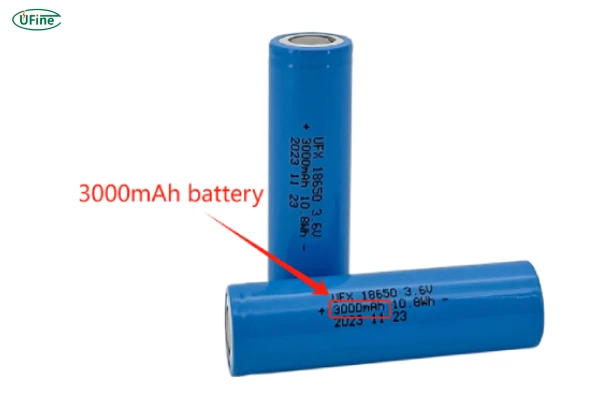
When we talk about a 3000mAh battery, we’re referring to its energy storage capacity. But what does this number actually mean in real-world usage?
-
mAh (milliampere-hour) measures how much charge a battery can deliver over time.
-
A 3000mAh battery can theoretically supply 3000mA for 1 hour, 1500mA for 2 hours, or 500mA for 6 hours.
However, real-world performance depends on factors like:
✔ Battery chemistry (Li-ion vs. LiPo vs. LiFePO4)
✔ Discharge rate (higher drain = shorter runtime)
✔ Temperature conditions (cold reduces efficiency)
Part 2. Converting 3000mAh to Watts
Many consumers confuse mAh (capacity) with watts (power). Here’s how they relate:
-
Watt-hours (Wh) = Voltage (V) × Amp-hours (Ah)
-
Most 3000mAh lithium batteries operate at 3.7V (standard for Li-ion/LiPo)
-
Calculation: 3.7V × 3.0Ah = 11.1Wh
Why This Matters:
-
Devices are often rated in watts, not mAh.
-
A 3000mAh battery can theoretically power an 11.1W device for 1 hour.
-
For solar applications, knowing watt-hours helps size battery banks correctly.
Conversion of Watt Hour to Amp Hour (Wh to Ah)
Part 3. Rechargeable 3000mAh batteries
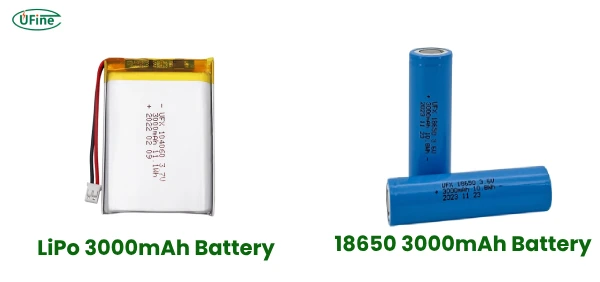
Not all 3000mAh rechargeable batteries are created equal. Let’s break down the three main lithium chemistries and their performance characteristics:
A. Lithium-Ion (Li-ion) – The Standard Choice
✔ Voltage: 3.6V – 3.7V nominal
✔ Energy Density: 200-265 Wh/kg
✔ Cycle Life: 500-1,000 cycles (to 80% capacity)
✔ Best For: Smartphones, laptops, power tools
B. Lithium Polymer (LiPo) – Flexible & Lightweight
✔ Voltage: 3.7V nominal
✔ Energy Density: 250-300 Wh/kg
✔ Cycle Life: 300-500 cycles
✔ Best For: Drones, RC vehicles, wearable devices
C. Lithium Iron Phosphate (LiFePO4) – The Safe Long-Laster
✔ Voltage: 3.2V nominal
✔ Energy Density: 90-120 Wh/kg
✔ Cycle Life: 2,000-5,000 cycles
✔ Best For: Solar storage, medical devices, EVs
Critical Parameters Beyond Capacity:
-
Peak Discharge Current (e.g., 10C = 30A for 3000mAh)
-
Continuous Discharge Rating (sustained current without overheating)
-
Charge Temperature Range (0°C to 45°C for most Li-ion)
-
Discharge Temperature Range (-20°C to 60°C for premium cells)
-
Internal Resistance (lower = more efficient)
-
Self-Discharge Rate (3-5% per month for quality cells)
-
Protection Circuit (essential for safety in consumer devices)
Why Choose Ufine Battery?
As a leading custom lithium battery manufacturer, we produce:
-
High-rate 3000mAh batteries for drones and power tools
-
Ultra-thin 3000mAh LiPo cells for sleek wearable designs
-
High-temperature 3000mAh variants for industrial applications
Primary Battery Vs. Rechargeable Lithium Battery
Part 4. Non-Rechargeable 3000mAh batteries
While rare, some applications require non-rechargeable 3000mAh batteries:
Primary Lithium Types:
-
Lithium Thionyl Chloride (Li-SOCl₂)
✔ Voltage: 3.6V
✔ Shelf Life: 10-15 years
✔ Best For: IoT sensors, emergency beacons -
Lithium Manganese Dioxide (Li-MnO₂)
✔ Voltage: 3.0V
✔ Shelf Life: 7-10 years
✔ Best For: Digital cameras, medical implants
Key Parameters for Disposables:
-
Operating Voltage Curve (how voltage drops over time)
-
Pulse Current Capability (critical for GPS trackers)
-
Storage Temperature Range (-55°C to 85°C for military-grade)
-
Weight & Size Constraints
-
Safety Certifications (UN38.3, UL)
-
Cost Per Watt-Hour
-
Environmental Impact (recycling considerations)
Part 5. Runtime calculations: How long does a 3000mAh battery really last?
A 3000mAh battery life in hours depends mainly on the device’s power requirements. There is no single answer to how long a 3000mAh battery can last because different devices consume different amounts of energy.
The basic formula is:
Battery runtime (hours) = Battery capacity (mAh) ÷ Device current consumption (mA)
For example:
If a device uses 500mA:
3000mAh ÷ 500mA = 6 hours
The actual runtime may be around 5–6 hours after considering efficiency losses.
Here are some typical examples:
| Application | Approximate power consumption | Expected runtime |
|---|---|---|
| Smartwatch | 20–100mA | 1–6 days |
| Bluetooth headset | 30–80mA | 1–4 days |
| GPS tracker | 50–200mA | 15–60 hours |
| Portable medical device | 100–500mA | 6–30 hours |
| Smartphone | 500–1500mA | 2–6 hours of heavy use |
Part 6. How to calculate 3000mAh battery runtime
To estimate the runtime of a 3000 mah battery, you need two key specifications:
- Battery capacity (mAh)
- Device operating current (mA)
The calculation is straightforward:
Runtime = Capacity ÷ Current
For example:
A wireless sensor uses 50mA continuously.
3000mAh ÷ 50mA = 60 hours
In a real application, the runtime may be lower because the battery rarely operates at 100% efficiency.
Several factors can affect the result:
Battery efficiency
Electronic devices often use voltage regulators to convert battery voltage into usable power. These circuits consume some energy during conversion.
Operating conditions
Temperature, charging cycles, and discharge speed can influence available capacity. Lithium batteries usually perform best under moderate temperature conditions.
Battery protection systems
Lithium batteries often include protection circuits to prevent overcharging, over-discharging, and excessive current draw. These safety systems also affect usable capacity.
Use our online calculator to estimate battery runtime:
Part 7. How long does a 3000mAh battery take to charge?
The 3000mAh battery charging time depends on the charger output, charging efficiency, battery chemistry, and the device’s charging management system.
A simple estimation formula is:
Charging time (hours) = Battery capacity (mAh) ÷ Charger current (mA) × 1.2
The additional 1.2 factor accounts for charging losses and the slower charging speed during the final stage of lithium battery charging.
For example, charging a 3000mAh battery:
Charger outputEstimated charging time500mA chargerAbout 6–7 hours1A chargerAbout 3–4 hours2A chargerAbout 1.5–2 hours
However, the actual charging time may vary because lithium batteries usually use a constant current–constant voltage (CC-CV) charging method. During the final charging stage, the current gradually decreases to protect the battery and improve safety.
Factors that affect charging speed include:
- Charger power output
- Charging IC design
- Battery temperature
- Battery age and health
- Battery management system (BMS) performance
Using a charger that matches the battery specifications is important. An unsuitable charging solution can reduce battery lifespan or create safety risks.
Part 8. What factors affect 3000mAh battery life?
Although capacity is an important factor, a battery’s actual performance depends on many other conditions.
Device power consumption
The biggest factor affecting how long does a 3000 mah battery last is the device’s energy demand.
A device with:
- High-performance processors
- Bright displays
- GPS functions
- Wireless communication modules
will consume more power and drain the battery faster.
A low-power sensor, on the other hand, may operate for much longer using the same 3000mAh capacity.
Battery chemistry
Different lithium battery chemistries provide different characteristics.
Common 3000mAh battery options include:
| Battery type | Main advantages | Common applications |
|---|---|---|
| Lithium polymer (LiPo) | Thin, lightweight, flexible shapes | Wearables, medical devices, portable electronics |
| Lithium-ion (Li-ion) | High energy density and mature technology | Consumer electronics, power devices |
| LiFePO4 | Long cycle life and excellent safety | Industrial equipment, energy storage |
For compact products where space is limited, lithium polymer batteries are often preferred because manufacturers can customize the shape and thickness according to the device design.
Battery temperature
Temperature has a significant impact on lithium battery performance.
Extreme cold can temporarily reduce available capacity, while excessive heat may accelerate battery aging.
For reliable operation, battery design should consider the device’s working environment, especially for outdoor, medical, and industrial applications.
Battery aging and cycle life
A new 3000mAh battery will not always provide the same capacity after hundreds of charge cycles.
Over time:
- Internal resistance increases
- Available capacity decreases
- Runtime becomes shorter
High-quality battery cells and proper charging management can help extend battery lifespan.
Part 9. Is 3000mAh right for your device?
Use this step-by-step evaluation:
-
Measure Your Device’s:
-
Average current draw (in mA)
-
Peak current requirements
-
Operating voltage range
-
-
Consider Usage Patterns:
-
Daily runtime requirements
-
Recharging opportunities
-
Environmental conditions
-
-
Physical Constraints:
-
Available space for battery
-
Weight limitations
-
Shape requirements (cylindrical vs. pouch)
-
When to Consider Custom Solutions:
-
Need unusual dimensions? Ufine offers ultra-thin batteries down to 4mm thickness.
-
Require extreme temperature performance? Our high-temperature series operates up to 85°C.
-
Need higher discharge rates? We manufacture 20C+ 3000mAh batteries for racing drones.
Part 10. 7 Critical battery selection factors
-
Voltage Compatibility
-
Mismatched voltage can damage devices
-
Some systems need precise voltage curves
-
-
Discharge Rate (C-Rating)
-
Standard devices: 1C (3A for 3000mAh)
-
Power tools: 10C-30C required
-
-
Cycle Life Expectations
-
Consumer electronics: 500 cycles acceptable
-
Industrial applications: 2000+ cycles needed
-
-
Temperature Resilience
-
Standard range: 0°C to 45°C
-
Industrial grade: -40°C to 85°C
-
-
Safety Mechanisms
-
Built-in PCM/PCB protection
-
Venting mechanisms for pressure relief
-
-
Physical Form Factor
-
18650 cylindrical (standard)
-
Pouch cells (custom shapes available)
-
-
Regulatory Compliance
-
CE, UL, UN38.3 certifications
-
Transportation regulations
-
Part 11. FAQs
Can I replace my 2500 mAh battery with a 3000 mAh one?
Yes — as long as voltage and size match, you’ll just get longer runtime.
Does a higher mAh battery charge slower?
Not necessarily. Charging time depends more on your charger’s output and the battery’s internal design.
Why is my 3000 mAh battery draining so fast?
It could be battery age, high background power consumption, or environmental conditions like heat.
Can Ufine Battery build a special battery pack for my project?
Absolutely! Ufine Battery specializes in custom lithium battery solutions, including packs for drones, medical devices, industrial sensors, and much more.
How can I safely store my spare 3000 mAh lithium battery?
Store it at about 40–60% charge in a cool, dry place. Avoid extreme temperatures!
Related Tags:

More Articles

How to Choose the Right Electric Fence Battery?
Learn how to choose the best electric fence battery by voltage, chemistry, Ah capacity, runtime, solar charging, maintenance, and safety.
PS4 Controller Battery: Everything You Need to Know
Learn everything about PS4 controller battery type, size, lifespan, features, replacement, and care. Play longer with the right battery!
The Ultimate Guide to Charging 24V Lithium Battery
Learn how to charge a 24V lithium battery safely. Compare 29.2V LiFePO4 and 29.4V Li-ion chargers, charging current, solar methods, and safety tips.
Battery Bags: Essential Safety Guide for Lithium Batteries
Discover the best fireproof battery bags for safe storage & travel. Prevent lithium battery fires with expert tips & top-rated picks. Essential read!
Understanding 1.2 V NiMH Battery: Key Insights
Understand 1.2V NiMH battery voltage, charging voltage, discharge behavior, and key differences between NiMH and other rechargeable batteries.