- Key takeaways
- Part 1. What is a lithium battery?
- Part 2. Why battery weight matters
- Part 3. What affects lithium battery weight?
- Part 4. Lithium battery weight chart by size
- Part 5. Lithium-ion battery size chart: common cells and packs
- Part 6. Lithium battery weight vs lead-acid battery weight
- Part 7. How much does a car battery weigh?
- Part 8. Why are lithium batteries lighter?
- Part 9. Lithium battery weight by application
- Part 10. Do lithium batteries lose weight over time?
- Part 11. How to choose the right lithium battery weight
- Part 12. Air travel and lithium battery weight
- Part 13. FAQs about lithium battery weight
How much does a lithium battery weigh? It depends on size, voltage, capacity, and chemistry. A small coin cell may weigh only a few grams, while a 12V 100Ah lithium battery typically weighs 25 to 30 lbs, and a 48V 100Ah pack can reach 85 to 110 lbs.
Lithium batteries are lighter than lead-acid batteries with the same usable energy, thanks to higher energy density. This makes them widely used in RVs, solar systems, electric vehicles, and portable devices. For more details, see our guide on lithium battery weight vs energy density.
Key takeaways
- A 12V 100Ah lithium battery usually weighs about 25 to 30 lbs, or 11 to 14 kg.
- A similar 12V 100Ah lead-acid battery often weighs around 60 to 70 lbs.
- Battery weight increases with capacity, voltage, casing strength, BMS design, and discharge rate.
- LiFePO4 batteries are slightly heavier than some NMC lithium batteries, but they offer better thermal stability and long cycle life.
- For engineering selection, compare weight together with energy density, C-rate, dimensions, cycle life, and safety certification.
Part 1. What is a lithium battery?
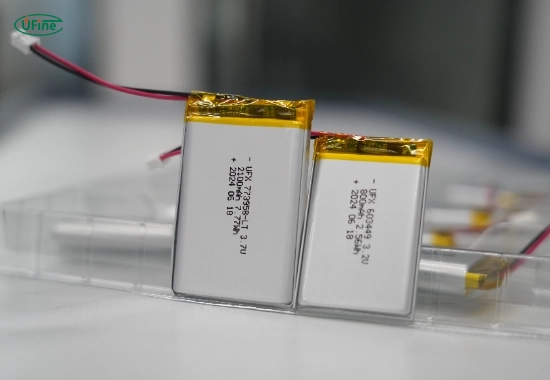
A lithium battery is a rechargeable battery that stores and releases energy through lithium ions. These ions move between the positive and negative electrodes during charging and discharging.
Lithium batteries are known for high energy density, long cycle life, low self-discharge, and lighter weight. They are used in mobile phones, laptops, power tools, smart devices, medical equipment, RVs, boats, solar systems, and electric vehicles.
Common lithium battery chemistries include:
- LiFePO4: Safer and more stable, often used in RVs, solar storage, marine batteries, and industrial packs.
- NMC: Higher energy density, often used in electric vehicles, drones, and compact battery packs.
- LCO: Common in phones, tablets, and small consumer electronics.
- LTO: Long cycle life and fast charging, but lower energy density and higher cost.
Each chemistry has a different weight-to-energy ratio. This is why two lithium batteries with the same voltage and capacity may not have the same weight.
Part 2. Why battery weight matters
Battery weight affects more than portability. In B2B projects, it can influence the whole product design.
Vehicle efficiency
In RVs, marine systems, golf carts, electric bikes, AGVs, and electric vehicles, every extra pound affects range, handling, and energy use. A lighter lithium battery can reduce vehicle load and improve system efficiency.
Installation and maintenance
Large lead-acid batteries may need two people or lifting tools. Lithium batteries with the same usable energy are often easier to move, install, and replace.
Shipping and system cost
Battery weight affects freight cost, packaging, pallet layout, and export planning. For international buyers, lower weight can help reduce total landed cost.
Mechanical design
For portable devices, robots, drones, and medical equipment, weight affects product size, balance, grip, and user comfort. This is why lithium battery dimensions and weight must be checked together.
Part 3. What affects lithium battery weight?
1. Battery Capacity
Capacity (Ah) directly affects weight. Higher capacity means more cells and materials, so the battery is heavier.
Example: 12V 50Ah ≈ 11–15 lbs; 12V 100Ah ≈ 25–30 lbs; 12V 200Ah ≈ 45–60 lbs.
2. Battery Voltage
Higher voltage requires more cells in series. With the same Ah, higher voltage means more total energy and more weight.
Example: A 48V 100Ah battery stores about 4× the energy of a 12V 100Ah battery, so it is much heavier.
3. Battery Chemistry
Chemistry affects energy density. NMC batteries are lighter for the same energy. LiFePO4 batteries are slightly heavier but offer better safety and longer life.
Learn more: lithium-ion battery energy density.
4. Casing and Structure
Metal cases are stronger but heavier. Plastic cases are lighter. Pouch cells are the lightest and used in compact designs.
5. Battery Management System (BMS)
The BMS adds weight. Larger batteries need stronger boards, wires, and connectors.
6. Discharge Rate
High-discharge batteries are heavier due to stronger internal design and heat management.
Example: A 12V 100Ah 1C battery ≈ 25 lbs; a 3C version may reach 28–30 lbs.
Part 4. Lithium battery weight chart by size
The table below gives common lithium battery weight ranges. Actual values vary by brand, chemistry, casing, BMS, terminals, and certification requirements.
| Battery Size | Voltage | Typical Energy | Average Weight | Weight in kg | Common Applications |
|---|---|---|---|---|---|
| 10Ah | 12V | About 128Wh | 2.2 to 3.5 lbs | 1 to 1.6 kg | Small backup power, lighting, portable devices |
| 20Ah | 12V | About 256Wh | 4.4 to 5.5 lbs | 2 to 2.5 kg | Fish finders, small solar systems, mobility devices |
| 50Ah | 12V | About 640Wh | 11 to 15 lbs | 5 to 6.8 kg | Trolling motors, RV backup, portable power |
| 100Ah | 12V | About 1,280Wh | 25 to 30 lbs | 11.3 to 13.6 kg | RVs, marine, solar storage, camper vans |
| 200Ah | 12V | About 2,560Wh | 45 to 60 lbs | 20.4 to 27.2 kg | Off-grid power, large RVs, backup systems |
| 100Ah | 24V | About 2,560Wh | 40 to 48 lbs | 18 to 22 kg | Solar systems, carts, industrial equipment |
| 100Ah | 48V | About 5,120Wh | 85 to 110 lbs | 38 to 50 kg | ESS, telecom backup, AGVs, golf carts |
Part 5. Lithium-ion battery size chart: common cells and packs
When people search for lithium battery weight, they may mean small cells, cylindrical cells, pouch cells, or large battery packs. The table below gives a simple lithium-ion battery size chart for common formats.
| Battery Type | Typical Size | Average Weight | Notes |
|---|---|---|---|
| AA lithium battery | 14.5 × 50.5 mm | About 15 g | Used in cameras, sensors, meters, and consumer devices |
| 18650 lithium-ion cell | 18 × 65 mm | About 45 to 50 g | Common in laptops, e-bikes, tools, and battery packs |
| 21700 lithium-ion cell | 21 × 70 mm | About 65 to 75 g | Higher capacity than 18650 cells |
| Small pouch lithium battery | Custom size | A few grams to 100 g+ | Used in wearables, smart devices, medical devices, and IoT products |
| 12V 100Ah LiFePO4 battery | Varies by case | 25 to 30 lbs | Used in RV, marine, solar, and backup systems |
Part 6. Lithium battery weight vs lead-acid battery weight
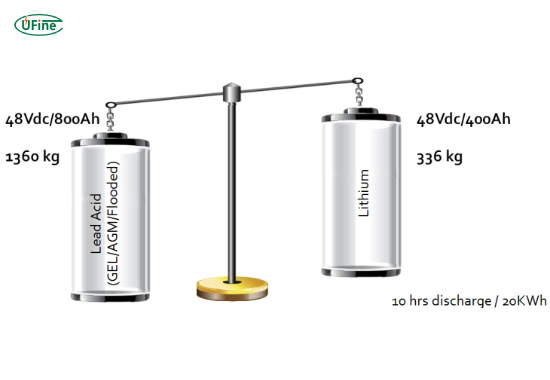
Lithium batteries are much lighter than lead-acid batteries with similar usable energy. Lead-acid batteries use heavy lead plates and liquid electrolyte. Lithium batteries use lighter active materials and have higher energy density.
| Battery Capacity | Lithium Battery Weight | Lead-Acid Battery Weight | Typical Weight Saving |
|---|---|---|---|
| 12V 50Ah | 11 to 15 lbs | 30 to 40 lbs | About 50% to 65% |
| 12V 100Ah | 25 to 30 lbs | 60 to 70 lbs | About 50% to 60% |
| 12V 200Ah | 45 to 60 lbs | 115 to 130 lbs | About 50% to 65% |
This weight difference is one reason lithium batteries are popular in RVs, boats, solar systems, and mobile equipment. The U.S. Department of Energy also notes that lead-acid batteries have much lower volumetric energy density than lithium-ion batteries, which helps explain why lead-acid packs are larger and heavier for similar energy storage.
Part 7. How much does a car battery weigh?
A standard lead-acid car battery usually weighs about 30 to 50 lbs. Larger automotive batteries can be heavier. The average car battery weight depends on battery group size, cold cranking amps, reserve capacity, and construction.
When people ask “how much does a car battery weigh,” they often mean a traditional 12V starter battery. These batteries are different from lithium deep-cycle batteries. A lead-acid starter battery is built for short bursts of high current. A lithium deep-cycle battery is built for repeated charge and discharge.
| Automotive Battery Type | Average Weight | Main Use |
|---|---|---|
| Small lead-acid car battery | 25 to 35 lbs | Compact cars |
| Average lead-acid car battery | 30 to 50 lbs | Most passenger vehicles |
| Large lead-acid automotive battery | 50 to 70 lbs | Trucks, SUVs, commercial vehicles |
| Lithium automotive battery | 10 to 25 lbs | Performance vehicles, racing, lightweight applications |
If you are replacing an automotive battery, do not choose by weight alone. Check voltage, battery group size, terminal layout, cold cranking amps, charging compatibility, and vehicle requirements.
Part 8. Why are lithium batteries lighter?
Lithium batteries are lighter because they store more energy per unit of weight. This is called specific energy, usually measured in Wh/kg. They also store more energy per unit of volume, known as volumetric energy density.
In simple terms, lithium technology can deliver the same usable energy with less material. This helps reduce battery size and weight. It also gives product designers more space for other components.
However, lighter is not always better. A very light battery may have lower capacity, thinner casing, weaker terminals, or lower discharge capability. For industrial use, the best choice is a balance of weight, safety, power, cycle life, and cost.
Part 9. Lithium battery weight by application
RVs and camper vans
Most RV users choose 12V 100Ah or 12V 200Ah LiFePO4 batteries. A 12V 100Ah lithium battery weighs about 25 to 30 lbs. A 12V 200Ah model may weigh 45 to 60 lbs. This is much lighter than using lead-acid batteries with similar usable capacity.
Marine and trolling motors
Marine users care about weight because it affects boat balance and runtime. A 12V 50Ah lithium battery may be light enough to carry by hand. Larger 24V and 36V lithium battery systems are common for trolling motors and marine power systems.
Solar energy storage
Solar battery systems often use 12V, 24V, or 48V lithium packs. A 48V 100Ah lithium battery may weigh 85 to 110 lbs, but it can still replace a much heavier lead-acid bank. For fixed solar systems, weight matters less than cycle life, safety, and installation design.
Electric vehicles and mobility
In electric vehicles, scooters, e-bikes, wheelchairs, and AGVs, battery weight directly affects range and payload. NMC batteries may be used when high energy density is needed. LiFePO4 batteries may be used when safety and long cycle life are more important.
Portable electronics and IoT devices
Small lithium pouch batteries can weigh only a few grams. They are common in smart rings, GPS trackers, Bluetooth devices, medical sensors, and handheld electronics. In these products, even a small weight change can affect comfort and product design.
Part 10. Do lithium batteries lose weight over time?
No. A lithium battery does not normally lose physical weight as it ages. The battery may lose capacity after many cycles, but the materials inside the battery remain inside the cell or pack.
If a battery looks swollen, damaged, leaking, or deformed, stop using it. Swelling does not mean the battery has lost weight. It may indicate internal gas generation or cell damage. The battery should be inspected or replaced by a qualified professional.
Part 11. How to choose the right lithium battery weight
For engineering projects, battery selection should not start with weight alone. Use weight as one part of the full selection process.
| Selection Factor | Why It Matters | What to Check |
|---|---|---|
| Capacity | Decides runtime | Ah and Wh rating |
| Voltage | Must match the system | 12V, 24V, 36V, 48V, or custom voltage |
| Weight | Affects handling, shipping, and product design | kg, lbs, and mounting limits |
| Dimensions | Must fit the battery compartment | Length, width, height, cable exit, connector position |
| C-rate | Controls power output | Continuous and peak discharge current |
| Chemistry | Affects safety, energy density, and cycle life | LiFePO4, NMC, LCO, LTO |
| Certification | Important for transport and compliance | UN38.3, IEC62133, CE, UL where required |
Part 12. Air travel and lithium battery weight
For air travel, watt-hours are more important than weight. The FAA states that rechargeable lithium-ion batteries are generally limited to 100Wh per battery for passenger travel. With airline approval, passengers may carry up to two larger spare lithium-ion batteries rated 101Wh to 160Wh.
This means most large lithium batteries, such as 12V 100Ah batteries, are not allowed as normal passenger baggage. Buyers should also check IATA guidance and local airline rules before shipping or carrying lithium batteries by air. IATA publishes lithium battery guidance for air transport, including battery handling and documentation requirements.
Part 13. FAQs about lithium battery weight
How much does a lithium battery weigh?
It ranges from a few grams to over 100 lbs. Small cells weigh under 10 g, 18650 cells about 45–50 g, and a 12V 100Ah battery about 25–30 lbs.
How much does a 100Ah lithium battery weigh?
A 12V 100Ah lithium battery typically weighs 25–30 lbs (11–14 kg), depending on design and components.
How much does a car battery weigh?
Most lead-acid car batteries weigh 30–50 lbs. Smaller ones are lighter, while larger truck batteries can reach 70 lbs. Lithium versions are lighter.
How much does an AA lithium battery weigh?
About 15 g on average, depending on brand and design.
How much does an 18650 battery weigh?
Typically 45–50 g, with slight variation based on capacity and build.
Related Tags:

More Articles

Dead Battery or Device Failure? How to Find the Cause
Think your device is broken? Learn how to tell if the problem comes from battery aging or hardware failure before replacing your electronics.
Why iPhone Duo Uses Two Batteries: The Engineering Behind Foldable Phone Power
Why do foldable phones need two batteries? Explore the engineering challenges behind iPhone Duo’s dual-battery architecture and future battery trends.
Solid-State Batteries: 3 Myths You Need to Know
Solid-state batteries promise safer EVs and longer range, but the reality is more complex. Discover the challenges behind this next-gen technology.
Battery Capacity vs Discharge Rate: The Choice Engineers Face
Higher capacity or higher discharge rate? Learn how to choose the right LiPo battery for longer runtime, stable power output, and better device performance.
Battery Cable Size Guide: Choose the Right Wire Fast
Not sure what battery cable size you need? Learn how to select the right wire gauge, terminal size, and cable for safer, more efficient battery systems.