- Part 1. What is a 100ah lithium battery
- Part 2. How much energy does a 100ah lithium battery store
- Part 3. How long will a 100ah lithium battery last
- Part 4. Factors that affect battery runtime
- Part 5. 12v vs 24v vs 100ah lithium battery systems
- Part 6. Depth of discharge and usable capacity
- Part 7. Cycle life and long-term value
- Part 8. 100ah lithium battery in solar system
- Part 9. How long to charge a 100Ah lithium battery?
- Part 10. How to choose a 100ah lithium battery
- Part 11. 100ah lithium battery price factors
- Part 12. FAQs
Key takeaways
- A 100Ah lithium battery stores energy based on voltage (Wh = V × Ah), not Ah alone
- A 12V 100Ah battery provides about 1.2kWh usable energy
- Real runtime depends on your load (watts), not just capacity
- Lithium batteries offer 80–95% usable capacity vs ~50% for lead-acid
- A 100Ah LiFePO4 battery typically lasts 2000–6000 cycles
- 24V systems double runtime compared to 12V at the same Ah rating
Part 1. What is a 100ah lithium battery
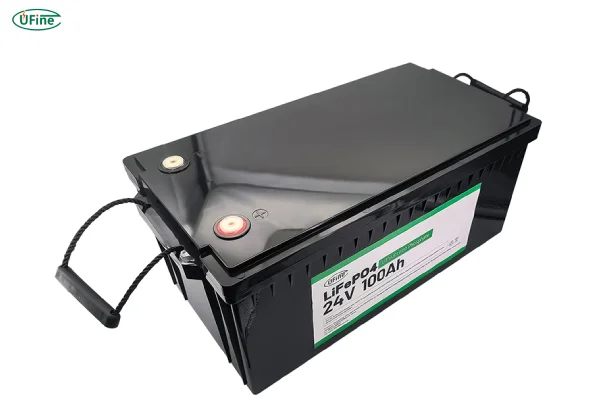
A 100Ah lithium battery means the battery can deliver 100 amp-hours of current under specific conditions.
In simple terms, it represents energy storage capacity, not runtime directly.
Most modern 100Ah lithium batteries use LiFePO4 chemistry, which offers:
- Higher safety
- Longer lifespan
- More stable voltage output
- Higher usable capacity than lead-acid batteries
When you use a lithium battery, you get nearly full capacity without damaging the battery, unlike traditional lead-acid systems.
Lithium vs lead acid 100ah comparison
| Feature | Lithium (LiFePO4) | Lead-acid |
|---|---|---|
| Usable capacity | 90–95% | ~50% |
| Cycle life | 2000–6000 | 300–500 |
| Weight | Light | Heavy |
| Efficiency | High | Low |
| Maintenance | None | Required |
For a deeper technical comparison, see lead acid vs lithium batteries to understand why lithium performs better in real applications.
Part 2. How much energy does a 100ah lithium battery store

To understand real usage, you must convert Ah into watt-hours (Wh):
Wh=V×AhWh = V \times AhWh=V×Ah
Example:
- 12V 100Ah = 1200Wh (1.2kWh)
- 24V 100Ah = 2400Wh (2.4kWh)
However, lithium batteries allow deeper discharge, so usable energy is typically:
- LiFePO4 usable: 90–95%
- Lead-acid usable: ~50%
This means a 100Ah lithium battery gives you almost double the real energy usage compared to lead-acid.
Part 3. How long will a 100ah lithium battery last
Battery runtime depends on your load (watts), not just capacity.
\text{Runtime} = \frac{V \times Ah}{Load(W)}}
Real-world examples (12V 100Ah lithium battery)
| Device load | Estimated runtime |
|---|---|
| 100W light load | 10–12 hours |
| 300W appliances | 3–4 hours |
| 500W devices | ~2 hours |
| 1000W inverter load | ~1 hour |
So when you ask “how long will a 100Ah battery last”, the real answer is:
It depends entirely on how many watts you are using.
Estimate battery runtime using our online calculator:
Part 4. Factors that affect battery runtime
Several factors can influence the runtime of a 100Ah lithium battery, including:
- Load: The amount of current drawn from the battery directly impacts its runtime. For example, if you’re using high-power appliances, the battery will drain faster.
- Temperature: Extreme cold or heat can reduce the battery’s performance. Lithium batteries operate best in moderate temperatures.
- Depth of Discharge (DoD): This refers to how much of the battery’s capacity is used. A 100Ah lithium battery should ideally only be discharged to about 80% to maintain its lifespan.
- Battery Health: Over time, batteries naturally degrade. Regular maintenance and proper charging practices can help extend their lifespan.
- Charging Cycle: A battery’s lifespan is determined by the number of charge-discharge cycles it undergoes. The more cycles, the shorter the battery’s life.
How Temperature Affects Battery?
Part 5. 12v vs 24v vs 100ah lithium battery systems
Voltage plays a major role in runtime and efficiency.
| System | Energy (Wh) | Efficiency | Best use case |
|---|---|---|---|
| 12V 100Ah | 1200Wh | Simple, lower efficiency | RV, small setups |
| 24V 100Ah | 2400Wh | Better efficiency | Solar systems, medium load |
| 48V system | Higher scalability | Highest efficiency | Home energy storage |
A 24V system will generally last about 2x longer than a 12V system with the same Ah rating.
Part 6. Depth of discharge and usable capacity
One of the biggest advantages of lithium batteries is depth of discharge (DoD).
- LiFePO4 battery: 80–100% usable capacity
- Lead-acid battery: recommended 50% usable capacity
This means:
A 100Ah lithium battery can deliver almost its full rated energy safely.
This is why lithium batteries are widely used in solar and backup power systems.
To better understand how discharge levels affect battery lifespan, you can learn more about battery DoD and cycle life impact.
Part 7. Cycle life and long-term value
A high-quality 100Ah LiFePO4 battery typically offers:
- 2000–6000 cycles
- 8–15 years lifespan (depending on usage)
Compared to:
- Lead-acid: 300–500 cycles
This makes lithium batteries significantly more cost-effective over time, even if the upfront price is higher.
Part 8. 100ah lithium battery in solar system
A 100Ah lithium battery is commonly used in off-grid solar systems.
Typical setup:
- Solar panel → charge controller → battery → inverter → load
Common applications:
- RV and camper systems
- Home backup power
- Solar street systems
- Small off-grid cabins
If you pair it with solar panels, charging time depends on input current:
- 20A charger → ~5 hours
- 50A charger → ~2 hours
Maximum load and inverter sizing
A 100Ah battery does not define power directly—it defines energy storage.
However, in practical systems:
- 12V 100Ah → ~1000W–1500W usable inverter range
- 24V 100Ah → ~2000W+ stable systems
Always match:
- Battery capacity
- Inverter rating
- Cable thickness
- BMS current limit
Part 9. How long to charge a 100Ah lithium battery?
Charging time for a 100Ah lithium battery depends on the charger used and the current provided to the battery. Generally, lithium batteries charge faster than lead-acid batteries. For example:
- Using a 20-amp charger, it would take about 5-6 hours to charge a 100Ah lithium battery from 0% to 100%.
- With a 40-amp charger, this time could be cut in half to about 2-3 hours.
Keep in mind that charging times may vary depending on the battery’s state of charge and environmental conditions.
Part 10. How to choose a 100ah lithium battery
When selecting a 100Ah lithium battery, consider:
- Battery chemistry (LiFePO4 preferred)
- BMS protection quality
- Cycle life rating
- Temperature range
- Certifications (UN38.3, CE)
- Brand reliability vs OEM sourcing
These factors directly impact safety and lifespan.
Part 11. 100ah lithium battery price factors
The price of a 100Ah lithium battery varies depending on:
- Cell grade (A-grade vs lower grade cells)
- Built-in BMS quality
- Voltage configuration (12V vs 24V systems)
- Certifications and compliance
- Shipping and import costs (varies by country, e.g., South Africa)
Higher quality batteries may cost more upfront but offer much lower long-term cost per cycle.
Part 12. FAQs
1. What is the weight of a 100Ah lithium battery?
A typical 100Ah LiFePO4 battery weighs around 10–14 kg, much lighter than lead-acid batteries of similar capacity, which can exceed 25–30 kg.
2. Can I charge a 100Ah lithium battery with a generator?
Yes. You can charge it using a compatible lithium charger connected to a generator, as long as the output voltage and current are stable.
3. How fast can a 100Ah lithium battery discharge safely?
It depends on the BMS rating, but most high-quality batteries support 1C discharge, meaning up to 100A continuous safely.
4. Does temperature affect 100Ah lithium battery performance?
Yes. Cold temperatures reduce efficiency and charging ability, while high heat can reduce long-term cycle life.
5. Can I use a 100Ah lithium battery in parallel with older batteries?
It is not recommended to mix old and new batteries because differences in internal resistance can cause imbalance and reduced performance.
Related Tags:

More Articles
Lithium vs Lithium Salt: What’s the Difference?
Learn the difference between lithium and lithium salts, their battery applications, common types, safety considerations, and roles in lithium-ion batteries.
How to Build LiFePO4 Battery Pack: Easy Steps and Expert Tips
Want to build a DIY LiFePO4 battery? Learn the exact steps, tools, BMS selection, wiring tips, and mistakes to avoid in this complete guide.
How Many Volts Is a AAA Battery? Full Guide + Chart
Learn AAA battery voltage, normal range, full charge level, and dead voltage with a clear chart explaining different battery types.
Confused about 18350 batteries? Learn the size, capacity, charger options, and key differences between 18350 vs 18650 before you buy.
The Ultimate Guide to 18650 Battery Holders
Discover 18650 battery holders: types, series vs parallel, applications, safety tips, and how to choose the right holder for electronics and DIY projects.