
- Part 1. How much lithium is on Earth?
- Part 2. Global lithium reserves by country
- Part 3. Where lithium can be found
- Part 4. The lithium industry chain
- Part 5. How long will lithium reserves last?
- Part 6. Environmental impact of lithium mining
- Part 7. Common myths about lithium reserves
- Part 8. Why lithium reserves matter for battery buyers
- Part 9. FAQs
Lithium has quietly become one of the most strategic materials on Earth.
Every time you charge your phone, drive an EV, store solar power, or scale an energy storage system, lithium is somewhere in that story. That is exactly why people keep asking questions like:
How much lithium is on Earth?
Which country has the most lithium?
Will lithium reserves run out?
Where does lithium actually come from?
According to the 2026 U.S. Geological Survey (USGS), global lithium reserves are now estimated at 37 million metric tons, while total identified lithium resources are around 150 million metric tons. That difference matters a lot, and we’ll explain why. Australia leads the world in reserves, while Chile, Argentina, and China remain critical players in both reserves and production.
So no, lithium is not about to “run out.”
However, supply chains, mining capacity, refining bottlenecks, and geopolitics are where the real challenges begin.
Let’s break it all down.
Key takeaways
- Global lithium reserves reached 37 million metric tons in 2026, while total identified resources are about 150 million tons, according to USGS.
- Australia currently holds the largest reported reserves at 68.4 million tons of ore-equivalent reserve reporting standards, while Chile remains one of the most important brine-based lithium regions.
- Lithium reserves are different from lithium resources—this is one of the most misunderstood topics in the battery industry.
- The “Lithium Triangle” in South America remains one of the world’s most important lithium source regions.
- Lithium is extracted mainly from brine, hard rock (spodumene), and clay deposits
- The bigger challenge is not whether lithium exists, but whether it can be mined, refined, and recycled fast enough to meet EV demand
Part 1. How much lithium is on Earth?
resources and reserves.
They are not the same thing.
Lithium resources vs lithium reserves
Resources mean the total known amount of lithium that exists in the ground—whether or not it is economical to extract today.
Reserves mean the portion that can be economically mined using current technology, current prices, and current regulations.
Think of it like this:
You may own land with gold underground. That’s a resource.
But only the gold you can actually profitably mine right now counts as a reserve.
That distinction changes everything.
In 2026, USGS reports:
| Category | Global estimate |
|---|---|
| Lithium reserves | 37 million metric tons |
| Lithium resources | 150 million metric tons |
This is why headlines claiming “the world only has X years of lithium left” are often misleading.
They usually confuse reserves with total resources.
And resources continue to grow as exploration improves.
In fact, new discoveries in the U.S. Appalachians announced by USGS in April 2026 added an estimated 2.3 million metric tons of economically recoverable lithium, enough to replace 328 years of U.S. lithium imports at last year’s level.
That alone tells you something important:
Lithium scarcity is often more of a supply-chain issue than a geology issue.
Part 2. Global lithium reserves by country
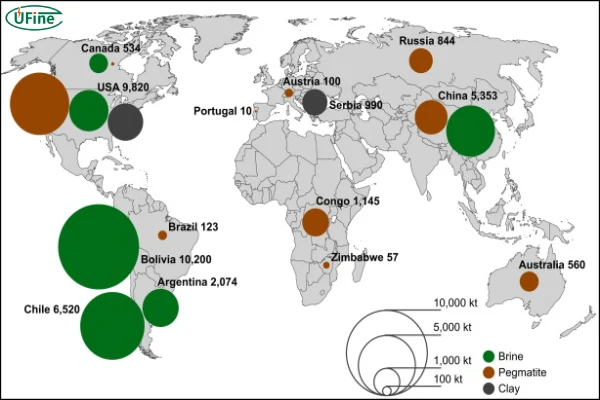
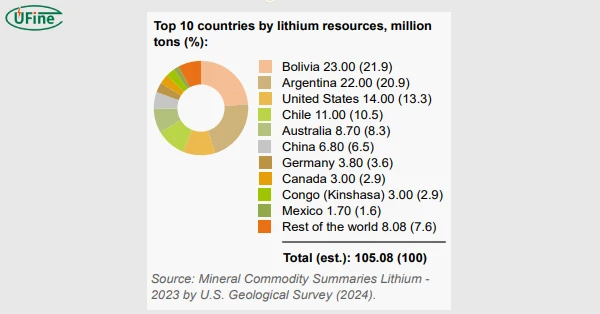
Lithium reserves are geographically concentrated, with significant resources in salt flats and hard rock deposits. According to the U.S. Geological Survey (USGS), global lithium reserves total approximately 89 million tons.
Key Resource-Holding Countries
- Bolivia: The leader in lithium reserves (21 million tons), particularly in the vast Uyuni Salt Flats.
- Argentina and Chile: Together with Bolivia, these countries form the “Lithium Triangle,” responsible for a significant portion of global production.
- Australia: A powerhouse in hard rock lithium mining, particularly spodumene.
- China: A major producer and innovator in lithium extraction technologies.
Not all countries hold lithium equally.
Some dominate reserves. Others dominate mining. And those are often not the same countries.
That distinction matters if you work in battery sourcing, EV manufacturing, or OEM procurement.
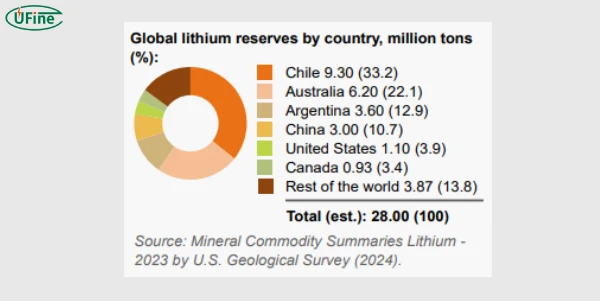
Here’s the latest reserve snapshot from USGS 2026:
| Country | Lithium reserves (metric tons) |
|---|---|
| Australia | 68,400,000 |
| Chile | 9,200,000 |
| China | 4,600,000 |
| Argentina | 4,400,000 |
| United States | 4,400,000 |
| Canada | 1,600,000 |
| Brazil | 540,000 |
| Zimbabwe | 500,000 |
Australia dominates largely because of hard-rock spodumene mining, while Chile and Argentina rely heavily on brine extraction from salt flats.
China is especially powerful not only because of domestic reserves, but because it controls a large share of global lithium refining.
That is often the bigger strategic advantage.
What is the Lithium Triangle?
If you follow lithium reserves at all, you’ll hear this phrase constantly:
The Lithium Triangle
It refers to the high-altitude salt flat region shared by:
- Chile
- Argentina
- Bolivia
This region contains some of the world’s richest lithium brine deposits, especially in salt lakes like Salar de Atacama and Salar de Uyuni.
Why here?
Because these regions combine:
high lithium concentration, intense sunlight, and extremely dry conditions—perfect for brine evaporation.
That makes extraction cheaper than many hard-rock operations.
Chile has historically been the strongest commercial success story, while Bolivia has enormous theoretical resources but much slower industrial development.
So when people ask where lithium can be found, South America is one of the first places experts look.
Part 3. Where lithium can be found
Lithium does not come from one single source.
In fact, there are several major lithium sources around the world, and each comes with different costs, environmental trade-offs, and supply risks.
The three main commercial sources are:
Brine deposits
This is lithium dissolved in underground saltwater beneath arid salt flats.
It is pumped to the surface and concentrated through evaporation ponds.
Common in:
Chile, Argentina, Bolivia, and parts of China
Hard rock deposits
Usually mined from spodumene ore in pegmatite rock.
This is faster to bring online but often more energy-intensive.
Common in:
Australia, Canada, Zimbabwe, and parts of the U.S.
Clay and unconventional deposits
These include claystone, geothermal brines, and oilfield brines.
They are promising but still developing commercially.
Examples include:
Nevada, Arkansas, and geothermal projects in California
USGS also notes lithium sources from oilfield brines and geothermal brines, which may become increasingly important for cleaner domestic supply chains.
Lithium production is not the same as reserves
This is one of the biggest misunderstandings in the industry.
A country can have huge lithium reserves and still produce very little lithium.
Bolivia is the classic example.
On the other hand, Australia leads global production because its mining infrastructure is already mature.
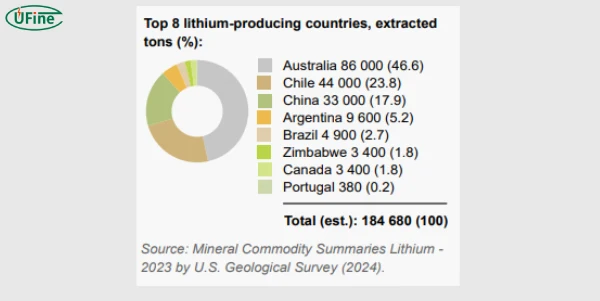
According to USGS 2026:
- Australia produced about 92,000 metric tons
- China produced about 62,000 metric tons
- Chile produced about 56,000 metric tons
- Argentina produced about 23,000 metric tons
So reserves tell you long-term potential.
Production tells you who is supplying batteries right now.
For battery manufacturers, production often matters more than reserves.
Because factories cannot wait for “future potential.”
They need supply today.
Part 4. The lithium industry chain
The lithium industry is a multi-tiered chain comprising exploration, processing, and application. Let’s break it down:
Upstream: Lithium Extraction
Lithium is extracted from two primary sources:
- Salt Lake Brines: These are vast salt flats rich in lithium-containing brines, where lithium is separated through evaporation processes. The largest reserves are found in South America’s “Lithium Triangle” (Bolivia, Argentina, and Chile).
- Hard Rock Deposits: Spodumene, a lithium-rich mineral, is mined and processed into lithium concentrates. Australia leads the world in this type of extraction.
Midstream: Lithium Processing
Once extracted, raw lithium undergoes processing to create lithium salts such as lithium carbonate, lithium hydroxide, and lithium chloride. These are further refined to meet the high purity requirements for specific uses:
- Battery-grade lithium: Used in the production of cathodes for lithium-ion batteries.
- Industrial-grade lithium: Used in glass, ceramics, and lubricants.
Downstream: Applications of Lithium
Processed lithium finds its way into a wide array of industries, the most prominent being:
- Energy Storage: Lithium-ion batteries dominate EVs, grid energy storage, and portable electronics.
- Aerospace and Defense: Lightweight lithium alloys reduce aircraft weight, improving fuel efficiency.
- Medical: Lithium compounds are used in psychiatric treatments and other pharmaceutical applications.
Part 5. How long will lithium reserves last?
This is probably the highest-click question—and also the most emotionally loaded one.
People worry:
“If everyone buys EVs, will lithium run out?”
The answer is no, but supply pressure is real.
USGS projected in 2025 that global lithium production capacity is expected to double by 2029, driven by battery demand from EVs and grid storage.
That’s significant.
It means the industry is scaling fast, but demand is scaling even faster.
Several factors determine how long lithium reserves will last:
First, EV adoption rates.
Second, battery chemistry shifts like LFP and sodium-ion.
Third, recycling efficiency.
Fourth, how quickly new mines can actually get permits and start production.
This is why experts rarely ask “Will lithium run out?”
Instead, they ask:
“Can supply ramp fast enough without causing price shocks?”
That is the real question.
And if you’ve ever watched lithium prices swing wildly, you already know the answer is complicated.
Part 6. Environmental impact of lithium mining
Lithium is critical for clean energy, but mining it is not impact-free.
Brine extraction can consume large amounts of water, especially in already dry regions like northern Chile.
Hard-rock mining uses more energy and creates a larger direct mining footprint.
That creates tension between climate goals and local environmental concerns.
In places like the Atacama Desert, water management has become one of the biggest debates around lithium extraction.
This matters because sustainable battery supply is not just about quantity.
It is also about social license.
If communities reject projects, reserves on paper do not become supply in reality.
Balanced content matters here, because serious buyers and engineers know this issue cannot be ignored.
Can lithium be recycled?
Yes—and this may be the most important long-term answer of all.
Lithium is not like oil.
It does not disappear after use.
Battery materials can be recovered and reused.
Today, large-scale recycling is still growing, but the economics improve dramatically as more EV batteries reach end-of-life.
That creates a second supply stream.
Instead of relying only on mining, the industry can increasingly rely on:
- recovered lithium
- nickel and cobalt recovery
- second-life battery systems
- black mass processing
This is why many experts believe recycling will be one of the biggest supply stabilizers of the next decade.
And honestly, it has to be.
Because the cleanest lithium is often the lithium you do not need to mine twice.
Part 7. Common myths about lithium reserves
Let’s clear up a few myths quickly.
Myth 1: Lithium is extremely rare
Actually, lithium is relatively abundant in Earth’s crust.
The problem is not rarity.
The problem is economically viable extraction.
Myth 2: EV batteries permanently consume lithium
Not true.
Lithium can be recovered and recycled, especially as recycling systems mature.
Myth 3: China owns all the lithium
China is powerful in refining, but not necessarily because it has the most reserves.
Its strategic strength is processing capacity.
Myth 4: We will run out of lithium soon
Current evidence does not support that.
Supply constraints are real, but global resources continue to expand with exploration and new extraction technologies.
Part 8. Why lithium reserves matter for battery buyers
If you run an OEM battery business, this topic is not just academic.
It affects pricing, sourcing, lead times, and long-term procurement strategy.
When lithium prices spike, battery costs move fast.
That impacts:
ESS projects, golf carts, marine batteries, RV systems, telecom backup, and EV battery packs.
Understanding lithium reserves helps you think beyond today’s quote sheet.
It helps you ask better questions:
Where is the supply coming from?
Is refining capacity stable?
How exposed is your supplier to geopolitical risk?
For serious battery buyers, those questions matter more than marketing claims.
And frankly, that is where most sourcing mistakes happen.
Not in the battery specs.
But upstream.
Part 9. FAQs
Is lithium considered a rare earth metal?
No, lithium is not a rare earth metal. It is an alkali metal in the periodic table. Although people often group it with critical minerals because of its importance in batteries, it is chemically different from rare earth elements like neodymium or lanthanum.
Why is lithium so important for electric vehicles?
Lithium is essential because it helps batteries store a large amount of energy while keeping weight relatively low. This makes lithium-ion batteries ideal for EVs, portable electronics, and large-scale energy storage systems where efficiency and energy density matter.
Can seawater be a future source of lithium?
Yes, seawater contains a massive amount of dissolved lithium, but extraction is currently too expensive for large-scale commercial use. Researchers are developing new technologies to make seawater lithium extraction more practical in the future.
Which type of lithium extraction is cheaper?
Brine extraction is often cheaper than hard-rock mining because it uses solar evaporation rather than intensive crushing and chemical processing. However, it also takes more time and depends heavily on local climate conditions.
Does sodium-ion battery technology reduce lithium demand?
Potentially, yes. Sodium-ion batteries may reduce dependence on lithium for certain applications like low-cost EVs and stationary storage. However, lithium-ion batteries still dominate high-performance applications, so lithium demand remains strong.
Related Tags:

More Articles
Dead Battery or Device Failure? How to Find the Cause
Think your device is broken? Learn how to tell if the problem comes from battery aging or hardware failure before replacing your electronics.
Why iPhone Duo Uses Two Batteries: The Engineering Behind Foldable Phone Power
Why do foldable phones need two batteries? Explore the engineering challenges behind iPhone Duo’s dual-battery architecture and future battery trends.
Solid-State Batteries: 3 Myths You Need to Know
Solid-state batteries promise safer EVs and longer range, but the reality is more complex. Discover the challenges behind this next-gen technology.
Battery Capacity vs Discharge Rate: The Choice Engineers Face
Higher capacity or higher discharge rate? Learn how to choose the right LiPo battery for longer runtime, stable power output, and better device performance.
Battery Cable Size Guide: Choose the Right Wire Fast
Not sure what battery cable size you need? Learn how to select the right wire gauge, terminal size, and cable for safer, more efficient battery systems.


