
- Key Takeaways
- Part 1. What is a supercapacitor?
- Part 2. What is a lithium-ion battery?
- Part 3. Supercapacitor vs lithium-ion battery: Key differences
- Part 4. Supercapacitor vs lithium-ion battery: Typical applications
- Part 5. Hybrid systems: Using supercapacitors with batteries
- Part 6. Supercapacitor vs lithium ion battery: FAQs
Supercapacitors and lithium-ion batteries are two common energy storage technologies. The main difference lies in energy density vs power density.
In a typical supercapacitor vs lithium ion battery comparison, lithium-ion batteries store far more energy, while supercapacitors deliver power much faster and support millions of cycles.
Because of these differences, batteries are used for long-duration energy storage, while supercapacitors are used for high-power bursts and rapid charging systems.
Key Takeaways
- Lithium-ion batteries provide much higher energy density, making them suitable for long-duration energy storage such as electric vehicles and portable devices.
- Supercapacitors deliver extremely high power density, enabling rapid charge and discharge within seconds.
- Supercapacitors can withstand millions of cycles, while lithium-ion batteries typically last 500–1500 cycles depending on chemistry and usage.
- Supercapacitors work well in extreme temperatures, while lithium batteries usually require thermal management systems.
- In many systems, supercapacitors and batteries are used together to combine high energy storage with high power output.
Part 1. What is a supercapacitor?
A supercapacitor (also called an ultracapacitor or electric double-layer capacitor) is an energy storage device that stores electrical energy through electrostatic charge separation rather than chemical reactions.
Because the storage process is physical rather than electrochemical, supercapacitors can charge and discharge extremely quickly and tolerate far more cycles than conventional batteries.
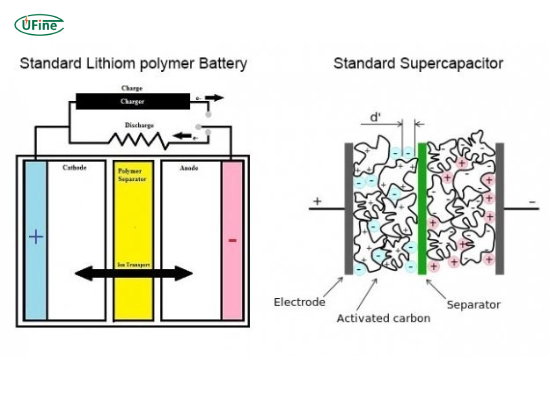
1 How supercapacitors work
A supercapacitor typically contains:
- Two conductive electrodes
- An electrolyte
- A separator between the electrodes
When voltage is applied, ions in the electrolyte move toward the electrode surfaces. This creates an electric double layer, where energy is stored as an electrostatic field.
Because this process does not rely on slow chemical reactions, supercapacitors can deliver very high power output within milliseconds.
2 Advantages of supercapacitors
- Extremely Fast Charging
Supercapacitors can charge within seconds or minutes, making them ideal for systems that require rapid energy storage. - Very High Cycle Life
Most supercapacitors support 500,000 to over 1 million charge cycles, far exceeding typical batteries. - High Power Density
Supercapacitors can release energy very quickly, which is useful for short bursts of high power. - Wide Temperature Range
They can operate reliably from approximately -40°C to +65°C, depending on design.
3 Disadvantages of supercapacitors
- Lower Energy Density
A major limitation is the low energy density of supercapacitors, typically around 5–10 Wh/kg, far below lithium-ion batteries. - Higher Cost per Stored Energy
Although durable, supercapacitors can have a higher cost per watt-hour compared with batteries.
Part 2. What is a lithium-ion battery?
A lithium-ion battery stores energy using electrochemical reactions that move lithium ions between two electrodes during charging and discharging.
This technology offers one of the highest energy densities among commercial rechargeable batteries, which explains its widespread use in electronics and electric vehicles.
For example, many portable devices and EV packs rely on lithium-ion battery chemistries such as NMC, NCA, or LiFePO4.
If you want a deeper explanation of lithium battery chemistry, see:
What are Lithium Polymer Batteries?
1 How lithium-ion batteries work
Lithium-ion batteries consist of:
- Cathode (often lithium metal oxide)
- Anode (usually graphite)
- Electrolyte that allows ion transport
During discharge:
- Lithium ions move from the anode to the cathode
- Electrons flow through the external circuit to power the device
During charging, the process reverses.
2 Advantages of lithium-ion batteries
- High Energy Density
Lithium-ion batteries typically reach 150–250 Wh/kg, which is far higher than supercapacitors. - Long Runtime
This high energy density allows devices to run for hours or days on a single charge. - Low Self-Discharge
Lithium batteries lose only about 2–3% of charge per month, which helps with long-term storage.
3 Disadvantages of lithium-ion batteries
- Slower Charging
Charging typically requires tens of minutes to several hours, depending on battery size and charger power. - Limited Cycle Life
Most lithium-ion batteries last 500–1500 cycles before noticeable capacity loss. - Thermal Management Required
Improper charging or high temperatures can lead to thermal runaway, which is why battery management systems (BMS) are required.
Part 3. Supercapacitor vs lithium-ion battery: Key differences
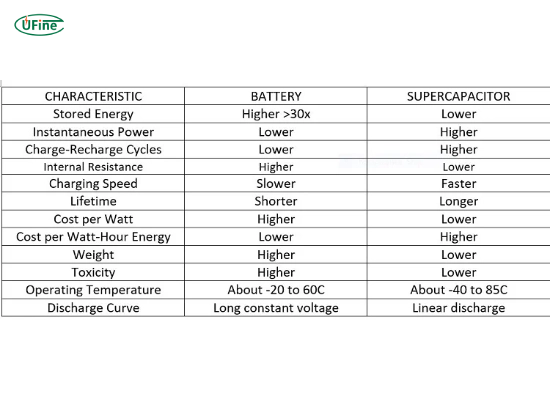
When evaluating supercapacitor vs battery performance, engineers typically compare energy density, power density, lifespan, charging speed, and cost.
| Feature | Supercapacitor | Lithium-Ion Battery |
|---|---|---|
| Energy Density | 5–10 Wh/kg | 150–250 Wh/kg |
| Power Density | Extremely high | Moderate |
| Charge Time | Seconds to minutes | 30 minutes to several hours |
| Cycle Life | Up to 1 million cycles | 500–1500 cycles |
| Temperature Range | Wide | Moderate |
| Typical Use | Short bursts of power | Long-duration energy supply |
1 Supercapacitor energy density vs lithium-ion
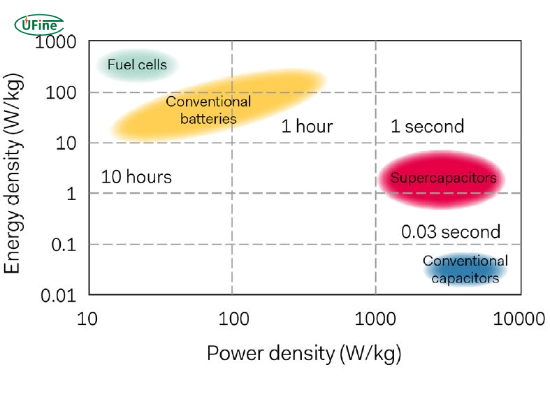
One of the most searched comparisons is supercapacitor energy density vs lithium-ion battery performance.
- Energy density of supercapacitor: ~5–10 Wh/kg
- Energy density of lithium-ion battery: ~150–250 Wh/kg
This means lithium-ion batteries store 15–40× more energy per kilogram.
However, supercapacitors excel in power density, which can exceed 10,000 W/kg. This allows them to deliver energy extremely quickly.
Because of this difference:
- Batteries are used for long-duration energy storage
- Supercapacitors are used for high-power bursts
Part 4. Supercapacitor vs lithium-ion battery: Typical applications
1 Applications of supercapacitors
Supercapacitors are used where high power and rapid cycling are required.
Common applications include:
- Regenerative braking in electric vehicles
- Industrial power stabilization
- Backup power for servers and telecom equipment
- Energy harvesting systems
- Memory backup in electronics
2 Applications of lithium-ion batteries
Lithium-ion batteries are best for applications requiring high energy storage and long operating time.
Examples include:
- Smartphones and laptops
- Electric vehicles
- Robotics and drones
- Solar and renewable energy storage systems
Part 5. Hybrid systems: Using supercapacitors with batteries
In many advanced energy systems, supercapacitors and lithium-ion batteries work together.
For example:
- EV regenerative braking systems store sudden energy bursts in supercapacitors
- Batteries provide steady long-term energy supply
- Supercapacitors reduce battery stress and extend battery lifespan
This hybrid approach improves both power response and energy efficiency.
Part 6. Supercapacitor vs lithium ion battery: FAQs
What is the difference between a supercapacitor and a lithium-ion battery?
The key difference is the storage mechanism. Supercapacitors store energy electrostatically, enabling very fast charging and discharging. Lithium-ion batteries store energy through electrochemical reactions and offer much higher energy density.
Can supercapacitors replace lithium-ion batteries?
Usually no. Supercapacitors have much lower energy density. They are commonly used together with batteries to improve power performance and reduce battery stress.
What is the energy density of a supercapacitor vs lithium-ion battery?
Supercapacitors typically have 5–10 Wh/kg energy density. Lithium-ion batteries usually reach 150–250 Wh/kg, making them better for long-term energy storage.
Are supercapacitors safer than lithium-ion batteries?
Supercapacitors are generally safer because they do not suffer from thermal runaway. Lithium-ion batteries require battery management systems to ensure safe operation.
When should you choose a supercapacitor instead of a battery?
Choose a supercapacitor when the system requires very fast charging, high power bursts, or extremely long cycle life. Batteries are better for long runtime and energy storage.
Related Tags:

More Articles

JST vs Molex: The Right Battery Connector Choice
JST or Molex for your battery? Learn how connector selection affects current, voltage drop, reliability, and device performance.
Custom Battery Pricing: Costs Manufacturers Don’t Mention
A low battery quote may not be the final cost. Discover common hidden expenses that affect custom lithium battery projects.
Battery Wire Length: Hidden Cause of Power Loss
A longer battery wire can cause voltage drop, power loss, and unstable operation. Learn how wire length affects battery performance.
How Device Sleep Modes Affect Battery Life
Think sleep mode extends battery life? Learn why devices still drain power and how firmware, hardware, and batteries affect runtime.
LiPo Battery and PCB Design: Clearance, Insulation, and Placement
Learn how to optimize LiPo battery PCB clearance, insulation, placement, wiring, and thermal design—and avoid common integration mistakes.


