- Part 1. What is a 300 amp hour lithium battery?
- Part 2. What can a 300Ah lithium battery power?
- Part 3. How long will a 300Ah lithium battery last?
- Part 4. How to charge a 300Ah lithium battery
- Part 5. 300Ah lithium battery vs. lead-acid: which is better?
- Part 6. How much does a 300Ah lithium battery cost?
- FAQs
Among high-capacity battery options, a 300 amp hour lithium battery is worth considering. With substantial energy storage, it can support everything from RV appliances and marine electronics to solar systems and emergency backup equipment.
But what does 300Ah actually mean? How many appliances can it run, and how long will the power last? More importantly, how do you choose the right voltage, charger, and battery configuration?
This guide covers everything you need to know before investing in a 300Ah lithium battery.
Key takeaways
-
A 300Ah battery does not have a fixed energy capacity. Its total energy depends on voltage.
-
A 12.8V 300Ah LiFePO4 battery stores approximately 3,840Wh (3.84kWh).
-
Runtime depends on appliance power consumption, usable battery capacity, and inverter efficiency.
-
Choosing the correct lithium battery charger is essential for safe and efficient charging.
-
Compared with lead-acid batteries, lithium batteries generally offer lower weight, deeper usable capacity, and longer cycle life.
-
Battery chemistry, BMS protection, charging compatibility, and actual power requirements should all influence your purchase.
Part 1. What is a 300 amp hour lithium battery?
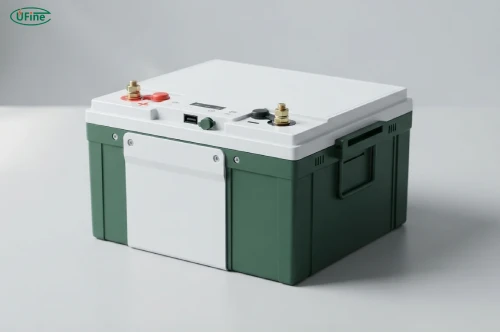
A 300 amp hour (300Ah) lithium battery describes how much electrical charge the battery can store and deliver over time. In simple terms, a fully charged 300Ah battery could theoretically deliver 300 amps for one hour, 30 amps for 10 hours, or 10 amps for 30 hours. Actual performance depends on discharge limits, temperature, and battery design.
However, amp-hours alone don’t tell you how much energy a battery holds. You also need to consider voltage.
Energy capacity formula:
Energy (Wh) = Voltage (V) × Capacity (Ah)
For example:
|
Battery voltage |
Capacity |
Total energy |
|---|---|---|
|
12.8V |
300Ah |
3,840Wh (3.84kWh) |
|
25.6V |
300Ah |
7,680Wh (7.68kWh) |
|
51.2V |
300Ah |
15,360Wh (15.36kWh) |
As you can see, a 48V-class 300Ah battery stores four times as much energy as a 12V-class 300Ah battery. This is why voltage is just as important as capacity when comparing battery specifications.
You’ll also encounter different lithium chemistries. LiFePO4 batteries typically use a nominal cell voltage of 3.2V and are popular for stationary storage, RVs, and marine systems because of their cycle life and thermal stability. Other lithium-ion chemistries can offer higher energy density, making them useful when weight and size are major priorities.
Part 2. What can a 300Ah lithium battery power?
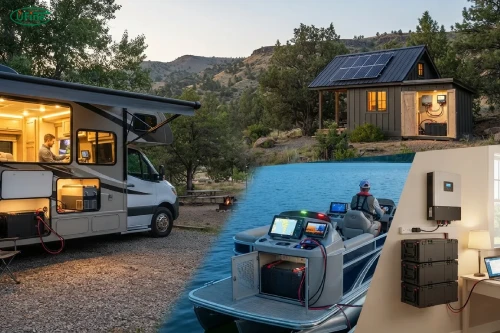
A 300Ah lithium battery can support a wide range of equipment, but the actual applications depend on its voltage, continuous discharge rating, and available energy.
Here are some common examples.
RV and camping equipment
For RV owners, a 300Ah battery can supply power to refrigerators, LED lights, ventilation fans, televisions, water pumps, and charging devices. It can also support air conditioning when the battery voltage, inverter capacity, and discharge rating are sufficient.
Home backup systems
A 300Ah battery can provide backup power for essential household equipment, such as Wi-Fi routers, laptops, lighting, security cameras, and selected small appliances. However, running high-power equipment like electric ovens or central air conditioning requires careful capacity planning.
Solar energy storage
When connected to a compatible solar charge controller, a 300Ah battery can store excess solar electricity for nighttime use or cloudy periods. It is particularly useful for off-grid cabins, small solar installations, and backup systems.
Marine applications
Boats can use 300Ah lithium batteries to power navigation equipment, fish finders, lighting, communication devices, and trolling motors. Their relatively low weight can also be an advantage where onboard space and payload matter.
Part 3. How long will a 300Ah lithium battery last?
This is probably the most important question when choosing a high-capacity battery.
The answer depends on three things: battery voltage, usable capacity, and the total power consumption of your equipment.
For a practical example, let’s use a 12.8V 300Ah LiFePO4 battery.
Its nominal energy capacity is:
12.8V × 300Ah = 3,840Wh
You may not want to use the entire rated capacity in every application. Assuming 80% usable capacity and 90% inverter efficiency, the estimated usable AC energy is:
3,840Wh × 80% × 90% = 2,764.8Wh
Based on this example, here’s how long the battery could run different loads:
|
Appliance power consumption |
Estimated runtime |
|---|---|
|
100W |
27.6 hours |
|
300W |
9.2 hours |
|
500W |
5.5 hours |
|
1,000W |
2.8 hours |
|
1,500W |
1.8 hours |
These figures are estimates, not guaranteed operating times. Actual runtime changes with inverter efficiency, battery temperature, discharge limits, and fluctuating appliance loads. DC-powered equipment may also avoid some inverter losses.
For example, a refrigerator doesn’t necessarily consume its rated wattage continuously. Its compressor cycles on and off, so its daily energy consumption is usually more useful than its maximum running wattage when estimating battery runtime.
If you want a more accurate estimate, add up the watt-hours consumed by all your appliances over a typical day.
Part 4. How to charge a 300Ah lithium battery
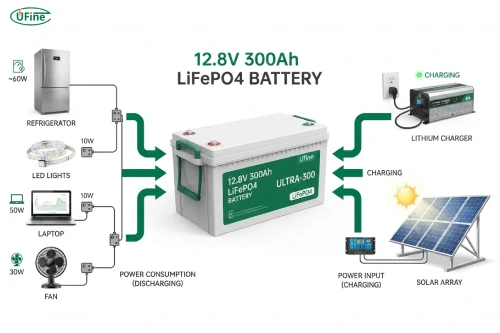
Charging a large-capacity battery requires more than simply connecting it to a power source. You need a charger or charging system that matches the battery’s chemistry, nominal voltage, and charging specifications.
1. Choose the right lithium battery charger
A dedicated lithium battery charger is generally the best choice. For LiFePO4 batteries, look for a charger with a compatible lithium charging profile, typically using a constant-current/constant-voltage (CC/CV) charging process.
The charger should match the battery’s system voltage. For example, a 12.8V LiFePO4 battery requires a charger designed for a 12V-class lithium battery, not a 24V lead-acid charger.
Charging voltage also matters. A typical 12.8V LiFePO4 battery may use a charging voltage around 14.2–14.6V, but the exact setting must follow the manufacturer’s specifications.
Avoid using an incompatible lead-acid charging profile, especially one that applies equalization charging or unsuitable maintenance voltages.
2. How long does it take to charge a 300Ah battery?
Charging time mainly depends on the charger’s output current.
Charging time formula:
Charging time (hours) = Battery capacity (Ah) / Charging current (A)
For a 300Ah battery:
|
Charger output |
Ideal charging time |
|---|---|
|
20A |
15 hours |
|
30A |
10 hours |
|
50A |
6 hours |
|
60A |
5 hours |
|
100A |
3 hours |
These are theoretical estimates from an empty battery. Actual charging takes longer because of voltage regulation, current tapering near full charge, temperature limitations, and BMS restrictions.
You should also check the maximum permitted charging current in the battery datasheet. A charger with a higher output rating does not mean the battery can safely accept that current.
3. Choose a suitable charging method
Depending on your installation, you can charge a 300Ah battery through several methods:
-
AC lithium battery charger: Connects to household electricity or shore power and is convenient for RVs and backup systems.
-
Solar charge controller: Regulates power from solar panels and manages battery charging according to the selected lithium profile.
-
DC-DC charger: Allows an auxiliary battery to charge from a vehicle alternator while protecting the charging system.
-
Inverter charger: Combines inverter and battery-charging functions in one device, making it useful for integrated off-grid systems.
Part 5. 300Ah lithium battery vs. lead-acid: which is better?
Both lithium and lead-acid batteries can store electrical energy, but they differ considerably in everyday use.
A 300Ah lithium battery generally provides more usable energy because it can support deeper discharge than a conventional lead-acid battery. It also tends to weigh less, charge faster, and deliver more charge-discharge cycles.
Lead-acid batteries, on the other hand, usually have a lower initial purchase price and remain suitable for applications with limited budgets and less demanding cycling requirements.
For example, a 300Ah lead-acid battery may have a nominal capacity of approximately 3,600Wh at 12V, but regularly using only around 50% of its capacity is a common design approach to help extend battery life.
A comparable 12.8V 300Ah lithium battery stores 3,840Wh and can often provide a much larger usable portion of its rated energy, depending on the manufacturer’s discharge recommendations.
If you plan to use your battery frequently for solar storage, RV travel, or off-grid applications, lithium is often the more practical long-term option.
Part 6. How much does a 300Ah lithium battery cost?
The price of a 300Ah lithium battery depends on its chemistry, brand, battery management system (BMS), and additional features.
In the US market, a 12V 300Ah LiFePO4 battery typically costs around $500–$1,500, depending on its specifications and configuration.
Some well-known brands in this market include LiTime, Redodo, Renogy, SOK, Battle Born, and Epoch. Their 12V 300Ah lithium battery models generally fall into different price ranges:
-
Budget-friendly options: Approximately $500–$700, commonly offered by brands such as LiTime and Redodo.
-
Mid-range options: Approximately $700–$1,000, including selected models from Renogy and SOK.
-
Premium options: Approximately $1,000–$1,500 or more, particularly from brands such as Battle Born and Epoch, depending on additional features and specifications.
These prices are general market estimates rather than fixed retail prices. Seasonal promotions, warranty coverage, battery features, and product availability can all affect the final cost.
What affects the price of a 300Ah lithium battery?
Several factors explain why batteries with the same rated capacity can have different prices:
-
Battery chemistry: Different lithium chemistries have different material costs, energy densities, and performance characteristics.
-
BMS capabilities: Advanced protection against overcharging, over-discharging, overcurrent, and temperature extremes can increase manufacturing costs.
-
Additional features: Bluetooth monitoring, self-heating, and integrated displays may add to the price.
-
Cycle life: Batteries designed for frequent charging and discharging may offer better long-term value.
-
Certifications and warranty: Safety certifications, warranty coverage, and manufacturer support also influence pricing.
Is a more expensive 300Ah lithium battery worth it?
Not necessarily. A higher price doesn’t automatically mean better performance.
If you only need to power basic RV appliances or a small off-grid system, a standard 300Ah LiFePO4 battery may be sufficient. However, applications involving frequent cycling, cold environments, or demanding power loads may benefit from more advanced battery features.
When comparing prices, look beyond the initial purchase cost. Consider usable capacity, continuous discharge current, charging limits, BMS protection, cycle life, and warranty.
Ultimately, the best choice is a battery that meets your actual power requirements without paying for unnecessary features.
FAQs
1. What is the difference between a 300Ah battery and a 300A battery?
A 300Ah battery refers to its electrical capacity, while 300A refers to the amount of current flowing through a circuit. A 300Ah battery does not necessarily support a continuous discharge current of 300A. Always check its maximum continuous discharge rating.
2. Does cold weather affect a 300Ah lithium battery?
Yes. Low temperatures can reduce available capacity and charging performance. Many LiFePO4 batteries prohibit charging below freezing unless they have a suitable low-temperature protection or heating system.
3. What size inverter do I need for a 300Ah lithium battery?
The inverter should be selected based on the total running wattage and startup surge requirements of your appliances, not just the battery’s Ah rating. You should also ensure that the battery’s continuous discharge current can support the inverter’s power demand.
4. Can a 300Ah lithium battery lose capacity over time?
Yes. Like all rechargeable batteries, lithium batteries gradually lose capacity through aging and repeated charge-discharge cycles. High temperatures, excessive charging voltage, and frequent deep discharges can accelerate capacity degradation.
5. What cable size is needed for a 300Ah lithium battery?
Cable size depends on the maximum current, cable length, allowable voltage drop, installation environment, and applicable electrical standards. A 300Ah rating alone is not enough to determine the correct cable gauge.
6. Does a 300Ah lithium battery need regular maintenance?
Lithium batteries generally require less maintenance than lead-acid batteries. However, you should periodically inspect terminals, cables, connectors, and the battery enclosure, while monitoring for unusual temperature changes or physical damage.
Related Tags:

More Articles

How Much Should You Charge Your Phone? The Best Battery Percentage Explained
Should you charge your phone to 80% or 100%? Discover the best charging range and simple tips to keep your phone battery healthy longer.
Does Charging a Battery Make It Heavier?
Does charging make a battery heavier? Discover the surprising science behind battery weight and how much mass a full battery really gains.
Single-Bank vs. Dual-Bank Chargers for Two 12V Batteries
Choose a single-bank or dual-bank charger for two 12V batteries. Compare amps per bank, output control, and the charging setup each design supports.
Can You Charge Two 12V Batteries in Parallel While Running a Load?
Can you charge two 12V batteries in parallel while running a load? Calculate net charging current and check whether your recharge window is long enough.
Why Is Only One of My Two 12V Batteries Charging in Parallel?
Only one of your two 12V batteries seems to charge in parallel? Check branch current, charger status, and BMS alerts to find out why.