- Part 1. Battery basics: what 100Ah really means
- Part 2. How long will a 100Ah golf cart battery last?
- Part 3. How long do golf cart batteries last in total lifespan?
- Part 4. Cycle life vs runtime: what’s the difference?
- Part 5. Key factors affecting runtime and lifespan
- Part 6. Lead-acid vs lithium batteries for golf carts
- Part 7. How to extend golf cart battery life
- Part 8. When to replace or upgrade your battery
- Part 9. Conclusion
- Part 10. FAQs
Part 1. Battery basics: what 100Ah really means
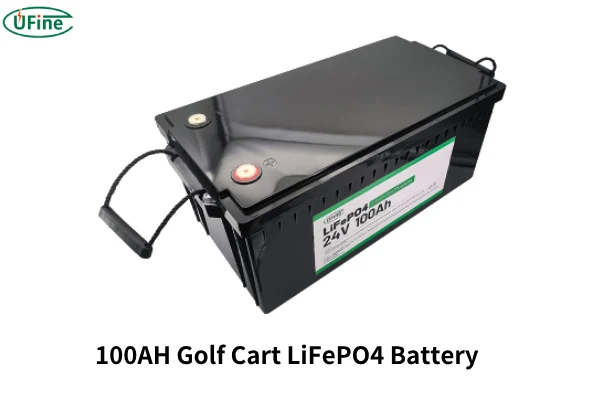
“Ah” stands for ampere-hours, which measures a battery’s energy storage capacity. A 100Ah golf cart battery can theoretically deliver:
- 100 amps for 1 hour,
- 50 amps for 2 hours, or
- 10 amps for 10 hours.
However, this is a theoretical value. Real runtime depends on several factors:
- System voltage (36V / 48V)
- Motor efficiency
- Load weight
- Terrain and temperature
- Battery chemistry and condition
Typically, a 48V 100Ah lithium (LiFePO4) battery stores about 4.8 kWh of energy — enough to power a standard golf cart for 25–40 miles per charge under normal conditions.
Part 2. How long will a 100Ah golf cart battery last?
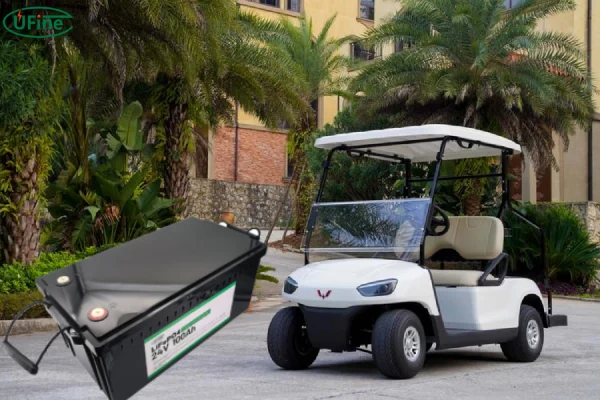
A 100Ah battery’s runtime depends on how much power your golf cart draws on average.
Step 1: Estimate Power Consumption
A standard golf cart motor consumes between 1,000W–2,000W under typical load. At 48V, that equals around 20–40 amps of continuous draw.
Step 2: Apply Runtime Formula
Runtime (hours) = Battery Capacity (Ah) × Efficiency / Average Current Draw (A)
Assuming:
Capacity = 100Ah
Efficiency = 0.9 (for lithium)
Current Draw = 25A
Runtime = (100 × 0.9) / 25 = 3.6 hours of drive time.
Step 3: Real-World Estimates
| Terrain | Load | Average Draw | Expected Runtime | Typical Distance |
|---|---|---|---|---|
| Flat course | 1–2 passengers | 15A | 5–6 hours | 30–40 miles |
| Hilly terrain | 2–4 passengers | 25A | 3–4 hours | 18–25 miles |
| Heavy load or utility use | — | 30A+ | 2.5–3 hours | 15–20 miles |
Part 3. How long do golf cart batteries last in total lifespan?
Battery “life” can mean two things:
- Runtime per charge (how long it lasts before recharge)
- Cycle life (how many charge/discharge cycles it can endure before capacity drops)
Let’s look at total lifespan comparisons:
| Battery Type | Typical Lifespan | Average Cycles | Maintenance | Notes |
|---|---|---|---|---|
| Flooded Lead-Acid | 3–5 years | 500–800 cycles | High | Requires regular watering and cleaning |
| AGM Lead-Acid | 4–6 years | 600–1,000 cycles | Medium | Sealed, less maintenance |
| Lithium (LiFePO4) | 8–10+ years | 3,000–5,000 cycles | Very Low | High efficiency, lighter weight, higher cost |
This shows why lithium batteries dominate the modern golf cart market—they may cost more upfront but last two to three times longer than lead-acid types.
Part 4. Cycle life vs runtime: what’s the difference?
Many confuse cycle life with runtime, but they represent different aspects of performance.
- Runtime = how long your golf cart runs per charge (hours or miles).
- Cycle Life = how many times the battery can be charged and discharged before it degrades to about 80% of its original capacity.
Example:
- A lead-acid battery might give you 3 hours per charge (runtime) for about 600 cycles.
- A lithium battery could give 5 hours per charge for 4,000 cycles.
That means:
- Lead-acid: 3 hrs × 600 = 1,800 total hours of use
- Lithium: 5 hrs × 4,000 = 20,000 total hours of use
In other words, cycle life determines long-term value, while runtime defines daily convenience.
Part 5. Key factors affecting runtime and lifespan
Several factors can shorten or extend your golf cart battery’s usable life:
1 Depth of Discharge (DoD)
Deeper discharges shorten battery life.
- Lead-acid batteries perform best when kept above 50% charge.
- Lithium batteries tolerate deeper discharges (up to 80–90%) without major degradation.
2 Temperature
- High heat accelerates chemical aging and water loss (for lead-acid).
- Extreme cold reduces voltage output and runtime.
3 Charging Habits
- Partial or infrequent charging leads to sulfation in lead-acid batteries.
- Overcharging or mismatched chargers can damage lithium packs.
4 Terrain and Load
Driving uphill, carrying passengers, or towing increases current draw, draining the battery faster.
5 Maintenance
Dirty terminals, corroded connectors, and low electrolyte levels all reduce performance and efficiency.
Part 6. Lead-acid vs lithium batteries for golf carts
If you’re considering a golf cart lithium conversion, here’s a quick performance comparison:
| Feature | Lead-Acid | Lithium (LiFePO4) |
|---|---|---|
| Runtime per charge | 2–4 hours | 4–8 hours |
| Total lifespan | 3–5 years | 8–10+ years |
| Weight | Heavy | 50–70% lighter |
| Maintenance | Regular | Minimal |
| Charge time | 8–10 hrs | 2–4 hrs |
| Efficiency | 70–80% | 95%+ |
| Depth of discharge | 50% recommended | 80–90% safe |
| Cost | Lower upfront | Higher upfront, cheaper over time |
Lead Acid vs. Lithium Ion Batteries: A Complete Comparison
When factoring in both runtime and cycle life, lithium batteries provide up to 5× more total operating hours than lead-acid systems.
For example, a 48V 100Ah lithium pack can outlast three sets of lead-acid batteries over its service life.
Battery Manufacturer View: How Long Do Golf Cart Batteries Last
Part 7. How to extend golf cart battery life
Follow these practices to maximize both runtime and lifespan:
✅ Charge after every use – Avoid long periods at low charge.
✅ Avoid deep discharges – Keep above 20% SOC (state of charge).
✅ Clean terminals monthly – Prevent corrosion and voltage drops.
✅ Use compatible chargers – Especially important for lithium packs.
✅ Store properly – In a cool, dry environment between 10°C–25°C.
✅ Balance charging – For lithium batteries, use a BMS (Battery Management System) to balance cells.
✅ Drive efficiently – Gradual acceleration and moderate speeds conserve energy.
Part 8. When to replace or upgrade your battery
Signs it’s time for replacement or upgrade:
- Reduced runtime even after full charge
- Longer charging times
- Swelling, leakage, or corrosion
- Sluggish acceleration
- Voltage dropping quickly under load
If your cart still uses lead-acid batteries and they’re past three years old, consider upgrading to the best 48V lithium battery for golf carts.
You’ll gain higher efficiency, lower weight, and drastically longer lifespan — paying for itself in the long run.
Part 9. Conclusion
So, how long do golf cart batteries last?
For a standard 100Ah pack, expect around 4–6 hours of runtime per charge and up to 8–10 years of service life with lithium technology.
Remember, runtime determines how far you can go today, while cycle life determines how many years your battery will serve you.
By choosing a high-quality lithium golf cart battery, maintaining it properly, and charging smartly, you can enjoy thousands of cycles of efficient, reliable performance — and say goodbye to range anxiety on the green.
Part 10. FAQs
How long do lithium golf cart batteries last?
Up to 10 years or 4,000–5,000 cycles under proper maintenance.
How far can a 100Ah golf cart battery go on one charge?
Typically 25–40 miles, depending on terrain, load, and driving style.
What’s the difference between runtime and cycle life?
Runtime = per-charge operating time; Cycle life = total number of charges before capacity falls below 80%.
How can I tell if my battery is dying?
Noticeable power loss, voltage drops, and slower acceleration are clear signs of capacity decline.
Should I switch from lead-acid to lithium?
Yes—if you value longer range, faster charging, lighter weight, and reduced maintenance.
Related Tags:

More Articles
Battery Load Test: A Comprehensive Guide
Step-by-step battery load test guide for car, solar & industrial use. Learn how to load test a battery, interpret voltage charts, and avoid common mistakes.
The Comprehensive Guide to Battery Balancing and Battery Balancer
Discover how battery balancers improve lithium battery performance, lifespan, and safety. Learn types, functions, and tips to choose the right balancer.
What Is the Best Voltage for a Chainsaw Battery?
Compare 12V-80V chainsaw batteries for light pruning, medium firewood, and professional cutting. See best battery chainsaw with runtime charts and safety tips.
Lithium VS. Alkaline Batteries: A Comprehensive Comparison
Lithium batteries last 3–7× longer than alkaline and perform better in cold weather. Compare lifespan, cost, safety, and best uses to choose the right battery.
Comparing Lithium-Sulfur and Lithium-Ion Batteries: Which is Right for You?
Compare lithium-sulfur (Li-S) and lithium-ion batteries on energy, lifespan, cost, safety, and applications. Best choice for drones, EVs, and electronics.