

- Part 1. Remote control battery applications & solutions
- Part 2. Remote control battery applications we support
- Part 3. Power requirements for remote control devices
- Part 4. Remote control battery selection – Decision parameters
- Part 5. Recommended battery types for remote control applications
- Part 6. Battery specifications & customization options
- Part 7. Why choose Ufine Battery for remote control applications
- Part 8. Contact us for custom remote control battery solutions
Part 1. Remote control battery applications & solutions
Remote control devices are evolving from simple infrared transmitters into multi-function, wireless, and rechargeable systems used across consumer electronics, gaming, industrial automation, and unmanned systems. However, manufacturers consistently face three core challenges: ultra-low standby power consumption, stable voltage under pulse load, and tight mechanical constraints.
At Ufine Battery, we design and manufacture application-specific lithium battery solutions for remote control devices, supporting operating voltages from 3.0 V to 11.1 V, capacities from 30 mAh to 10,000 mAh, and custom pack configurations for both disposable and rechargeable designs. Our solutions are engineered to meet real-world current profiles, duty cycles, and lifecycle expectations, not laboratory assumptions.
Part 2. Remote control battery applications we support
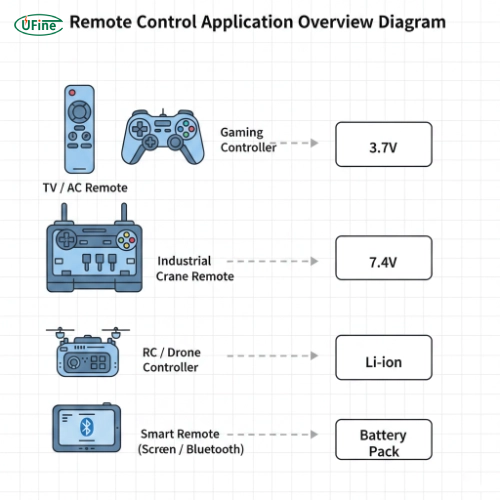
Consumer Electronics Remote Controls
Consumer remote controls typically operate at average standby currents below 20–40 µA, with short transmission pulses reaching 80–150 mA during IR or RF signal bursts. Battery performance must remain stable over 12–36 months of shelf and service life, even under infrequent use.
These applications prioritize:
- Long shelf life and low self-discharge
- Stable voltage to prevent signal failure at low SOC
- Compact prismatic or pouch cell formats
Gaming Controllers & Entertainment Devices
Modern gaming controllers integrate Bluetooth, vibration motors, gyroscopes, and LED indicators, resulting in continuous current draws of 80–300 mA, with peak loads exceeding 1 A during haptic feedback events.
Battery requirements include:
- High discharge capability
- Rechargeability with >500 cycles
- Mechanical robustness for frequent handling
Industrial Remote Control Systems
Industrial remote controls operate in harsh environments, including temperature ranges from -20°C to 60°C, and require absolute voltage reliability to avoid control interruption. These systems often run at 7.4 V or higher, with redundant safety protection.
According to IEC 60204-32 and industrial wireless control guidelines, power failure tolerance is a key safety parameter for operator-held controls.
RC Models & Drone Controllers
RC and drone controllers demand high transient current capability and stable RF output voltage, especially during long-range transmission. Typical operating currents range from 150–400 mA, with extended session runtimes expected by users.
Weight optimization and pack balancing are critical for ergonomics and endurance.
Smart & Rechargeable Remote Controls
Smart remotes integrate displays, voice modules, and WiFi/BLE SoCs. Industry reference designs from Nordic Semiconductor and Texas Instruments show idle currents <50 µA but active currents up to 300 mA, requiring batteries that perform efficiently across wide load ranges.
Part 3. Power requirements for remote control devices
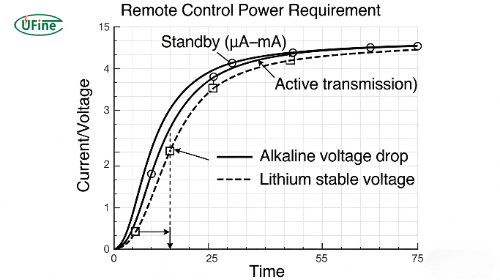
- Low Power Consumption & Long Standby Time
Most remote controls spend over 99.5% of their lifetime in standby mode. Batteries must exhibit self-discharge rates below 3% per year, as recommended in IEEE battery storage studies, to maintain usable voltage throughout the product lifecycle. - Stable Voltage Output for Signal Reliability
Wireless transmission modules are sensitive to voltage drops. A decline below the RF module’s minimum operating voltage can cause packet loss or delayed response, even when capacity remains. This makes voltage stability under pulse load more critical than nominal capacity. - Compact Size & Lightweight Design
Remote control enclosures often allocate less than 20% of internal volume to the battery. Prismatic lithium-ion and lithium-polymer cells enable higher volumetric energy density than cylindrical cells in slim designs. - Rechargeable vs. Non-rechargeable Power Options
While alkaline and primary lithium cells dominate traditional remotes, rechargeable designs are increasingly adopted to meet sustainability regulations and reduce battery replacement costs, especially in premium consumer and industrial products.
Part 4. Remote control battery selection – Decision parameters
This table summarizes typical decision parameters used by OEM engineers and procurement teams when selecting batteries for different remote control applications.
| Application Type | Typical Operating Voltage | Average Current Draw | Peak Current | Expected Runtime / Cycle | Recommended Battery Solution |
|---|---|---|---|---|---|
| Consumer Electronics Remote Controls (TV / AC) | 3.0–3.7 V | < 40 µA (standby) | 80–150 mA (pulse) | 12–36 months standby life | Ultra-thin Li-ion / Primary lithium cells |
| Gaming Controllers | 3.7 V | 80–300 mA | >1 A (vibration) | 20–40 hours per charge, >500 cycles | High-capacity Li-ion battery |
| Industrial Remote Control Systems | 7.4–11.1 V | 100–300 mA | 500 mA–2 A | Full-shift operation, high reliability | Multi-cell Li-ion battery pack (2S / 3S) |
| RC & Drone Controllers | 7.4–11.1 V | 150–400 mA | >1 A | Extended session runtime | Balanced Li-ion battery pack |
| Smart & Rechargeable Remote Controls | 3.7 V | <50 µA idle / 200–300 mA active | 500 mA+ | Daily charging, >500 cycles | Rechargeable Li-ion / Li-polymer |
Part 5. Recommended battery types for remote control applications
Below are application-matched battery solutions, selected based on real operating profiles rather than generic chemistry descriptions.
Consumer Electronics Remote Controls
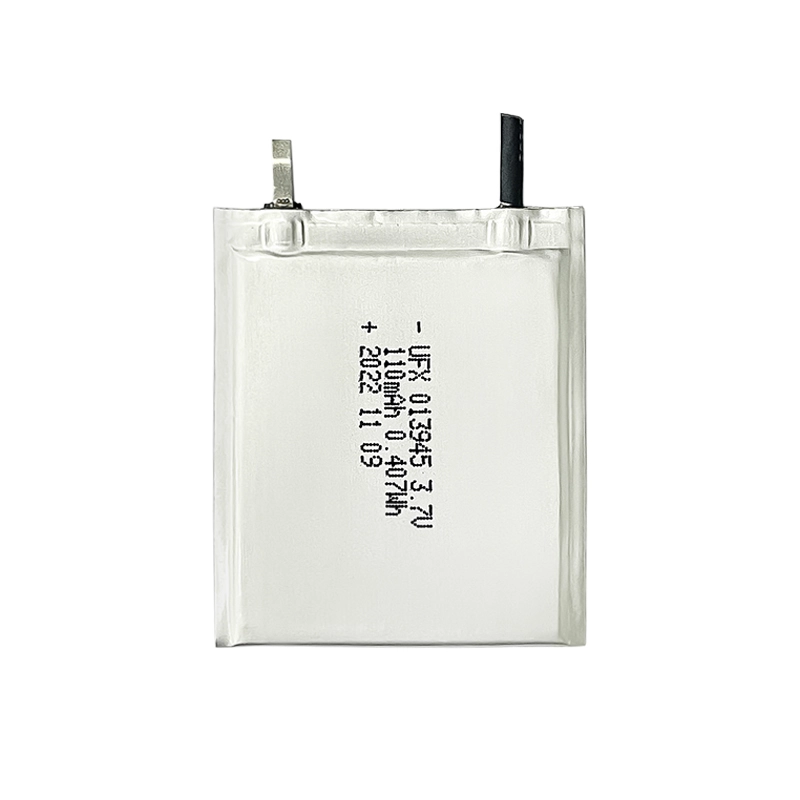
- 3.7 V 180 mAh Ultra-thin Li-ion Battery (014461)
Ideal for slim TV and AC remotes requiring minimal thickness and long standby life. - 3.7 V 300 mAh Li-ion Battery (702025)
Suitable for RF-enabled remotes with occasional higher transmission loads.
Gaming Controllers & Entertainment Devices
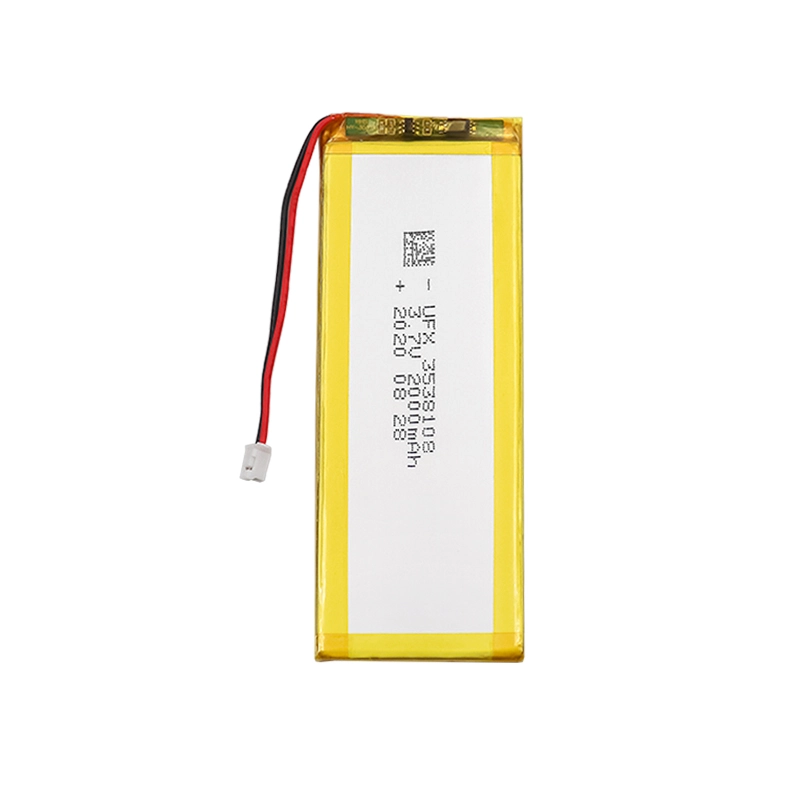
- 3.7 V 2000 mAh Li-ion Battery (103450)
Supports continuous gameplay, vibration motors, and fast charging. - 3.7 V 3600 mAh Li-ion Battery (124060)
Designed for extended gaming sessions and high peak current demands.
Industrial Remote Control Systems
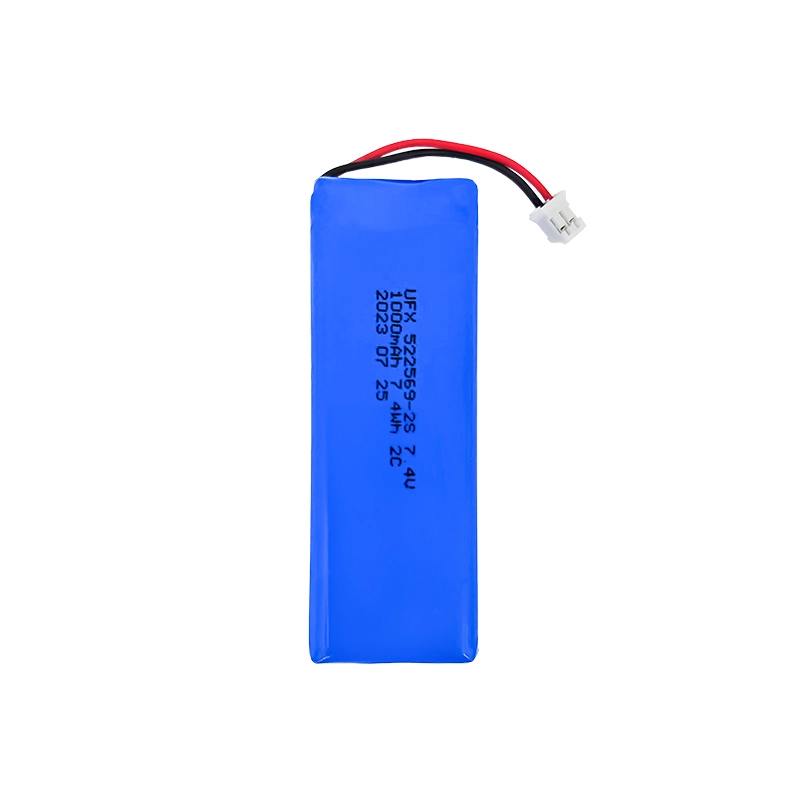
- 7.4 V 1500 mAh Li-ion Battery Pack (123450-2S)
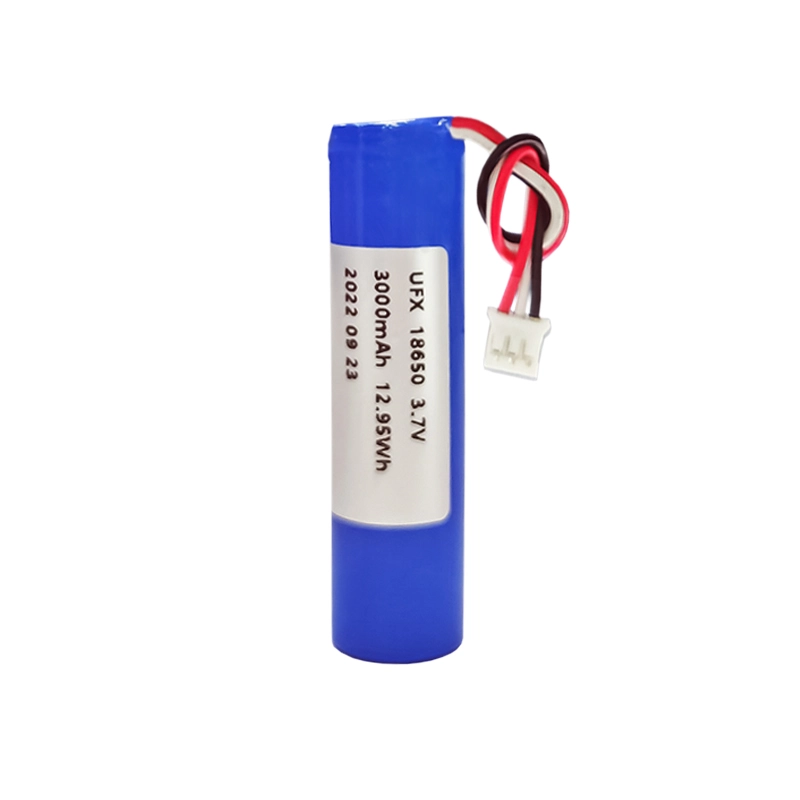
Provides stable dual-cell voltage for industrial-grade wireless controllers. - 11.1 V 2000 mAh 18650 Battery Pack (18650-3S)
Suitable for heavy-duty machinery remote controls requiring higher voltage margins.
RC Models & Drone Controllers
- 7.4 V 2000 mAh Li-ion Battery Pack (103450-2S)
Balances weight, discharge rate, and runtime for RC transmitters. - 11.1 V 1200 mAh Li-ion Battery Pack (603450-3S)
Optimized for long-range transmission and multi-channel control.
Smart & Rechargeable Remote Controls
- 3.7 V 1000 mAh Li-ion Battery (803040)
Suitable for smart remotes with displays, BLE, and voice input. - 3.7 V 1800 mAh Li-ion Battery (104040)
Supports WiFi-enabled remotes with higher continuous power demand.
Part 6. Battery specifications & customization options
Key Battery Decision Factors for Remote Control Devices
These parameters are often more critical than nominal capacity when evaluating battery performance.
| Decision Factor | Why It Matters in Remote Controls |
|---|---|
| Voltage Stability | Prevents signal dropouts during RF transmission bursts |
| Self-discharge Rate | Determines shelf life and long-term usability |
| Peak Discharge Capability | Supports vibration motors, RF modules, and displays |
| Mechanical Size & Shape | Must fit tight enclosure designs |
| Cycle Life | Impacts total cost of ownership for rechargeable designs |
| Safety Protection | Required for consumer and industrial compliance |
How to Use This Table:
- If your remote control operates mainly in standby mode, prioritize low self-discharge and voltage stability, not just capacity.
- If your device includes motors, displays, or wireless modules, ensure the battery supports high peak current without voltage collapse.
- For industrial or professional systems, multi-cell battery packs with protection circuits are strongly recommended.
Voltage Options for Remote Control Batteries
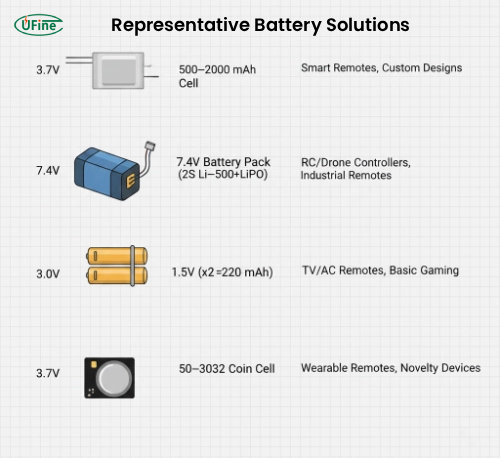
Ufine supports 3.0–3.7 V single-cell, 7.4 V (2S), and 11.1 V (3S) configurations, aligned with common RF module and MCU operating ranges.
Capacity Range & Runtime Considerations
Based on field data and customer deployments, typical remote control runtimes range from:
- 12–24 months (low-power consumer remotes)
- 20–40 hours per charge (gaming controllers)
- 8–16 hours continuous operation (industrial systems)
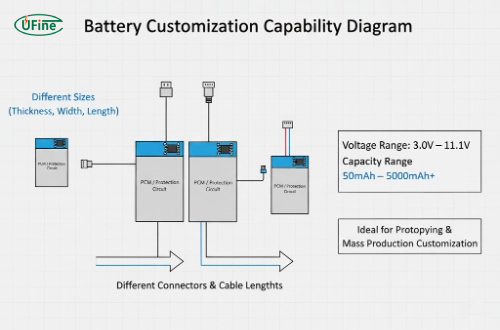
Size, Shape & Connector Customization
We provide custom:
- Cell dimensions (pouch, prismatic, cylindrical)
- Wire length and connector types
- Mechanical reinforcement for drop resistance
Protection Circuit & Safety Design
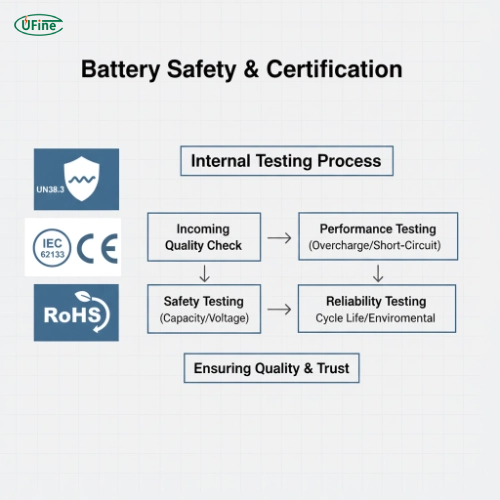
All rechargeable packs integrate PCM/BMS protection against overcharge, over-discharge, overcurrent, and short circuit, compliant with IEC 62133 design principles.
Part 7. Why choose Ufine Battery for remote control applications
- Custom Battery Design for Remote Control Devices
Our engineers design batteries based on actual current waveforms, not nominal averages, ensuring consistent performance under real usage conditions. - Stable Supply & Consistent Quality Control
With in-house cell selection, aging tests, and capacity grading, we maintain batch-to-batch consistency, critical for long-term OEM projects. - Compliance with International Safety Standards
Ufine batteries are designed to meet UN38.3, IEC 62133, and relevant transportation and safety requirements for global markets.
Part 8. Contact us for custom remote control battery solutions
Contact Ufine Battery to discuss voltage, capacity, size constraints, and certification requirements with our engineering team.
Get Custom Remote Control Battery SolutionsRelated Remote Control Battery Applications
Beyond standard remote control battery solutions, we also support specialized applications such as RC Cars and RC Planes, where high discharge rates, responsive power output, and reliable safety protection are essential for stable operation.
High Energy Density
It stores large amounts of energy in a smaller and lighter package
Longer Cycle Life
Withstands extensive charge and discharge cycles
Low Self-Discharge
Maintains power longer when not in use
Safety
Minimizes the risk of accidents and ensures safe operation
More Information About Remote Control Battery
-
Can lithium batteries replace alkaline batteries in remote control applications?
-
What battery voltage is typically used for remote control devices?
-
What certifications are required for remote control batteries in commercial products?
-
How do you ensure safety for rechargeable remote control batteries?
-
What is the typical MOQ for custom remote control battery projects?
Latest Blogs
About Lithium Battery Industry News
Best 24V Lithium Battery: Top 10 Compared
Discover the top 24V lithium batteries. We compare capacity, price, cycle life, safety features, and the best options for different applications.
2026/08/24 Ufine
Top LFP Cell Manufacturers in China You Should Know
Looking for reliable LiFePO4 cells? Explore China's top LFP battery manufacturers, key technologies, production capabilities, and supplier selection tips.
2026/08/24 Ufine
Check If Your Charger Works: Simple Test Guide
Think your battery charger's broken? Quick tests can show you for sure. See if it’s the charger or the battery that's causing issues. Read more.
2026/08/24 Ufine
Best Camera Batteries: 7 Brands Compared & Tested
Looking for the best camera battery? Compare 7 top brands, including OEM and third-party options, to find the right battery for your camera.
2026/08/24 Ufine
What You Need to Know About Portable Fan Batteries
Discover the best portable electric fan battery, its types, lifespan, and maintenance tips. Learn how to choose the right one and keep it running longer.
2026/08/18 Ufine

13 E-Bike Battery Options Compared: Voltage, Fit, Chemistry & Use Case
Compare 13 e-bike battery options by voltage, capacity, chemistry, mounting style and compatibility to find the right battery for your electric bike.
2026/08/18 Ufine

