

- Part 1. Pulse oximeter battery solutions for medical monitoring devices
- Part 2. Industry pain points in pulse oximeter battery design
- Part 3. Pulse Oximeter Application Scenarios & Recommended Battery Solutions
- Part 4. Decision Parameters for Selecting a Pulse Oximeter Battery
- Part 5. Battery Safety & Compliance Considerations
- Part 6. Typical Pulse Oximeter Battery Specifications (Reference)
Part 1. Pulse oximeter battery solutions for medical monitoring devices
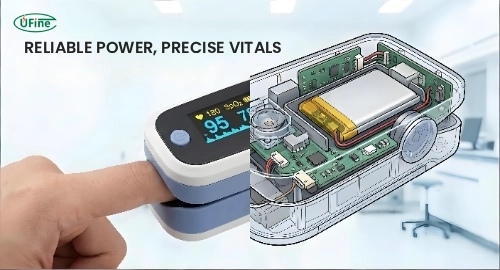
Ufine provides custom lithium battery solutions for pulse oximeter manufacturers, addressing the industry’s core challenges: limited device space, strict safety requirements, and the need for long, stable operating time in medical monitoring environments.
In pulse oximeters, battery performance directly affects measurement accuracy, device uptime, and patient safety. Common industry pain points include unstable voltage during long monitoring sessions, insufficient battery life in compact designs, and safety risks caused by poor cell consistency or inadequate protection circuits.
Our role is to help medical device manufacturers select and integrate the right battery solution for each pulse oximeter application scenario, balancing size, runtime, safety, and regulatory compliance.
Part 2. Industry pain points in pulse oximeter battery design
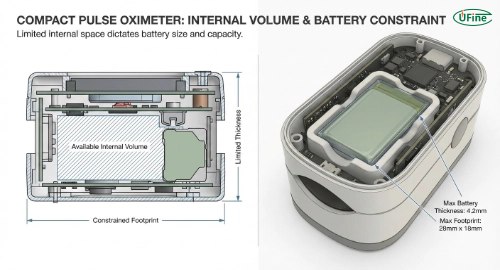
Limited Space vs. Required Runtime
Portable and fingertip pulse oximeters typically allocate only 20–30% of internal volume to the battery, yet are expected to support 20–40+ hours of intermittent use. This creates a constant trade-off between pulse oximeter battery size and achievable battery life, especially in compact consumer and home-care devices.
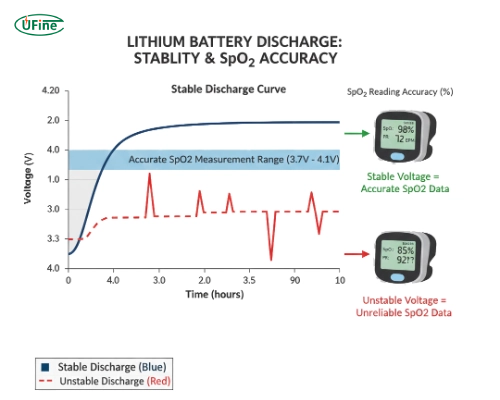
Voltage Stability & Signal Accuracy
Pulse oximeter sensors and MCUs are sensitive to voltage fluctuation. Even minor instability during discharge can affect SpO₂ signal accuracy, data continuity, and alarm reliability during long monitoring sessions. Stable discharge characteristics are therefore a core requirement when selecting an oximeter battery.
Safety & Medical Device Risk Control
According to IEC 60601-1 general safety requirements for medical electrical equipment, battery-related failures are considered high-risk events in medical devices. Overheating, swelling, leakage, or unstable charging behavior is unacceptable in clinical and home-care environments.
For an overview of how IEC 60601-1 addresses electrical, mechanical, and thermal risks in medical equipment such as pulse oximeters, see:
IEC 60601 – Medical Electrical Equipment Safety Overview
Product Lifecycle & Replacement Cost
Frequent pulse oximeter battery replacement increases maintenance costs and negatively impacts user experience, especially in hospitals and long-term home-care deployments. Selecting a battery with stable cycle life and low self-discharge is critical to controlling total lifecycle cost.
Part 3. Pulse Oximeter Application Scenarios & Recommended Battery Solutions
Fingertip & Portable Pulse Oximeters
(Consumer / Home Healthcare)
Key Requirements
- Ultra-compact battery size
- Low power consumption
- Long standby time
- Stable 3.7V output
Recommended Battery Solutions
- 3.7V 250mAh Li-ion Battery (502030)
- 3.7V 750mAh Li-ion Battery (503048)
Why These Work
These batteries balance compact dimensions with sufficient capacity, helping extend pulse oximeter battery life without increasing device thickness or weight.
Handheld Medical Pulse Oximeters
(Clinical Use)
Key Requirements
- Longer continuous runtime
- Higher discharge stability
- Improved safety margin
Recommended Battery Solutions
- 3.7V 1000mAh Li-ion Battery (703048)
- 3.7V 1200mAh Li-ion Battery (102540)
Why These Work
Higher capacity supports extended monitoring cycles while maintaining a manageable pulse oximeter battery size for handheld clinical devices.
Multi-Parameter Monitors with Integrated SpO₂ Modules
Key Requirements
- Higher system voltage
- Support for multiple sensors
- Long operation during power outages
Recommended Battery Solutions
- 7.4V 1200mAh Li-ion Battery Pack (503759, 2S)
- 7.4V 2000mAh Li-ion Battery Pack (103450, 2S)
Why These Work
2S battery packs provide higher voltage stability and are well suited for integrated medical monitoring systems that combine SpO₂ with additional physiological parameters.
Part 4. Decision Parameters for Selecting a Pulse Oximeter Battery
| Decision Factor | Engineering Impact | Procurement Impact |
|---|---|---|
| Battery Voltage (3.7V / 7.4V) | Determines MCU & sensor compatibility | Affects system BOM |
| Battery Capacity (mAh) | Defines runtime & standby duration | Impacts replacement frequency |
| Battery Size (L×W×T) | Limits industrial design | Affects tooling cost |
| Battery Type (LiPo / Pack) | Influences safety & discharge curve | Determines supplier options |
| Protection Circuit (PCM) | Prevents overcharge & over-discharge | Reduces after-sales risk |
| Cycle Life | Controls long-term reliability | Lowers lifecycle cost |
Part 5. Battery Safety & Compliance Considerations

Medical lithium batteries are not only subject to device-level safety standards but also transportation and handling regulations. Lithium batteries used in medical equipment typically follow UN 38.3 transportation and safety testing requirements, which include altitude simulation, thermal cycling, vibration, shock, short-circuit, and overcharge tests.
A practical overview of UN 38.3 lithium battery safety testing requirements can be found at:
UN 38.3 Lithium Battery Testing – Intertek
Independent third-party explanations from testing organizations such as TÜV SÜD further clarify how these tests ensure battery safety during transport and storage:
UN/DOT 38.3 Testing Requirements Explained
These compliance requirements directly influence oximeter battery type selection, protection circuit design, and supplier qualification.
Part 6. Typical Pulse Oximeter Battery Specifications (Reference)
| Parameter | Typical Range |
|---|---|
| Nominal Voltage | 3.7V / 7.4V |
| Capacity Range | 500mAh – 2000mAh |
| Battery Size | Customizable |
| Battery Chemistry | Lithium-ion / LiPo |
| Protection | Overcharge, over-discharge, short circuit |
| Operating Environment | Medical-grade usage |
All specifications are reference values and can be customized.
If you are developing or upgrading a pulse oximeter, Ufine’s engineering team can help you select the right battery solution for your specific application scenario.
Contact us to discuss technical requirements, customization options, and sample evaluation.
Get Custom Pulse Oximeter Battery SolutionsHigh Energy Density
It stores large amounts of energy in a smaller and lighter package
Longer Cycle Life
Withstands extensive charge and discharge cycles
Low Self-Discharge
Maintains power longer when not in use
Safety
Minimizes the risk of accidents and ensures safe operation
More Information About Pulse Oximeter Battery
-
How do I choose the right pulse oximeter battery size for my device?
-
What is the typical MOQ for customized pulse oximeter battery projects?
-
How can battery design reduce pulse oximeter battery replacement frequency?
-
Can Ufine support OEM integration for medical device batteries?
-
Are Ufine batteries suitable for long-term medical monitoring use?
Latest Blogs
About Lithium Battery Industry News
Dead Battery or Device Failure? How to Find the Cause
Think your device is broken? Learn how to tell if the problem comes from battery aging or hardware failure before replacing your electronics.
2026/09/22 Ufine

Why iPhone Duo Uses Two Batteries: The Engineering Behind Foldable Phone Power
Why do foldable phones need two batteries? Explore the engineering challenges behind iPhone Duo’s dual-battery architecture and future battery trends.
2026/09/21 Ufine

Solid-State Batteries: 3 Myths You Need to Know
Solid-state batteries promise safer EVs and longer range, but the reality is more complex. Discover the challenges behind this next-gen technology.
2026/09/21 Ufine

Battery Capacity vs Discharge Rate: The Choice Engineers Face
Higher capacity or higher discharge rate? Learn how to choose the right LiPo battery for longer runtime, stable power output, and better device performance.
2026/09/21 Ufine

Battery Cable Size Guide: Choose the Right Wire Fast
Not sure what battery cable size you need? Learn how to select the right wire gauge, terminal size, and cable for safer, more efficient battery systems.
2026/09/21 Ufine

How to build a12V 10.5Ah Li-ion battery pack with 18650 cells
Learn how to build a high-capacity 12V 10.5Ah battery pack with Ufine 18650 cells. Explore cell selection, 3S3P configuration, BMS wiring, and performance tests.
2026/09/20 Ufine

