

- Part 1. Hair clipper battery solutions for cordless grooming devices
- Part 2. Hair clipper power requirements & usage scenarios
- Part 3. Why lithium batteries are preferred for hair clippers
- Part 4. Recommended lithium battery solutions for hair clippers
- Part 5. Battery specification matching for hair clipper design
- Part 6. Decision parameters for hair clipper battery selection
- Part 7. Safety, cycle life & user experience considerations
- Part 8. Custom hair clipper battery solutions
Part 1. Hair clipper battery solutions for cordless grooming devices
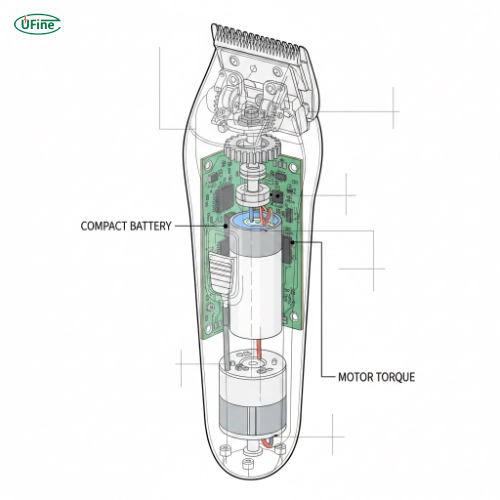
Cordless hair clippers and trimmers require compact batteries capable of delivering high peak current, fast charging, and long cycle life within a limited housing space.
Ufine provides application-specific lithium battery solutions for hair clippers, helping manufacturers optimize runtime, motor performance, charging speed, and product lifespan for both consumer and professional grooming devices.
Key industry challenges we address:
- High-speed motors requiring instant discharge currents of 3–10C
- Daily or high-frequency use demanding 500–1,000+ charge cycles
- Increasing demand for fast charging (1–3 hours) without compromising safety
- Tight internal space limiting battery voltage, capacity, and form factor
Part 2. Hair clipper power requirements & usage scenarios
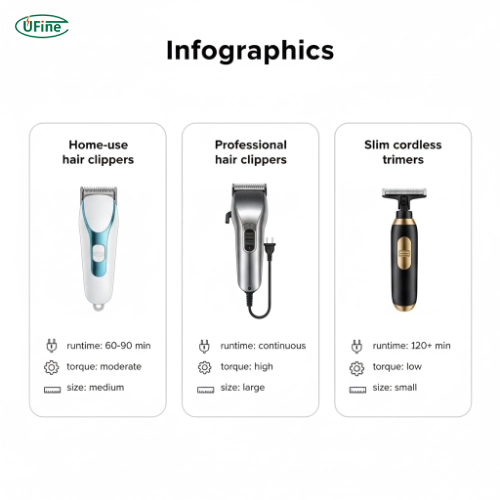
Typical Hair Clipper Usage Scenarios
| Scenario | Usage Pattern | Core Battery Requirement |
|---|---|---|
| Home-use hair clippers | Low frequency, short sessions | Stable runtime, long standby |
| Professional hair clippers | High frequency, continuous operation | High discharge, long cycle life |
| Compact cordless trimmers | Daily use, small form factor | Slim size, fast charging |
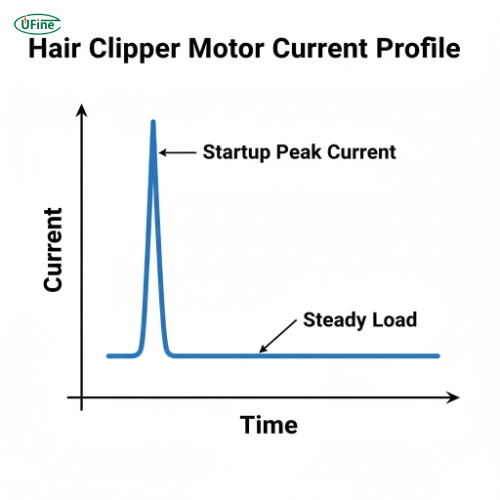
According to IEC design guidelines for cordless grooming devices, most cordless hair clippers operate with motor power in the 5–15W range, while the startup current can be several times higher than the steady-state load, placing higher demands on battery peak discharge capability.
Core Power Challenges in Hair Clippers
- Peak discharge current during motor startup and dense hair cutting
- Fast charging vs cycle life trade-off, especially in professional models
- Thermal stability in enclosed plastic housings
- Battery aging impact on cutting torque and user experience
Part 3. Why lithium batteries are preferred for hair clippers
Limitations of NiMH Batteries in Modern Hair Clippers
NiMH batteries are increasingly phased out due to:
- Charging time typically 8–12 hours
- Energy density below 100 Wh/kg
- Memory effect reducing usable capacity
- Limited cycle life under frequent charging
Advantages of Lithium Batteries for Cordless Hair Clippers
Lithium-ion batteries offer:
- Energy density of 180–260 Wh/kg
- Typical charging time 1–3 hours
- No memory effect
- 500–1,500 cycles depending on chemistry and depth of discharge
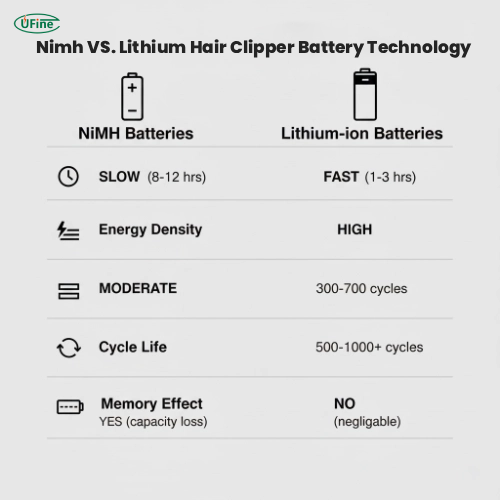
Compared with NiMH batteries, lithium-ion batteries are widely adopted in modern grooming devices due to their significantly higher energy density and faster charging capability.
As summarized by Battery University’s overview of lithium-ion battery types, typical lithium-ion cells deliver 180–260 Wh/kg, support 1–3 hour charging, and provide 500–1,500 cycles depending on chemistry and depth of discharge.
Part 4. Recommended lithium battery solutions for hair clippers
Scenario 1: Home-Use Hair Clippers (Standard Runtime, Compact Design)
Typical requirements
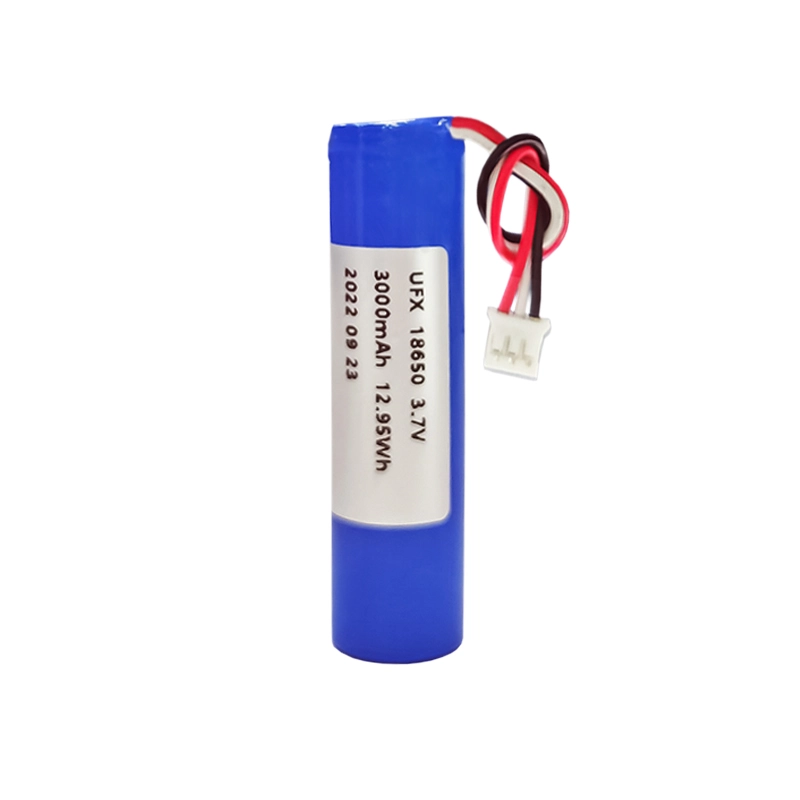
- Voltage: 3.7V
- Capacity: 1,200–2,000mAh
- Runtime: 60–120 minutes
Recommended battery solutions
These models balance runtime and size, making them suitable for entry-level and mid-range hair clippers.
Scenario 2: Professional Hair Clippers (High Torque, Long Runtime)
Typical requirements
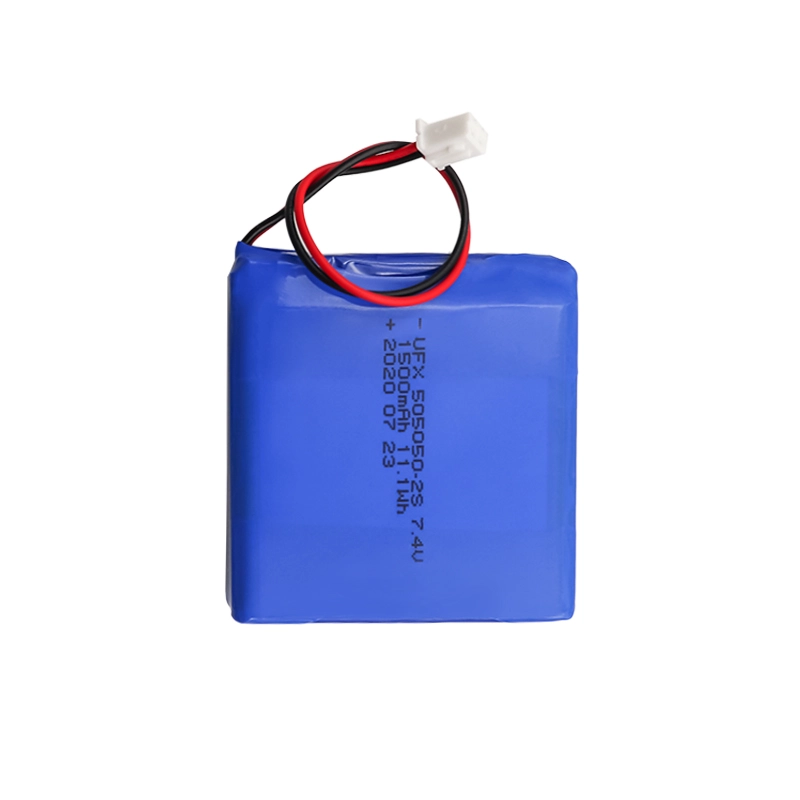
- Voltage: 7.4V (2S)
- Capacity: 2,000–5,000mAh
- High peak discharge for continuous cutting
Recommended battery solutions
These packs support stable torque output and extended professional use without frequent recharging.
Scenario 3: Slim Cordless Trimmers & Travel Clippers
Typical requirements
- Ultra-compact size
- Moderate runtime
- Fast charging
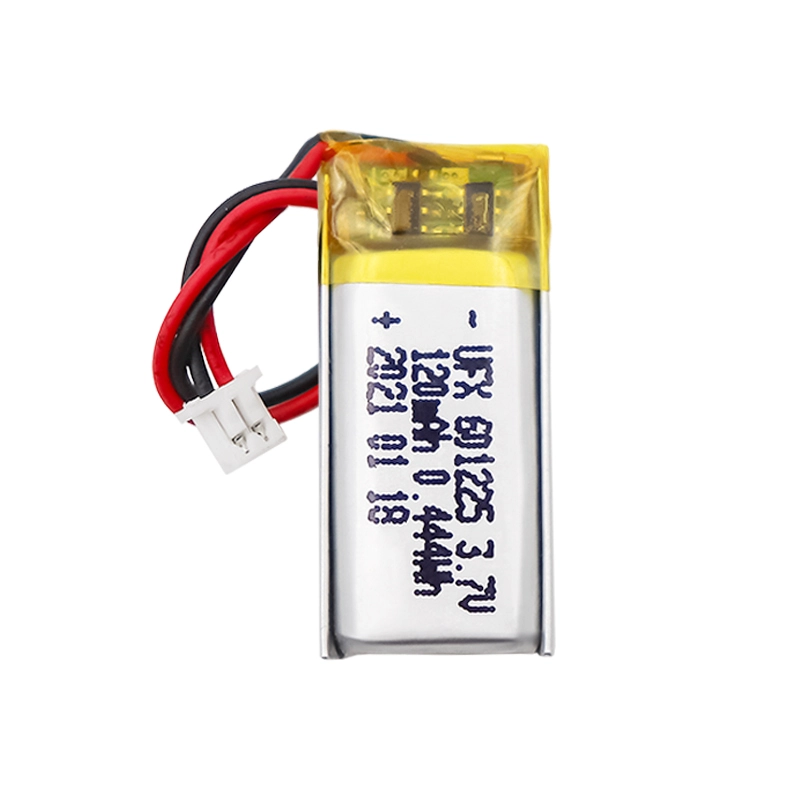
Recommended battery solutions
Polymer lithium batteries enable thin handle designs without sacrificing usability.
Part 5. Battery specification matching for hair clipper design

Typical Operating Voltage for Hair Clippers
- 3.6–3.7V: compact, low-power designs
- 7.2–7.4V: high-torque and professional clippers
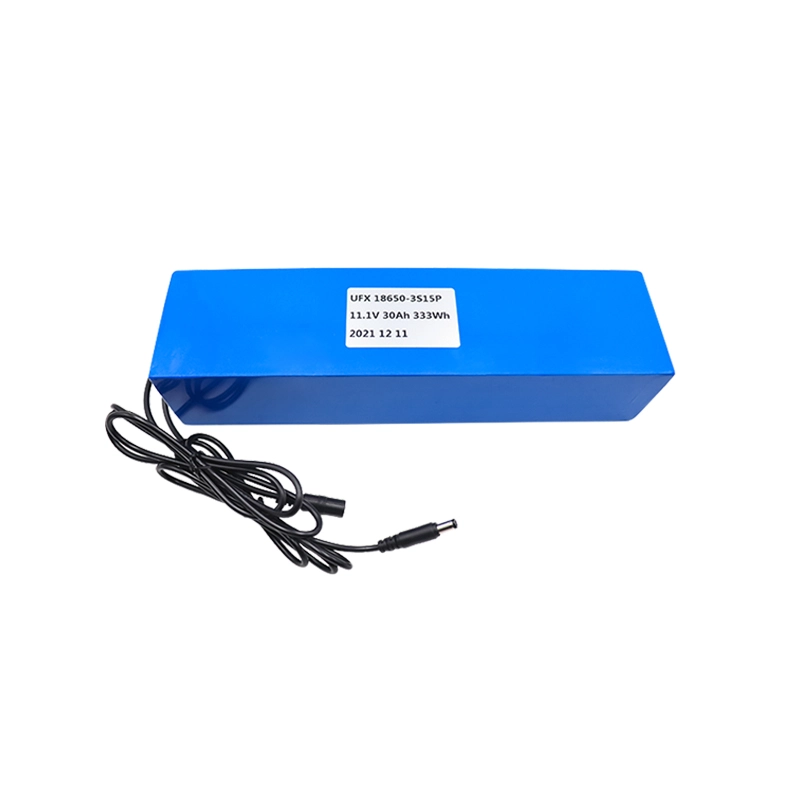
- 11.1V: specialty high-power grooming devices
Capacity Selection Based on Runtime Requirements
- <1500mAh: short, intermittent use
- 2000–3000mAh: daily grooming
- ≥5000mAh: professional continuous operation
Size & Form Factor Constraints
- Cylindrical cells: higher energy density, longer runtime
- Polymer cells: flexible shape, better ergonomics
Part 6. Decision parameters for hair clipper battery selection
| Parameter | Typical Range | Impact on Product |
|---|---|---|
| Nominal Voltage | 3.7V / 7.4V | Motor speed & torque |
| Capacity | 800–5000mAh | Runtime |
| Peak Discharge | 3C–10C | Cutting performance |
| Cycle Life | 500–1,500 cycles | Product lifespan |
| Charging Time | 1–3 hours | User convenience |
| Battery Size | Custom | Handle design |
Part 7. Safety, cycle life & user experience considerations
Lithium battery packs for hair clippers must include:
- Overcharge / over-discharge protection
- Short-circuit and temperature protection
- Stable performance under daily charging
To ensure long-term safety and reliability, lithium battery packs for hair clippers must be designed in compliance with IEC 62133 safety requirements for portable sealed secondary cells, including overcharge protection, short-circuit protection, and thermal monitoring in enclosed plastic housings.
Part 8. Custom hair clipper battery solutions
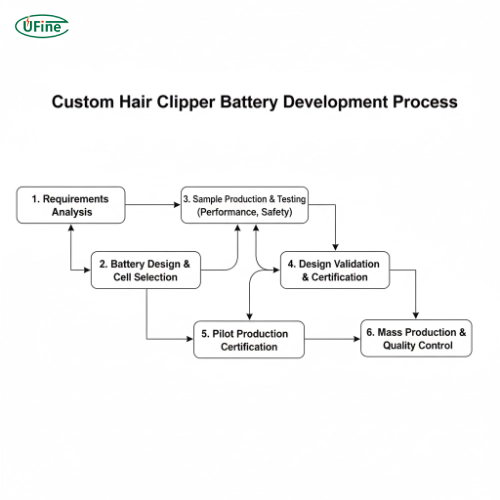
Ufine supports:
- Custom voltage, capacity, and size design
- Battery pack integration with PCM/BMS
- Sampling, validation, and mass production
Looking for a reliable lithium battery solution for hair clippers or trimmers?
Contact Ufine’s engineering team to discuss your application requirements.
High Energy Density
It stores large amounts of energy in a smaller and lighter package
Longer Cycle Life
Withstands extensive charge and discharge cycles
Low Self-Discharge
Maintains power longer when not in use
Safety
Minimizes the risk of accidents and ensures safe operation
More Information About Hair Clipper Battery
-
What battery voltage is best for professional hair clippers?
-
How does battery capacity affect hair clipper runtime?
-
Is fast charging safe for hair clipper lithium batteries?
-
How many charge cycles should a professional hair clipper battery support?
-
Can battery size be customized to fit slim clipper handles?
Latest Blogs
About Lithium Battery Industry News
LiFePO4 Voltage Chart Guide: Everything You Need to Know
Check the LiFePO4 voltage chart for 3.2V, 12V, 24V and 51.2V batteries. Compare SOC, charging voltage, cutoff limits and internal resistance.
2026/07/29 Ufine
Lithium Ion Cell Sizes: A Comprehensive Guide
Compare lithium ion cell sizes with a chart of dimensions, capacity ranges, cell types, applications, and key factors for selecting the right battery.
2026/07/29 Ufine
6 Volt Tractor Battery vs 12 Volt: Which One Fits Your Farm Equipment Best?
Compare 6V and 12V tractor batteries. Learn which voltage fits vintage or modern tractors, which specifications matter, and how to convert safely.
2026/07/28 Ufine

The Ultimate Guide to a Molten Salt Battery
Learn how a molten salt battery works, its main types, advantages, disadvantages, operating temperature, safety, and grid energy storage uses.
2026/07/28 Ufine
2000mAh Battery Runtime: How Long Will It Last in Real Devices?
Learn how to calculate 2000mAh battery runtime and backup time. See real device examples, power-loss factors, and battery replacement checks.
2026/07/28 Ufine
White Stuff on Battery Terminals: A Step-by-Step Cleaning and Maintenance Guide
White stuff on a battery may be corrosion or leaked electrolyte. Learn what causes white powder, whether it is dangerous, and how to clean it safely.
2026/07/28 Ufine

