Feature Battery
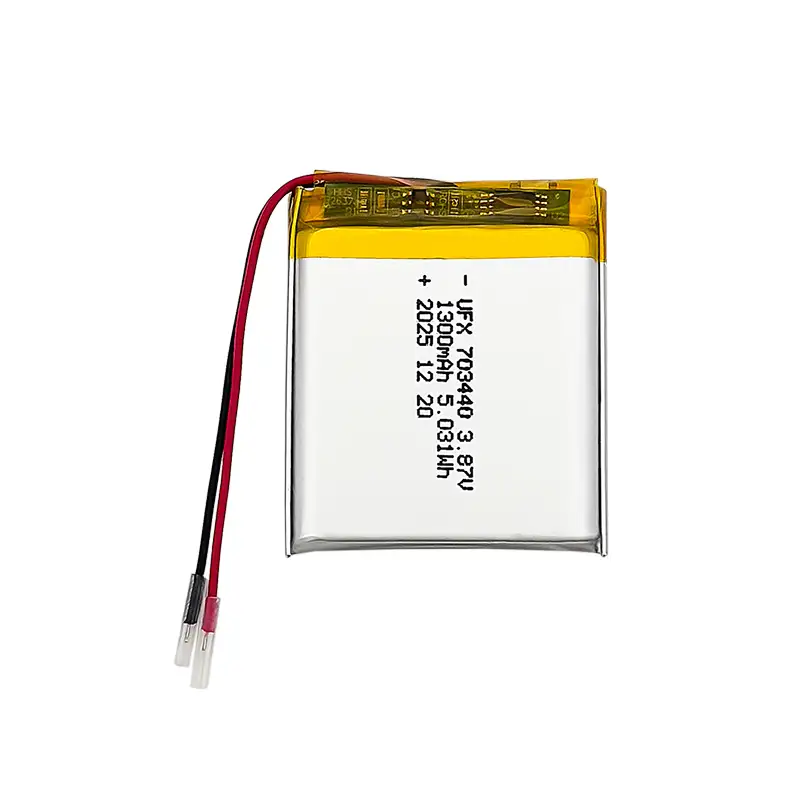
3.87V 1300mAh Lithium ion Battery 703440



- 16 Years Experience
- 200+ Certifications
- 1000+ Customers
- 7X24 Customer Support
-
Product Details
-
Specs
-
Content
-
FAQs

3.87V High-Voltage Design for More Power
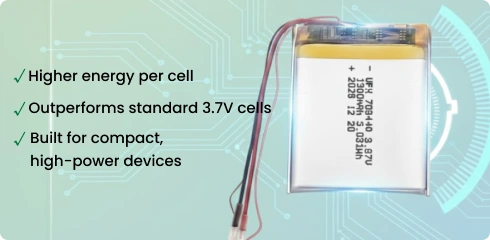
A higher nominal voltage means more usable energy in the same size. This 3.87V battery is designed to outperform standard 3.7V cells while keeping your device compact.
Test Curves of 3.87v Cell
Take a closer look at the battery test curves—see the stability and performance you can trust for all your power needs!
- Cycle Life
- Self-Discharge
- Discharge Rate
- Temp Performance

Long-Lasting Power
Exceptional Endurance Cycle
Empower your devices with longevity that goes the distance. This premium high-voltage LiPo cell maintains a remarkable 82% capacity even after 500 rigorous charge-discharge cycles. Engineered for stability at a higher 4.45V limit, it ensures your high-end electronics remain powerful and reliable throughout years of intensive daily use.
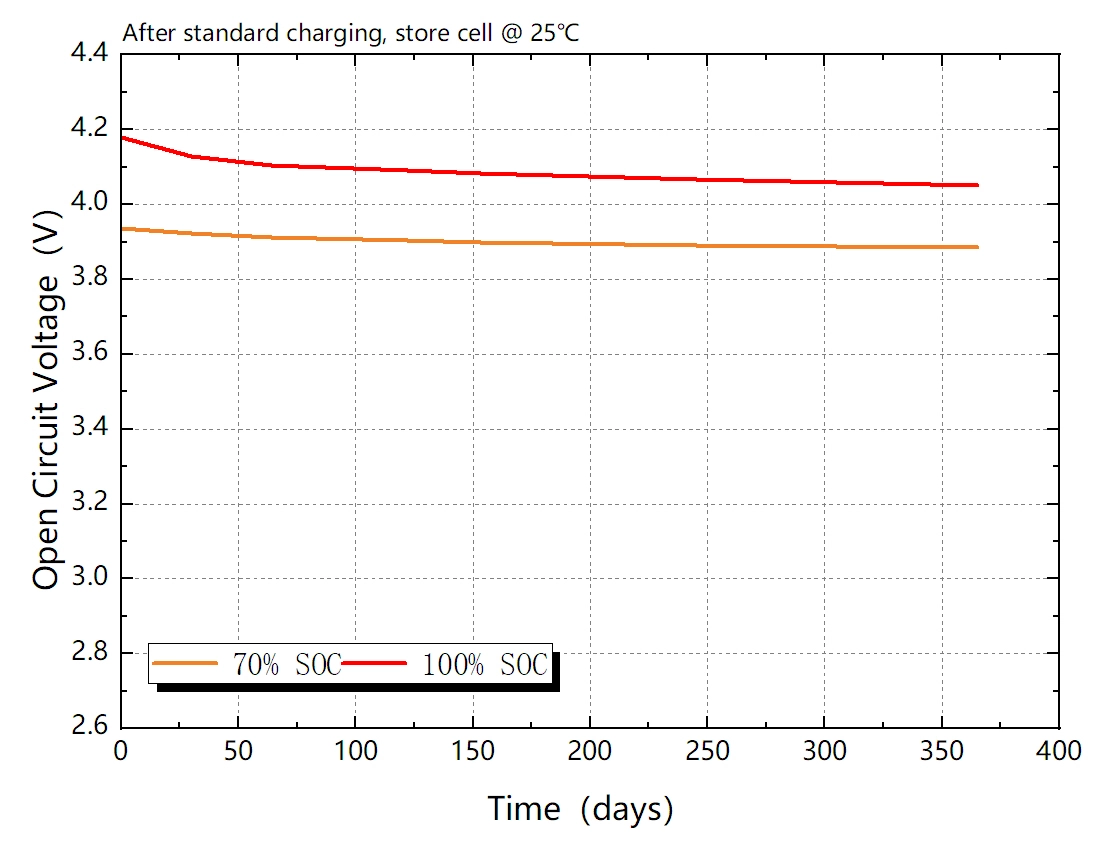
Incredible Charge Retention
With an incredibly low self-discharge rate, this battery holds its charge exceptionally well. After a full year of storage, its voltage only shows a minimal drop from 4.15V to 4.05V, keeping your device ready to go even after long periods of inactivity.
Learn More About Discharge Rate 
Superior High-Rate Discharge
Unleash peak performance without compromise. This cell is optimized for high-drain applications, retaining an incredible 97% of its capacity even at a heavy 5.0C discharge rate. Whether under standard load or maximum power demand, our advanced high-voltage technology minimizes voltage drop to ensure your device operates at full throttle until the very last drop of energy.
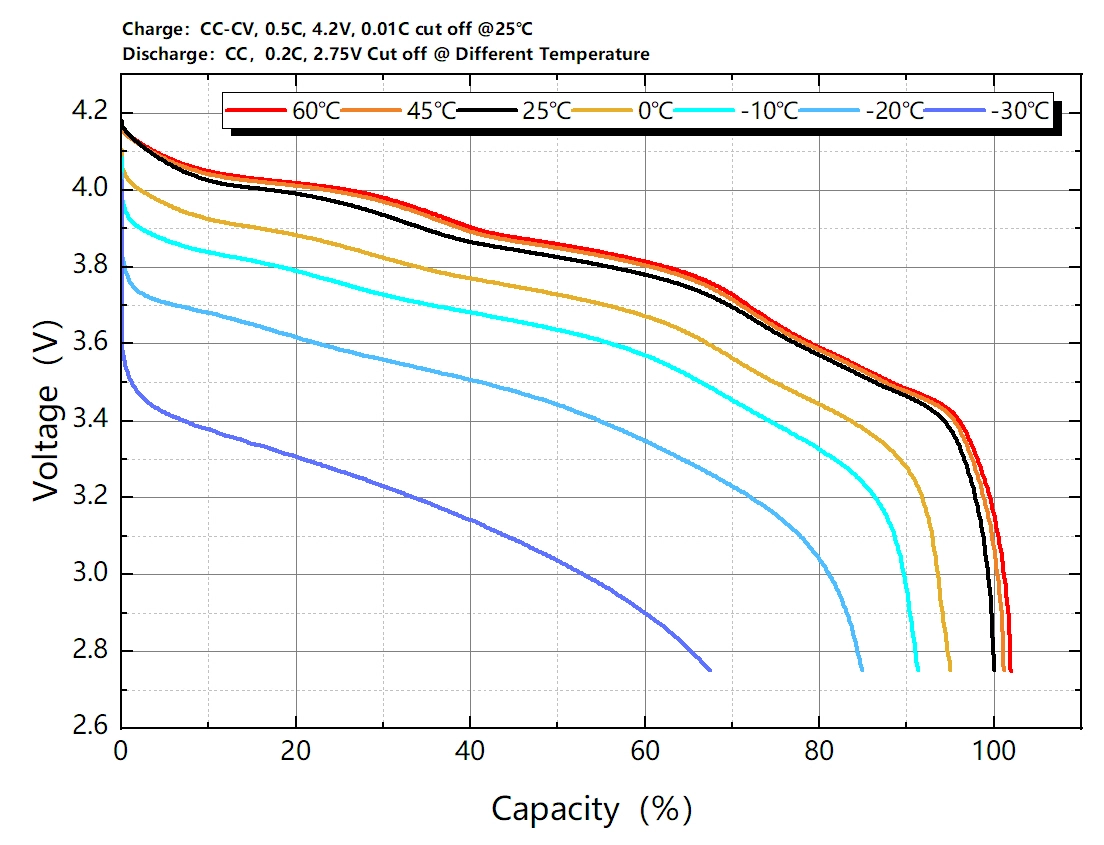
Extreme Temperature Performance
This battery is built for a wide range of climates. It offers consistent, high-capacity performance from 25°C to 60°C. Even in freezing conditions, it remains reliable, providing approximately 65% of its capacity at a frigid -30°C.
Unlock Longer Runtime with 4.45V Charging
Thanks to a 4.45V charging voltage, this battery stores more energy and keeps devices running longer between charges.
- 4.45V high-voltage charging design
- More usable capacity per cycle
- Longer operating time without increasing battery size
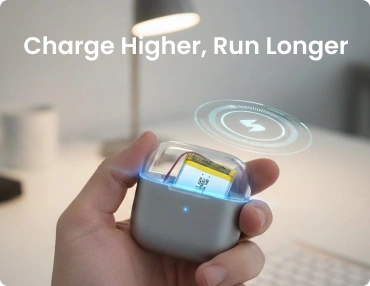
IR < 70mΩ, Stable Power You Can Rely On
Low internal resistance helps reduce heat and power loss, keeping your device running smoothly.
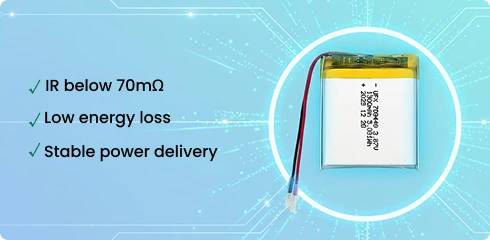
1300mAh High Capacity, Compact Design
This 1300mAh battery fits into a slim 703440 form factor, making it easy to integrate into space-limited products.
- 1300mAh capacity in a compact size
- Dimensions: 7 × 34 × 42 mm (max)
- Perfect for lightweight and slim device designs
- Discharge temperature: -20°C to 60°C
- Charge temperature: 0°C to 45°C
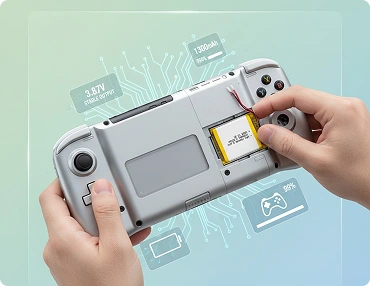
Why Choose Ufine Battery
Ufine Battery (Direct Factory)
- Direct manufacturer with full production control, ensuring consistent quality for every 18650 battery pack
- Volume-based pricing with competitive factory cost
- Supports custom battery pack size, PCM/BMS, connectors, cables, and configurations
- Flexible MOQ, suitable for prototypes and small pilot runs
- 17 years of lithium battery manufacturing experience; provides technical drawings, pack design, and engineering guidance
- Complete reports available: MSDS, UN38.3, CE, RoHS, etc.
- Stable production with predictable lead time, ideal for OEM/ODM projects
- Professional after-sales service with quick response for B2B clients
Ordinary Channels / Traders / Small Workshops
- Often resell from unknown factories; inconsistent quality and higher failure risk
- Middleman markups lead to unstable or higher pricing
- Limited or no customization; mostly standard products only
- High MOQ, difficult for new projects to start
- Little to no technical support; only sells finished goods
- Certifications often missing or incomplete, causing delays in shipping or customs
- Lead time uncertain; stock availability unstable
- Limited support; difficult to handle quality claims
Battery Specification
-
1. Mechanical Characteristics
Cell 703440 PCM Yes NTC No Weight appr. 19g Configuration 1S1P -
2. Electrical Specification
Capacity 1300mAh Nominal Voltage 3.87V Energy 5.031Wh Internal Resistance less than 70mΩ Max. Charge Voltage 4.45V Discharge Cut Off 2.75V Max. Charge Current 650mA Max. Discharge Current 650mA Standard Charge Current 260mA Standard Discharge Current 260mA Charging Temperature 0℃ to 45℃ Discharging Temperature -20℃ to 60℃ Storage Temp. Range 1 year at -20℃ to +30℃ 3 mos. at -20℃ to +45℃ 1 mo. at -20℃ to +60℃ Cycle life 100 cycles ≥92% 300 cycles ≥88% 500 cycles ≥80% -
3. Cell protection
Overcharge Detection 4.45 ±25mV (1000 to 1600msec delay, release 4.2V ±50mV) Overdischarge Detection 2.8V ±50mV (115 to 175msec. delay, release 3.0V ±50mV) Overcurrent Detection 5A to 9A (9 to 15msec. delay) Short protection Yes
Choosing a lithium battery is not about capacity alone. For engineers and product teams, the real questions are voltage behavior, charge limits, lifecycle trade-offs, and customization feasibility. This page answers those questions directly.
Part 1. Why 3.87V Nominal Voltage Matters (Compared to 3.7V)
A 3.87V nominal voltage battery delivers higher usable energy within the same physical size than a standard 3.7V cell.
-
More runtime without increasing battery size
-
Higher system voltage headroom for modern ICs
-
Better performance in space-constrained designs
For the 703440 size, moving from 3.7V to 3.87V nominal voltage allows designers to extract more energy without redesigning the enclosure.
Part 2. Understanding the 4.45V Charging Voltage (And Why It’s a Concern)
This battery is designed to be charged up to 4.45V, enabling higher energy density—but it requires proper charge control.
-
Charging to 4.45V increases capacity compared to 4.2V / 4.35V systems
-
Requires a high-voltage compatible charger IC
-
Proper protection circuitry is critical for safety and cycle life
Ufine Battery integrates high-voltage chemistry with stable electrode materials to support 4.45V charging while maintaining reliability.
Part 3. Is High Voltage Worth the Trade-Off?
Yes—when designed correctly.
| Factor | Standard Li-ion (4.2V) | High Voltage Li-ion (4.45V) |
|---|---|---|
| Energy density | Lower | Higher |
| Runtime | Shorter | Longer |
| Charger requirement | Standard | HV-compatible |
| Design complexity | Lower | Moderate |
For devices like wearables, medical electronics, smart sensors, and compact consumer products, the benefits often outweigh the added charger requirements.
Part 4. Real Capacity: What Does 1300mAh Actually Mean?
1300mAh is the rated nominal capacity under controlled test conditions, not a marketing peak value.
-
Discharge current
-
Cut-off voltage
-
Operating temperature
-
Load profile
Ufine Battery provides capacity testing under customer-specified conditions, not just standard lab specs.
Estimate battery runtime using an online calculator:
Part 5. Battery Size 703440: Is It Right for Your Design?
703440 typically refers to:
-
Approx. 7.0 mm thickness
-
34 mm width
-
40 mm length
This format is commonly selected when PCB layout is already fixed, thickness must stay under 8 mm, and a single-cell solution is preferred over parallel cells.
Part 6. Can This Battery Be Customized?
Yes. Ufine Battery offers deep customization, not just label changes.
-
Charging voltage (4.35V / 4.4V / 4.45V)
-
Capacity tuning
-
PCM / protection circuit design
-
Connector type and cable length
-
Cell thickness or footprint adjustment
-
Branding and OEM packaging
This allows you to match the battery to your system, not redesign your system around the battery.
Part 7. Typical Applications for 3.87V High-Voltage 703440 Cells
This battery is often evaluated for:
-
Wearable electronics
-
Portable medical devices
-
Smart sensors and IoT modules
-
Compact consumer electronics
-
Custom OEM devices requiring long runtime
If your product is energy-limited but space-constrained, this chemistry is usually a strong candidate.
Part 8. Is This Battery Safe for Mass Production?
Yes—when paired with the correct protection and charging design.
-
PCM design matching your charging voltage
-
UN38.3, IEC-related testing support
-
Sample validation before mass production
-
Engineering support during integration
High voltage does not mean unsafe—it means design discipline matters more.
Part 9. Final Takeaway
The 3.87V 1300mAh High Voltage Li-ion Battery 703440 is not for every product—but it is ideal when:
-
You need more energy without increasing size
-
Your system supports or can adopt 4.45V charging
-
Customization and long-term supply stability matter
Ufine Battery doesn’t just sell cells—we help tailor high-voltage batteries to real products.
FAQs
-
Can multiple cells be safely connected in series or parallel?
Yes, but it requires proper balancing and protection circuits to ensure consistent voltage and prevent overcharge or over-discharge in multi-cell configurations. -
Is this battery RoHS and REACH compliant?
Yes. Ufine Battery ensures all cells meet major environmental compliance standards including RoHS and REACH, making them safe for global markets. -
How long does it take to fully charge the battery?
Charging time depends on the charger current, but with a recommended high-voltage 4.45V charger, full charge typically takes 2–3 hours at 0.5C rate. -
Can this battery support high-current discharge for short bursts?
Yes. The 703440 cell is designed to handle moderate peak currents, making it suitable for devices that occasionally demand high power, such as sensors or portable electronics. -
Does this battery require a specific charging profile?
Yes. To ensure safety and longevity, it should be charged using a high-voltage compatible charger with proper constant-current/constant-voltage (CC/CV) profile for 4.45V cells. -
Can this battery be used in custom-shaped enclosures or unusual form factors?
Yes. Ufine Battery offers customization of cell size, thickness, and connectors, allowing the battery to fit non-standard layouts without compromising performance.
Ready to Power Your Project?
We’ll help you design the perfect power source — tailored to your voltage, capacity, size, C-rate, and performance needs.
Contact Us NowWhat Our Customers Are Saying
We love hearing from you! Your experiences help us improve and inspire others. Check out what our happy customers have to say about our lithium batteries—share your thoughts with us too!









Latest Articles
About Lithium Battery Industry News
고방전 배터리는 높은 전류와 발열로 배터리수명이 줄어듭니다. 구조적 한계, 사용 패턴, 충전 습관 등 실제 수명 단축 요인을 체계적으로 분석했습니다.
2026-2-28 이선우
Capacitor vs Battery: What is the Difference?
Capacitor vs battery explained in detail. Learn the difference between capacitor and battery in energy storage, charging speed, lifespan, and real applications.
2026-2-28 Ufine
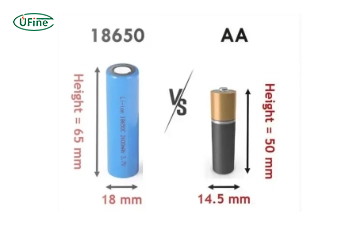
18650 Battery vs AA: Which Is Better for Your Device?
Compare 18650 vs AA batteries in capacity, voltage, rechargeability, and applications. Learn which battery type fits high-drain or everyday devices.
2026-2-28 Ufine