Feature Battery
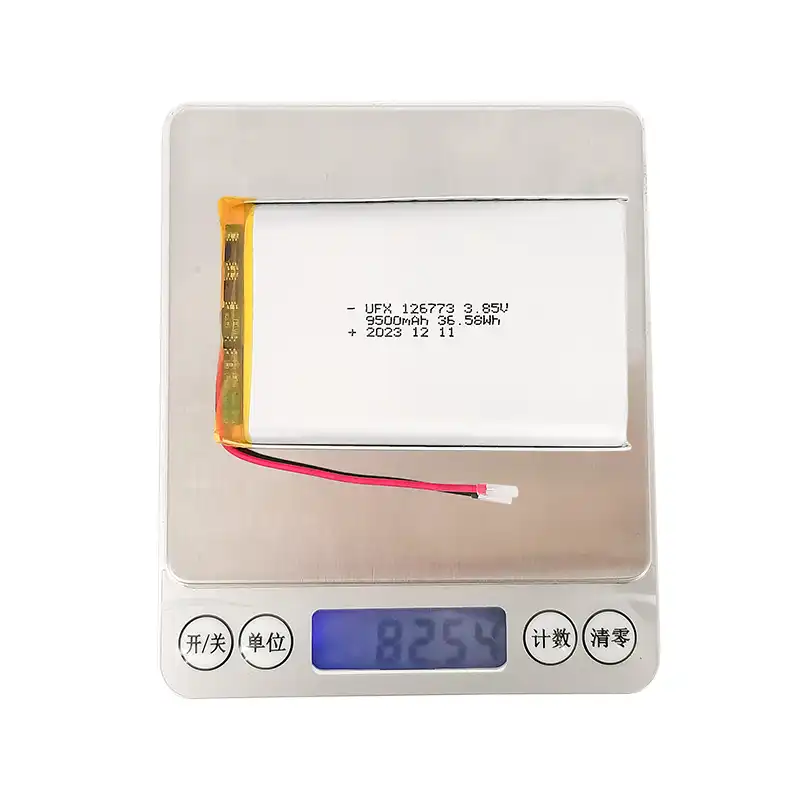
3.85V 9500mAh Lithium ion Battery 126773


- 16 Years Experience
- 200+ Certifications
- 1000+ Customers
- 7X24 Customer Support
-
Product Details
-
Specs
-
Content
-
FAQs

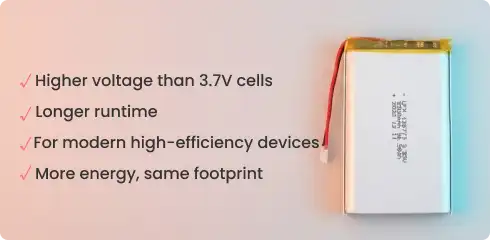
Power More with a 3.85V Battery
Solve the problem of short runtime without increasing battery size
Test Curves of 3.85v Cell
Take a closer look at the battery test curves—see the stability and performance you can trust for all your power needs!
- Cycle Life
- Self-Discharge
- Discharge Rate
- Temp Performance

Outstanding Cycle Longevity
Experience unwavering power that lasts. This high-performance 3.85V LiPo cell is engineered for endurance, maintaining an impressive 86% capacity retention even after 500 full charge-discharge cycles. While standard batteries often fade quickly, our advanced chemistry ensures a steady, reliable energy output with minimal degradation, guaranteeing your device stays powered longer over years of daily use.
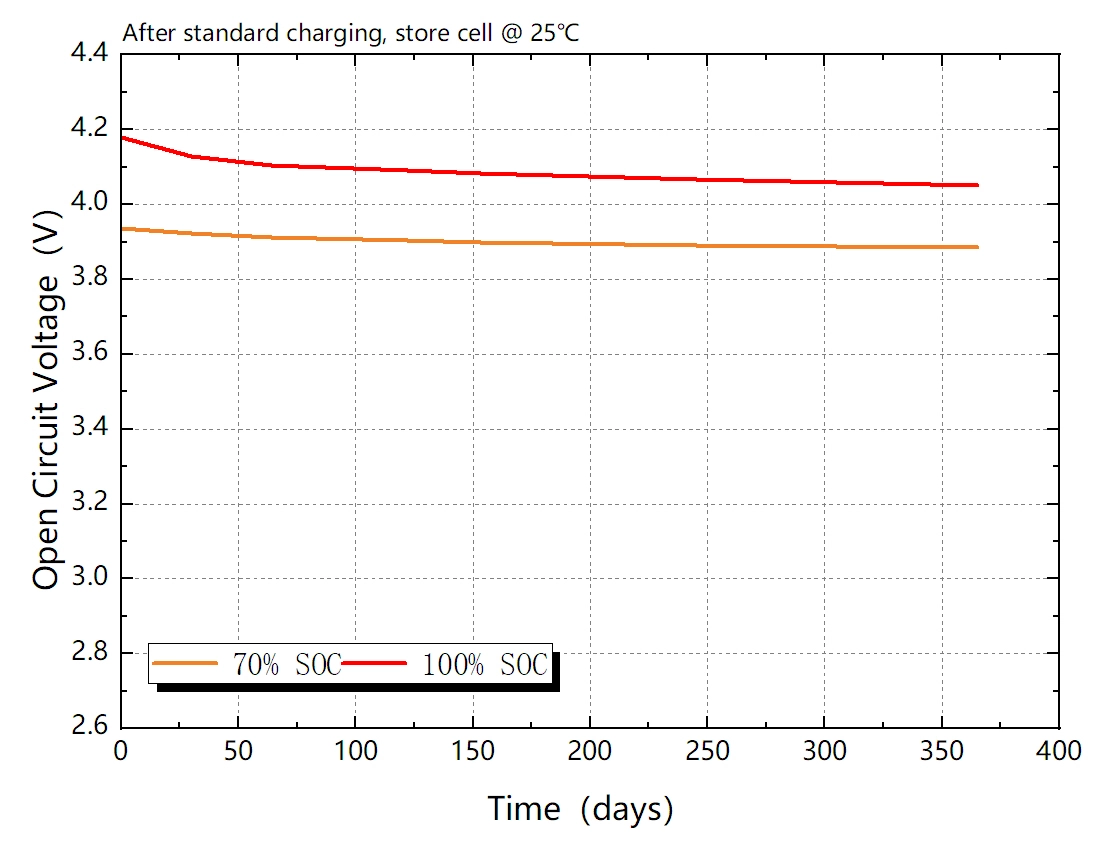
Incredible Charge Retention
With an incredibly low self-discharge rate, this battery holds its charge exceptionally well. After a full year of storage, its voltage only shows a minimal drop from 4.15V to 4.05V, keeping your device ready to go even after long periods of inactivity.
Learn More About Discharge Rate 
Unmatched High-Rate Performance
Empower your high-drain devices with relentless energy. This advanced 3.85V LiPo cell is built to excel under pressure, delivering stable voltage even at extreme discharge rates. While performance typically drops significantly under load, our cell maintains over 95% capacity at a 2.0C rate and continues to provide robust power even at a massive 5.0C discharge, ensuring your device performs at its peak when you need it most.
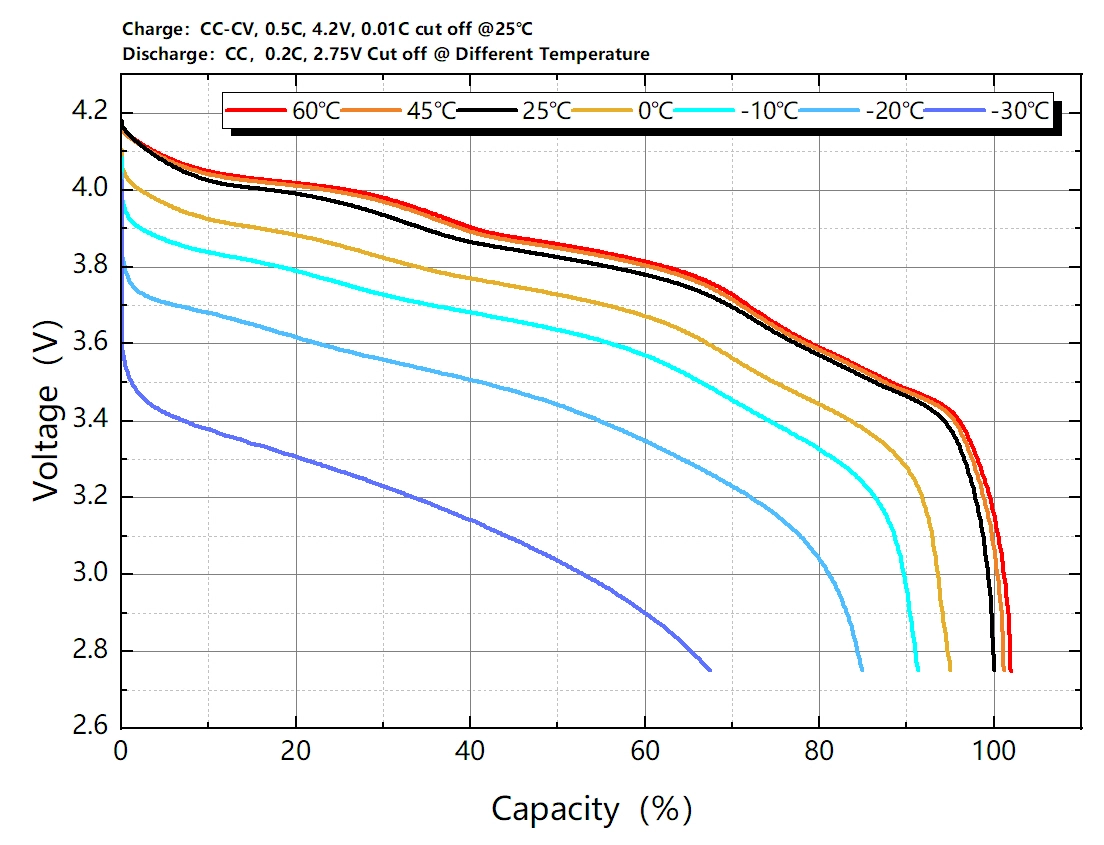
Extreme Temperature Performance
This battery is built for a wide range of climates. It offers consistent, high-capacity performance from 25°C to 60°C. Even in freezing conditions, it remains reliable, providing approximately 65% of its capacity at a frigid -30°C.
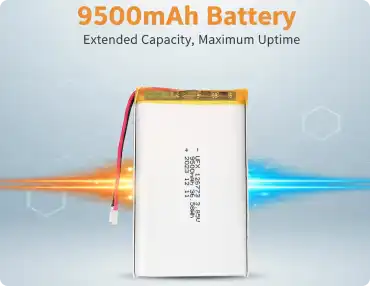
Run Longer on a 9500mAh Battery
Achieve extended operating time and fewer charging cycles
- High 9500mAh capacity for long-lasting power
- Reduces charging frequency for end users
- Supports power-hungry devices and long-duty cycles
- Improves overall user experience and uptime
Faster Charging with a 4.4V High-Voltage Design
Reduce charging time and improve energy efficiency

Flexible Design with a LiPo Battery
Fit high-capacity power into space-constrained devices
- Slim pouch-style LiPo battery structure
- Easy to integrate into custom enclosures
- Ideal for flat or uniquely shaped products
- Supports flexible and lightweight device designs

What We Custom and How
At Ufine, we know that one size doesn't fit all, especially when it comes to battery needs. That's why we specialize in custom battery solutions.
- Battery Chemistries: We build with Lithium, Polymer, LiFePO4, and 18650 cells.
- Custom Specs: We customize size, voltage, capacity, and shape to fit your needs.
- Connectors: Get the perfect fit with JST, Molex, XT series, and more.
- Performance: Our batteries handle discharge rates from 0.2C to 25C.
- Temperature: They're designed to operate from -40°C to 80°C.
-
01Enquiry and Design: Contact us with requirements. The technical team creates tailored designs.
-
02Sampling and Sample Testing: Receive customized battery samples for evaluation within two days.
-
03Confirmation and Production: Finalize specifications, sign the production contract, and pay a 30% deposit.
-
04Delivery and Shipping: Make final payment, and arrange safe and efficient delivery.
Battery Specification
-
1. Mechanical Characteristics
Cell 126773 PCM Yes NTC No Weight appr. 82.54g Configuration 1S1P -
2. Electrical Specification
Capacity 9500mAh Nominal Voltage 3.85V Energy 36.575Wh Internal Resistance less than 110mΩ Max. Charge Voltage 4.4V Discharge Cut Off 2.75V Max. Charge Current 4750mA Max. Discharge Current 4750mA Standard Charge Current 1900mA Standard Discharge Current 1900mA Charging Temperature 0℃ to 45℃ Discharging Temperature -20℃ to 60℃ Storage Temp. Range 1 year at -20℃ to +30℃ 3 mos. at -20℃ to +45℃ 1 mo. at -20℃ to +60℃ Cycle life 100 cycles ≥92% 300 cycles ≥88% 500 cycles ≥80% -
3. Cell protection
Overcharge Detection 4.4 ±25mV (1000 to 1600msec delay, release 4.2V ±50mV) Overdischarge Detection 2.8V ±50mV (115 to 175msec. delay, release 3.0V ±50mV) Overcurrent Detection 5A to 9A (9 to 15msec. delay) Short protection Yes
Many modern electronic devices are constrained by energy density rather than physical space. Standard 3.7V lithium batteries often struggle to deliver sufficient usable energy without increasing battery size or adding more cells.
The 126773 lithium-ion battery addresses this limitation by combining a higher nominal voltage, higher charge voltage, and ultra-high capacity—enabling longer runtime and more efficient system design for advanced electronic products.
Part 1. What problem does this battery solve?
Traditional 3.7V batteries limit total energy output in space-constrained designs. Increasing runtime usually means adding cells, which raises cost, complexity, and size.
-
3.85V nominal voltage for higher energy density
-
4.4V charge voltage for increased usable capacity
-
9500mAh ultra-high capacity in a single cell
This combination allows designers to achieve longer runtime, fewer cells, and a simpler power architecture.
Part 2. Why choose 3.85V instead of standard 3.7V?
This is often the first question engineers ask when evaluating high-energy batteries.
-
More energy stored per charge cycle
-
Improved DC-DC conversion efficiency
-
More stable device performance over discharge
In practical terms, a 3.85V battery delivers more watt-hours without increasing battery size—making it ideal for energy-demanding applications.
Part 3. Is 4.4V charging safe and reliable?
Yes—when the battery is specifically designed for high-voltage charging.
-
High-voltage lithium chemistry designed for 4.4V
-
Not a forced overcharge of standard 4.2V cells
-
Compatible with dedicated 4.4V charging ICs
This design enables higher capacity while maintaining safety, reliability, and long-term performance.
Part 4. How does 9500mAh capacity impact real-world runtime?
Capacity directly affects user experience, maintenance cycles, and device availability.
-
Longer continuous operation time
-
Reduced charging frequency
-
Lower depth-of-discharge stress per cycle
This is especially beneficial for field devices, limited-access charging environments, and systems designed for long standby or operating cycles.
Use our calculator to quickly estimate battery runtime.
Part 5. Why watt-hours (Wh) matter more than mAh
While mAh is commonly referenced, watt-hours provide the true measure of total energy.
-
Nominal voltage: 3.85V
-
Capacity: 9500mAh
The result is significantly higher total energy compared to standard 3.7V batteries of similar size—meaning longer runtime and fewer batteries required at the system level.
Use our online calculator for quick Wh to mAh conversion.
Part 6. System design benefits for engineers
From an engineering perspective, this battery simplifies both electrical and mechanical design.
-
Fewer cells needed to meet runtime targets
-
Simplified battery pack architecture
-
Improved efficiency in power management circuits
-
Better support for high-load and peak-current demands
These advantages reduce BOM cost, shorten development cycles, and improve overall product reliability.
Part 7. Typical applications where this battery excels
Customers often ask whether this battery fits their specific product category.
-
Industrial portable equipment
-
Medical and healthcare electronics
-
High-end consumer devices
-
Energy storage modules
-
Smart devices requiring extended runtime
Any application that values high energy density and stable voltage output is a strong candidate.
Part 8. Customization and OEM/ODM support
Customization is a key requirement for many OEM and ODM customers.
-
Custom sizes and shapes
-
Custom nominal and charge voltages
-
Custom capacities and discharge rates
-
Complete battery pack development
This battery can serve as a reference design—not a limitation.
Part 9. Who should choose this battery?
This solution is ideal for teams that:
-
Need longer runtime without increasing size
-
Plan to upgrade from standard 3.7V cells
-
Design products with high power or long duty cycles
-
Require stable, high-energy battery solutions
Part 10. Final takeaway
The 126773 3.85V 9500mAh lithium-ion battery is not just a higher-capacity cell—it is a system-level upgrade.
By combining a 3.85V nominal voltage, 4.4V charging capability, and ultra-high 9500mAh capacity, it enables better performance, longer runtime, and more efficient product design.
FAQs
-
Is this 3.85V battery compatible with systems designed for 3.7V batteries?
In many cases, yes, but system-level evaluation is required. Power management ICs, charging circuits, and voltage tolerances must support high-voltage lithium cells. Ufine Battery can assist with compatibility assessment and optimization. -
Does using a 4.4V charging battery require a special charger?
Yes. A charger or charging IC specifically designed for 4.4V high-voltage lithium batteries is required. Using a standard 4.2V charger will limit usable capacity and total energy output. -
Can this battery be supplied as a battery pack instead of a single cell?
Yes. Ufine Battery provides complete battery pack solutions, including PCM/BMS integration, connector selection, and enclosure design for OEM and ODM projects. -
What safety protections are available for this battery?
Safety protections such as overcharge, over-discharge, overcurrent, and short-circuit protection can be integrated at the battery pack level. Protection features can be customized according to application needs.
Ready to Power Your Project?
We’ll help you design the perfect power source — tailored to your voltage, capacity, size, C-rate, and performance needs.
Contact Us NowWhat Our Customers Are Saying
We love hearing from you! Your experiences help us improve and inspire others. Check out what our happy customers have to say about our lithium batteries—share your thoughts with us too!









Latest Articles
About Lithium Battery Industry News
고방전 배터리는 높은 전류와 발열로 배터리수명이 줄어듭니다. 구조적 한계, 사용 패턴, 충전 습관 등 실제 수명 단축 요인을 체계적으로 분석했습니다.
2026-2-28 이선우
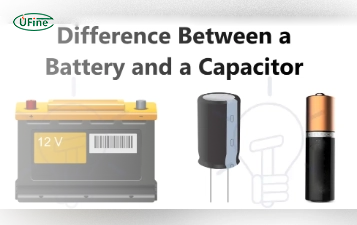
Capacitor vs Battery: What is the Difference?
Capacitor vs battery explained in detail. Learn the difference between capacitor and battery in energy storage, charging speed, lifespan, and real applications.
2026-2-28 Ufine
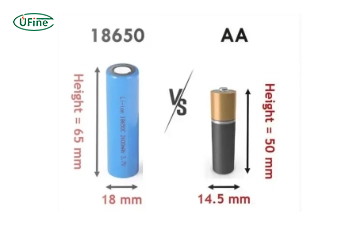
18650 Battery vs AA: Which Is Better for Your Device?
Compare 18650 vs AA batteries in capacity, voltage, rechargeability, and applications. Learn which battery type fits high-drain or everyday devices.
2026-2-28 Ufine