Popular Choice
955565 5000mAh LiPo Battery for Portable Devices


- 16 Years Experience
- 200+ Certifications
- 1000+ Customers
- 7X24 Customer Support
-
Product Details
-
Specs
-
Content
-
FAQs

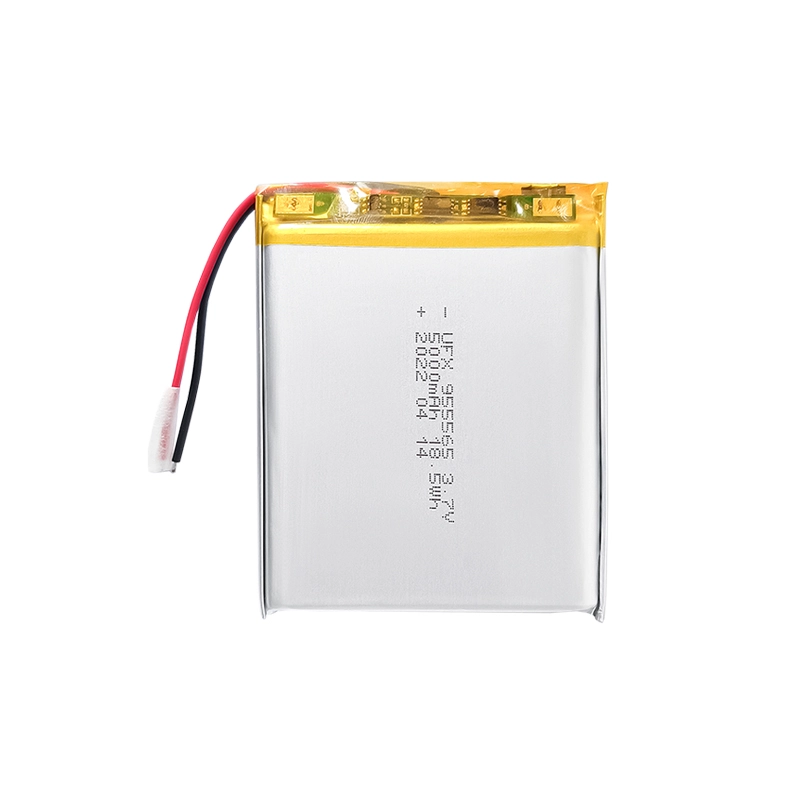
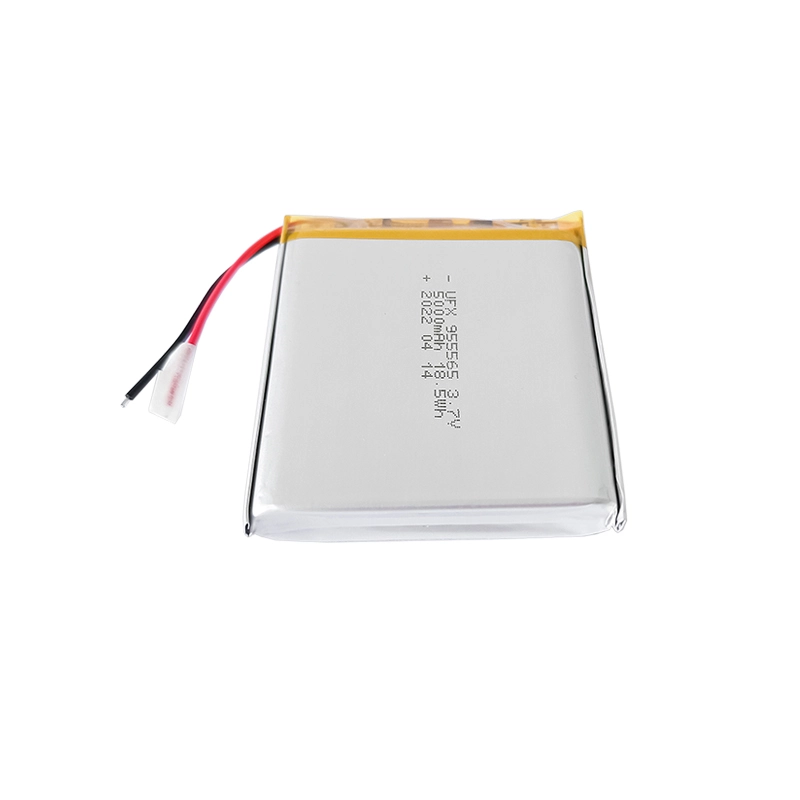
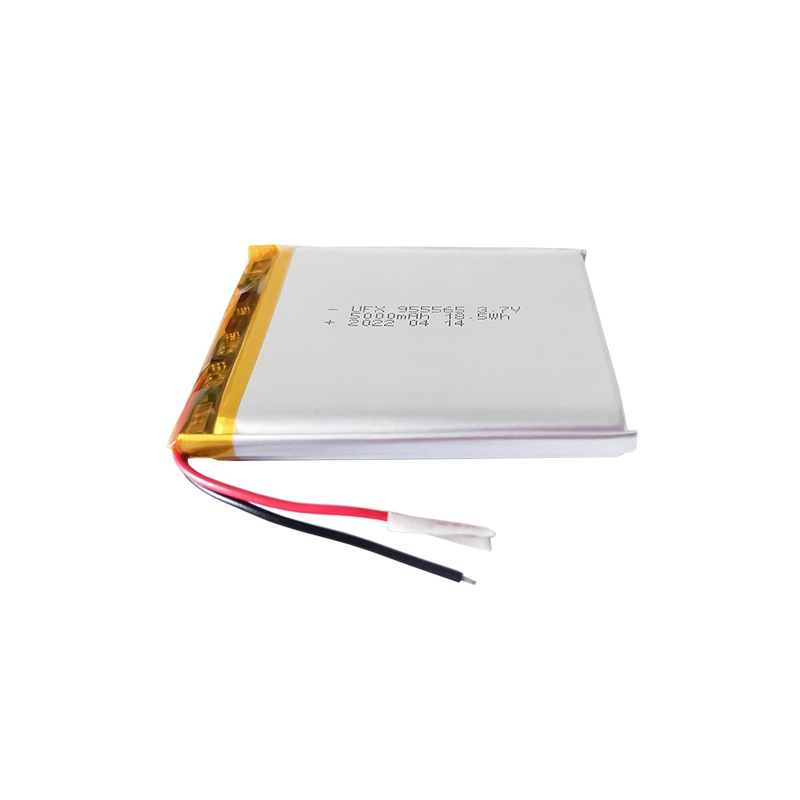
The Ufine 955565 is a 3.7V 5000mAh rechargeable lithium polymer pouch battery. It stores 18.5Wh of nominal energy in a body measuring up to 9.5 × 55 × 67mm. The standard assembly includes a protection board. KC and UL1642 are listed for this model. Request the documents to check their scope.
955565 Battery Performance
Review the load, charging method, and use conditions. Capacity alone does not show whether a battery suits your device.
- Power Output
- Cycle Life
- Storage
- Temperature
5000mAh Capacity With a Load Review
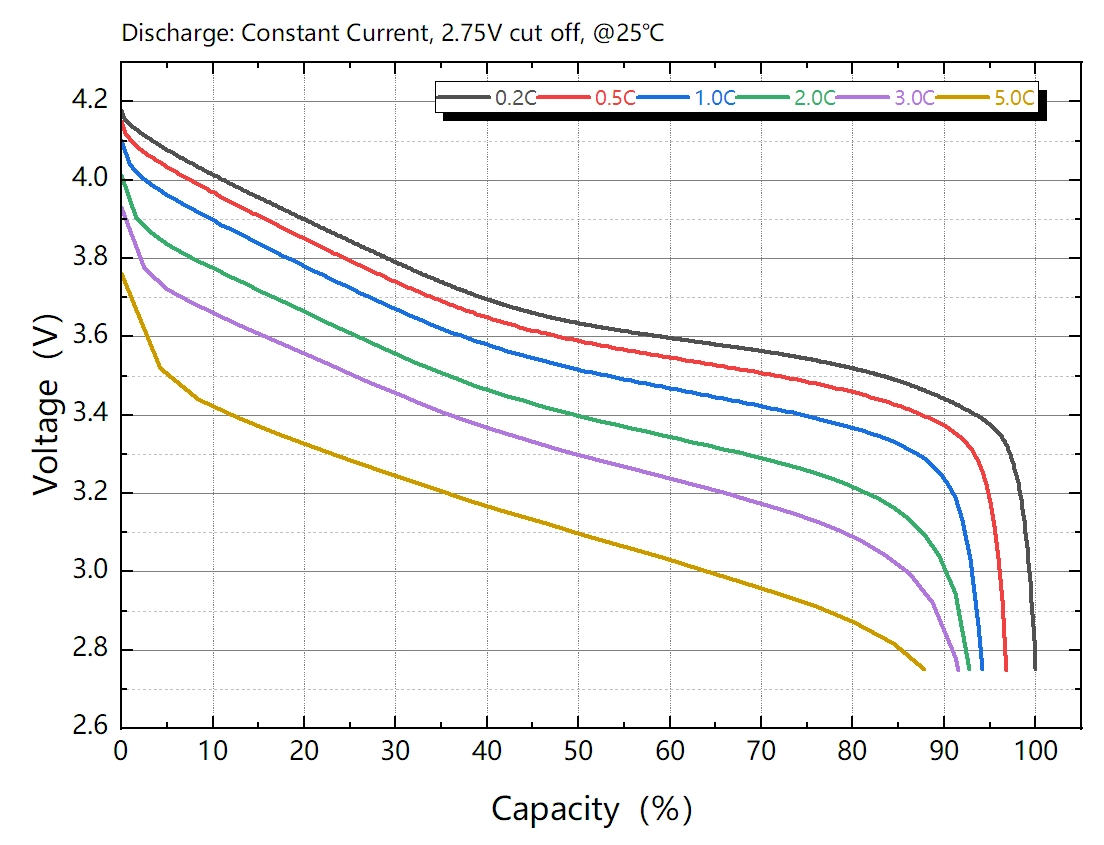
The 955565 provides 18.5Wh of nominal energy. The detailed specification lists a standard charge and discharge current of 1000mA (0.2C).
- Nominal voltage: 3.7V
- Maximum charge voltage: 4.2V
- Listed discharge cut-off: 2.75V
The electrical table lists 5A maximum charge and discharge current. However, the listed PCM overcurrent detection range is 2.5–4.5A. Confirm the finished assembly current limit before designing for high loads.
Understand Discharge Rate and Current 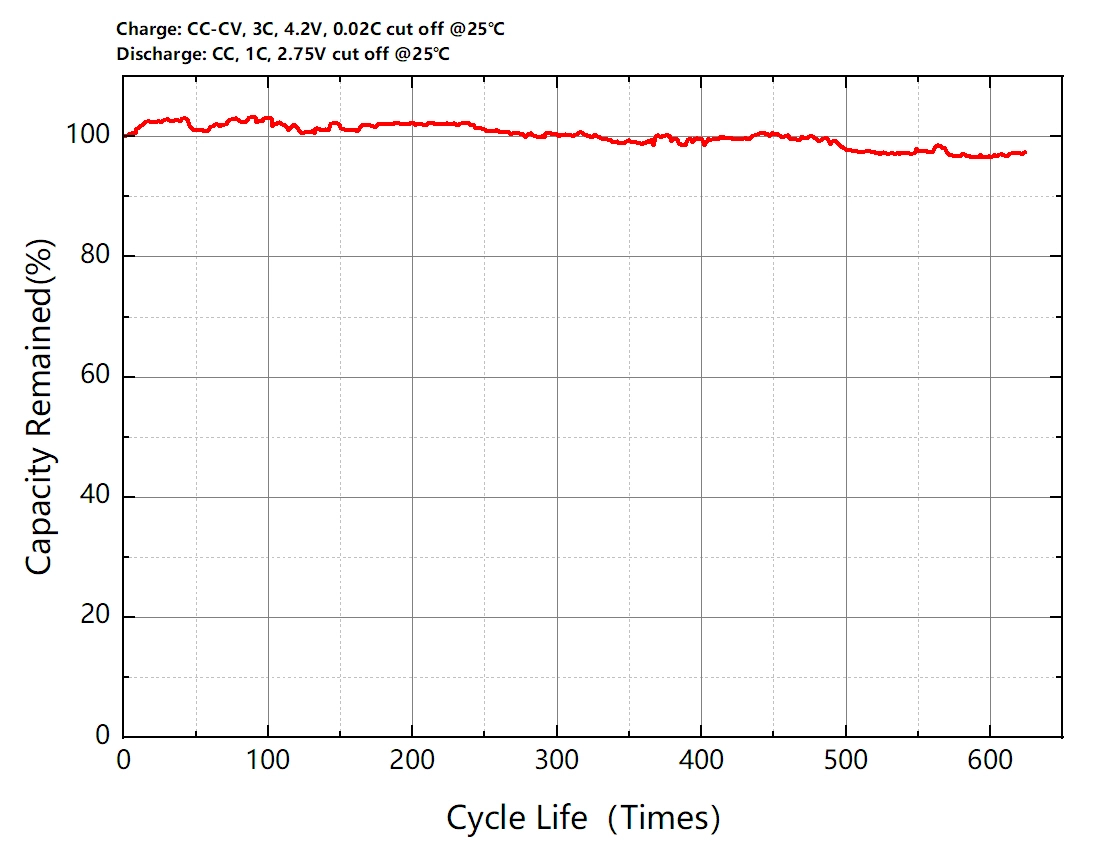
Check the Capacity Left After Cycling
The detailed specification lists the following capacity retention values for the 955565.
- 100 cycles: ≥92% capacity
- 300 cycles: ≥88% capacity
- 500 cycles: ≥80% capacity
Request the test method before comparing these values with another battery. Charge rate, discharge rate, temperature, and voltage limits must be stated.
Learn About Battery Charge Cycles 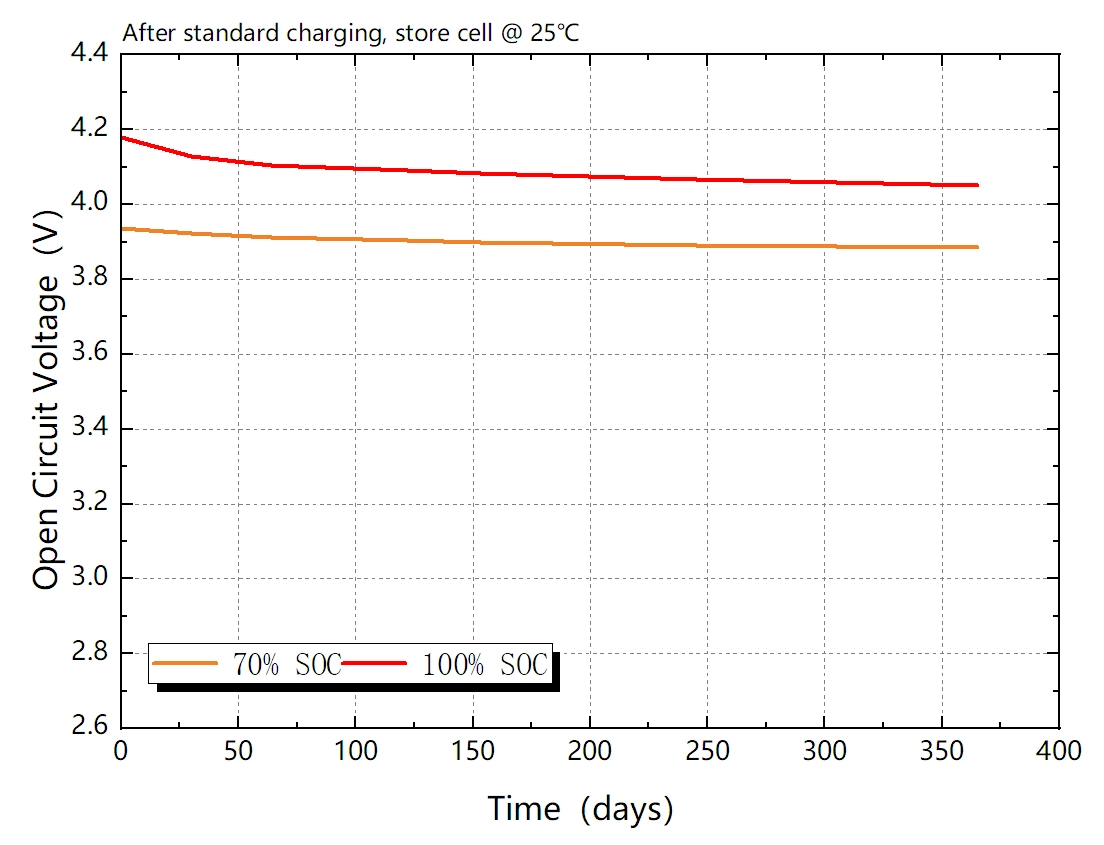
Match Storage Temperature to Storage Time
The listed storage temperature limits change with the planned storage period.
- Up to 1 year: −20°C to 30°C
- Up to 3 months: −20°C to 45°C
- Up to 1 month: −20°C to 60°C
These ranges do not promise a full charge after storage. Check standby drain in the device and agree on storage charge level and inspection intervals.
Learn About Storage and Self-Discharge 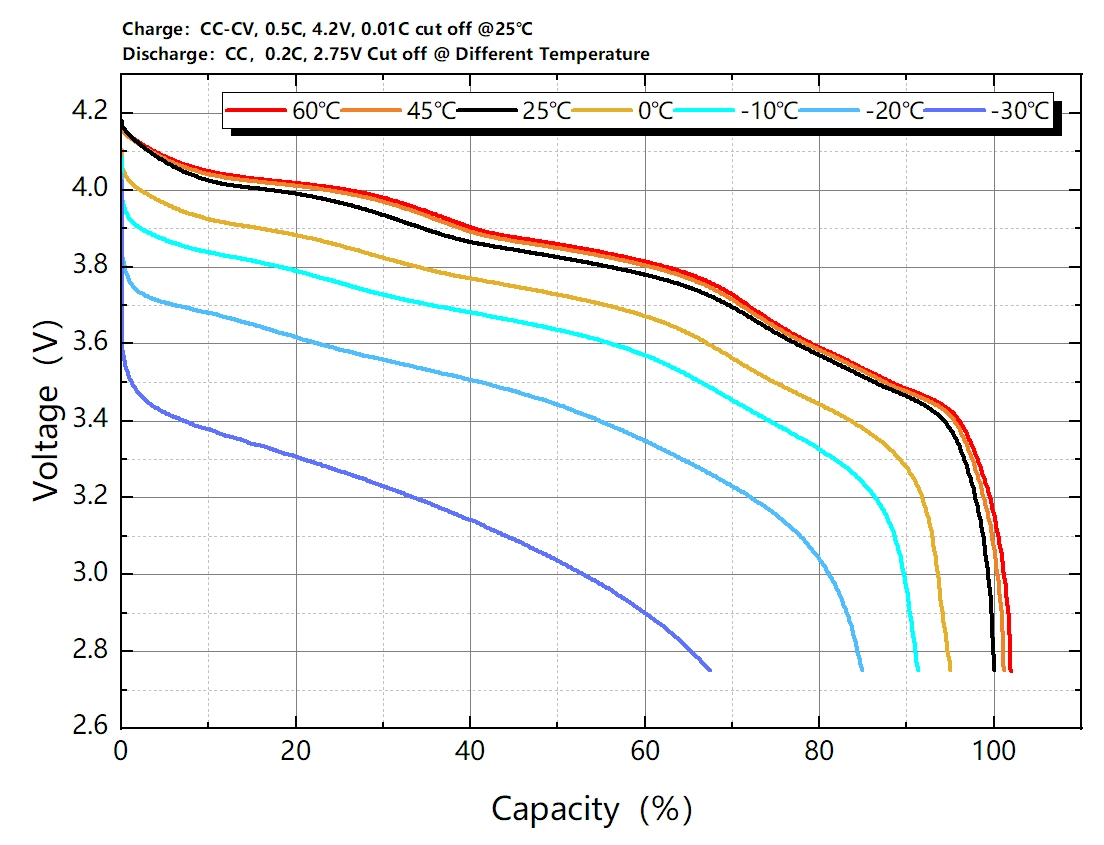
Measure Temperature Inside the Product
The battery may be warmer than the air around the device. Check it inside the closed housing during charging and heavy use.
- Charging range: 0°C to 45°C
- Discharge range: −20°C to 60°C
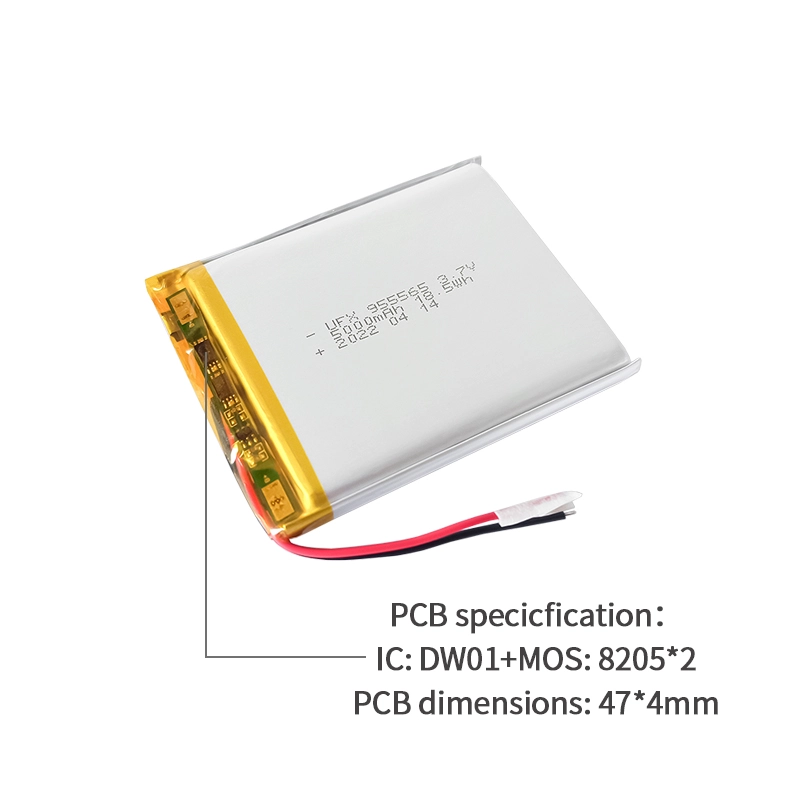
- Standard assembly: No NTC temperature sensor
Low temperatures can reduce available capacity. The discharge range does not apply to charging.
Understand Battery Temperature Ranges Fit 18.5Wh Into Your Product Layout
Check the battery footprint, housing depth, and lead route together.
Allow for the Complete Battery Assembly
The listed maximum body size is 9.5 × 55 × 67mm. The battery weighs about 76g. Use the approved drawing to plan the final mounting space.
- Housing depth: Leave assembly clearance around the pouch.
- Mounting: Support the battery without pressure from screws or sharp ribs.
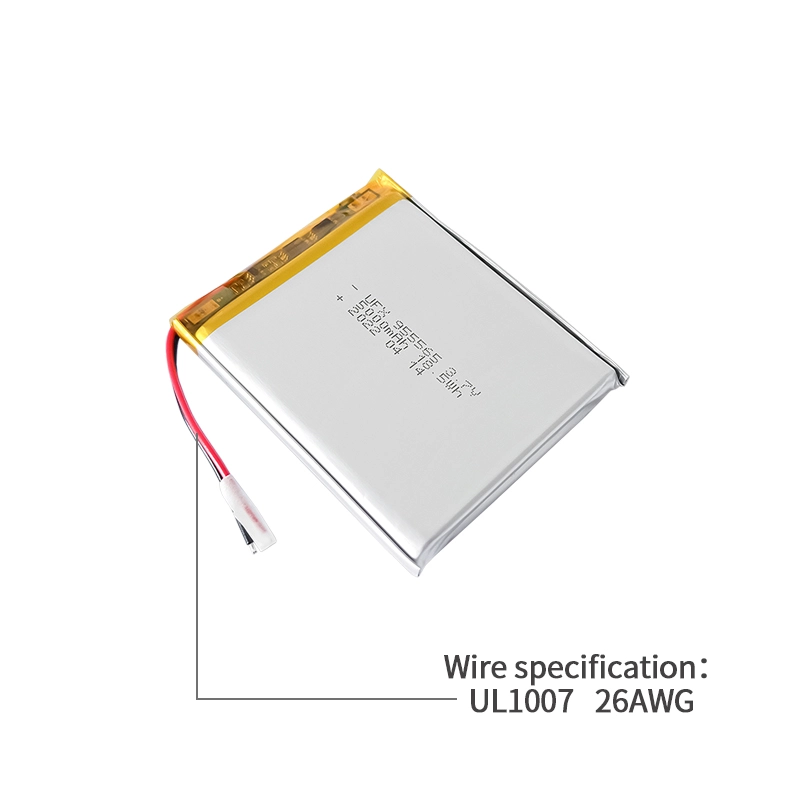
- Lead route: Allow room for wires and the connector.
- Heat sources: Review the distance from power circuits and other hot parts.
- Assembly access: Make the connector easy to reach before closing the housing.
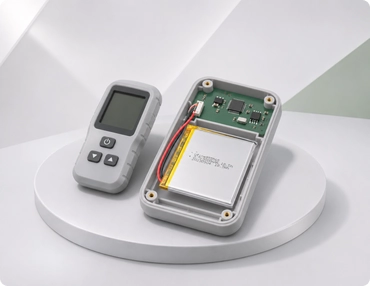
For Devices With Longer Use Between Charges
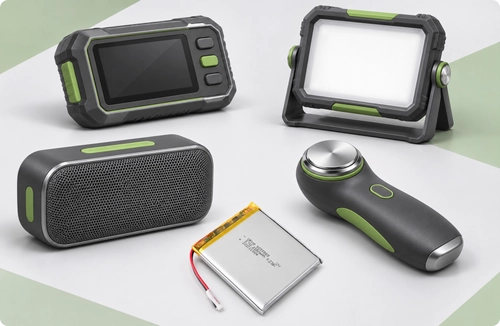
The 955565 can be evaluated for portable instruments, rechargeable work lights, portable speakers, and beauty devices. These products need enough housing space for the battery and a compatible single-cell charging system.
Check the load in the most demanding mode. This may be full brightness, high audio output, or motor startup. A 5000mAh capacity rating does not confirm that the battery can support every peak.
Give Your Team More Than a Capacity Claim
A battery choice needs evidence that engineering, purchasing, and quality teams can review. Use these four points to prepare your project.
Request the 955565 Review Documents 


Same Capacity, Different Size
Compare the 105573 battery if your housing allows a slightly thicker and longer body.
Need a Narrower Battery?
The 104867 battery is 7mm narrower than the 955565. Check whether its lower capacity meets your runtime target.
Turn Your Runtime Target Into a Sample Plan
Tell us what the device must do between charges. We can review whether the 955565 is a suitable starting point.
- Runtime: hours of use and operating modes
- Load: average current, peak current, and peak duration
- Space: compartment dimensions or enclosure drawing
- Charging: charger settings and temperature sensing needs
- Connection: wire length, connector, and polarity
-
01Send the device requirements and sample quantity.
-
02Confirm the finished assembly current limit and drawing.
-
03Agree on device tests and required documents.
-
04Request sample pricing and a production quote.
Battery Specification
-
1. Mechanical Characteristics
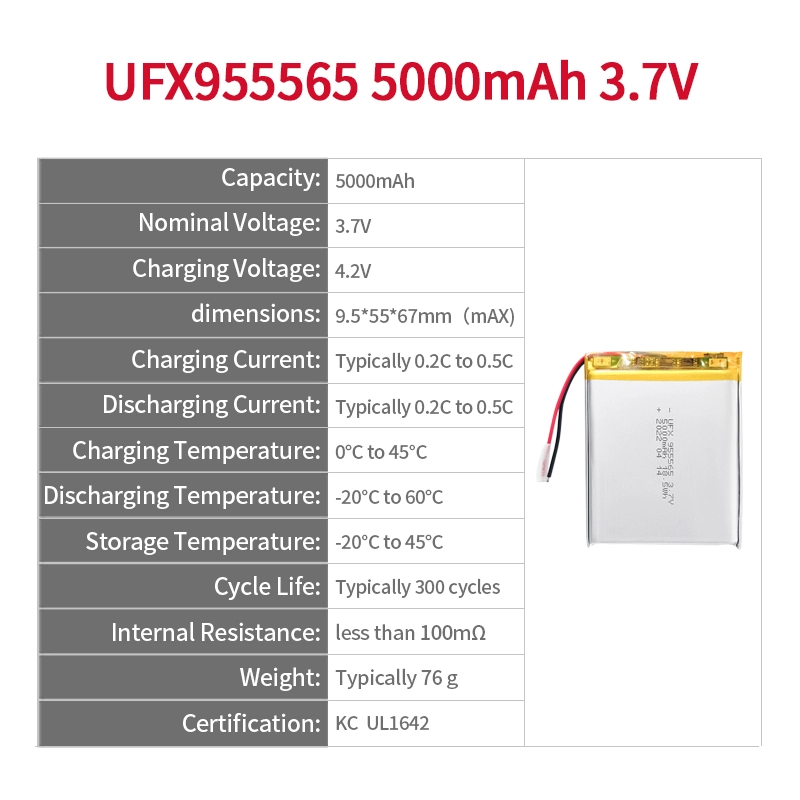
Cell 955565 PCM Yes NTC No Weight appr. 76g Configuration 1S1P -
2. Electrical Specification
Capacity 5000mAh Nominal Voltage 3.7V Energy 18.5Wh Internal Resistance less than 100mΩ Max. Charge Voltage 4.2V Discharge Cut Off 2.75V Max. Charge Current 5000mA Max. Discharge Current 5000mA Standard Charge Current 1000mA Standard Discharge Current 1000mA Charging Temperature 0℃ to 45℃ Discharging Temperature -20℃ to 60℃ Storage Temp.Range 1 year at -20℃ to +30℃ 3 mos. at -20℃ to +45℃ 1 mo. at -20℃ to +60℃ Cycle life 100 cycles ≥92% 300 cycles ≥88% 500 cycles ≥80% -
3. Cell protection
Overcharge Detection 4.28V ±50mV (80 to 200msec delay, release 4.08V ±50mV) Overdischarge Detection 2.4V ±100mV (40 to 120msec. delay, release 3.0V ±100mV) Overcurrent Detection 2.5A to 4.5A (5 to 10msec. delay) Short protection Yes
The Ufine 955565 is a 3.7V 5000mAh rechargeable pouch battery with 18.5Wh of nominal energy. Its maximum body size is 9.5 × 55 × 67mm. The standard version includes PCM protection and weighs about 76g.
This battery can be considered when runtime is a key design goal. Start with the energy your device needs for a full day, work session, or charge cycle. Then check whether the complete battery assembly fits the load and housing.
What does 18.5Wh mean for your runtime target?
Energy is useful when your device uses a voltage converter. Estimate runtime from average device power and the energy that reaches the load.
Estimated runtime (hours) ≈ 18.5Wh × usable energy fraction × conversion efficiency ÷ average device power (W)
For example, assume 90% of nominal battery energy is usable and the converter is 90% efficient. These assumptions give about 15Wh at the device load.
-
At 1.5W average power: about 10 hours.
-
At 3W average power: about 5 hours.
-
At 5W average power: about 3 hours.
These are planning examples, not measured 955565 results. Usable energy and efficiency vary with the circuit, load, temperature, and battery age. Verify the target with samples.
A higher output voltage can increase battery current
A converter can raise voltage, but it also changes the current drawn from the battery. Check battery-side current when powering a 5V device from a 3.7V battery.
For example, a 5V load drawing 1A uses 5W. At 3.7V battery voltage and 90% conversion efficiency, the estimated battery current is about 1.5A. Current rises as battery voltage falls if the output power stays the same.
-
Measure current at full charge and near the device shutdown point.
-
Include startup, full brightness, high audio output, and other demanding modes.
-
Record how long each peak lasts and how often it repeats.
The supplied electrical table lists a 5A maximum, while the PCM overcurrent detection range is 2.5–4.5A. These values need to be reconciled before approving a high-current design. Request a confirmed working current limit for the finished battery assembly.
Plan recharge time alongside operating time
A longer runtime target also needs a practical charging plan. The detailed specification lists 1000mA standard charge current and a 4.2V maximum charge voltage.
Dividing 5000mAh by 1000mA gives five hours, but this is only a simple capacity-to-current calculation. A full charge also includes a constant-voltage stage, during which current falls.
-
Use a compatible single-cell lithium-ion CC/CV charger.
-
Check the power left for charging when the device is running.
-
Measure charging time and battery temperature with the housing closed.
-
Confirm temperature sensing needs. The standard battery has no NTC.
The listed charging range is 0°C to 45°C. Agree on the charge current for the final assembly rather than selecting it from capacity alone.
Use the full battery footprint in your housing review
The 955565 needs space for its 55 × 67mm maximum body footprint and 9.5mm maximum thickness. Leads, the connector, and assembly clearance also need room.
-
Check the approved drawing against the real housing, including ribs and screw bosses.
-
Support the battery without bending the pouch or pressing it against hard edges.
-
Route the wires so they cannot be trapped when the cover closes.
-
Include the battery weight of about 76g when reviewing mounting and device balance.
If the battery does not fit, identify which dimension causes the problem. A narrower option may be thicker or longer. The same capacity does not mean the same shape or a direct replacement.
Compare Connector Types for Your Battery AssemblySeparate listed ratings from project approval evidence
The supplied information lists KC and UL1642 for the 955565. Request the actual documents and check the model and covered configuration before using them in your project records.
The detailed specification also lists at least 80% capacity after 500 cycles. A useful comparison needs the test conditions behind that figure.
-
Confirm charge and discharge currents used in the cycle test.
-
Check the test temperature, voltage limits, and capacity measurement method.
-
Confirm which documents apply to the battery configuration you plan to order.
-
List any additional project or shipping documents needed before the order.
Keep the approved drawing, specification, and test records together. This gives your team a clear reference when reviewing samples or changing the wire, connector, or protection design.
Request a sample against a clear pass target
A sample review is more useful when success is defined in advance. Set targets for runtime, charging time, temperature, and reliable operation near the end of a charge.
-
State the required runtime and the device modes included in the test.
-
Share measured battery-side current, including peaks.
-
Provide the enclosure drawing and connection details.
-
Confirm the test temperature and device shutdown settings.
-
Include sample quantity and expected production volume.
Send these details to review the 955565 assembly and request sample pricing. Use the agreed configuration for device testing before approving a production order.
FAQs
-
What should I check before replacing another 5000mAh battery with the 955565?
Match the voltage, charging system, current limits, connector, polarity, and protection. The 955565 has a maximum body size of 9.5 × 55 × 67mm. Allow extra room for wiring and assembly clearance. -
Does 5000mAh mean the 955565 can supply 5A?
No. Capacity and current limits are different ratings. The electrical table lists a 5A maximum, but the PCM overcurrent detection range is 2.5–4.5A. Confirm the working current limit for the finished assembly before using it in a high-load device. -
How can I estimate runtime for a device with a voltage converter?
Start with the nominal energy of 18.5Wh. Multiply it by the usable energy fraction and converter efficiency, then divide by average device power in watts. Confirm the estimate with device tests, since temperature, load, and shutdown voltage affect runtime. -
Can the 955565 power a 5V device directly?
The battery does not provide a regulated 5V output. It has a 3.7V nominal voltage and a 4.2V maximum charge voltage. A device that requires 5V needs a suitable converter. Check battery-side current across the planned operating range. -
Will a 1A charger fully charge this battery in five hours?
Five hours is only the simple calculation of 5000mAh ÷ 1000mA. A full charge also includes a constant-voltage stage as current falls. Use a compatible 4.2V lithium-ion CC/CV charger and measure charging time in the device. -
Does the included protection board measure battery temperature?
The standard assembly includes PCM protection but no NTC temperature sensor. If your charger needs temperature feedback, request a sensing review. The listed charging range is 0°C to 45°C. -
What evidence supports the 955565 cycle life rating?
The detailed specification lists at least 80% capacity after 500 cycles. The supplied table does not state the full test conditions. Request the charge rate, discharge rate, temperature, and voltage limits before comparing this figure with another battery. -
Which certification documents are listed for the 955565?
KC and UL1642 are listed in the supplied product information. Request the actual documents to confirm the model and covered configuration. Do not assume that a different connector, PCM, or assembly is covered without checking. -
Which alternative should I compare if the 955565 does not fit?
The 105573 offers 5000mAh at up to 10 × 55 × 75mm. The 104867 offers 4000mAh at up to 10 × 48 × 69mm. Both are thicker and longer than the 955565; the 104867 is narrower. Check electrical and connection details before switching.
Ready to Power Your Project?
We’ll help you design the perfect power source — tailored to your voltage, capacity, size, C-rate, and performance needs.
Contact Us NowWhat Our Customers Are Saying
We love hearing from you! Your experiences help us improve and inspire others. Check out what our happy customers have to say about our lithium batteries—share your thoughts with us too!











Latest Articles
About Lithium Battery Industry News

What Happens If One Cell in a Battery Pack Goes Bad? How to Fix It
Found a faulty battery cell? Discover how to identify the problem, whether one cell can be replaced, and how to fix a battery pack safely.
2026-11-5 Ufine

4S LiFePO4 BMS Wiring: Step-by-Step Connection Guide
Wiring a 4S LiFePO4 BMS for the first time? Discover the correct balance wire connections, terminal functions, and mistakes that could damage your BMS.
2026-11-5 Ufine

Learn 24V Battery Management System
Need a 24V battery management system? Explore wiring diagrams, BMS current ratings, charging compatibility, battery protection, and troubleshooting tips.
2026-11-5 Ufine