
- Part 1. What is an 11.1V (3S) LiPo battery?
- Part 2. 11.1V LiPo battery voltage chart (Fully charged, storage, cutoff)
- Part 3. Key specifications of 11.1V LiPo batteries
- Part 4. Why 11.1V instead of 12V?
- Part 5. 11.1V (3S) LiPo vs 7.4V (2S) vs 14.8V (4S)
- Part 6. Applications
- Part 7. How to charge an 11.1V (3S) LiPo battery safely
- Part 8. How to choose the right 11.1V LiPo battery
- Part 9. Storage voltage & battery maintenance
- Part 10. How long does an 11.1V LiPo battery last?
- Part 11. Common problems & troubleshooting
- Part 12. FAQs
Part 1. What is an 11.1V (3S) LiPo battery?
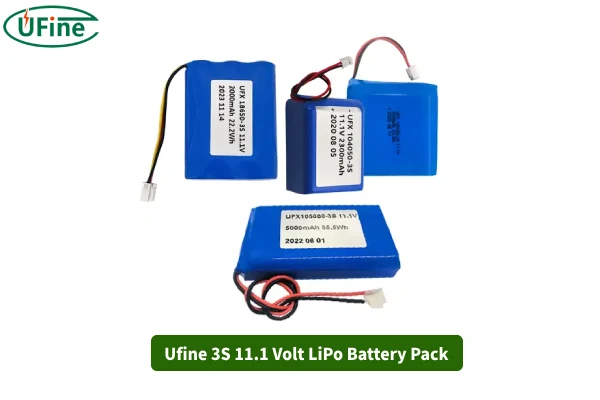
An 11.1V LiPo battery is a lithium polymer battery pack consisting of three cells connected in series (3S).
Voltage Basics
- Nominal voltage per cell: 3.7V
- Nominal pack voltage (3 × 3.7V): 11.1V
- Fully charged voltage per cell: 4.20V
- Fully charged pack voltage (3 × 4.2V): 12.6V
Because of the series configuration, the voltage increases while capacity (mAh) remains the same as a single cell. This 3-cell setup strikes a balance between power output, size, and weight, making 11.1V LiPo batteries ideal for medium-power devices that require strong bursts of current.
Understanding S and P in Lithium Battery Packs
Part 2. 11.1V LiPo battery voltage chart (Fully charged, storage, cutoff)
One of the most common user questions is:
“What is the fully charged voltage of an 11.1V LiPo battery?”
Below is the complete voltage chart:
3S (11.1V) LiPo Voltage Chart
| Battery State | Per-Cell Voltage | Total Voltage (3S) |
|---|---|---|
| Fully Charged | 4.20V | 12.6V |
| Storage Level | 3.80V | 11.4V |
| Nominal | 3.70V | 11.1V |
| Cutoff (Safe Minimum) | 3.0–3.2V | 9.0–9.6V |
| Danger Level | < 3.0V | < 9.0V |
Key technical note: Discharging below 3.0V/cell may cause irreversible chemical damage, cell swelling, internal resistance rise, and permanent failure.
Part 3. Key specifications of 11.1V LiPo batteries
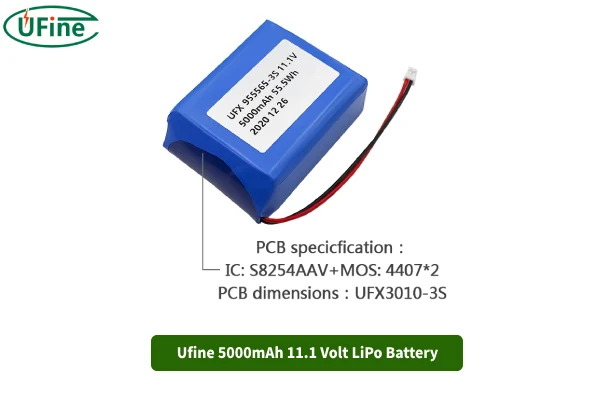
11.1V LiPo batteries vary by capacity, discharge rate, design, and intended applications.
1 Capacity (mAh)
Common capacities include:
- 1000mAh
- 1500mAh
- 2200mAh
- 3000mAh
- 5000mAh+
Higher capacity = longer runtime, but also greater weight.
2 Discharge Rate (C-Rating)
C-rating determines how much current the battery can safely deliver.
Example:
A 2200mAh 30C pack delivers:
- 2.2Ah × 30 = 66A continuous discharge
High-C packs (50C–120C) are typically used in FPV drones and high-performance RC cars.
3 Dimensions & Weight
These vary significantly depending on pack design (soft-pack, hard-case), cell form factor, and connector type.
4 Connectors
Common output connectors:
- XT60
- Deans (T-plug)
- EC3 / EC5
- Tamiya
- Airsoft micro-Tamiya
Balance connector: typically JST-XH 3-pin for 3S packs.
Part 4. Why 11.1V instead of 12V?
Many users wonder why the nominal voltage is 11.1V instead of 12V.
The answer lies in the cell chemistry.
Chemistry Explanation
- Lithium polymer chemistry defines 3.7V as the nominal voltage per cell.
- When three cells are connected in series, the sum is 11.1V, not 12V.
- 12.6V is only the peak charge voltage, not the usable average voltage.
Thus, 11.1V is the scientifically correct nominal rating for a 3-cell LiPo battery.
Part 5. 11.1V (3S) LiPo vs 7.4V (2S) vs 14.8V (4S)
A comparison across popular LiPo configurations:
| Battery Type | Voltage | Cell Count | Power Level | Typical Applications |
|---|---|---|---|---|
| 7.4V LiPo | 2S | Low | Light drones, beginner RC | |
| 11.1V LiPo | 3S | Medium | RC cars, FPV drones, airsoft, robotics | |
| 14.8V LiPo | 4S | High | FPV racing, professional UAVs |
Why choose 11.1V?
It delivers significantly more power than 7.4V while remaining compact and lightweight—ideal for mid-power systems.
Part 6. Applications
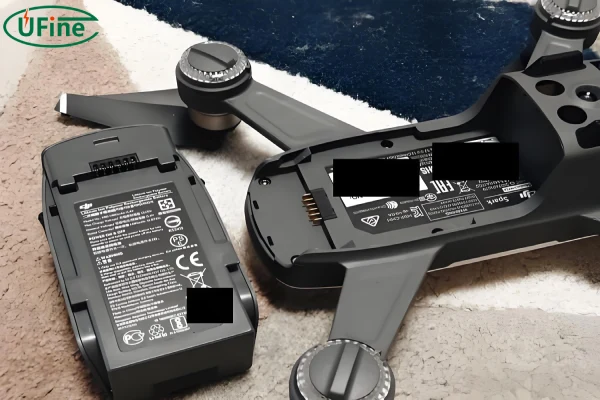
1 RC Cars, Boats & Airplanes
3S LiPo packs provide:
- Strong acceleration
- Stable voltage under load
- High discharge current capability
Widely used in 1/10 scale RC cars and brushless motor systems.
2 Drones & FPV
The 3S configuration is popular for:
- Aerial photography drones
- FPV freestyle 4-inch/5-inch builds
- Medium-power multirotors
Provides a good balance of thrust, flight time, and weight.
3 Airsoft AEG Guns
An 11.1V airsoft LiPo offers:
- Higher rate of fire (ROF)
- Faster trigger response
- Steady voltage output
Most AEGs can support 11.1V with reinforced internals.
4 Robotics & DIY Electronics
Used for:
- Autonomous robots
- Smart devices
- Portable power systems
- Embedded designs
Due to high current availability and lightweight structure.
5 Backup Power / Portable Power Systems
Provides stable energy for:
- Wireless communication devices
- Medical monitoring devices (non-implantable)
- Field instruments
Part 7. How to charge an 11.1V (3S) LiPo battery safely
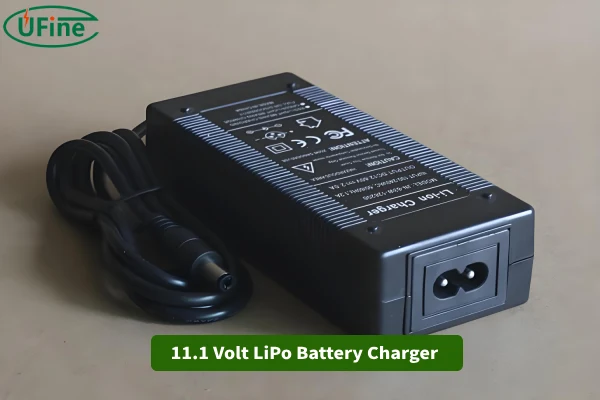
Charging must be done with a LiPo-specific charger that supports balance charging.
Charging Standards
- Charging mode: Balance charge
- Recommended charge rate: 1C
- Example: 3000mAh → 3A
- Maximum safe per-cell voltage: 4.20V
- Never charge unattended
Charging Procedure
- Inspect the pack (no swelling or damage).
- Connect the main lead + balance lead.
- Select 3S LiPo / 11.1V on the charger.
- Ensure balance mode is enabled.
- Charge at recommended current.
- Disconnect only after charger indicates completion.
Part 8. How to choose the right 11.1V LiPo battery
When selecting a 3S LiPo, consider the following technical parameters:
1 Required Capacity (mAh)
Match your runtime needs and weight limits.
2 C-Rating & Max Current Draw
Choose a discharge rating that meets the maximum current required by motors or gearboxes.
3 Connector Compatibility
Different systems require different connectors:
- Airsoft AEG → Tamiya / Mini-Tamiya
- FPV → XT60
- RC → Deans / XT60 / EC5
4 Dimensions & Fitment
Airsoft battery compartments and RC chassis often have strict space limits—measure before purchasing.
5 Soft Pack vs Hard Case
- Soft pack: lighter, used in drones
- Hard case: safer for RC cars and airsoft
Part 9. Storage voltage & battery maintenance
Improper storage is the leading cause of LiPo degradation.
Storage Standard
- 3.80V per cell
- 11.4V for 3S
Storage Recommendations
- Store at 40–60% charge
- Temperature: 5°C–25°C
- Store in a fireproof LiPo bag or metal container
- Avoid high humidity
Long-term storage at full charge or empty charge accelerates chemical degradation and increases safety risk.
Part 10. How long does an 11.1V LiPo battery last?
A well-maintained 3S LiPo battery typically lasts:
- 300–500 cycles
- 1–2 years of regular use
Factors that shorten lifespan
- Over-discharging
- Charging above 4.2V/cell
- High operating temperatures
- Storing fully charged for long periods
- Mechanical damage or swelling
Part 11. Common problems & troubleshooting
Cell Imbalance
Cause: aging, over-discharge
Solution: balance charge repeatedly, replace if severe.
Battery Swelling
Cause: overheating, overcharging
Solution: discontinue use immediately.
Voltage drops quickly
Cause: high internal resistance
Solution: battery is near end-of-life.
Charger not detecting the pack
Cause: voltage dropped below threshold
Solution: recover with NiMH mode (expert only) or replace.
Part 12. FAQs
1. What is the fully charged voltage of an 11.1V LiPo battery?
Fully charged voltage is 12.6V (4.2V × 3).
2. Can I use an 11.1V LiPo in place of a 7.4V battery?
Yes, but check whether the device can handle the higher voltage. Motors and electronics may overheat.
3. What is the safe cutoff voltage for 3S LiPo?
Around 9.0–9.6V.
4. Can I charge a 3S LiPo with a 4S charger?
Yes, as long as the charger supports LiPo balance charging and you select 3S mode.
5. Is 11.1V LiPo safe for airsoft?
Yes, but reinforced internal components are recommended due to higher ROF and motor stress.
6. How do I know if my 11.1V LiPo is dead?
- Voltage < 3.0V per cell
- Severe swelling
- Very fast voltage drop
- Cannot reach full charge
Related Tags:

More Articles
Buck vs. Boost vs. Buck-Boost Converter: Which Is Best for Battery?
Not sure which converter your battery-powered device needs? Compare Buck, Boost, and Buck-Boost designs and discover what affects voltage stability and runtime.
How to Match 18650 Cells for a Reliable Battery Pack?
Building an 18650 battery pack? Learn how to compare cell capacity, voltage, and internal resistance to avoid mismatches and improve reliability.
Why Do 18650 Battery Packs Get Hot During Discharge?
Is your 18650 battery pack overheating under load? Learn what causes excess heat, how to spot dangerous symptoms, and what to do next.
18650 Battery BMS: How to Get the Specs Right
Learn how to choose a BMS for an 18650 battery pack. Compare voltage, current ratings, protection features, and balancing before you buy.
Why Does My Ring Camera Battery Drain So Fast or Stop Charging?
Is your Ring camera battery draining fast or not charging? Discover common causes, practical fixes, and when to replace the battery.


