
- Key takeaways
- Part 1. What are watts and amps?
- Part 2. Why convert watts to amps?
- Part 3. The basic watts to amps formula (DC systems)
- Part 4. Watts, volts, and amps relationship
- Part 5. How to convert watts to amps in single-phase AC systems
- Part 6. How to calculate amps from watts in three-phase systems
- Part 7. Quick watts to amps conversion table
- Part 8. Common mistakes when converting watts to amps
- Part 9. Practical battery and power system applications
- Part 10. Watts to amps formula summary
- Part 11. FAQs about watts to amps conversion
Knowing how to convert watts to amps is essential for sizing batteries, inverters, cables, and electrical circuits. The correct calculation depends on voltage and, for AC systems, power factor. This guide explains the watts-to-amps formula, provides practical examples, and highlights common mistakes that can affect safety and system performance.
Key takeaways
- The basic watts-to-amps formula is Amps = Watts ÷ Volts.
- To convert watts to amps in AC systems, power factor must be included.
- Higher voltage reduces current for the same power output.
- Correct amperage calculations are critical for batteries, inverters, cables, breakers, and chargers.
- Three-phase systems use a different watt volt amp formula than DC and single-phase AC systems.
- Current, not power alone, often determines system limitations and safety margins.
Part 1. What are watts and amps?
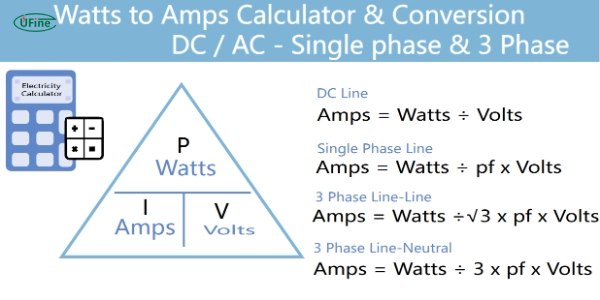
Before learning how to calculate amperage, it helps to understand the difference between watts and amps.
Watts (W) measure electrical power—the rate at which electrical energy is consumed or delivered.
For example:
- A 100W LED light consumes 100 watts of power.
- A 2000W inverter can deliver up to 2000 watts to connected loads.
Amps (A) measure electrical current, which is the flow of electricity through a conductor.
Current affects:
- Wire and cable sizing
- Fuse and breaker selection
- Connector ratings
- Battery discharge capability
- Heat generation within electrical systems
In practical terms, watts indicate how much power a device needs, while amps indicate how much electrical current the system must safely carry.
For battery applications, understanding the relationship between watts, volts, and amps is especially important. You may also find our guide on Amp Hours vs Watt Hours useful for understanding battery capacity calculations.
Part 2. Why convert watts to amps?
Many electrical specifications list only wattage. However, engineers and installers often need current values for system design.
Converting watts to amps helps with:
| Application | Why Current Matters |
|---|---|
| Circuit design | Prevents overloaded wiring |
| Breaker selection | Ensures proper protection |
| Battery sizing | Verifies discharge capability |
| Inverter selection | Checks DC input current |
| Solar systems | Calculates cable and fuse requirements |
| Equipment procurement | Confirms real operating conditions |
For lithium battery systems, current is often the most important design parameter because excessive current increases heat generation and accelerates battery aging.
Part 3. The basic watts to amps formula (DC systems)
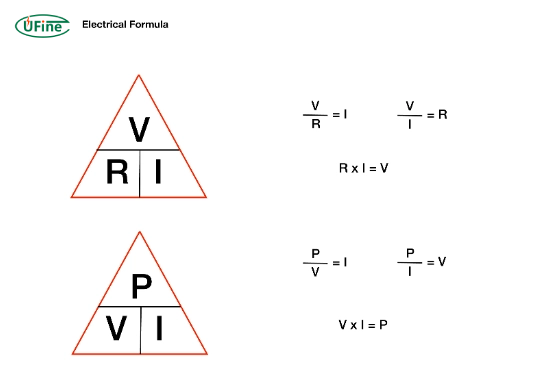
In DC systems and purely resistive loads, the equation for watts is:
I = P ÷ V
Where:
- I = Current (amps)
- P = Power (watts)
- V = Voltage (volts)
This is the most common formula for watts used in:
- Lithium battery packs
- DC power supplies
- Telecom systems
- Electric vehicles
- Solar battery storage
Example: 100 watts to amps
If a device uses 100 watts at 12 volts: Amps = 100 ÷ 12 = 8.33A
Example: 500 watts to amps
At 24V: Amps = 500 ÷ 24 = 20.83A
This simple equation allows you to quickly convert watt into ampere for most DC applications.
Part 4. Watts, volts, and amps relationship
The watt volt amp formula is based on: P = V × I
This means:
- Increase voltage → current decreases
- Decrease voltage → current increases
- Power remains the same
Watts, volts, and amps are directly related. Understanding this relationship makes it easier to calculate current, power, and voltage in batteries, solar systems, and electrical equipment.
For a deeper explanation of the relationship between these electrical units, see our guide on how to calculate watts, volts, and amps with simple formulas and examples.
Example: A 2400W load can operate at:
| Voltage | Current |
|---|---|
| 120V | 20A |
| 240V | 10A |
| 480V | 5A |
This is why industrial equipment and energy storage systems often use higher voltages. Lower current reduces cable losses and improves efficiency.
Part 5. How to convert watts to amps in single-phase AC systems
Most household and commercial electrical systems use single-phase AC power.
In AC systems, some equipment such as motors, compressors, chargers, and transformers creates reactive power. Therefore, power factor (PF) must be included.
Single-phase AC formula:
I = P ÷ (V × PF)
Where: PF = Power Factor (typical PF ranges from 0.7 to 1.0)
Example:
Given: Power = 1000W, Voltage = 120V, Power Factor = 0.8
Calculation: Amps = 1000 ÷ (120 × 0.8) = 10.42A
Ignoring power factor would incorrectly suggest only 8.33A, which could lead to undersized wiring or breaker selection.
Part 6. How to calculate amps from watts in three-phase systems
Three-phase systems are commonly used in:
- Manufacturing facilities
- Data centers
- EV charging stations
- Industrial motors
- Energy storage systems (ESS)
Three-phase watt to amp formula (using line-to-line voltage):
I = P ÷ (√3 × V × PF)
Example:
Given: Power = 15,000W, Voltage = 400V, PF = 0.9
Calculation: Amps = 15,000 ÷ (1.732 × 400 × 0.9) ≈ 24A
Because three-phase systems distribute power more efficiently, they require less conductor material and experience lower losses than equivalent single-phase systems.
For technical references regarding power systems and electrical calculations, consult the official standards published by the International Electrotechnical Commission (IEC).
Part 7. Quick watts to amps conversion table
At 12V DC:
| Watts | Amps |
|---|---|
| 60W | 5A |
| 120W | 10A |
| 240W | 20A |
| 600W | 50A |
| 1200W | 100A |
At 24V DC:
| Watts | Amps |
|---|---|
| 120W | 5A |
| 240W | 10A |
| 480W | 20A |
| 1200W | 50A |
| 2400W | 100A |
These tables help quickly perform watts amps conversion without using a calculator.
Part 8. Common mistakes when converting watts to amps
Many calculation errors occur because important variables are overlooked.
-
Using Nominal Voltage Instead of Operating Voltage
- A lithium battery labeled 48V may operate between approximately 42V and 54.6V depending on its state of charge.
- Using actual operating voltage produces more accurate results.
-
Ignoring Power Factor
- One of the most common AC design mistakes is assuming PF equals 1.0.
- For motors and inductive loads, current can be significantly higher than expected.
-
Confusing Watts and Kilowatts
- Remember: 1 kW = 1000 W
- A 5kW load equals 5000 watts.
-
Assuming Current Stays the Same at Different Voltages
- Current changes whenever voltage changes.
- For a fixed power level:
- Higher voltage = lower current
- Lower voltage = higher current
-
Forgetting Startup Current
- Motors, pumps, compressors, and some inverters may draw several times their rated current during startup.
- Always account for surge current when sizing cables and protection devices.
Part 9. Practical battery and power system applications
Watts-to-amps calculations are used daily in lithium battery engineering.
-
Battery Pack Design
Current directly affects:
- Cell temperature
- Voltage drop
- Cycle life
- BMS requirements
If you are designing a battery pack, understanding current draw is just as important as selecting battery capacity.
-
Inverter Sizing
- 3000 ÷ 12 = 250A
Actual current can be even higher when inverter efficiency losses are considered.
-
Solar Energy Systems
Solar designers use amperage calculations to determine:
- Cable sizes
- Fuse ratings
- Charge controller specifications
- Battery bank requirements
-
EV and Energy Storage Systems
Modern EV chargers and battery energy storage systems rely heavily on accurate current calculations to ensure safe operation and thermal management.
For related calculations, see our Battery Energy Converter and our guides on battery voltage, capacity, and energy storage design.
Part 10. Watts to amps formula summary
| System Type | Formula |
|---|---|
| DC | Amps = Watts ÷ Volts |
| Single-Phase AC | Amps = Watts ÷ (Volts × PF) |
| Three-Phase AC | Amps = Watts ÷ (√3 × Volts × PF) |
Choosing the correct formula is essential for accurate amperage calculations.
Part 11. FAQs about watts to amps conversion
How do you convert watts to amps?
For DC systems, divide watts by volts: Amps = Watts ÷ Volts. For AC systems, include power factor in the calculation.
How do I calculate amps from watts and volts?
Use the basic amperage formula: Current (A) = Power (W) ÷ Voltage (V). This is the fastest way to figure out amperage from watts when voltage is known.
What is the formula for wattage?
The standard formula for wattage is: Watts = Volts × Amps. In AC systems, power factor may also be included.
Why does voltage affect current?
Power equals voltage multiplied by current. If power stays constant, increasing voltage reduces the current required to deliver that power.
Are amps or watts more important for lithium batteries?
Both matter, but battery limitations are usually defined by maximum charge and discharge current. Excessive amps generate heat, stress cells, and shorten battery life.
Related Tags:

More Articles

JST vs Molex: The Right Battery Connector Choice
JST or Molex for your battery? Learn how connector selection affects current, voltage drop, reliability, and device performance.
Custom Battery Pricing: Costs Manufacturers Don’t Mention
A low battery quote may not be the final cost. Discover common hidden expenses that affect custom lithium battery projects.
Battery Wire Length: Hidden Cause of Power Loss
A longer battery wire can cause voltage drop, power loss, and unstable operation. Learn how wire length affects battery performance.
How Device Sleep Modes Affect Battery Life
Think sleep mode extends battery life? Learn why devices still drain power and how firmware, hardware, and batteries affect runtime.
LiPo Battery and PCB Design: Clearance, Insulation, and Placement
Learn how to optimize LiPo battery PCB clearance, insulation, placement, wiring, and thermal design—and avoid common integration mistakes.


