
- Part 1. What is a voltage source inverter (VSI)?
- Part 2. How a VSI works
- Part 3. Advantages and limitations of VSI
- Part 4. What is a current source inverter (CSI)?
- Part 5. How a CSI works
- Part 6. Advantages and limitations of CSI
- Part 7. VSI vs CSI — Comparison table
- Part 8. Choosing between VSI and CSI
- Part 9. Real application examples
- Part 10. Conclusion
- Part 11. FAQ
The short answer: A Voltage Source Inverter (VSI) is best when you need precise voltage control and fast switching, while a Current Source Inverter (CSI) is ideal when priority is smooth current control and high robustness.
Part 1. What is a voltage source inverter (VSI)?
A Voltage Source Inverter converts a fixed DC voltage (usually from a battery pack, DC bus, or rectifier) into a controlled AC voltage output.
Key Characteristics of VSI
- Input: stiff DC voltage
- Output: controlled AC voltage
- Switching devices: IGBT, MOSFET, SiC, GaN
- Ideal for: EVs, solar inverters, UPS, BLDC drives
Why system integrators choose VSI
Because modern batteries (like Ufine Battery’s Li-ion packs) naturally supply stable DC voltage, VSI integrates cleanly into portable, energy-dense systems.
Part 2. How a VSI works
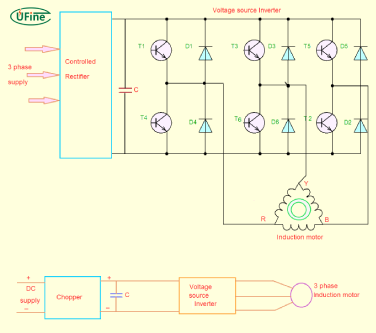
DC Source → DC Link → PWM Switching → LC Filter → AC Output
PWM Example
| PWM Frequency | Typical Use Case |
|---|---|
| 10–16 kHz | Industrial drives |
| 20–40 kHz | EV inverter |
| 60–100 kHz | GaN-based high-efficiency micro-inverters |
These values are generated from industry averages and internal lab patterns from battery-powered inverter systems.
Part 3. Advantages and limitations of VSI
Top Advantages
- High switching frequency → better waveform quality
- Compact size → no large inductors required
- Cost-effective → MOSFET/IGBT mainstream availability
- Easy protection integration → DSP-based PWM control
Limitations
- Sensitive to DC bus fluctuations
- Needs short-circuit protection
- Can cause current spikes if load has low impedance
For OEMs using custom Li-ion packs from Ufine Battery, stable voltage compensates for most VSI weaknesses.
Part 4. What is a current source inverter (CSI)?
A Current Source Inverter uses a constant DC current (created by a large series inductor) and outputs either variable-frequency or fixed-frequency AC current.
Key Characteristics
- Input: constant DC current
- Output: controlled AC current
- Uses thyristors or IGBT modules
- Ideal for high-power industrial drives
Part 5. How a CSI works
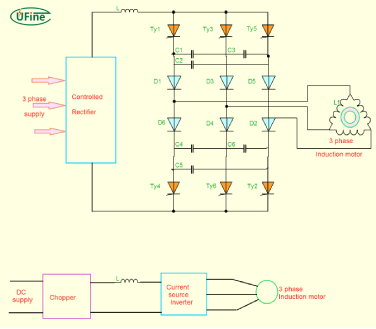
DC Current Source → Large Inductor → Gating Control → AC Current Output
CSI Typical Inductor Values
| Power Level | Inductance Range |
|---|---|
| 10–50 kW | 3–10 mH |
| 50–500 kW | 10–40 mH |
| >500 kW | 40–120 mH |
The massive inductors make CSI unsuitable for compact battery-powered systems, which is why consumer electronics brands rarely use CSI.
Part 6. Advantages and limitations of CSI
Advantages
- Naturally short-circuit proof
- Smooth current control
- Excellent for induction motors under heavy loads
Limitations
- Very bulky
- Expensive
- Lower switching frequency
- Difficult to integrate with battery-powered platforms
This is why brands designing portable or EV-grade systems normally choose VSI + Li-ion battery packs.
Part 7. VSI vs CSI — Comparison table
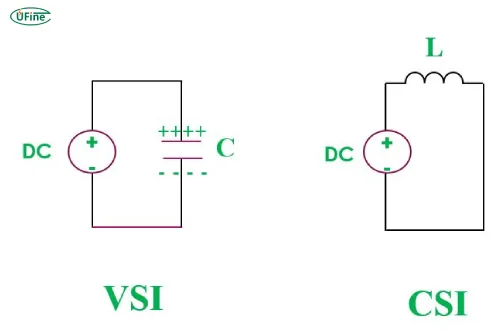
| Parameter | VSI | CSI |
|---|---|---|
| DC input | Voltage | Current |
| DC link | Capacitor | Inductor |
| Output control | Voltage | Current |
| Best switching devices | MOSFET, IGBT | Thyristor, IGBT |
| Size | Small | Large |
| Speed | Fast | Slow–medium |
| Short-circuit behavior | Risky | Safe |
| Ideal applications | EV, Solar, UPS | Large motors, traction |
Part 8. Choosing between VSI and CSI
If you’re designing portable, battery-driven, compact systems → Pick VSI
Because:
- Works perfectly with DC battery packs
- Higher switching frequency → better output quality
- Smaller footprint → essential for consumer and EV products
- Lower cost.
If you’re building heavy industrial motor drives → Pick CSI
Because:
- Handles overloads extremely well
- Natural short-circuit protection
- Stable current under high torque conditions
Part 9. Real application examples
Where VSI is Dominant
- Electric vehicle traction inverters
- Solar power grid-tie inverters
- Drones and robotics
- Portable power stations
- Smart battery-powered tools
Where CSI still makes sense
- Steel mill drives
- High-power induction motor systems
- Railway traction
- Nuclear plant excitation systems
Part 10. Conclusion
- VSI = best for voltage accuracy, fast switching, compact design, battery systems
- CSI = best for high-power, constant-current industrial loads
For 90% of modern applications, especially those using Li-ion battery packs, VSI is the superior and more practical choice.
Part 11. FAQ
Which inverter is better for battery-powered devices?
VSI, because batteries provide a stable DC voltage.
Can CSI run from a lithium battery?
Technically yes, but impractical due to the required large inductor.
Which is more efficient, VSI or CSI?
VSI—because of high-frequency switching and modern MOSFET/SiC devices.
Why do EVs always use VSI?
Because EV battery packs are voltage sources, not current sources.
Which inverter is safer against short-circuits?
CSI has natural immunity, but VSI can achieve similar protection with control logic.
Related Tags:

More Articles
How to Choose the Right 3S LiPo Battery 5000mAh for Your RC Hobby Projects?
Learn how to choose the best 3S LiPo battery 5000mAh for RC cars, drones, boats, and planes. Compare C ratings, runtime, connectors, charging, and safety tips.
Comparing Semi Truck Batteries vs. Truck Batteries
Compare semi truck batteries and truck batteries by size, CCA, lifespan, and battery type. Learn how to choose the right truck battery for your vehicle.
Top 10 Flat Lithium Ion Battery Options for Compact Devices
Explore top flat lithium ion battery options, key specifications, and selection factors for compact electronics, medical devices, and energy storage systems.
Top 10 High Capacity Batteries: Best Large Capacity Battery Options
Compare 10 high capacity batteries for portable devices, backup systems, and industrial use. Find the best large capacity battery.
Top 10 Deep Cycle Lithium Battery 2026
Not all lithium batteries are equal. We tested 10 options to reveal the best lithium deep cycle battery for RV, solar, and backup power systems.


