- Key Takeaways
- Part 1. Understanding state of charge (SoC)
- Part 2. How to measure SOC of battery
- Part 3. How to calculate SOC of battery: step-by-step example
- Part 4. Tools for SOC testing
- Part 5. SOC and battery health
- Part 6. Factors influencing SoC estimation accuracy
- Part 7. Practical guidelines for measuring SoC accurately
- Part 8. Common mistakes and tips
- Part 9. FAQs
Key Takeaways
- SOC (State of Charge) is a critical metric to monitor battery health and performance.
- There are multiple SOC estimation methods: voltage-based, Coulomb counting, and model-based.
- Accurate SOC measurement helps extend battery life and prevent overcharge or deep discharge.
- Choosing the right SOC tool or method depends on your battery type, application, and accuracy needs.
Part 1. Understanding state of charge (SoC)

The State of Charge (SoC) represents the current capacity of a battery as a percentage of its maximum capacity. It’s a dynamic parameter, influenced by factors such as discharge/charge rates, temperature, and battery aging. Accurate SoC estimation is pivotal for:
-
Performance Optimization: Ensuring devices operate within optimal parameters to prevent unexpected shutdowns.
-
Safety Assurance: Preventing overcharging and deep discharging, which can lead to thermal runaway or battery degradation.
-
Battery Longevity: Maintaining the battery within recommended charge levels to extend its usable life.
-
Range Prediction for EVs: Providing accurate information on remaining driving range, alleviating range anxiety among users.
Difference Between Percentage, Voltage, and State of Charge (SoC) of Rechargeable Battery?
Part 2. How to measure SOC of battery
Measuring SOC might sound complicated, but you have several practical ways to do it. Each has its own advantages and limitations. Let’s walk through them.
1 Voltage-Based Estimation
This is the simplest method. By measuring the battery’s voltage at rest, you can estimate its SOC. But beware: temperature, load, and battery age can all skew the reading. For example, a lithium-ion battery may show 3.7V at 50% SOC, but under heavy load, it could drop and mislead you.
2 Coulomb Counting Method
Coulomb counting tracks the current going in and out of your battery over time. It’s more accurate than voltage measurement but requires calibration. If you use this method, make sure to reset the counter occasionally to prevent cumulative errors.
3 Model-Based Estimation
For advanced users or high-performance applications, model-based SOC uses battery behavior models and sometimes machine learning to estimate SOC. This is highly accurate but requires more setup and data.
4 SOC estimation methods compared
Here’s a quick comparison of the main methods so you can decide which one fits your needs:
| Method | Accuracy | Cost | Best For | Limitation |
|---|---|---|---|---|
| Voltage-Based | Low | Low | Quick checks | Sensitive to temperature and load |
| Coulomb Counting | Medium-High | Medium | BMS integration, DIY projects | Requires calibration |
| Model-Based | High | High | Research & high-end battery packs | Complex setup, technical knowledge required |
Part 3. How to calculate SOC of battery: step-by-step example
Let’s make it practical. Suppose you have a 12V, 10Ah lithium-ion battery. You discharge it at 2A for 2 hours.
Calculate energy used:
2𝐴×2ℎ=4𝐴ℎ2A×2h=4Ah
Remaining capacity:
10𝐴ℎ−4𝐴ℎ=6𝐴ℎ10Ah−4Ah=6Ah
SOC:
𝑆𝑂𝐶(%)=610×100=60%SOC(%)=106×100=60%
You now know your battery is at 60% SOC. This simple calculation is the foundation for more complex estimations.
Part 4. Tools for SOC testing
To make SOC measurement easier, you can use dedicated tools:
- SOC testers: Simple handheld devices that measure battery voltage and estimate SOC.
- Battery Management Systems (BMS): Integrated into smart devices or EVs, providing real-time SOC data.
- Apps & software: Some lithium battery packs allow you to monitor SOC via Bluetooth.
Selecting the right tool depends on your accuracy needs, battery type, and usage scenario.
Part 5. SOC and battery health
SOC isn’t just a number—it directly impacts your battery’s lifespan. Overcharging or deep discharging can damage lithium-ion cells. By keeping your SOC in a safe range (typically 20%–80%), you can extend your battery’s life significantly.
Monitoring SOC regularly also helps detect capacity degradation over time, allowing proactive maintenance.
Part 6. Factors influencing SoC estimation accuracy
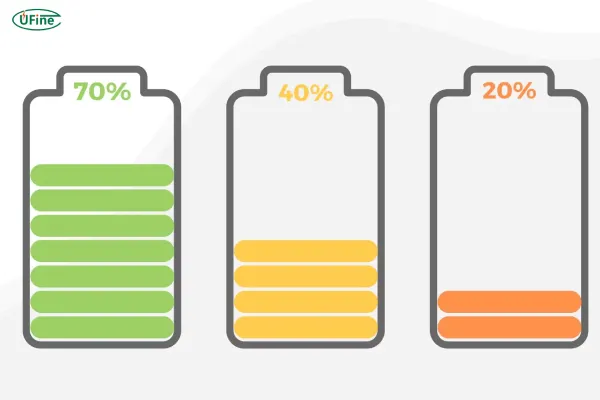
Accurate SoC estimation is challenged by various factors:
-
Temperature Variations: Affect battery voltage and internal resistance, leading to estimation errors.
-
Battery Aging: Capacity fade and increased internal resistance alter the battery’s performance characteristics.
-
Discharge Rates: High discharge rates can cause voltage drops, misleading voltage-based SoC estimations.
-
Self-Discharge: Batteries lose charge over time even when not in use, affecting SoC accuracy.
Part 7. Practical guidelines for measuring SoC accurately
To achieve the most accurate SoC measurement, consider the following best practices:
1. Choose the Right Method for Your Application
- For consumer electronics (e.g., smartphones, laptops): Use a combination of voltage-based and coulomb counting methods.
- For electric vehicles: Model-based estimation, such as the Extended Kalman Filter, is preferred due to its adaptability.
- For grid storage and industrial batteries: Electrochemical impedance spectroscopy (EIS) provides precise data on battery health and SoC.
2. Regular Calibration
To prevent SoC drift, periodically perform a full charge/discharge cycle. This helps reset estimation errors in coulomb counting methods.
3. Temperature Compensation
Implement temperature correction factors to avoid inaccuracies due to voltage fluctuations caused by environmental changes.
4. Software and Firmware Updates
Keep your battery management system updated to benefit from the latest improvements in SoC estimation algorithms.
Part 8. Common mistakes and tips
- Relying only on voltage can mislead you, especially under load.
- Ignoring temperature effects may cause overestimation or underestimation of SOC.
- Neglecting calibration for Coulomb counting leads to cumulative errors.
- Always pair estimation with proper BMS or SOC monitoring tool.
Part 9. FAQs
1. What is the easiest way to check SOC of a lithium battery?
Voltage-based estimation is quick but less accurate. For more precision, Coulomb counting or BMS monitoring is better.
2. How accurate is voltage-based SOC estimation?
It’s okay for rough estimates but can be affected by load and temperature. Expect ±5–10% accuracy.
3. Can I use a smartphone app to measure SOC?
Yes, if your battery supports Bluetooth monitoring. Accuracy depends on the data source.
4. Can you rely on SOC alone to judge battery health?
SOC shows current charge but not overall battery health; combine it with capacity tests and voltage trends for full insight.
5. How often should you check SOC for lithium-ion batteries?
For frequent use devices, checking once per week is sufficient; for critical applications like EVs, continuous monitoring is recommended.
6. Is SOC measurement different for LiFePO4 batteries?
Yes, LiFePO4 has a very flat voltage curve, so voltage-based SOC is less reliable; Coulomb counting or BMS is preferred.
7. Can you estimate SOC while charging or discharging?
You can, but readings are less accurate under load; it’s better to measure at rest or use advanced algorithms for real-time estimation.
8. Do high discharge rates affect SOC estimation accuracy?
Absolutely—high current can cause voltage sag, which may mislead voltage-based SOC estimation. Consider using current-integrating methods instead.
9. Are there online tools or apps to simulate SOC for learning purposes?
Yes, some battery simulation apps allow you to input current, voltage, and capacity to estimate SOC virtually, which is great for educational purposes.
Related Tags:

More Articles

Best 24V Lithium Battery: Top 10 Compared
Discover the top 24V lithium batteries. We compare capacity, price, cycle life, safety features, and the best options for different applications.
Top LFP Cell Manufacturers in China You Should Know
Looking for reliable LiFePO4 cells? Explore China's top LFP battery manufacturers, key technologies, production capabilities, and supplier selection tips.
Check If Your Charger Works: Simple Test Guide
Think your battery charger's broken? Quick tests can show you for sure. See if it’s the charger or the battery that's causing issues. Read more.
Best Camera Batteries: 7 Brands Compared & Tested
Looking for the best camera battery? Compare 7 top brands, including OEM and third-party options, to find the right battery for your camera.
What You Need to Know About Portable Fan Batteries
Discover the best portable electric fan battery, its types, lifespan, and maintenance tips. Learn how to choose the right one and keep it running longer.