
- Part 1. What is battery cycle life?
- Part 2. Cycle life vs. runtime
- Part 3. What affects LiFePO4 cycle life?
- Part 4. What is a LiFePO4 deep cycle battery?
- Part 5. LiFePO4 battery DoD chart
- Part 6. LiFePO4 voltage chart
- Part 7. How to test LiFePO4 battery cycle life
- Part 8. How to extend the LiFePO4 battery cycle life
- Part 9. LiFePO4 vs. other battery chemistries (Cycle life comparison)
- Part 10. About Ufine Battery
- Part 11. FAQs
Quick Answer: LiFePO4 battery cycle life — also known as the life cycle of a lithium iron phosphate (LFP) battery — determines how many times it can be charged and discharged before its capacity drops significantly.
Part 1. What is battery cycle life?
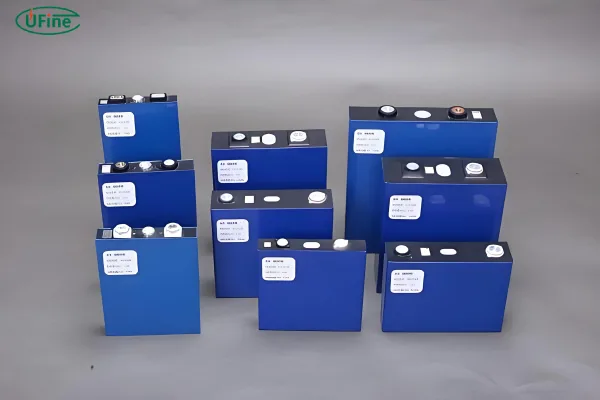
Battery cycle life refers to the number of complete charge and discharge cycles a battery can undergo before its capacity degrades to 80% of the original rated capacity.
Each time a LiFePO4 battery is charged and discharged, minor chemical and structural changes occur inside the electrodes. Over hundreds or thousands of cycles, these changes accumulate, leading to increased internal resistance and reduced active lithium ions.
For example:
A LiFePO4 cell rated for 3,000 cycles at 1C means it can handle 3,000 full charge–discharge cycles under controlled temperature and voltage limits before its capacity falls to 80% of its original design value.
Part 2. Cycle life vs. runtime
Although often confused, cycle life and runtime measure two different performance dimensions.
| Term | Definition | Impact Factor |
|---|---|---|
| Cycle Life | Total number of charge/discharge cycles before capacity declines | Affected by DoD, temperature, and C-rate |
| Runtime | Duration a single charge can power a device | Depends on capacity (Ah) and load (W) |
A long runtime doesn’t necessarily mean a long cycle life — for example, deep discharges increase runtime per use but shorten the overall number of cycles.
Ufine Battery Insight: In long-term solar or ESS applications, optimizing DoD (Depth of Discharge) is more important than maximizing single-use runtime.
Part 3. What affects LiFePO4 cycle life?
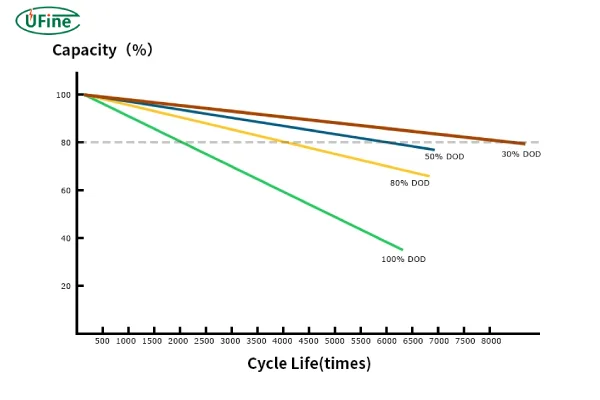
LiFePO4 batteries have an inherently stable olivine crystal structure that resists oxygen release and structural collapse, giving them a natural advantage over other chemistries.
However, the actual cycle life performance depends on several operational and design parameters:
1 Depth of Discharge (DoD)
The deeper the discharge per cycle, the fewer total cycles the cell can complete.
LiFePO4 cathodes experience increased lithium-ion diffusion stress when fully depleted, accelerating SEI (solid electrolyte interphase) layer growth and loss of active lithium.
| DoD (%) | Typical Cycle Life | Expected Service Years (Daily Use) |
|---|---|---|
| 100% | ~2,000 cycles | 5–6 years |
| 80% | ~3,000 cycles | 7–8 years |
| 50% | ~5,000 cycles | 10+ years |
| 30% | 6,000–8,000 cycles | 12+ years |
Tip: Operate LiFePO4 packs between 20–80% SoC for long-term stability — this balance can double the effective lifetime.
2 Charging and Discharging Rate (C-rate)
A C-rate defines the current relative to the battery’s rated capacity.
For example, a 1C rate for a 100Ah battery equals 100A current.
- High C-rate (>1C) charging/discharging increases internal temperature and mechanical stress.
- Slow charging (≤0.5C) promotes uniform lithium diffusion and prolongs life.
- Proper BMS control prevents excessive current draw and maintains balance among cells.
3 Temperature
Temperature significantly affects chemical reaction kinetics, electrolyte viscosity, and electrode interface stability.
| Temperature Range | Cycle Life Impact | Ufine Observation |
|---|---|---|
| 10°C–35°C (optimal) | 100% nominal life | Stable operation |
| 45°C–60°C | –20% to –40% life | Accelerated SEI thickening |
| >60°C | –60% or more | Structural degradation of cathode |
| <0°C | Capacity fade, lithium plating risk | Reduced energy output |
4 Material Quality & Manufacturing Precision
Cycle life is also determined by:
- Purity of LiFePO4 powder and uniform coating thickness
- Electrolyte formulation (additives affect SEI formation)
- Precision of cell assembly & formation process
- Balancing & matching during pack manufacturing
5 Manufacturing Factors That Also Influence LiFePO4 Cycle Life
Beyond operating conditions like temperature and DoD, manufacturing precision also plays a critical role in determining long-term LiFePO4 battery durability.
Even with the same cell chemistry, differences in electrode processing, moisture control, electrolyte filling, and cell balancing can lead to major variations in cycle performance.
Key manufacturing-related factors include:
- Material purity and crystal structure stability
- Electrode compaction density
- Moisture and contamination control
- Coating thickness consistency
- Anode/cathode capacity balancing
- Electrolyte volume and wetting quality
- Formation process and testing standards
For example, excessive electrode compaction may improve energy density, but it can also reduce electrolyte retention and increase internal stress during repeated cycling.
Similarly, insufficient electrolyte filling or poor SEI film formation can accelerate lithium loss and capacity degradation over time.
This is why high-cycle-life LiFePO4 batteries depend not only on chemistry selection, but also on advanced manufacturing control and strict quality testing.
Part 4. What is a LiFePO4 deep cycle battery?

A LiFePO4 deep cycle battery is specifically designed for repeated deep discharge and recharge cycles — maintaining performance even when discharged to 80–100% DoD.
These batteries feature thicker electrodes and optimized electrolytes for high structural integrity.
Applications include:
- Solar energy storage systems (ESS)
- Marine & RV power
- Electric vehicles and e-mobility
- Backup power and UPS systems
Unlike conventional starter batteries, deep cycle LiFePO4 batteries deliver stable voltage output over the entire discharge curve, ensuring consistent performance across thousands of cycles.
Part 5. LiFePO4 battery DoD chart
The following chart illustrates how depth of discharge affects total usable capacity versus longevity:
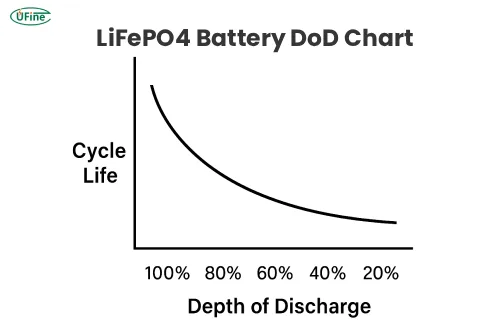
Reducing DoD from 100% to 50% can increase the total energy throughput by nearly 2×, even though each cycle uses less energy.
Total energy throughput (kWh) = Cycle life × Capacity × DoD
Part 6. LiFePO4 voltage chart
Understanding voltage helps in estimating State of Charge (SOC).
Below is a typical LiFePO4 12.8V battery voltage–SOC chart tested under 0.2C discharge rate:
| SOC (%) | Voltage (V) | Remarks |
|---|---|---|
| 100% | 13.6V | Fully charged |
| 90% | 13.4V | Excellent condition |
| 80% | 13.3V | Optimal upper limit |
| 70% | 13.2V | Ideal mid-range |
| 50% | 13.0V | Balanced for life & performance |
| 30% | 12.9V | Recommend recharge soon |
| 10% | 12.7V | Deep discharge begins |
| 0% | <12.0V | Risk of capacity loss |
Note: LiFePO4 batteries maintain a flat voltage curve (~13.0V) for most of the discharge cycle, unlike Li-ion chemistries which drop linearly. This makes voltage-based SoC estimation less precise — hence BMS monitoring is recommended.
Part 7. How to test LiFePO4 battery cycle life
At Ufine Battery’s testing facility, we evaluate LiFePO4 cell and pack performance using precision equipment under controlled environments.
Standard Tests Include:
- Cycle Life Test – Continuous charge/discharge at specific DoD and C-rate to record degradation trends.
- Capacity Retention Test – Measures remaining Ah capacity after 500, 1,000, or 2,000 cycles.
- Impedance Growth Test – Uses AC impedance spectroscopy to monitor electrolyte and electrode degradation.
- Temperature Cycling Test – Tests reliability from –20°C to 60°C.
- Abuse & Safety Tests – Overcharge, nail penetration, thermal stability, and short-circuit verification.
Part 8. How to extend the LiFePO4 battery cycle life
Ufine Battery recommends the following engineering and usage guidelines to maximize cycle life:
- Keep DoD ≤ 80% for general applications; ≤50% for mission-critical systems.
- Charge at ≤0.5C, discharge ≤1C whenever possible.
- Avoid charging below 0°C — lithium plating can occur.
- Maintain temperature range 10°C–35°C during operation.
- Store at 40–60% SOC for long-term storage.
- Use BMS with active balancing to equalize cell voltages.
- Prevent continuous high-load or pulse discharge unless rated for it.
Part 9. LiFePO4 vs. other battery chemistries (Cycle life comparison)
| Chemistry | Cycle Life (80% DoD) | Energy Density (Wh/kg) | Thermal Stability | Safety Level |
|---|---|---|---|---|
| LiFePO4 | 2,000–6,000 | 90–160 | Excellent (stable up to 250°C) | Very high |
| NMC/NCA Li-ion | 500–1,000 | 150–220 | Moderate (risk of runaway >180°C) | Medium |
| Lead-acid | 300–500 | 30–50 | Poor | Low |
| LTO (Lithium Titanate) | 8,000–15,000 | 60–100 | Excellent | Very high |
While LiFePO4 doesn’t offer the highest energy density, it provides the best balance between longevity, stability, and cost, making it ideal for long-cycle industrial and renewable energy applications.
Part 10. About Ufine Battery
Ufine Battery is a professional custom lithium battery manufacturer based in China, specializing in:
- LiFePO4 batteries
- Lithium polymer (LiPo) batteries
- 18650 and cylindrical cells
- Ultra-thin, high-rate, and low/high temperature batteries
We provide customized voltage, capacity, and pack design for OEM, solar, EV, and industrial applications.
With over a decade of experience in lithium battery R&D and manufacturing, Ufine Battery focuses on delivering high-quality, long-cycle, and safe energy storage solutions to global customers.
Part 11. FAQs
How long does a LiFePO4 battery last?
Typically 2,000–6,000 cycles (about 8–15 years) under moderate DoD and temperature control.
Does temperature affect cycle life significantly?
Yes. High temperatures accelerate electrolyte decomposition and SEI growth, while low temperatures can cause lithium plating and capacity loss.
What is the best DoD for long-term operation?
Operating at 50–80% DoD provides the optimal balance between energy throughput and longevity.
Related Tags:

More Articles
Dead Battery or Device Failure? How to Find the Cause
Think your device is broken? Learn how to tell if the problem comes from battery aging or hardware failure before replacing your electronics.
Why iPhone Duo Uses Two Batteries: The Engineering Behind Foldable Phone Power
Why do foldable phones need two batteries? Explore the engineering challenges behind iPhone Duo’s dual-battery architecture and future battery trends.
Solid-State Batteries: 3 Myths You Need to Know
Solid-state batteries promise safer EVs and longer range, but the reality is more complex. Discover the challenges behind this next-gen technology.
Battery Capacity vs Discharge Rate: The Choice Engineers Face
Higher capacity or higher discharge rate? Learn how to choose the right LiPo battery for longer runtime, stable power output, and better device performance.
Battery Cable Size Guide: Choose the Right Wire Fast
Not sure what battery cable size you need? Learn how to select the right wire gauge, terminal size, and cable for safer, more efficient battery systems.


