- Part 1. What is a 6S battery?
- Part 2. 6S Battery voltage and voltage curve
- Part 3. How long does a 6S LiPo battery last?
- Part 4. Cell types used in 6S batteries (LiPo pouch, 18650, 21700)
- Part 5. LiPo vs Li-ion vs LiFePO4 (Chemistry comparison)
- Part 6. Charger
- Part 7. Connectors
- Part 8. How to choose the best 6s lipo battery?
- Part 9. Different applications
- Part 10. Are 6S LiPo batteries easy to explode?
- Part 11. How to check for swelling?
- Part 12. Common misuse of 6S batteries
- Part 13. FAQs
Quick Answers: A 6S LiPo battery consists of six lithium polymer cells in series, delivering a nominal voltage of 22.2V (25.2V fully charged). Compared with 4S or 5S packs, 6S batteries provide higher power, lower current draw, and better efficiency—but they also require compatible motors, ESCs, and proper handling to stay safe.
Part 1. What is a 6S battery?
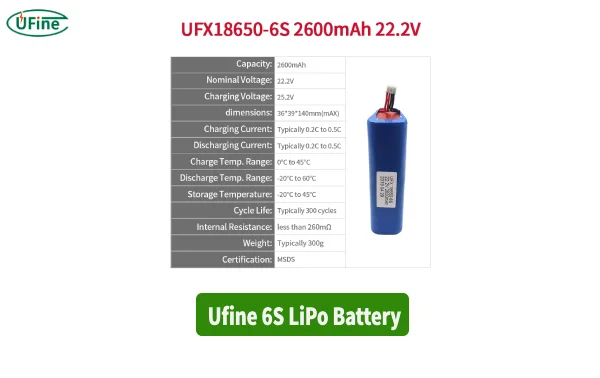
A 6S battery is a battery pack composed of six cells connected in series (“S” stands for “Series”). Each cell contributes its nominal voltage to the total output.
- Nominal voltage (LiPo): 3.7V × 6 = 22.2V
- Fully charged voltage: 4.2V × 6 = 25.2V
- Minimum safe voltage: ~3.5V × 6 = 21.0V
Series connection increases voltage, not capacity. So a 6S 2200mAh battery still has 2200mAh, but at a higher working voltage than 2S, 3S, 4S, or 5S packs.
6S batteries are favored because they:
- Deliver high power output
- Reduce current draw compared to lower-voltage packs
- Improve motor efficiency
- Support demanding applications such as racing drones and high-power RC cars
Is a 6S LiPo battery dangerous?
6S LiPo batteries are not inherently dangerous, but they store significantly more energy than lower-voltage packs.
Most safety issues come from overcharging, physical damage, or using incompatible ESCs and motors.
When used with proper chargers, voltage monitoring, and quality components, 6S LiPos are widely used and considered safe in FPV, RC, and industrial applications.
Part 2. 6S Battery voltage and voltage curve
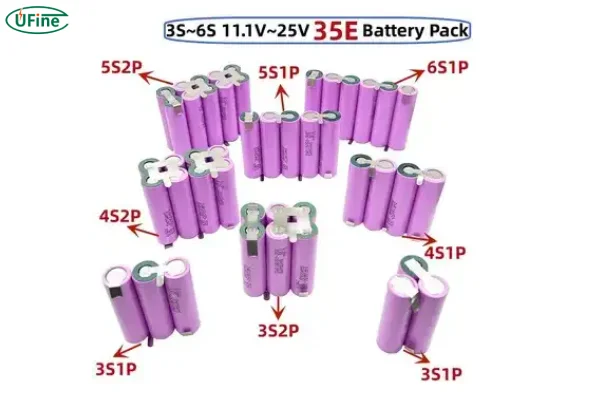
Understanding S and P in Lithium Battery Packs
Understanding the voltage curve is essential for predicting performance, protecting your battery, and avoiding over-discharge.
1 6S LiPo Battery Voltage Chart (Per Cell & Total Voltage)
| Battery State | Per Cell | 6S Total |
|---|---|---|
| Fully Charged | 4.20V | 25.2V |
| 100% | 4.20V | 25.2V |
| 75% | 3.95V | 23.7V |
| 50% (Storage Voltage) | 3.80V | 22.8V |
| 25% | 3.65V | 21.9V |
| Minimum Safe Voltage | 3.50V | 21.0V |
| Unrecoverable / Over-Discharged | 3.30V or lower | 19.8V or lower |
2 Voltage Curve Explained
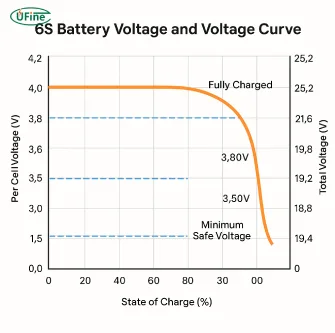
A LiPo battery does not discharge linearly. It follows this pattern:
4.20–3.90V
Power remains strong; ideal performance range.
3.90–3.70V
Gradual decline; this is the widest part of the curve.
Below 3.60V
Voltage drops rapidly → dangerous for LiPo health.
Below 3.50V
Risk of permanent cell damage.
3 Voltage Sag
Under high load (e.g., FPV drone full throttle):
- Voltage may temporarily dip (“sag”)
- Caused by internal resistance, temperature, and C-rate
- Old or low-quality batteries sag more
Monitoring voltage under load vs resting voltage helps determine battery health.
Part 3. How long does a 6S LiPo battery last?
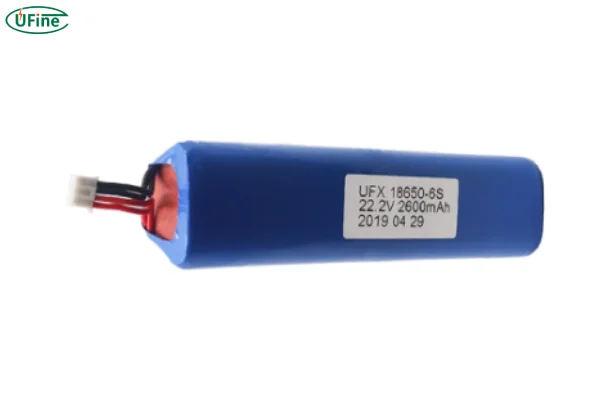
1 Cycle Life
A typical 6S LiPo lasts:
- 300–500 cycles under proper usage
- As low as 100–150 cycles in high-performance racing conditions
- Up to 800+ cycles for LiFePO4 6S packs
2 What Shortens Lifespan
- Overcharging (above 4.20V)
- Over-discharging (below 3.50V)
- High temperature
- Storing at 100% charge
- Excessive C-rate discharge
- Physical damage
3 Practical Runtime
Depends on:
- Capacity (mAh)
- Discharge rate
- Load / motor KV
- Temperature
Example for FPV quad:
A 6S 1300mAh LiPo → 3–6 minutes depending on flight style.
Part 4. Cell types used in 6S batteries (LiPo pouch, 18650, 21700)
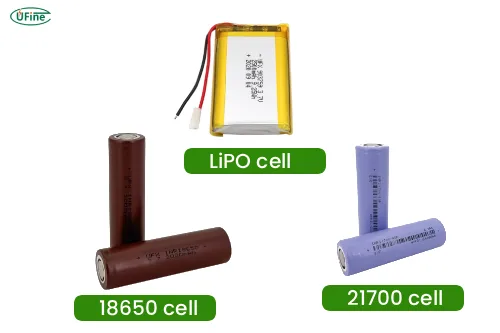
A 6S battery can be built using different cell formats:
1 LiPo Pouch Cells
- Flexible, lightweight
- High discharge rates (20C–120C)
- Used in drones, RC models, robotics
- Custom sizes available
2 18650 Cylindrical Cells
Nominal 3.6V, capacity 2600–3600mAh.
- Lower discharge (5A–20A per cell)
- Higher energy density
- Used in e-bikes, UPS, medical devices
- Safer than LiPo pouch
3 21700 Cylindrical Cells
Higher capacity 4000–5000mAh.
- Higher continuous discharge
- Better thermal performance
- Used in EVs, portable energy systems
Different applications require different chemistries and formats.
Part 5. LiPo vs Li-ion vs LiFePO4 (Chemistry comparison)
| Chemistry | Per Cell Voltage | 6S Voltage | Energy Density | Safety | Discharge Rate |
|---|---|---|---|---|---|
| LiPo | 3.7V | 22.2V | High | Medium | Very High |
| Li-ion (18650/21700) | 3.6V | 21.6V | Very High | High | Medium |
| LiFePO4 | 3.2V | 19.2V | Medium | Very High | Medium |
When to Choose Which?
- LiPo: Drones, RC, robotics → needs high burst power
- Li-ion: E-bikes, industrial devices → needs long runtime
- LiFePO4: Solar, energy storage → needs ultra safety + long life
Part 6. Charger
A proper charger is essential for safety and longevity.
1 Balance Charger (Recommended)
Ensures each cell reaches same voltage → prevents drift.
2 Smart Charger
Includes:
- Automatic balancing
- Temperature monitoring
- Battery health analysis
3 BMS-based Charging (for Li-ion / LiFePO4 Packs)
Used in e-bikes, scooters, industrial packs.
Charger works with a built-in BMS for safe charging.
Charging Guidelines
- Use 1C for longest life
- Maximum recommended: 2C
- Always monitor temperature
- Never leave LiPo unattended during charge
Part 7. Connectors
Common High-Power Connectors
- XT60 – Medium power drones
- XT90 – High power RC + e-bikes
- EC5 / IC5 – High current, stable connection
- QS8 / QS10 – Anti-spark, ultra-high current
- AS150U – High-performance FPV and industrial
Balance Connector
Almost all 6S LiPos use:
- JST-XH 7-pin balance connector
(1 ground + 6 cell taps)
Part 8. How to choose the best 6s lipo battery?
Choosing the right 6s battery for your device or application can significantly impact performance, runtime, and safety. Here are the key considerations when selecting the best 6s battery:
-
Capacity (mAh or Ah): Select a battery with the appropriate capacity for your device’s power requirements. Higher capacity batteries (e.g., 5000mAh or 6000mAh) offer longer runtime but can be heavier.
-
Discharge Rate (C-Rate): Ensure the battery’s C-rate is high enough to meet the power demands of your application. For instance, if you’re using the battery in a high-performance drone, look for a discharge rate of 20C or higher.
-
Battery Chemistry: The most common chemistry for 6s batteries is LiPo (Lithium Polymer), but LiFePO4 batteries may be used for more safety-conscious applications. LiPo offers higher energy density, while LiFePO4 offers longer lifespan and more thermal stability.
-
Voltage: Ensure the battery’s voltage is compatible with your device’s voltage requirements. For a 6s battery, the nominal voltage is 22.2V, and the fully charged voltage is 25.2V. Make sure your device can handle this voltage range.
-
Weight: If weight is a concern (e.g., for drones or RC cars), choose a battery with an appropriate capacity that doesn’t add unnecessary bulk. Larger capacity batteries tend to be heavier.
-
Brand Reputation and Reviews: Choose reputable brands known for high-quality, reliable batteries. Checking user reviews and performance data can help you avoid poor-quality or counterfeit batteries.
-
Size and Fit: Ensure the 6s battery fits in your device or battery compartment. Even though 6s batteries have standardized dimensions (around 135mm x 46mm x 25mm), always double-check the fit for your specific application.
Part 9. Different applications
1 FPV Racing Drones
- 1300–1800mAh, 75C+
- Motor KV: 1700–2100KV
- Connector: XT60 or XT90
- Priorities: light weight, high discharge
2 RC Cars / Trucks
- 5000–6000mAh, 50–100C
- Long runtime + high power
- Connector: EC5, XT90, QS8
3 Robotics & Industrial
- 3000–10000mAh
- Lower discharge needed
- Focus on stability, cycle life
- Often choose Li-ion or LiFePO4
4 E-bikes / E-scooters
Usually assembled as 6S packs in series/parallel (6S3P, 6S5P, etc.)
Needs a BMS, not a balance lead.
Part 10. Are 6S LiPo batteries easy to explode?
LiPo batteries do not spontaneously explode when used correctly.
However, they are more sensitive than cylindrical Li-ion cells.
Potential Causes of Thermal Runaway
- Overcharging beyond 4.2V
- Puncture or physical damage
- Short circuit
- Over-discharging
- Excessive temperature (>60°C)
- Manufacturing defects (rare in reputable brands)
With proper handling, LiPo batteries are safe for hobby and professional use.
Part 11. How to check for swelling?
Swelling indicates internal gas buildup.
Check:
- Battery becomes soft or bloated
- Middle area expands
- Battery cannot sit flat
- Cells inside feel uneven
Swollen batteries are unsafe.
Immediately:
- Stop using it
- Store in a fireproof bag
- Recycle properly
Part 12. Common misuse of 6S batteries
Avoid the following mistakes:
❌ Over-discharging below 3.5V/cell
❌ Charging at excessive current
❌ Storing at 100% or 0%
❌ Leaving the battery in a hot car
❌ Mixing old and new packs in parallel
❌ Using damaged wiring or connectors
❌ Flying or driving with swollen packs
Proper use dramatically extends battery life.
Part 13. FAQs
1. Can I charge a 6S LiPo with a normal power supply?
No. You must use a LiPo balance charger designed for multi-cell packs.
A power supply will overcharge and destroy the battery.
2. What is the storage voltage for a 6S LiPo?
The ideal storage voltage is 3.80V per cell, or 22.8V total.
3. How do I know if my 6S LiPo is dead?
It is considered dead if:
- Resting voltage is below 3.3V/cell
- It sags heavily under load
- IR (internal resistance) increases significantly
- It is swollen or cannot balance properly
4. Can I replace a 4S battery with a 6S battery in a drone or RC car?
Only if:
- Motor KV supports 6S
- ESC supports 6S
- Voltage-sensitive components are rated for 25.2V
Otherwise, equipment will be damaged.
5. Is it safe to charge multiple 6S batteries in parallel?
Yes—but only if:
- All batteries are similar voltage (within 0.05V)
- Same capacity & chemistry
- No swollen or damaged pack
Parallel boards must be used cautiously.
Related Tags:

More Articles
Dead Battery or Device Failure? How to Find the Cause
Think your device is broken? Learn how to tell if the problem comes from battery aging or hardware failure before replacing your electronics.
Why iPhone Duo Uses Two Batteries: The Engineering Behind Foldable Phone Power
Why do foldable phones need two batteries? Explore the engineering challenges behind iPhone Duo’s dual-battery architecture and future battery trends.
Solid-State Batteries: 3 Myths You Need to Know
Solid-state batteries promise safer EVs and longer range, but the reality is more complex. Discover the challenges behind this next-gen technology.
Battery Capacity vs Discharge Rate: The Choice Engineers Face
Higher capacity or higher discharge rate? Learn how to choose the right LiPo battery for longer runtime, stable power output, and better device performance.
Battery Cable Size Guide: Choose the Right Wire Fast
Not sure what battery cable size you need? Learn how to select the right wire gauge, terminal size, and cable for safer, more efficient battery systems.