- Key Takeaways
- Part 1. What is a capacitor?
- Part 2. What is a battery?
- Part 3. Capacitor vs battery: core differences explained
- Part 4. Similarities between capacitors and batteries
- Part 5. Typical applications: battery vs capacitor
- Part 6. Engineering selection guide: capacitor vs battery
- Part 7. Capacitor and battery used together (hybrid design)
- Part 8. FAQs: difference between capacitor and battery
Capacitors and batteries are two fundamental energy storage components used across electronics, industrial systems, and energy infrastructure. Although both store electrical energy, their working principles, performance characteristics, and application scenarios are fundamentally different.
Understanding the difference between a capacitor and a battery is critical for engineers, product designers, and procurement teams when selecting power solutions for electronics, EV systems, backup power, or industrial equipment.
Key Takeaways
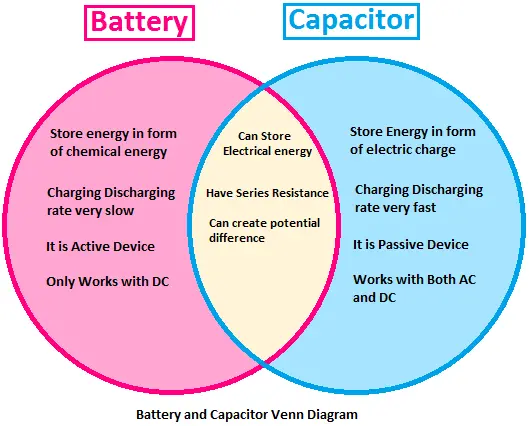
- Capacitors store energy electrostatically, while batteries store energy chemically.
- Capacitors deliver very fast charge and discharge, but with low energy density.
- Batteries provide long-duration, stable power, but have limited cycle life and slower charge rates.
- Capacitors are ideal for power buffering, voltage smoothing, and surge handling.
- Batteries are better suited for continuous power supply and long-term energy storage.
Part 1. What is a capacitor?
A capacitor is an electronic component that stores energy in an electric field. It consists of two conductive plates separated by a dielectric material. When voltage is applied, electrical charge accumulates on the plates.
Unlike batteries, capacitors do not generate energy and do not rely on chemical reactions. They temporarily store and release energy almost instantaneously.
1 Advantages of capacitors
- Ultra-fast charging and discharging: Ideal for applications requiring short power bursts or rapid response.
- Long operational lifespan: Minimal degradation since no chemical reactions occur.
- High power efficiency: Low internal resistance enables efficient energy transfer.
- Wide temperature tolerance: More stable than batteries in extreme environments.
2 Disadvantages of capacitors
- Low energy density: Cannot store large amounts of energy compared to batteries.
- Voltage drops during discharge: Output voltage decreases linearly as energy is released.
- Limited use for long-duration power: Unsuitable as a standalone power source.
Part 2. What is a battery?
A battery is an electrochemical energy storage device that converts chemical energy into electrical energy. It contains one or more cells with positive and negative electrodes separated by an electrolyte.
Batteries are designed to deliver sustained power over time, making them essential for portable electronics, electric vehicles, and energy storage systems.
👉 Learn more about industrial battery systems in our guide on custom lithium battery solutions.
1 Advantages of batteries
- High energy density: Stores significantly more energy in a compact size.
- Stable voltage output: Suitable for continuous and predictable power delivery.
- Portable and scalable: Easily integrated into consumer and industrial products.
2 Disadvantages of batteries
- Limited cycle life: Capacity degrades due to chemical aging.
- Slower charge and discharge rates: Compared to capacitors.
- Thermal and safety management required: Especially for lithium-based batteries.
Part 3. Capacitor vs battery: core differences explained
| Parameter | Capacitor | Battery |
|---|---|---|
| Energy storage method | Electrostatic field | Chemical reaction |
| Energy density | Very low | High |
| Charge / discharge speed | Extremely fast | Slow to moderate |
| Voltage behavior | Drops rapidly | Relatively stable |
| Cycle life | Millions of cycles | Hundreds to thousands |
| Maintenance | Minimal | Aging and replacement required |
| Typical use | Power buffering, filtering | Long-term power supply |
This comparison explains why capacitors cannot replace batteries, and why batteries alone cannot handle high-power transients effectively.
Part 4. Similarities between capacitors and batteries
Despite their differences, capacitors and batteries share several functional similarities:
- Both store electrical energy
- Both are used in consumer electronics, automotive, and industrial systems
- Both can support backup or auxiliary power functions
- Both require proper recycling and disposal
Part 5. Typical applications: battery vs capacitor
1 Capacitor applications
- Power supply filtering and voltage smoothing
- Motor starting and inrush current control
- Power factor correction in industrial grids
- Energy buffering in EV regenerative braking systems
2 Battery applications
- Smartphones, laptops, and portable electronics
- Electric vehicles and energy storage systems (ESS)
- Medical devices and backup power systems
- Industrial equipment requiring long runtime
For advanced battery pack design, see: lithium battery pack manufacturing
Part 6. Engineering selection guide: capacitor vs battery
1 Application × parameter decision table
| Application Scenario | Key Technical Requirement | Capacitor | Battery | Engineering Recommendation |
|---|---|---|---|---|
| Power supply filtering | Fast transient response, ripple suppression | ✅ Excellent | ❌ Poor | Use capacitors for voltage smoothing and noise filtering |
| Motor starting | High inrush current, short-duration power | ✅ Suitable | ❌ Not ideal | Capacitors handle peak current efficiently |
| Portable electronics | Long runtime, compact energy storage | ❌ Not suitable | ✅ Required | Batteries are necessary for sustained power |
| Electric vehicles (EV) | Energy + peak power handling | ⚠ Partial | ✅ Required | Use batteries with capacitors for peak load buffering |
| Regenerative braking | Rapid charge acceptance | ✅ Excellent | ⚠ Limited | Capacitors absorb braking energy quickly |
| Backup power (UPS) | Long discharge duration | ❌ Not suitable | ✅ Required | Batteries provide extended backup time |
| Industrial automation | Voltage stability, surge protection | ✅ Yes | ⚠ Partial | Capacitors protect systems from voltage spikes |
| Renewable energy storage | Energy shifting (hours) | ❌ No | ✅ Yes | Batteries are essential for energy storage |
| Medical equipment | Stable output, predictable behavior | ⚠ Limited | ✅ Preferred | Batteries ensure consistent voltage delivery |
| IoT / sensors | Low power, long lifespan | ⚠ Limited | ✅ Required | Batteries dominate low-power applications |
2 How engineers should use this table
- If power duration is milliseconds to seconds → choose a capacitor
- If power duration is minutes to hours → choose a battery
- If the system experiences frequent power spikes → add capacitors
- If energy density matters → batteries are unavoidable
- In high-performance systems → hybrid (battery + capacitor) design is optimal
Part 7. Capacitor and battery used together (hybrid design)
In many real-world systems, capacitors and batteries are used together, not as alternatives.
- Capacitors handle peak power, noise suppression, and rapid transients
- Batteries provide baseline energy and long-duration power
This hybrid architecture is widely adopted in EVs, industrial power supplies, and renewable energy systems.
Industry reference standards from IEEE and IEC define best practices for combining capacitors and batteries safely.
Part 8. FAQs: difference between capacitor and battery
How long do capacitors last?
Capacitors typically last 10–20 years or millions of cycles, depending on temperature and voltage stress.
Is a capacitor better than a battery?
No. Capacitors excel at fast power delivery, while batteries are better for long-term energy storage.
Why can’t capacitors replace batteries?
Because capacitors have very low energy density and cannot sustain power output over time.
Do capacitors charge faster than batteries?
Yes. Capacitors can charge and discharge almost instantly.
Can a battery replace a capacitor in a circuit?
Generally no. Batteries cannot respond fast enough to handle voltage spikes or transient loads.
Related Tags:

More Articles
Best 24V Lithium Battery: Top 10 Compared
Discover the top 24V lithium batteries. We compare capacity, price, cycle life, safety features, and the best options for different applications.
Top LFP Cell Manufacturers in China You Should Know
Looking for reliable LiFePO4 cells? Explore China's top LFP battery manufacturers, key technologies, production capabilities, and supplier selection tips.
Check If Your Charger Works: Simple Test Guide
Think your battery charger's broken? Quick tests can show you for sure. See if it’s the charger or the battery that's causing issues. Read more.
Best Camera Batteries: 7 Brands Compared & Tested
Looking for the best camera battery? Compare 7 top brands, including OEM and third-party options, to find the right battery for your camera.
What You Need to Know About Portable Fan Batteries
Discover the best portable electric fan battery, its types, lifespan, and maintenance tips. Learn how to choose the right one and keep it running longer.