
- Part 1. Industry challenges in military & defense power systems
- Part 2. Typical engineering considerations for military battery design
- Part 3. Military battery solutions overview
- Part 4. Ruggedization strategies for military battery packs
- Part 5. Typical specifications for military battery packs
- Part 6. Recommended battery chemistries for military applications
- Part 7. Common battery failure risks in military applications
- Part 8. Certifications & compliance support
- Part 9. How we support military & defense projects
Part 1. Industry challenges in military & defense power systems
Power systems for military and defense equipment face challenges far beyond those of commercial or industrial electronics. Batteries are expected to operate reliably in unpredictable environments, often with no tolerance for failure.
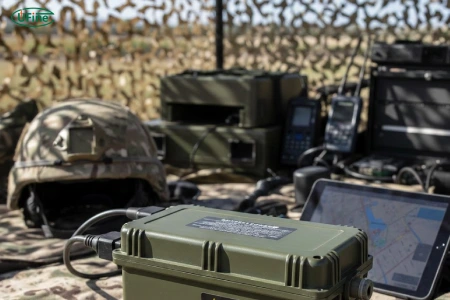
Key challenges include:
1. Extreme operating conditions
Military batteries must withstand vibration, shock, humidity, dust, and wide temperature ranges during storage, transport, and operation.
2. Mission-critical reliability requirements
Power loss can directly lead to communication failure, data loss, or system shutdown during critical operations.
3. Long-term storage and readiness
Many military devices remain in storage for extended periods and must deliver stable performance immediately when deployed.
4. Strict safety, compliance, and documentation standards
Battery packs must meet transportation and safety regulations while maintaining traceability and consistent quality across production batches.
Part 2. Typical engineering considerations for military battery design
Designing battery packs for military applications involves a series of engineering trade-offs focused on reliability and risk control rather than maximum performance.
1 Cell Selection Trade-offs
- Energy density is often balanced against thermal stability and consistency.
- Lithium iron phosphate (LiFePO₄) may be selected over higher-density chemistries when safety and long service life are prioritized.
- Cell batch consistency and long-term availability are critical to ensure repeatability for future production runs.
2 Temperature Performance vs. Cycle Life
- Low-temperature operation reduces discharge efficiency and available capacity.
- Conservative current design and cell selection help balance wide temperature performance with acceptable cycle life.
- Operating temperature ranges are defined based on real-world use conditions rather than absolute datasheet limits.
3 Redundancy and Failure Mitigation
- Series and parallel configurations are evaluated to minimize the impact of single-cell failure.
- Mechanical and electrical isolation strategies reduce cascading failures.
- Battery management systems are designed with conservative thresholds to prioritize safety and system stability.
See how Ufine Battery engineers produce rugged, custom lithium battery packs in our state-of-the-art factory.
Part 3. Military battery solutions overview
As a custom battery pack manufacturer, we support military and defense projects from early evaluation through stable mass production. Our solutions focus on engineering control, repeatability, and long-term supply reliability.
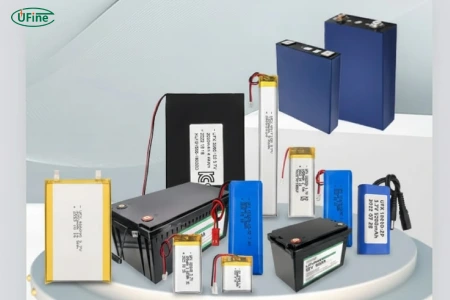
Our military battery solutions support applications such as:
1. Communication & Tactical Systems
Portable radios, command terminals, relay units, and tactical communication equipment requiring stable voltage and long runtime.
2. Unmanned & Surveillance Equipment
Power systems for UAVs, ground sensors, and monitoring devices where energy density and reliability are critical.
3. Portable & Wearable Military Devices
Battery packs for night vision systems, wearable electronics, and soldier-mounted devices with strict size and weight constraints.
4. Backup Power for Defense Electronics
Reserve battery systems designed for emergency power and mission continuity.
Discover how we enhanced performance for a custom pocket light battery in this real-world project.
Ufine x Rollei: 50% More Power in Custom Pocket Light Battery
Part 4. Ruggedization strategies for military battery packs
Ruggedization is not a single feature but a combination of mechanical, electrical, and material design strategies.
- Secure cell fixing methods to prevent micro-movement under vibration and shock
- Reinforced enclosure materials selected based on impact resistance and environmental exposure
- Connector locking mechanisms and strain relief to prevent loosening during transport and use
- Internal insulation and spacing design to reduce abrasion, short-circuit risk, and wear over time
Whether for tactical communication, wearable devices, or UAV systems, Ufine Battery can adapt your pack’s specifications for rapid prototyping or large-scale production.
Find a Solution NowPart 5. Typical specifications for military battery packs
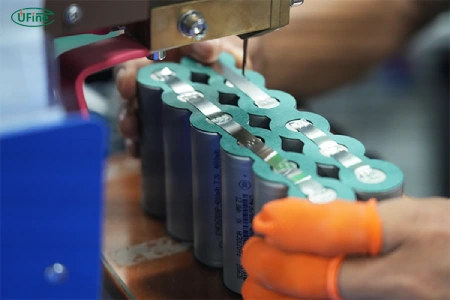
Actual specifications vary by project. The ranges below reflect common military and defense requirements.
- Nominal voltage: 7.4V – 48V (customizable)
- Capacity range: 1Ah – 100Ah+
- Operating temperature: -20°C to +60°C (extended options available)
- Cycle life: 500–2000 cycles, depending on chemistry and usage profile
- Protection functions: Overcharge, over-discharge, short circuit, overcurrent, thermal protection
Part 6. Recommended battery chemistries for military applications
| Battery Chemistry | Typical Use Cases | Key Characteristics |
|---|---|---|
| Lithium-ion (Li-ion) | Communication systems, portable equipment | High energy density, balanced performance |
| Lithium Polymer (LiPo) | Wearable and compact devices | Flexible form factor, lightweight |
| Lithium Iron Phosphate (LiFePO₄) | Backup and safety-critical systems | High thermal stability, long cycle life |
All chemistries can be configured with custom electrical and mechanical designs to match specific mission requirements.
Part 7. Common battery failure risks in military applications
Understanding potential failure modes is essential to reliable battery design.
Capacity loss during long-term storage
Addressed through low self-discharge cell selection and controlled storage voltage strategies.
Connector or internal structure loosening
Mitigated by mechanical reinforcement, locking connectors, and vibration-resistant design.
Thermal risk under high load or extreme conditions
Reduced through conservative current design, thermal monitoring, and BMS protection logic.
Part 8. Certifications & compliance support
We support military battery projects with internationally recognized certifications and complete technical documentation.
- UN38.3 transportation safety certification
- IEC 62133
- CE, KC, UL (as required)
- Test reports, specifications, and revision-controlled documentation
Part 9. How we support military & defense projects
- Small-batch prototypes for evaluation and qualification
- Engineering support for design iterations and field feedback
- Long-term BOM stability planning
- Documentation and revision control for repeat orders and lifecycle support
1 Custom military battery development process
Our development process is designed to support controlled iteration and long-term supply stability.
- Requirement analysis and application review
- Electrical and mechanical design proposal
- Prototype manufacturing and validation testing
- Design optimization based on test feedback
- Mass production with quality and change control
2 Why choose us as your military battery supplier
- Engineering-driven approach to custom battery design
- Experience with non-standard and mission-critical applications
- Flexible support from prototype to volume production
- Strong focus on safety, reliability, and compliance
Looking for a custom battery manufacturer for military and defense applications?
Contact our engineering team to discuss your technical requirements and application challenges.
High Energy Density
It stores large amounts of energy in a smaller and lighter package
Longer Cycle Life
Withstands extensive charge and discharge cycles
Low Self-Discharge
Maintains power longer when not in use
Safety
Minimizes the risk of accidents and ensures safe operation
More Information About Military Battery
-
What is the difference between military batteries and industrial batteries?
-
Are military batteries required to meet MIL-STD standards?
-
Can commercial lithium cells be used in military battery packs?
-
How is battery reliability validated for military applications?
-
What documentation is typically required for military battery procurement?
Latest Blogs
About Lithium Battery Industry News
Buck vs. Boost vs. Buck-Boost Converter: Which Is Best for Battery?
Not sure which converter your battery-powered device needs? Compare Buck, Boost, and Buck-Boost designs and discover what affects voltage stability and runtime.
2026/10/20 Ufine

How to Match 18650 Cells for a Reliable Battery Pack?
Building an 18650 battery pack? Learn how to compare cell capacity, voltage, and internal resistance to avoid mismatches and improve reliability.
2026/10/19 Ufine

Why Do 18650 Battery Packs Get Hot During Discharge?
Is your 18650 battery pack overheating under load? Learn what causes excess heat, how to spot dangerous symptoms, and what to do next.
2026/10/19 Ufine

18650 Battery BMS: How to Get the Specs Right
Learn how to choose a BMS for an 18650 battery pack. Compare voltage, current ratings, protection features, and balancing before you buy.
2026/10/19 Ufine

Why Does My Ring Camera Battery Drain So Fast or Stop Charging?
Is your Ring camera battery draining fast or not charging? Discover common causes, practical fixes, and when to replace the battery.
2026/10/19 Ufine

Battery Pack Overheating? Causes and Solutions
Is your battery pack getting too hot? Learn the common causes, identify potential risks, and discover practical ways to prevent overheating.
2026/10/16 Ufine