
- Part 1. Common power challenges in laptop applications
- Part 2. Laptop battery solutions by application type
- Part 3. Key battery technologies for laptop applications
- Part 4. Recommended battery configurations for laptops
- Part 5. Customization & engineering support
- Part 6. Power your laptop projects with reliable battery solutions
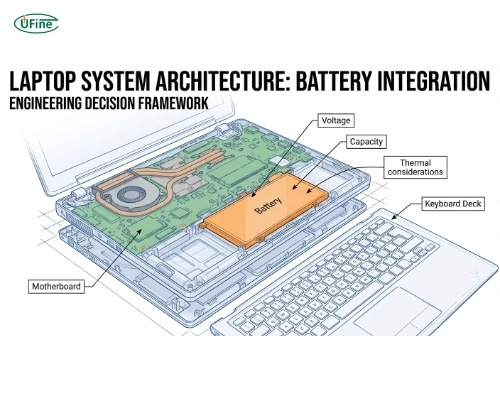
Modern laptops face increasing power pressure from high-performance processors, compact industrial design, and extended runtime expectations. Battery failures such as fast capacity fade, thermal instability, or swelling directly affect product reliability and brand reputation.
Ufine provides application-oriented lithium battery solutions for laptop manufacturers by balancing energy density, safety, cycle life, and form factor compatibility across different laptop use scenarios.
Part 1. Common power challenges in laptop applications
Battery Life and Runtime Requirements
Laptop power consumption varies significantly between light office use, high-performance workloads, and continuous operation scenarios. Designers must balance long runtime with peak discharge capability without oversizing the battery pack.
Space and Weight Limitations
Thin-and-light laptops impose strict constraints on battery thickness, footprint, and weight. Achieving sufficient capacity within limited internal space requires optimized cell selection and pack configuration.
Thermal Management and Safety
Sustained high load, fast charging, and poor ventilation can lead to heat accumulation inside laptop enclosures. Battery stability and protection design are critical to prevent swelling, performance degradation, or safety incidents.
Cycle Life and Reliability
Business and industrial laptops often operate under daily charge–discharge cycles. Insufficient cycle life leads to early battery replacement, higher maintenance cost, and reduced device uptime.
According to Battery University and IEC safety guidelines , thermal stability and cycle performance are among the primary failure factors in portable computing batteries.
Part 2. Laptop battery solutions by application type
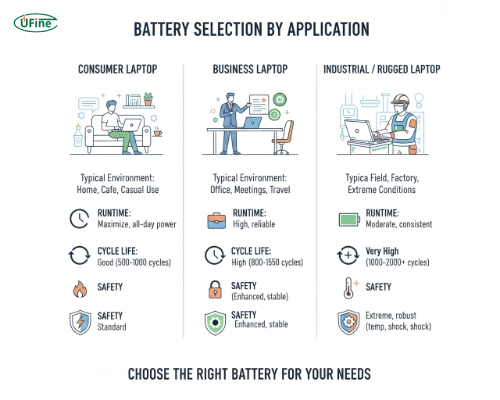
Consumer Laptops
Typical requirements: thin profile, long runtime, balanced cost
Recommended solutions:
- 3.8V 5000mAh Lithium-ion Battery (6759104)
Optimized for slim laptop designs where space efficiency and energy density are critical. - 7.4V 5000mAh Lithium-ion Battery Pack (105565, 2S)
Suitable for mainstream consumer laptops requiring stable voltage and longer screen-on time.
Business & Commercial Laptops
Typical requirements: high reliability, long cycle life, stable output
Recommended solutions:
- 7.4V 4400mAh 18650 Battery Pack (18650-2P2S)
Designed for sustained daily use with improved cycle life and thermal consistency. - 11.1V 2000mAh 18650 Battery Pack (18650-3S)
Ideal for higher-voltage systems and performance-oriented commercial laptops.
Industrial & Rugged Laptops
Typical requirements: wide temperature range, safety margin, durability
Recommended solutions:
- 7.4V 10000mAh Lithium-ion Battery Pack (1160100, 2S)
High-capacity design for extended runtime in field and industrial environments. - 3.7V 7500mAh 18650 Battery Pack (18650-3P)
Suitable for modular or externally mounted power systems requiring long endurance.
Part 3. Key battery technologies for laptop applications
High Energy Density Cell Design
Ufine selects optimized lithium-ion chemistries to maximize capacity within limited enclosure space, supporting longer runtime without increasing battery size.
Low Self-Discharge Performance
Reduced self-discharge ensures laptops maintain usable capacity during storage, shipping, or intermittent use.
Thermal Stability and Safety Protection
Cell-level consistency, controlled internal resistance, and pack-level protection help mitigate heat accumulation during high-load operation.
Long Cycle Life Optimization
For business and industrial laptops, Ufine designs battery packs to support extended cycle life under frequent charge–discharge conditions.
Industry data from IEEE and UL certification guidelines emphasize cycle life optimization as a key factor for professional-grade portable electronics.
Part 4. Recommended battery configurations for laptops
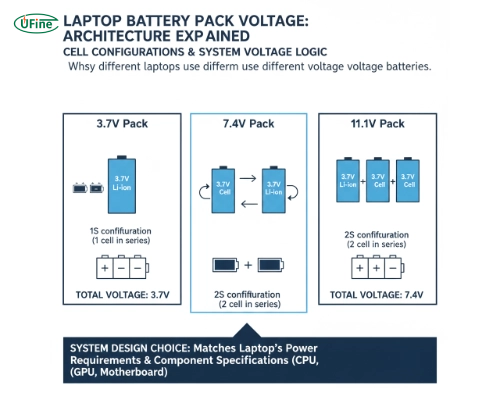
| Configuration | Typical Use Case | Application Notes |
|---|---|---|
| 3.7V Single-cell | Ultra-thin or modular systems | Suitable for compact designs or auxiliary power modules |
| 7.4V (2S) | Mainstream consumer & business laptops | Balanced voltage, capacity, and system compatibility |
| 11.1V (3S) | Performance-oriented laptops | Supports higher power CPUs and GPUs |
Capacity Selection Guidance:
Thin-and-light laptops typically use 4000–6000mAh packs, while performance or industrial laptops often require 7000–10000mAh to support extended runtime. Final selection should consider internal space, thermal design, and system power management.
Part 5. Customization & engineering support
- Custom Battery Design for Laptop Applications
Ufine supports customization of battery size, voltage, capacity, and pack structure to match specific laptop enclosures. - BMS and Electrical Compatibility Support
Battery packs can be designed to integrate seamlessly with laptop power management systems and charging protocols. - Testing, Certification and Compliance
Support for UL, CE, IEC, UN38.3, and other application-related certifications ensures compliance across global markets.
Part 6. Power your laptop projects with reliable battery solutions
Contact Ufine’s engineering team to discuss performance requirements, form factor constraints, and certification needs.
Find A Solution NowHigh Energy Density
It stores large amounts of energy in a smaller and lighter package
Longer Cycle Life
Withstands extensive charge and discharge cycles
Low Self-Discharge
Maintains power longer when not in use
Safety
Minimizes the risk of accidents and ensures safe operation
More Information About Laptop Battery
-
What type of lithium battery is suitable for my laptop application?
-
How do I choose the right voltage and capacity for a laptop battery?
-
Can Ufine customize or replace batteries for existing laptop models?
-
Do you support high-cycle or low-temperature laptop applications?
-
What safety and compliance standards do Ufine laptop batteries meet?
Latest Blogs
About Lithium Battery Industry News
Dead Battery or Device Failure? How to Find the Cause
Think your device is broken? Learn how to tell if the problem comes from battery aging or hardware failure before replacing your electronics.
2026/09/22 Ufine

Why iPhone Duo Uses Two Batteries: The Engineering Behind Foldable Phone Power
Why do foldable phones need two batteries? Explore the engineering challenges behind iPhone Duo’s dual-battery architecture and future battery trends.
2026/09/21 Ufine
Solid-State Batteries: 3 Myths You Need to Know
Solid-state batteries promise safer EVs and longer range, but the reality is more complex. Discover the challenges behind this next-gen technology.
2026/09/21 Ufine

Battery Capacity vs Discharge Rate: The Choice Engineers Face
Higher capacity or higher discharge rate? Learn how to choose the right LiPo battery for longer runtime, stable power output, and better device performance.
2026/09/21 Ufine

Battery Cable Size Guide: Choose the Right Wire Fast
Not sure what battery cable size you need? Learn how to select the right wire gauge, terminal size, and cable for safer, more efficient battery systems.
2026/09/21 Ufine

How to build a12V 10.5Ah Li-ion battery pack with 18650 cells
Learn how to build a high-capacity 12V 10.5Ah battery pack with Ufine 18650 cells. Explore cell selection, 3S3P configuration, BMS wiring, and performance tests.
2026/09/20 Ufine