
- Key Takeaways
- Part 1. Materials & chemistry behind thin batteries
- Part 2. How ultra-thin lithium polymer battery work
- Part 3. Best ultra-thin battery at Ufine
- Part 4. Design challenges of ultra thin batteries
- Part 5. Key performance metrics
- Part 6. Advantages of ultra thin batteries
- Part 7. Limitations & engineering trade-offs
- Part 8. Applications
- Part 9. Future trends & selection guidelines
- Part 10. Conclusion
- Part 11. FAQs
In the past decade, the demand for ultra thin batteries has skyrocketed, driven by the proliferation of compact electronics, wearable devices, foldable smartphones, and medical implants. Consumers and engineers alike are pushing the limits of design, requiring batteries that occupy minimal space while delivering reliable power.
Unlike standard lithium-ion cells, thin lithium ion batteries are engineered to fit into constrained spaces without compromising performance. The global thin battery market is projected to reach several billion dollars by 2030, with a compound annual growth rate (CAGR) exceeding 12%, reflecting the rapid adoption of compact, high-performance electronics.
Key Takeaways
- Ultra thin batteries enable compact, flexible, and lightweight electronics.
- Material choices (LiPo vs Li-ion, electrode composition) are critical for performance.
- Thickness reduction involves trade-offs: capacity, heat management, and safety.
- Soft-pack and thin-film designs optimize space without sacrificing reliability.
- Applications include wearables, medical devices, drones, and foldable devices.
- Choosing the right battery requires balancing energy density, thickness, C-rate, and cycle life.
Part 1. Materials & chemistry behind thin batteries
1 Electrolytes and Cell Chemistry
Thin batteries rely on optimized chemistries to maximize energy density within minimal thickness:
- Lithium Polymer (LiPo): Uses solid or gel polymer electrolytes, allowing thickness as low as 1 mm. Offers flexibility but slightly lower energy density than Li-ion.
- Lithium-ion (Li-ion): Uses liquid electrolytes and rigid electrodes. Higher energy density but less adaptable to extreme thin form factors.
2 Electrode Materials
- Cathode: Common materials include LiCoO₂, LiNiMnCoO₂ (NMC), and LiFePO₄, each offering trade-offs between capacity, thermal stability, and cycle life.
- Anode: Graphite remains standard, while emerging materials like silicon-based anodes provide higher capacity for ultra-thin applications.
- Current Collectors: Thin copper (anode) and aluminum (cathode) foils enable flexibility and reduced thickness without significant resistance.
3 Separator & Packaging
- Separator: Micro-porous polymer films prevent short circuits while allowing lithium-ion migration.
- Packaging: Soft-pack (laminate) structures dominate ultra-thin batteries due to minimal thickness and high energy efficiency.
Part 2. How ultra-thin lithium polymer battery work
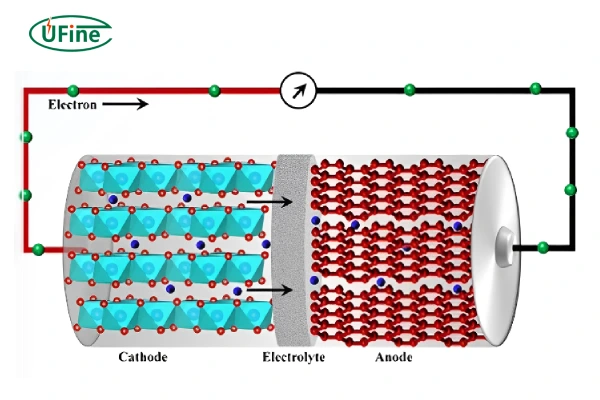
It works exactly similarly to other batteries. It transforms chemical energy into electrical energy. Its electrodes are composed of lithium oxides and graphite. These electrodes are immersed in a polymer electrolyte. So, when you attach the ultra-thin battery to the circuit, chemical processes begin.
As a result, electrons start flowing. These electrons then move from the anode to the cathode. The electrolyte enables the movement of electrons and generates power.
Part 3. Best ultra-thin battery at Ufine
Here are some of the best battery products available at UFine. These batteries can make your lives easier.
3.7 V 120mAh Ultra Thin Battery
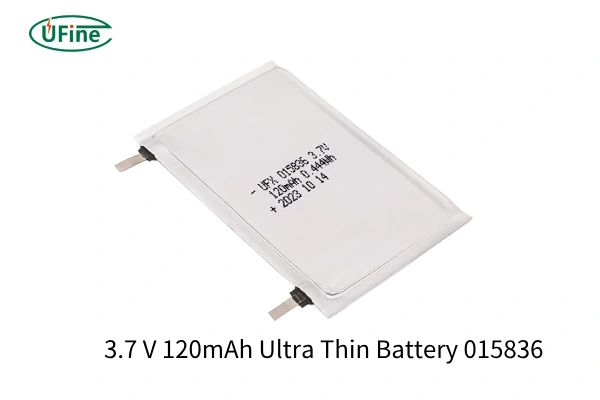
Ufine is one of the top producers of polymer lithium-ion battery cells. Its most popular thin lithium polymer battery is 3.7 V 120mAh ultra-thin battery. It has an energy storage capacity of 120mAH. The flexibility of this battery makes it ideal to use in thin devices.
3.7 V 180mAh Ultra Thin battery
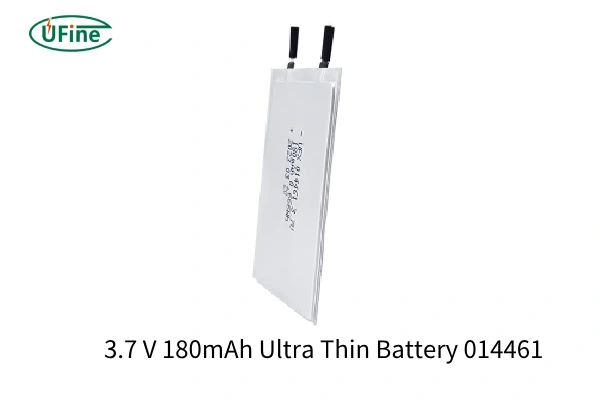
3.7 V 180mAh Ultra Thin battery is another best-selling lithium polymer battery. It weighs around 5 grams. Its charging temperature is 0°C to 45°C. Furthermore, its discharging temperature is -20°C to 60°C. As the name indicates, its average voltage is 3.7V. It has an energy storage capacity of 180mAh.
3.7 V 8mAh Ultra Thin Battery
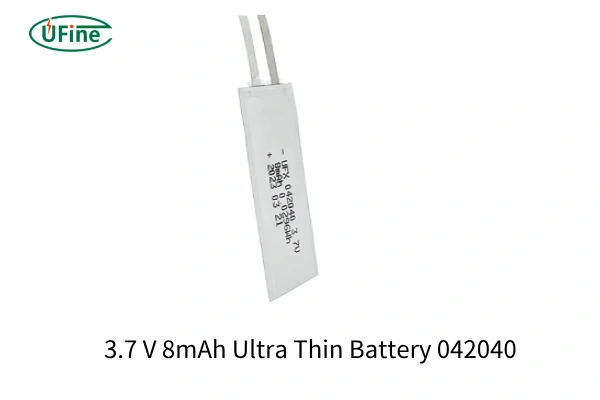
3.7 V 8mAh ultra-thin lipo battery weighs approximately 0.144g. It has a lower internal resistance of less than 1500 mΩ. It has an energy storage capacity of 8mAh. Its average voltage is 3.7 V. Moreover, it has a maximum circuit voltage of 4.2 V. This battery is designed specifically for tracker devices.
Moreover, they have the following features;
- Ultra-Low Self-Discharge
- Wide Temperature Range
- High Discharge Rate
- Long Cycle Life
These are some of the best ultra-thin lipo batteries available at Ufine. You can also order customized ultra-thin lithium according to your preferences.
Part 4. Design challenges of ultra thin batteries
Engineering ultra-thin batteries involves multiple trade-offs:
- Volume Constraints: Reducing thickness below 2 mm requires optimizing electrode layers, reducing electrolyte volume, and minimizing packaging material.
- Mechanical Stability: Thin electrodes are prone to cracking under bending or thermal cycling. Multi-layer lamination and polymer reinforcement are common solutions.
- Thermal Management: Small form factors reduce heat dissipation area, making high C-rate discharge potentially hazardous.
- Safety & Protection: Ultra thin batteries require integrated PCB (Protection Circuit Board) or PCM (Protection Circuit Module) to prevent overcharge, overdischarge, and short circuits.
These challenges mean that ultra-thin battery design is a careful balance between energy density, cycle life, safety, and flexibility.
Part 5. Key performance metrics
For engineers evaluating thin batteries, several metrics are critical:
| Metric | Typical Range for Ultra Thin LiPo / Li-ion |
|---|---|
| Thickness | 1 – 5 mm |
| Energy Density | 150 – 250 Wh/kg, 300 – 500 Wh/L |
| Cycle Life | 500 – 1000 cycles (80% capacity retention) |
| C-rate (Discharge) | 0.5C – 2C typical |
| Self-Discharge | 1–3% per month |
Example: A 2 mm LiPo battery powering a smartwatch may have 40 mAh capacity and sustain 0.5C continuous discharge without significant heat buildup.
Performance is closely tied to material selection, electrode thickness, and thermal design. Engineers often run simulations to predict heat generation and voltage sag under high load.
Part 6. Advantages of ultra thin batteries
Ultra thin batteries offer distinct advantages in modern electronics:
- Space Optimization: Minimizes footprint in PCB and wearable devices.
- Weight Reduction: Critical for wearables, medical implants, and drones.
- Flexible Form Factor: Can be customized to irregular shapes or curved surfaces.
- Energy Efficiency: Multi-layer thin-film designs allow higher volumetric energy density in tight enclosures.
- Compatibility with Advanced Designs: Enables foldable devices and flexible electronics where traditional cylindrical or prismatic cells cannot fit.
These advantages explain why ultra thin LiPo and lithium-ion batteries dominate emerging technology applications.
Part 7. Limitations & engineering trade-offs
Despite advantages, ultra thin batteries face inherent limitations:
- Limited Capacity: Thickness reduction reduces electrode volume, lowering maximum capacity.
- Thermal Issues: Higher resistance and reduced thermal mass increase the risk of overheating under high discharge.
- Cost: Manufacturing ultra thin cells with tight tolerances is more expensive than conventional prismatic or cylindrical cells.
- Safety Concerns: Overcharging, puncture, or bending can be more critical in thin cells; protection circuits are mandatory.
- Cycle Life vs Thickness: Thinner electrodes often degrade faster, requiring material engineering (e.g., flexible binders, solid-state electrolytes) to maintain cycle life.
Engineering decisions involve trading thickness for energy density, safety, and lifespan, requiring careful optimization.
Part 8. Applications
Ultra thin batteries enable cutting-edge electronics across industries:
- Wearables: Smartwatches and fitness trackers use 1–2 mm thin LiPo batteries, 30–50 mAh, balancing runtime with minimal thickness.
- Medical Devices: Implantable sensors and diagnostic devices rely on ultra thin, biocompatible LiPo batteries with stable voltage over long periods.
- Drones & Robotics: Small drones leverage thin Li-ion batteries for high energy-to-weight ratio, optimizing flight time.
- Foldable Smartphones & Tablets: Flexible thin-film batteries conform to foldable panels, maintaining consistent energy delivery across bending cycles.
Example: Samsung’s foldable devices use soft-pack thin batteries ~2.5 mm thick, 600–800 mAh, enabling multi-fold hinge designs.
Part 9. Future trends & selection guidelines
Future of Ultra-Thin Batteries
- Solid-State Thin Batteries: Replace liquid electrolytes with solid electrolytes, improving safety, energy density, and flexibility.
- Silicon Anodes: Boost capacity 3–5x compared to graphite in thin electrodes.
- Flexible & Printed Batteries: Advanced thin-film and printed designs for wearables and IoT devices.
How to Choose the Right Thin Battery
- Thickness vs Capacity Trade-off: Ensure the battery fits device enclosure without sacrificing required runtime.
- Discharge Rate (C-rate): Match battery C-rate with device peak power needs.
- Safety Certifications: UL 2054, IEC 62133, CE compliance.
- Cycle Life Consideration: For devices with daily charging, prioritize high-cycle-life chemistries.
- Application Fit: Choose LiPo for flexible shapes, Li-ion for higher energy density in rigid enclosures.
Selecting the right ultra thin lithium battery requires balancing energy density, form factor, safety, and cost.
Part 10. Conclusion
Ultra thin LiPo and lithium-ion batteries represent the intersection of material science, electrochemistry, and mechanical engineering. By understanding materials, design constraints, performance metrics, and application needs, engineers can select or design batteries that meet the demands of modern compact electronics.
From wearables to foldable smartphones and implantable medical devices, ultra thin batteries are crucial in pushing technology forward, and their evolution continues with solid-state, flexible, and high-capacity thin-film innovations.
Part 11. FAQs
How do ultra thin batteries maintain safety despite minimal thickness?
Thin batteries use integrated protection circuits and advanced packaging to prevent overcharge, overdischarge, and short circuits.
Can ultra thin batteries be used in extreme temperatures?
Most thin LiPo/Li-ion cells tolerate -20°C to 60°C; specialized designs handle wider ranges for industrial or military use.
Do ultra thin batteries support fast charging?
They can, but heat buildup is a concern; designers usually limit charge rate to balance speed, safety, and longevity.
Can thin LiPo batteries bend or flex without damage?
Certain ultra thin LiPo cells are flexible and can tolerate slight bending; extreme folding can cause cracks or internal short circuits.
Is there a significant cost difference between thin batteries and regular batteries?
Yes, ultra thin designs require precise materials and manufacturing, making them generally more expensive per mAh than standard Li-ion cells.
Related Tags:

More Articles

AGM vs Lithium Battery: Which One is Better?
AGM vs lithium battery comparison: learn differences in lifespan, weight, charging speed, cost, and applications to choose the right battery for your system.
Mini or Full-Size: Which Chainsaw Battery Should You Choose?
A chainsaw battery guide to choose the right power for your cuts. Compare top brands, runtime & factors affecting battery life.
Is a LiFePO4 Solar Battery Worth It? Full 2026 Guide
Discover LiFePO4 solar battery reviews, price ranges, and expert tips to choose the best LiFePO4 battery for solar energy storage.
What Car Battery Do I Have? Easy Ways to Identify It
Not sure what car battery you have? Learn how to identify your car battery type, group size, and dimensions to find the right battery for your vehicle.
Material Selection for Battery Enclosures: Metal vs. Plastic for Lithium Battery Applications
Compare metal and plastic battery enclosures for lithium battery systems. Learn differences in thermal performance, safety, weight, and applications.


