
- Key Takeaways
- Part 1. What is a lead carbon battery?
- Part 2. What is an agm battery?
- Part 3. Lead carbon battery vs agm battery: performance comparison
- Part 4. Application-based selection guide: lead carbon battery vs agm
- Part 5. Cost comparison: lead carbon battery vs agm
- Part 6. FAQ: lead carbon battery vs agm battery
When comparing a lead carbon battery vs AGM battery, most buyers focus on lifespan and cost. However, the real difference lies in how each battery performs under partial state of charge (PSOC), deep cycling, fast charging, and high-rate discharge.
This guide provides a technical, application-focused comparison to help engineers, integrators, and procurement managers make the right decision.
Key Takeaways
- Lead carbon batteries deliver significantly longer cycle life (often 1500–3000+ cycles) and superior performance in partial state of charge applications.
- AGM batteries excel in high-current discharge and standby applications, such as automotive starting and UPS systems.
- For solar energy storage and frequent cycling, lead carbon is typically the better long-term investment.
- For engine starting, backup power, and vibration-heavy environments, AGM remains highly reliable.
- Lead carbon battery disadvantages include higher upfront cost and heavier weight compared to AGM.
Part 1. What is a lead carbon battery?
A lead carbon battery is an advanced type of valve-regulated lead-acid (VRLA) battery that integrates carbon materials into the negative electrode. This modification reduces sulfation and dramatically improves cycle life and charge acceptance.
For a deeper technical overview, see our guide on 👉 Lead Carbon Battery Technology Explained
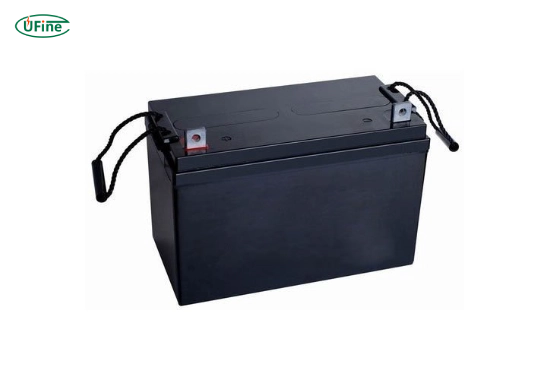
How lead carbon batteries work
Like traditional lead-acid batteries, they rely on the reversible reaction between lead dioxide (PbO₂), sponge lead (Pb), and sulfuric acid (H₂SO₄).
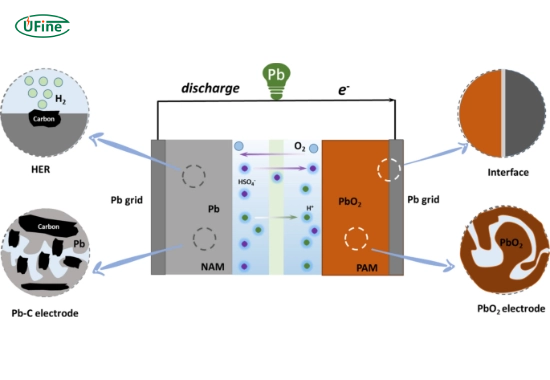
The carbon additive:
- Reduces negative plate sulfation
- Improves charge acceptance
- Enhances performance under PSOC operation
- Increases cycle stability
This makes lead carbon batteries particularly effective in renewable energy systems and microgrid storage, where batteries rarely stay fully charged.
Part 2. What is an agm battery?
An AGM battery (Absorbent Glass Mat) is a sealed lead-acid battery where the electrolyte is absorbed into fiberglass mats between the plates.
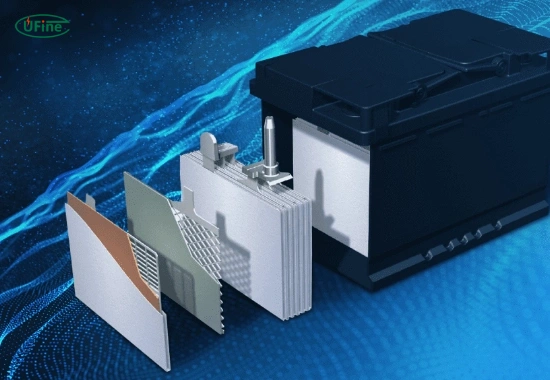
AGM batteries are part of the VRLA family defined under standards such as IEC 60896 (stationary lead-acid batteries).
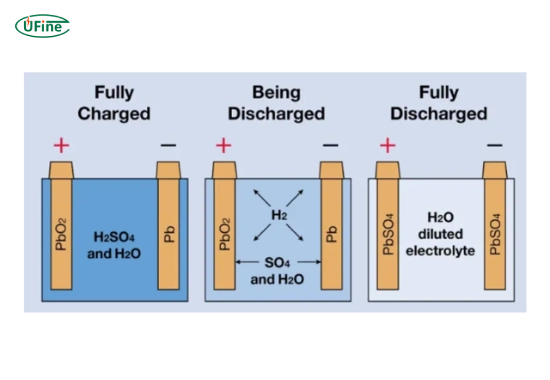
How agm batteries work
AGM batteries:
- Immobilize electrolyte in glass mats
- Maintain low internal resistance
- Support high discharge currents
- Operate as sealed, maintenance-free systems
Because of their low internal resistance, AGM batteries are widely used in automotive starting (SLI), UPS systems, marine equipment, and emergency lighting.
Part 3. Lead carbon battery vs agm battery: performance comparison
1 Quick technical comparison
| Feature | Lead Carbon Battery | AGM Battery |
|---|---|---|
| Cycle Life | 1500–3000+ cycles | 500–1000 cycles |
| PSOC Tolerance | Excellent | Moderate |
| Charge Acceptance | High | Medium |
| Charge Time | 80% in 2–4 h | 4–6 h typical |
| Self-Discharge | 3–5% / month | 4–6% / month |
| High-Rate Discharge | Moderate | Excellent |
| Weight | Heavier | Lighter |
| Upfront Cost | Higher | Lower |
2 Cycle life: the biggest difference
In the debate of lead carbon batteries vs AGM, cycle life is often decisive.
- Lead carbon batteries can exceed 2000 cycles at 50% depth of discharge (DoD).
- AGM batteries typically range between 500–1000 cycles under similar conditions.
For solar storage systems cycling daily, this difference can translate to 2–3× longer service life.
3 Charging speed and PSOC performance
Lead carbon batteries charge faster because carbon improves conductivity and reduces sulfation buildup.
In renewable systems where batteries frequently operate at 30–80% charge:
- Lead carbon maintains stable performance.
- AGM batteries gradually lose capacity under chronic partial charge.
This makes lead carbon more suitable for:
- Solar + storage systems
- Off-grid installations
- Telecom base stations
- Hybrid energy systems
4 High discharge applications
AGM batteries outperform lead carbon in high current burst applications.
Best AGM use cases:
- Engine starting
- Marine cranking
- UPS systems
- Emergency backup power
Their low internal resistance allows rapid discharge with minimal voltage drop.
5 Lead carbon battery disadvantages
While lead carbon batteries offer strong cycling advantages, they also have trade-offs:
- Higher initial purchase cost
- Heavier due to carbon-enhanced structure
- Slightly lower high-rate discharge capability vs AGM
- Not ideal for pure standby-only applications
For systems that rarely cycle (e.g., emergency lighting), AGM may be more cost-effective.
6 Temperature performance
Both battery types operate roughly between –20°C to 50–60°C (model dependent). AGM batteries often tolerate slightly higher ambient temperatures, but excessive heat reduces lifespan for both technologies. For extreme environments, thermal management remains critical.
Part 4. Application-based selection guide: lead carbon battery vs agm
| Application | Recommended Battery |
|---|---|
| Solar energy storage | Lead Carbon |
| Off-grid system | Lead Carbon |
| Telecom backup (cycling) | Lead Carbon |
| Automotive starting | AGM |
| UPS standby system | AGM |
| Marine cranking | AGM |
If your system cycles daily → choose lead carbon. If your system primarily provides backup or high bursts → choose AGM.
Part 5. Cost comparison: lead carbon battery vs agm
Although lead carbon batteries cost more upfront, their extended cycle life often results in:
- Lower cost per cycle
- Reduced replacement frequency
- Lower long-term maintenance cost
For commercial solar installations, this difference can significantly impact total cost of ownership (TCO).
Part 6. FAQ: lead carbon battery vs agm battery
What is the main difference between lead carbon and AGM batteries?
Lead carbon batteries use carbon in the negative plate to improve cycle life and PSOC performance, while AGM batteries use glass mats to immobilize electrolyte and focus on high discharge capability.
Are lead carbon batteries better than AGM?
It depends on the application. For cycling applications like solar storage, lead carbon batteries are typically superior. For engine starting or standby systems, AGM batteries are often more suitable.
How long does a lead carbon battery last?
Under proper conditions, lead carbon batteries can exceed 2000 charge-discharge cycles, significantly longer than standard AGM batteries.
Can I replace an AGM battery with a lead carbon battery?
In many cases, yes — provided the charging voltage and system parameters are compatible. Always verify system charging profiles before replacement.
Which battery is more environmentally friendly?
Both technologies are recyclable under established lead-acid recycling systems. According to data from organizations such as the U.S. Environmental Protection Agency (EPA), lead-acid batteries have one of the highest recycling rates among consumer products.
Related Tags:

More Articles

JST vs Molex: The Right Battery Connector Choice
JST or Molex for your battery? Learn how connector selection affects current, voltage drop, reliability, and device performance.
Custom Battery Pricing: Costs Manufacturers Don’t Mention
A low battery quote may not be the final cost. Discover common hidden expenses that affect custom lithium battery projects.
Battery Wire Length: Hidden Cause of Power Loss
A longer battery wire can cause voltage drop, power loss, and unstable operation. Learn how wire length affects battery performance.
How Device Sleep Modes Affect Battery Life
Think sleep mode extends battery life? Learn why devices still drain power and how firmware, hardware, and batteries affect runtime.
LiPo Battery and PCB Design: Clearance, Insulation, and Placement
Learn how to optimize LiPo battery PCB clearance, insulation, placement, wiring, and thermal design—and avoid common integration mistakes.


