
- Key Takeaways
- Part 1. How many volts is an aa battery?
- Part 2. What is a voltmeter?
- Part 3. Why test aa batteries with a voltmeter?
- Part 4. What tools do you need to test aa batteries?
- Part 5. How to test aa batteries with a voltmeter or multimeter
- Part 6. How to read aa battery test results
- Part 7. Why can an aa battery test good but still fail?
- Part 8. How to perform an aa battery load test
- Part 9. How to test rechargeable aa batteries
- Part 10. How to test several aa batteries in one device
- Part 11. Common mistakes when testing aa batteries
- Part 12. When should you replace or recharge an aa battery?
- Part 13. How to dispose of used aa batteries
- Part 14. FAQs about testing aa batteries with a voltmeter
Testing an AA battery with a voltmeter takes less than a minute. Set the meter to DC voltage, place the red probe on the positive terminal, and place the black probe on the negative terminal.
The reading shows the battery’s voltage, but not its exact remaining capacity. If a battery shows normal voltage but fails in a device, test it under load.
Key Takeaways
- A standard alkaline or lithium AA battery has a nominal voltage of 1.5V.
- A rechargeable NiMH or NiCd AA battery has a nominal voltage of 1.2V.
- Set the multimeter to DC voltage and select a range above 1.5V.
- Test each AA battery separately when a device uses several cells.
- A no-load voltage test is useful, but a load test gives a better view of real performance.
- Never connect a multimeter in current mode directly across a battery.
Part 1. How many volts is an aa battery?
The voltage of an AA battery depends on its chemistry. AA describes the battery size, not one fixed voltage.
| AA Battery Type | Nominal Voltage | Typical Fresh or Charged Voltage | Rechargeable |
|---|---|---|---|
| Alkaline AA | 1.5V | About 1.5–1.65V | No |
| Lithium AA | 1.5V | About 1.6–1.8V | No |
| NiMH AA | 1.2V | About 1.35–1.45V after charging | Yes |
| NiCd AA | 1.2V | About 1.3–1.45V after charging | Yes |
| 14500 lithium-ion cell | 3.6V or 3.7V | Up to 4.2V when fully charged | Yes |
A 14500 lithium-ion cell can look similar to an AA battery. However, its voltage is much higher. Do not use a 14500 cell in a device designed for standard 1.5V AA batteries unless the manufacturer allows it.
For more details, see our guide to AA-size lithium battery types and voltage differences.
Part 2. What is a voltmeter?
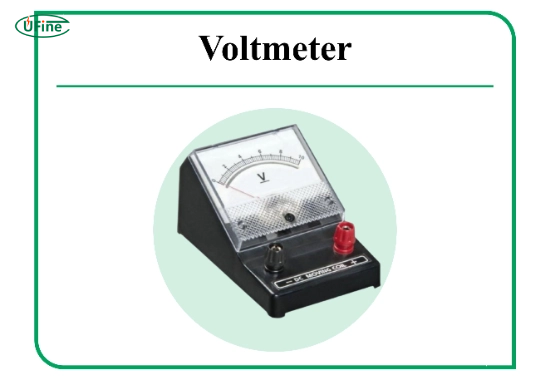
A voltmeter measures the electrical potential between two points. When connected to an AA battery, it shows the voltage between the positive and negative terminals.
A multimeter can also measure battery voltage. Most digital multimeters can measure voltage, current, resistance, and continuity.
- Digital voltmeter: Shows the result as a number and is easy to read.
- Analog voltmeter: Uses a needle and scale. It may be harder to read at low voltage.
- Digital multimeter: Measures voltage and several other electrical values.
For most AA battery tests, a digital multimeter is the easiest option.
Part 3. Why test aa batteries with a voltmeter?
An AA battery test helps confirm whether the battery or the device is causing a problem.
Testing batteries can help you:
- Find weak cells: One weak battery can stop a device that uses several AA batteries.
- Avoid early replacement: Some partly used batteries still work in low-power devices.
- Check rechargeable batteries: A voltage test shows whether a cell needs charging.
- Diagnose device faults: If the batteries test well, check the contacts, switch, wiring, or device.
- Reduce waste: Testing helps prevent usable batteries from being discarded.
Part 4. What tools do you need to test aa batteries?
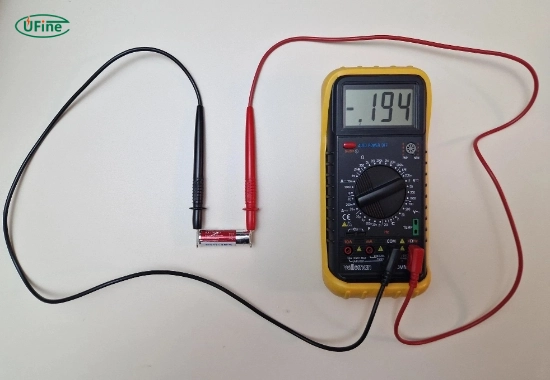
You need:
- A digital multimeter or voltmeter
- The AA battery you want to test
- Clean and undamaged test probes
- A dry and stable work surface
- An optional battery tester with a built-in load
Insert the black lead into the COM port. Insert the red lead into the port marked V or VΩ.
Do not insert the red lead into the A or mA port for a voltage test. This can create a short circuit if the probes are placed across the battery.
Fluke provides a useful reference on how to measure DC voltage with a digital multimeter.
Part 5. How to test aa batteries with a voltmeter or multimeter
Check the battery condition
Inspect the battery before testing it. Do not reuse a battery that is leaking, swollen, corroded, dented, or damaged.
Remove the battery from the device
Remove the AA battery and test it separately. If it was just used in a high-power device, let it rest for several minutes first.
Set the meter to DC voltage
Turn the selector to DC voltage. The symbol is usually a “V” with one solid line and one dashed line.
- For an auto-ranging multimeter, select DC voltage.
- For a manual-ranging meter, select 2V or 20V DC.
- Do not select AC voltage.
Identify the battery terminals
- Positive terminal: The raised end marked with a plus sign.
- Negative terminal: The flat end marked with a minus sign.
Connect the probes
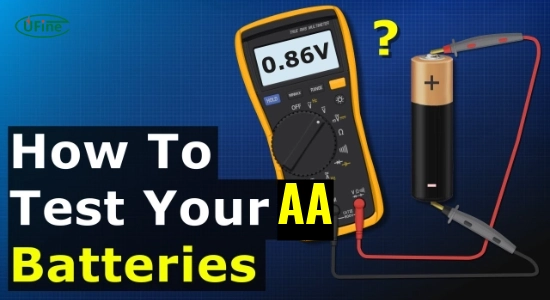
Touch the red probe to the positive terminal. Touch the black probe to the negative terminal.
If the meter shows a negative number, the probes are reversed. Swap them and test again.
Read the voltage
Keep both probes in place until the reading is stable. Record the result and compare it with the battery chemistry.
Test each battery separately
If a device uses two or more AA batteries, test every cell. A normal total voltage can still hide one weak battery.
Part 6. How to read aa battery test results
The table below gives practical voltage ranges. The exact result can vary with battery age, temperature, chemistry, and device load.
| Battery Type | Voltage Reading | Battery Condition |
|---|---|---|
| Alkaline AA | 1.5–1.65V | Fresh or lightly used |
| 1.3–1.5V | Usually still usable | |
| 1.1–1.3V | Low; better for low-power devices | |
| Below 1.0–1.1V | Near depletion for many devices | |
| NiMH AA | 1.35–1.45V | Recently charged |
| 1.2–1.35V | Normal operating range | |
| About 1.0–1.15V | Low; recharge the battery | |
| Lithium AA | 1.6–1.8V | Fresh or lightly used |
| 1.4–1.6V | Usually still usable | |
| Normal voltage but poor device performance | Perform a load test |
These ranges are not fixed replacement limits. Some clocks and remote controls can work at lower voltage. Motors, cameras, toys, and bright flashlights usually need stronger batteries.
The Energizer AA alkaline battery discharge data shows that usable capacity changes with current draw and operating conditions.
You can also learn more about how alkaline battery voltage changes during discharge.
Part 7. Why can an aa battery test good but still fail?
A multimeter normally measures open-circuit voltage. The battery supplies almost no current during this test.
An old battery may show an acceptable voltage with no load. However, its voltage can fall when a device starts drawing current.
This often happens because the battery’s internal resistance has increased. Higher resistance causes a larger voltage drop under load.
For example, an alkaline AA battery may read 1.35V with no load. It may still fail in a toy motor because the voltage drops when the motor starts.
For this reason, voltage alone does not show the exact remaining capacity.
Part 8. How to perform an aa battery load test
A load test checks whether the battery can hold its voltage while supplying current. It is useful when the battery passes a multimeter test but does not work in the device.
You can:
- Use an AA battery tester with a built-in load.
- Measure the battery voltage while it powers the device.
- Test the battery in a known working device with similar power needs.
A small voltage drop is normal. A fast or large drop usually means the battery is weak or has high internal resistance.
Never short the battery terminals. Do not connect a meter set to current mode directly across an AA battery. This can damage the meter and overheat the battery.
Part 9. How to test rechargeable aa batteries
Most rechargeable AA batteries use NiMH chemistry and have a nominal voltage of 1.2V. A reading below 1.5V is normal for this battery type.
- Charge the battery with a compatible charger.
- Let the battery rest after charging.
- Set the multimeter to DC voltage.
- Place the red probe on positive and the black probe on negative.
- Compare the result with other cells of the same model and age.
A recently charged NiMH AA battery often reads about 1.35–1.45V. During use, the voltage normally stays closer to 1.2V.
Panasonic also lists 1.2V as the nominal voltage for its AA-size NiMH rechargeable battery.
If the battery reaches normal voltage after charging but loses power quickly, its capacity may have declined. A charger-analyzer can measure actual discharge capacity more accurately.
Part 10. How to test several aa batteries in one device
Many devices connect AA batteries in series. In a series connection, the voltages add together.
- Two 1.5V alkaline batteries provide about 3V.
- Three 1.5V alkaline batteries provide about 4.5V.
- Four 1.2V NiMH batteries provide about 4.8V.
Do not check only the total voltage. Remove the batteries and test each one separately.
Avoid mixing:
- New and used batteries
- Different battery chemistries
- Different brands or models
- Charged and partly discharged batteries
- Batteries with different capacity ratings
Mixed batteries can discharge unevenly. The weakest cell will limit the whole set.
Part 11. Common mistakes when testing aa batteries
Using the AC voltage setting
AA batteries supply DC voltage. Select DC voltage before testing.
Using the current input port
Place the red lead in the voltage port, not the current port. Using the current port can short the battery.
Expecting every AA battery to read 1.5V
NiMH and NiCd batteries are normally rated at 1.2V. AA-size lithium-ion cells may have a much higher voltage.
Using voltage as an exact capacity reading
Voltage can help screen a battery. It cannot show the exact remaining milliamp-hour capacity.
Testing only the full battery set
A normal total voltage can hide one weak cell. Test every battery separately.
Testing dirty terminals
Dirt or corrosion can cause unstable readings. Make sure the probes touch clean metal surfaces.
Ignoring battery temperature
Cold batteries may show weaker performance. Compare batteries at a similar room temperature.
Part 12. When should you replace or recharge an aa battery?
Replace a disposable battery or recharge a rechargeable battery when:
- Its voltage is below the device’s operating range.
- Its voltage drops quickly under load.
- It is much weaker than other batteries in the same set.
- The device becomes dim, slow, unstable, or unable to start.
- A rechargeable battery loses power soon after charging.
- The battery leaks, swells, corrodes, or becomes damaged.
A partly used alkaline battery may still work in a clock or remote control. Keep it separate from new batteries and do not mix it into a fresh set.
Battery chemistry also affects size and mass. See our guide to the typical weight of different AA battery types.
Part 13. How to dispose of used aa batteries
Battery disposal rules depend on the battery chemistry and local regulations.
- Alkaline batteries: Recycle them where local collection is available.
- NiMH and NiCd batteries: Take them to an approved battery recycling point.
- Lithium batteries: Do not place them in curbside recycling bins.
- Damaged batteries: Isolate them and follow local hazardous waste rules.
Keep used batteries away from coins, keys, screws, and other metal objects. These materials can connect the terminals and cause a short circuit.
For disposal guidance, check the US EPA household battery recycling recommendations or your local waste authority.
Part 14. FAQs about testing aa batteries with a voltmeter
Can I use a multimeter instead of a voltmeter?
Yes. Set the multimeter to DC voltage and connect the red probe to positive and the black probe to negative.
What should I do if my battery shows 0 volts?
Check the meter setting and probe contact. If the reading remains 0V, the battery is dead, damaged, or internally disconnected.
Why is my rechargeable battery reading low even after charging?
The charger may not be working, or the battery may have lost capacity. Test another charger or perform a capacity test.
How often should I test my AA batteries?
Test them when a device becomes weak, before long-term storage, or before using batteries in important equipment.
Can I test batteries without a voltmeter?
Yes. Use a dedicated battery tester or a known working device. Informal methods such as the drop test are not reliable.
Related Tags:

More Articles

Charging a 6V Battery with a 12V Charger: Risks Explained
Can you charge a 6V battery with a 12V charger? Learn the risks, correct charging voltage, safe charger options, and what to do after a mistake.
GPS Tracker Battery Life: Secrets to Longer Runtime
Wondering how long a GPS tracker battery lasts? Learn battery life factors, battery types, power-saving tips, and how to choose a long-lasting GPS tracker.
What Battery to Use for Polaroid Cameras?
A complete guide to Polaroid batteries. Discover battery types, replacement tips, and maintenance for classic and new Polaroid cameras.
How to Check Battery Capacity: Measure mAh Step by Step
Learn how to test battery capacity, measure real mAh, use a battery capacity tester, and check whether your rechargeable battery meets its rated performance.
Understanding C Rating on LiPo Battery
Choosing the wrong C rating can affect battery performance and lifespan. Learn how LiPo C rating works and what rating your device really needs.


