
- Quick Answer
- Part 1. Why do humanoid robots consume so much power
- Part 2. Typical humanoid robot battery life by use case
- Part 3. Types of batteries used in humanoid robots
- Part 4. Battery capacity vs reality: why bigger is not always better
- Part 5. Battery size, weight, and placement trade-offs
- Part 6. Battery voltage: why higher voltage is preferred
- Part 7. Manufacturer claims vs real-world battery life
- Part 8. Battery swapping vs charging: which is better?
- Part 9. Safety and fire risks when extending battery life
- Part 10. How long will humanoid robot batteries last in the future?
- Part 11. FAQs
Quick Answer
Most humanoid robots today can operate for about 1.5 to 4 hours on a single battery charge.
- Under heavy workloads such as continuous walking, lifting, or dynamic balancing, battery life often drops to 1–2 hours.
- In light-duty or mixed-use scenarios, including intermittent movement and AI interaction, battery life typically ranges from 2–4 hours.
- In idle or standby modes, some humanoid robots may last 4–6 hours, but this does not represent real-world operation.
Battery life depends heavily on battery type, capacity, voltage, size, and system efficiency, not just the advertised number.
For example:
Agility Robotics’ Digit can reach up to 8 hours of operation in optimal conditions, significantly above industry average.
UBTECH’s Walker S2 walks for about 2 hours, or stands idle for up to 4 hours, before requiring a recharge.
These figures clearly illustrate that humanoid robot battery life varies widely, and runtime claims must be interpreted in the context of actual workload demands.
Part 1. Why do humanoid robots consume so much power
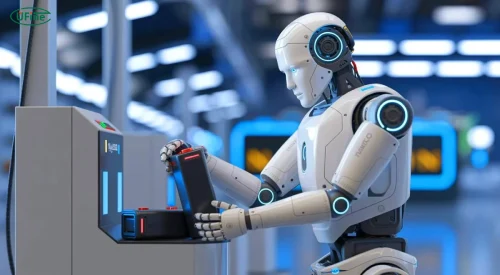
Humanoid robots are among the most power-hungry robotic systems ever built. Unlike wheeled robots, they must continuously fight gravity and maintain balance.
The main power consumers include:
Actuators and motors
Walking, standing, and manipulation require high peak currents, especially during acceleration and balance correction.
AI computing and perception
Vision systems, sensor fusion, and onboard AI inference draw continuous mid-to-high power.
Thermal management and control electronics
Power electronics, motor drivers, and cooling systems add constant background load.
This combination explains why humanoid robot battery life is fundamentally limited compared to traditional robots.
Part 2. Typical humanoid robot battery life by use case
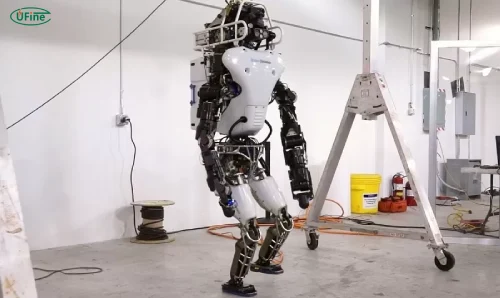
| Operating Scenario | Typical Battery Life |
|---|---|
| Standing / idle monitoring | 4–6 hours |
| Continuous walking | 1–3 hours |
| Object manipulation | 2–3 hours |
| AI interaction & perception | 2–4 hours |
| Mixed real-world tasks | 1.5–3 hours |
This wide range highlights why “hours of battery life” without context is misleading.
Part 3. Types of batteries used in humanoid robots
Battery type plays a decisive role in humanoid robot battery performance, safety, and lifespan.
1 Lithium-Ion (Li-ion) Batteries
Most commonly used today
Pros- High energy density
- Mature supply chain
- Good balance between cost and performance
Cons
- Thermal runaway risk under abuse
- Limited peak discharge without oversizing
Li-ion batteries are widely used in humanoid robot battery packs where space and weight are critical, but they require robust BMS and thermal protection.
2 Lithium Polymer (LiPo) Batteries
Often used in prototypes and research platforms
Pros
- Flexible form factor
- High discharge capability
Cons
- Shorter cycle life
- Higher safety risk if damaged
LiPo batteries are popular in early-stage humanoid robots but are less ideal for long-term commercial deployment.
3 Lithium Iron Phosphate (LiFePO₄)
Safety-oriented option
Pros- Excellent thermal stability
- Long cycle life
- Lower fire risk
- Lower energy density
- Larger battery size for the same capacity
LiFePO₄ is increasingly considered for fireproof humanoid robot battery designs, especially in public or industrial environments.
4 High-Rate Lithium Cells (Hybrid Designs)
Some humanoid robots use hybrid battery architectures, combining:
- High-energy cells for endurance
- High-power cells or capacitors for peak loads
This approach improves performance but increases system complexity and cost.
Part 4. Battery capacity vs reality: why bigger is not always better
Humanoid robot battery capacity (Wh or Ah) alone does not determine usable runtime.
Key limiting factors include:
High peak loads reduce effective capacity.
Voltage sag under load
Causes early shutdown even with remaining charge.
Thermal constraints
Heat limits sustained output power.
Battery aging
Real-world battery life drops 15–30% over time.
This is why two robots with similar battery capacity may show very different real-world endurance.
Part 5. Battery size, weight, and placement trade-offs
Increasing battery size improves runtime—but at a cost.
Key trade-offs:
- Larger batteries increase robot mass, raising energy consumption.
- Poor placement affects center of gravity, reducing balance efficiency.
- Compact humanoid robot battery packs often require custom mechanical design.
In many cases, a well-optimized smaller battery pack delivers better real-world performance than an oversized one.
Part 6. Battery voltage: why higher voltage is preferred
Most humanoid robots operate at 48V, 60V, or higher.
Higher voltage systems offer:
- Lower current for the same power
- Reduced resistive losses
- Improved motor efficiency
However, higher voltage increases insulation, safety, and BMS complexity, especially for humanoid robots operating close to humans.
Part 7. Manufacturer claims vs real-world battery life
Battery life advertised by manufacturers is usually measured under:
- Controlled environments
- Limited motion
- Minimal payload
- New batteries only
In real deployments:
A humanoid robot advertised with 4 hours of battery life often delivers 2–2.5 hours under continuous operation.
Understanding this gap is critical for deployment planning.
Part 8. Battery swapping vs charging: which is better?
| Aspect | Charging | Battery Swapping |
|---|---|---|
| Downtime | Long | Minimal |
| Mechanical complexity | Low | High |
| Best scenarios | R&D, home use | Factories, service robots |
| Cost | Lower | Higher upfront |
Battery swapping is gaining traction, particularly in China’s humanoid robot battery swap ecosystem, where uptime is prioritized over simplicity.
UBTECH’s Walker S2 demonstrates how autonomous battery swapping enables humanoid robots to operate continuously with minimal downtime.
Part 9. Safety and fire risks when extending battery life
Pushing for longer runtime increases safety challenges:
- Higher energy density raises thermal risk
- Faster discharge increases heat generation
- Compact packs limit cooling options
This is why fireproof humanoid robot battery design increasingly focuses on:
- Cell selection
- Structural isolation
- Intelligent BMS strategies
Part 10. How long will humanoid robot batteries last in the future?
- Short term (2025–2026): Incremental improvements (10–20%)
- Mid term (2027–2029): Better system efficiency, smarter power management
- Long term: No breakthrough allowing “all-day” operation without trade-offs
Battery technology improves gradually—software optimization and system design matter just as much as chemistry.
Part 11. FAQs
1. Can humanoid robots operate while charging their batteries?
Most humanoid robots cannot perform dynamic tasks while charging. Tethered operation may allow limited testing or software development, but walking or manipulation is usually restricted for safety and power stability reasons.
2. How many charge cycles does a humanoid robot battery typically last?
Depending on chemistry and usage, most humanoid robot batteries are rated for 500–1,000 full cycles. High-power applications and frequent fast discharging can reduce usable cycle life significantly.
3. Are humanoid robot batteries standardized across brands?
No. There is currently no industry-wide standard for humanoid robot battery size, voltage, or interface. Most systems use custom battery packs optimized for specific robot architectures.
4. What happens if a humanoid robot battery fails during operation?
Modern humanoid robots rely on battery management systems (BMS) to trigger controlled shutdowns. In most designs, the robot enters a safe posture or kneeling mode to prevent falls or damage.
5. Can humanoid robot batteries be upgraded after deployment?
In many cases, battery upgrades are limited. Higher-capacity batteries may change weight distribution, thermal behavior, or voltage compatibility, requiring system-level redesign rather than a simple swap.
6. How does ambient temperature affect humanoid robot battery performance?
Low temperatures reduce available capacity and peak power output, while high temperatures accelerate degradation. Humanoid robots operating outdoors or in factories often require active thermal management for stable battery performance.
7. Why don’t humanoid robots use supercapacitors instead of batteries?
Supercapacitors offer high power but extremely low energy density. They are sometimes used as auxiliary components, but cannot replace batteries for sustained humanoid robot operation.
Related Tags:

More Articles

Top 10 9 Volts Battery Options for Reliable Power
Top 10 9 volts battery options in 2025, including rechargeable 9 volt charging batteries for alarms, instruments, and wearable devices.
A Buyer’s Guide for AA Size Lithium Battery
A buyers guide to AA size lithium batteries covering types, voltage, chemistry, AA vs 14500, and applications like cameras and industrial devices.
When Were Lithium-Ion Batteries Invented? Full History
Explore the history of lithium-ion batteries, from early research to commercial breakthroughs, key inventors, and how the technology evolved.
3.7 Volt Rechargeable Battery: Complete Technical Guide
Learn what a 3.7V rechargeable battery is, how it works, charging voltage, common sizes, and how to choose the right charger.
A Comprehensive Guide to Air Purifier Battery
Learn how to choose the right air purifier battery by comparing battery types, lifespan, and selection criteria for portable and industrial air purifiers.


