- Part 1. What is a big square battery?
- Part 2. Why big square battery safety standards matter?
- Part 3. UL Certification for big square batteries
- Part 4. IEC Certification for big square batteries
- Part 5. UN38.3 Certification for big square battery transport
- Part 6. CE Mark for big square batteries
- Part 7. Insurance and liability considerations
- Part 8. Standards for electric vehicle big square batteries
- Part 9. Standards for battery energy storage systems (BESS)
- Part 10. Risks of non-certified big square batteries
- Part 11. FAQs about big square battery safety standards
When sourcing, installing, or transporting large-format lithium batteries, understanding safety standards is essential. Non-compliance can lead to fire hazards, shipment delays, regulatory fines, or insurance issues. This guide covers key safety standards for big square batteries, their practical implications, and how certified solutions, such as those from Ufine Battery, can simplify compliance for industrial, EV, and energy storage projects.
Part 1. What is a big square battery?
Big square batteries are large-format lithium-ion cells or modules, usually rectangular or square in shape. They are widely used in:
- Electric vehicles (EVs)
- Industrial machines and forklifts
- Energy storage systems (ESS)
- Backup power solutions
For example, a warehouse using electric forklifts benefits from big square batteries because their size allows for long runtimes and efficient stacking. The high energy density and long lifespan make them a practical choice for applications where reliability and compact integration are essential.
Part 2. Why big square battery safety standards matter?
Large-format batteries can pose risks if not properly designed, tested, and certified. Batteries that overheat, short-circuit, or leak chemicals can endanger people and property.
Consider shipping operations: uncertified batteries may be delayed or rejected by air carriers. For industrial installations, local fire inspectors may require proof of compliance before approving equipment.
Key requirements include:
- Safe operating temperature range
- Mechanical shock and vibration resistance
- Prevention of chemical leaks
- Compliance with air, sea, and road transport regulations
Adhering to these standards not only ensures safety but also facilitates international trade and reduces operational risks.
Part 3. UL Certification for big square batteries
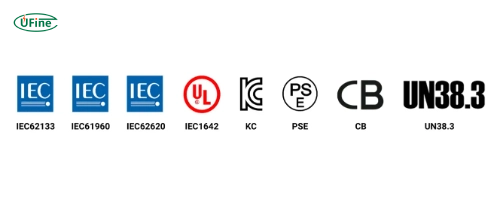
UL (Underwriters Laboratories) certification is a widely recognized standard in North America that ensures battery safety against fire and electrical hazards.
- UL 1642: Lithium-ion cell safety
- UL 2054: Battery pack safety
For instance, hospitals installing backup power systems typically require UL-certified batteries to meet fire safety codes and insurance requirements. Batteries lacking UL certification may face installation delays or denied insurance coverage.
Ufine Battery provides big square batteries with UL certification, helping clients meet North American safety requirements without complications.
Part 4. IEC Certification for big square batteries
The International Electrotechnical Commission (IEC) establishes global standards for battery safety and performance:
- IEC 62133: Sealed portable cells
- IEC 62619: Industrial applications
- IEC 62660: Electric vehicle batteries
In Europe, energy storage developers sourcing big square batteries rely on IEC certification to ensure systems comply with safety regulations and integrate smoothly with solar or grid-connected setups.
1 Comparison Table of Key Standards
| Standard | Region | Focus | Typical Use |
|---|---|---|---|
| UL 1642 / 2054 | USA | Fire & electrical safety | Backup power, EVs |
| IEC 62133 / 62619 | Global | Safety & performance | Industrial & EV applications |
| UN38.3 | Global | Transport safety | Air, sea, land shipping |
| CE | EU | Safety & environmental | Consumer & commercial products |
Part 5. UN38.3 Certification for big square battery transport
Transporting lithium batteries internationally requires UN38.3 compliance. Batteries undergo tests for:
- Altitude simulation
- Thermal cycling
- Vibration and shock
- Short circuit and overcharge
- Forced discharge and impact
For manufacturers exporting batteries to Asia, UN38.3 certification ensures smooth air freight operations and avoids shipment delays.
Part 6. CE Mark for big square batteries
Batteries sold in the European Economic Area (EEA) must carry the CE mark, demonstrating compliance with:
- Safety regulations
- Electromagnetic compatibility
- Environmental directives (RoHS, WEEE)
A solar distributor in Germany, for instance, must use CE-marked big square batteries to legally sell products and gain customer trust.
Part 7. Insurance and liability considerations
Insurance providers often require proof of compliance with UL, IEC, or UN38.3 standards. Certified batteries help reduce financial and legal risk:
- Insurance claims are more likely to be approved
- Regulatory inspections pass smoothly
- Liability in case of accidents is minimized
Uncertified batteries can lead to denied claims, shipment seizures, or legal action, highlighting the importance of verified safety standards.
Part 8. Standards for electric vehicle big square batteries
EV batteries require additional testing and compliance:
- IEC 62660 series: Performance and safety
- SAE J2464: EV battery system safety
- ISO 26262: Functional safety for road vehicles
EV startups using big square modules need to meet these standards to pass safety inspections and qualify for incentives or subsidies. Certified solutions simplify integration and reduce risk.
Part 9. Standards for battery energy storage systems (BESS)
For utility-scale energy storage projects, system-level certifications are critical:
- UL 9540: Energy storage system safety
- NFPA 855: Installation guidelines for ESS
- IEC 62933: Grid-connected ESS standards
Compliance ensures regulatory approval and safe operation of large systems using big square battery modules.
Part 10. Risks of non-certified big square batteries
Batteries lacking certification may face multiple challenges:
- Customs rejection
- Shipping bans
- Insurance denial
- Legal liability or recalls
Companies importing uncertified batteries often experience shipment delays and increased operational costs, emphasizing the value of certified products.
Part 11. FAQs about big square battery safety standards
What is a big square battery used for?
Electric vehicles, industrial equipment, energy storage systems, and backup power.
Is UL certification mandatory for big square batteries?
Not legally required in all cases, but essential for U.S. market compliance and insurance purposes.
Can I ship big square batteries without UN38.3?
No. Shipping requires UN38.3 certification.
What is the difference between IEC and UL standards?
UL is U.S.-specific; IEC is international. Both ensure safety for different regions.
How can I verify if a battery is certified?
Check the certification label or request documentation from the manufacturer. Reputable suppliers provide full reports.
Related Tags:

More Articles

고방전 배터리는 높은 전류와 발열로 배터리수명이 줄어듭니다. 구조적 한계, 사용 패턴, 충전 습관 등 실제 수명 단축 요인을 체계적으로 분석했습니다.
Capacitor vs Battery: What is the Difference?
Capacitor vs battery explained in detail. Learn the difference between capacitor and battery in energy storage, charging speed, lifespan, and real applications.
18650 Battery vs AA: Which Is Better for Your Device?
Compare 18650 vs AA batteries in capacity, voltage, rechargeability, and applications. Learn which battery type fits high-drain or everyday devices.
What is the Difference Between Battery Cell, Battery Control Module, and Battery Pack?
Compare battery cells, modules, and packs. Learn functions, design differences, control modules, and selection tips for EV, ESS, and industrial use.
How to Prevent LiPo Battery Explosion?
Can LiPo batteries explode or catch fire? Learn key causes of LiPo battery fires and proven charging, storage, and handling tips to reduce explosion risk.