
- Part 1. What does mAh really mean for a 7.2V battery and charger?
- Part 2. How to calculate runtime for 7.2V battery and charger correctly?
- Part 3. How to match 7.2V battery and charger capacity with load current?
- Part 4. Why bigger mAh is not always better for 7.2V battery and charger?
- Part 5. How does battery chemistry affect 7.2V battery and charger capacity selection?
- Part 6. How does charger current affect 7.2V battery and charger capacity?
- Part 7. Typical 7.2V battery and charger capacity by application
- Part 8. How does upgrading to lithium change 7.2V battery and charger capacity strategy?
- Part 9. How does 7.2V battery and charger capacity affect price?
- Part 10. When should you choose custom 7.2V battery and charger capacity instead of standard packs?
- Part 11. FAQ – 7.2V battery and charger capacity
Why 7.2V battery and charger capacity is the most misunderstood parameter?
When users buy a 7.2V battery and charger, most people only ask one question:
“How many mAh should I choose?”
But choosing the wrong capacity often leads to:
- Short runtime that cannot finish a full work cycle
- Oversized batteries that add unnecessary weight and cost
- Battery overheating caused by current mismatch
- Faster aging due to improper load design
This guide does not explain capacity in theory. It is written as a real runtime and load matching manual to help you choose the correct mAh for your actual device, not just the biggest number on the label.
Part 1. What does mAh really mean for a 7.2V battery and charger?
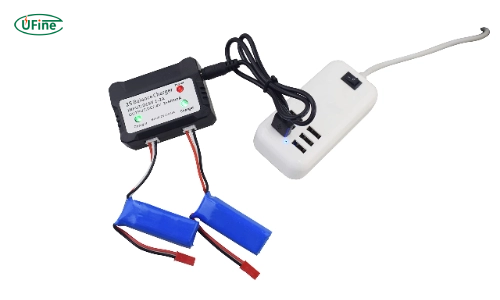
mAh (milliampere-hour) simply means how much energy the battery can store, but it does not directly tell you how powerful the battery is.
Basic definition:
1000 mAh = the battery can supply 1000 mA (1A) for 1 hour
But in real applications, runtime is always affected by:
- Load current size
- Working temperature
- Battery internal resistance
- Discharge efficiency
So mAh is only meaningful when combined with load current.
Part 2. How to calculate runtime for 7.2V battery and charger correctly?
The most practical runtime estimation formula:
Runtime (hours) ≈ Capacity (mAh) ÷ Load current (mA)
Simple examples:
- 2000mAh ÷ 1000mA = 2 hours
- 3000mAh ÷ 2000mA = 1.5 hours
- 5000mAh ÷ 2500mA = 2 hours
Real-world correction factors:
In real devices, you should apply:
- 10–20% efficiency loss
- 5–15% temperature loss (cold environments)
- 5–10% aging loss after long-term use
So always add a safety buffer when selecting capacity.
Part 3. How to match 7.2V battery and charger capacity with load current?
This is where most users make fatal mistakes.
Step 1. Identify real working current
You must know:
- Continuous current (average working load)
- Peak current (startup or motor stall current)
Example:
- Device average current: 1.5A
- Peak current: 5A
Your battery must safely support both.
Step 2. Define required runtime per work cycle
Ask a simple question:
Do you need 30 minutes, 2 hours, or 8 hours per charge?
Step 3. Apply practical selection logic
| Working current | Target runtime | Recommended capacity |
|---|---|---|
| 1A | 2 hours | 2500–3000mAh |
| 2A | 3 hours | 7000–8000mAh |
| 3A | 1.5 hours | 5000–5500mAh |
This is how capacity should be selected — not by guessing.
Part 4. Why bigger mAh is not always better for 7.2V battery and charger?
Many users think:
“If I buy the biggest capacity, I solve all problems.”
This often creates new problems:
- Excessive weight
- Longer charging time
- Higher cost
- Worse heat dissipation
- Unnecessary size increase
In handheld tools, robotics, and portable instruments, oversized capacity reduces usability instead of improving it.
Part 5. How does battery chemistry affect 7.2V battery and charger capacity selection?
For the same 7.2V voltage:
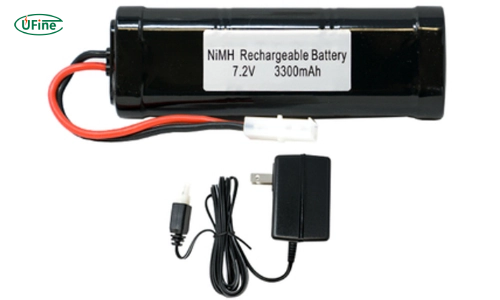
- NiMH → lower energy density → larger and heavier for same mAh
- Lithium → higher energy density → smaller and lighter for same mAh
If you’re comparing capacity behavior between chemistries, this detailed comparison explains the differences clearly:
NiMH vs lithium 7.2V battery and charger
Part 6. How does charger current affect 7.2V battery and charger capacity?
Capacity and charger current must be matched.
General charging time estimation:
Charging time (hours) ≈ Capacity (mAh) ÷ Charger current (mA) × 1.2
Example:
- 4000mAh + 1000mA charger → ≈ 4.8 hours
- 4000mAh + 2000mA charger → ≈ 2.4 hours
If the charger is too weak:
- Charging becomes extremely slow
- Battery may not reach full SOC
If the charger is too strong:
- Heat rises
- Battery lifespan shortens
- Safety risk increases
Part 7. Typical 7.2V battery and charger capacity by application
| Application | Typical capacity range |
|---|---|
| RC cars | 3000–6000mAh |
| Power tools | 2000–5000mAh |
| Medical portable devices | 2500–8000mAh |
| Test instruments | 4000–10000mAh |
| Robotics & AGV subsystems | 6000–15000mAh |
Part 8. How does upgrading to lithium change 7.2V battery and charger capacity strategy?
When upgrading from NiMH to lithium:
- You often need less mAh for the same runtime
- Weight reduction reaches 30–50%
- Discharge voltage stays more stable
If you are planning to upgrade, this conversion guide is essential:
Part 9. How does 7.2V battery and charger capacity affect price?
Capacity is one of the main cost drivers, but not the only one.
Price is affected by:
- mAh rating
- Discharge current ability
- Cell type
- Protection circuits
- Certification requirements
For a full breakdown, see:
7.2V battery and charger pricing guide
Part 10. When should you choose custom 7.2V battery and charger capacity instead of standard packs?
Standard packs work well when:
- Load is stable
- Connector and size are generic
- Certification is not strict
You should choose custom capacity solutions when:
- Device has irregular peak current
- Installation space is tight
- Special connectors are required
- Medical / industrial certification is mandatory
This is where professional lithium battery manufacturers provide cell matching, BMS tuning, and capacity optimization based on real load profiles.
Part 11. FAQ – 7.2V battery and charger capacity
How many mAh is good for a 7.2V battery and charger?
There is no universal best mAh. The correct capacity depends on your device current and required runtime. For most devices, 3000–6000mAh covers 80% of use cases.
Does higher mAh increase power output?
No. Higher mAh increases runtime, not power output. Power output depends on voltage and maximum discharge current.
Can I use a small charger for a large 7.2V battery?
You can, but charging will be very slow and may never reach full capacity efficiently.
Will a bigger capacity 7.2V battery damage my device?
Normally no, as long as voltage and discharge current are compatible. The main risks are weight, size, and heat.
Related Tags:

More Articles

고방전 배터리는 높은 전류와 발열로 배터리수명이 줄어듭니다. 구조적 한계, 사용 패턴, 충전 습관 등 실제 수명 단축 요인을 체계적으로 분석했습니다.
Capacitor vs Battery: What is the Difference?
Capacitor vs battery explained in detail. Learn the difference between capacitor and battery in energy storage, charging speed, lifespan, and real applications.
18650 Battery vs AA: Which Is Better for Your Device?
Compare 18650 vs AA batteries in capacity, voltage, rechargeability, and applications. Learn which battery type fits high-drain or everyday devices.
What is the Difference Between Battery Cell, Battery Control Module, and Battery Pack?
Compare battery cells, modules, and packs. Learn functions, design differences, control modules, and selection tips for EV, ESS, and industrial use.
How to Prevent LiPo Battery Explosion?
Can LiPo batteries explode or catch fire? Learn key causes of LiPo battery fires and proven charging, storage, and handling tips to reduce explosion risk.


