
- Key takeaways
- Part 1. Overview of 3.6V battery
- Part 2. Types of 3.6V batteries
- Part 3. Typical models of 3.6V batteries
- Part 4. What is the difference between protected and unprotected 3.6v batteries?
- Part 5. 3.2v vs 3.6v vs 3.7v vs 3.8v lithium batteries
- Part 6. What is a 3.6V battery pack?
- Part 7. Can I use a 3.7v battery instead of a 3.6v battery?
- Part 8. Why devices are designed for 3.6v lithium batteries
- Part 9. How to choose the right 3.6v rechargeable lithium battery
- Part 10. FAQs
Key takeaways
- A 3.6V battery is a nominal voltage, not the actual working voltage, and most lithium-ion cells operate between ~2.5V and 4.2V.
- In most cases, a 3.6V lithium battery and a 3.7V lithium battery are electrically the same, just labeled differently.
- You can often use a 3.7V battery instead of a 3.6V battery, but device voltage tolerance still matters.
- Battery voltage alone doesn’t define performance—chemistry, discharge curve, and BMS matter just as much.
Part 1. Overview of 3.6V battery
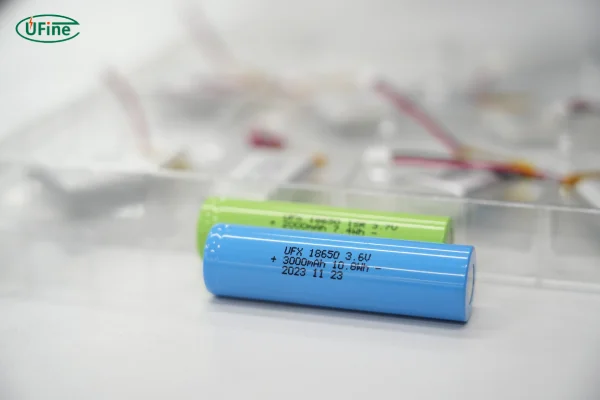
At its core, a 3.6V battery refers to a rechargeable or non-rechargeable battery that has a nominal voltage of 3.6 volts. This voltage is the potential difference between the positive and negative terminals of the battery, and it plays a critical role in how the battery performs in different devices.
Voltage Characteristics
While the nominal voltage of a 3.6V battery is usually around 3.6V, it’s important to understand that batteries don’t operate at a constant voltage. Several voltage characteristics come into play, each influencing the charging and discharge behavior:
- Charging Voltage: For most lithium-based 3.6V batteries, the charging voltage typically goes up to 4.2V when fully charged. This is because lithium-ion cells, the most common type of 3.6V battery, need a higher voltage for efficient charging.
- Discharge Voltage: As a 3.6V battery discharges, its voltage decreases. Depending on the battery’s chemistry and design, the battery will generally discharge to around 3.0V to 3.2V before the device starts to experience a loss of power.
- Cut-off Voltage: The cut-off voltage refers to the lowest permissible voltage a battery should be discharged to. For lithium-ion 3.6V batteries, this is generally around 2.5V, though it’s best to avoid discharging below 3.0V to prolong battery life.
Understanding these voltage characteristics is crucial when using and charging 3.6V batteries. For instance, using a charger that exceeds the recommended charging voltage can damage the battery or reduce its lifespan.
Part 2. Types of 3.6V batteries
When discussing 3.6V batteries, it’s essential to recognize that there are different chemistries and designs that can impact their performance. Each chemistry has its own set of strengths and weaknesses, and the best choice depends on your specific application.
1 Lithium-Ion (Li-ion) 3.6V Batteries
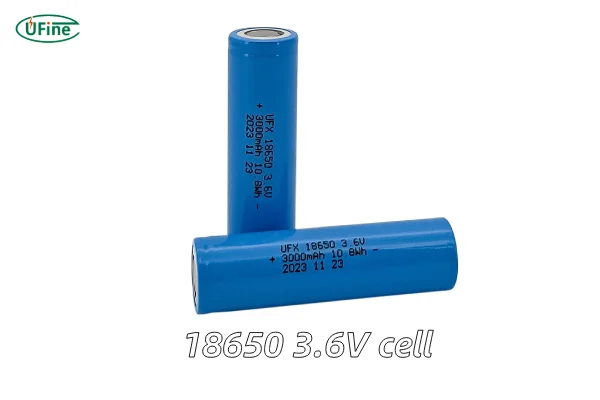
- Chemistry: The most popular type of 3.6V battery today, lithium-ion batteries use lithium compounds as the primary electrochemical material.
- Advantages:
- High Energy Density: Li-ion batteries are lightweight and compact while offering higher energy storage than other types.
- Long Lifespan: They can last for hundreds to thousands of charge cycles, making them highly cost-effective in the long run.
- No Memory Effect: Unlike older technologies, lithium-ion batteries don’t suffer from the “memory effect,” where they lose capacity if not fully discharged before recharging.
- Disadvantages:
- Temperature Sensitivity: Li-ion batteries are sensitive to high temperatures, which can lead to overheating or degradation.
- Safety Concerns: If damaged, overcharged, or improperly handled, lithium-ion batteries can overheat, catch fire, or even explode.
2 Nickel-Metal Hydride (NiMH) 3.6V Batteries
- Chemistry: NiMH batteries use a nickel metal hydride alloy for their electrochemical reactions.
- Advantages:
- More Environmentally Friendly: NiMH batteries are more eco-friendly than lithium-ion, with fewer toxic materials.
- Lower Cost: Generally cheaper than lithium-ion batteries, making them a good option for low-cost devices.
- Disadvantages:
- Lower Energy Density: NiMH batteries are bulkier and heavier than lithium-ion for the same energy output.
- Higher Self-Discharge Rate: NiMH batteries tend to lose their charge faster when not in use compared to lithium-ion batteries.
3 Lithium Phosphate (LiFePO4) 3.6V Batteries
- Chemistry: LiFePO4 is a variation of lithium-ion chemistry that uses iron phosphate as the cathode material.
- Advantages:
- Superior Safety: LiFePO4 batteries are much safer than standard Li-ion batteries and less prone to fire hazards.
- Longer Lifespan: These batteries can last longer, especially in high-drain applications.
- Disadvantages:
- Lower Energy Density: They tend to have a lower energy density, which means they are bulkier and heavier for the same amount of energy.
- Higher Cost: LiFePO4 batteries are generally more expensive than standard lithium-ion batteries.
Part 3. Typical models of 3.6V batteries
Now, let’s take a look at some of the common 3.6V battery models that you’ll find in various applications:
- 18650 Li-ion Battery (3.6V): This is one of the most widely used 3.6V battery models, primarily used in laptops, flashlights, power tools, and even electric vehicles. These cylindrical batteries are known for their high energy density and long life.
- CR123A Lithium Battery (3.6V): A smaller, high-performance lithium battery used in cameras, tactical flashlights, and security systems. Its compact size makes it ideal for devices that require a high current draw in a small form factor.
- AA NiMH Battery (3.6V): This battery is often used in household gadgets like remote controls, toys, and other low-power devices. NiMH AA batteries offer a great balance of cost and performance for everyday applications.
- Button Cell Li-ion Battery (3.6V): These small batteries are used in applications such as medical devices, hearing aids, and key fobs, where compact size is a priority.
Part 4. What is the difference between protected and unprotected 3.6v batteries?
When you start looking deeper into 3.6V lithium batteries, you’ll quickly come across two terms: protected and unprotected batteries. At first, they may look similar, but the difference actually matters a lot in real-world use.
A protected 3.6V battery includes a small built-in circuit, often called a PCB (protection circuit board). This circuit acts like a safety guard. It prevents the battery from being overcharged, over-discharged, or drawing too much current. In simple terms, it helps protect both the battery and your device from abnormal conditions.
On the other hand, an unprotected 3.6V lithium battery does not have this built-in safety layer. That means the battery itself relies entirely on the device’s internal battery management system (BMS) for protection. These batteries are often used in professional or industrial applications where engineers already control the power system.
So which one should you choose?
- If you’re using a consumer device like a flashlight, portable gadget, or DIY electronics project, a protected battery is usually the safer choice.
- If you’re working with a system that already has a well-designed BMS, an unprotected cell may be preferred for flexibility and size efficiency.
One important thing to remember: mixing protected and unprotected batteries in the same system is not recommended. It can lead to inconsistent behavior and reduced reliability.
If you want a deeper breakdown, check our guide on protected vs unprotected batteries to understand safety features and real-world use cases.
Part 5. 3.2v vs 3.6v vs 3.7v vs 3.8v lithium batteries
| Battery Type | Nominal Voltage | Chemistry | Typical Use Case | Key Feature |
|---|---|---|---|---|
| 3.2V | 3.2V | LiFePO₄ (LFP) | Solar storage, EV, backup power | Very safe, long cycle life |
| 3.6V | 3.6V | Li-ion (NMC / LCO) | Electronics, IoT, devices | High energy density |
| 3.7V | 3.7V | Li-ion (similar to 3.6V) | Consumer electronics | Most common labeling standard |
| 3.8V | 3.8V | High-voltage Li-ion (HV NMC) | Premium devices, drones | Higher energy density |
When you compare different lithium batteries, you’ll often see 3.2V, 3.6V, 3.7V, and 3.8V labels. At first glance, they look like small differences, but they actually reflect different chemistries and design priorities.
- 3.2V (LiFePO₄ / LFP): Focused on safety and long cycle life, commonly used in solar storage and backup systems.
- 3.6V / 3.7V (Li-ion): The most common lithium-ion type (NMC/LCO), widely used in electronics and portable devices.
- 3.8V (High-voltage Li-ion): A higher-energy version used in premium devices where compact size and higher energy density are important.
It’s also important to note that 3.6V and 3.7V batteries are often the same chemistry, just labeled differently depending on manufacturer or industry standard.
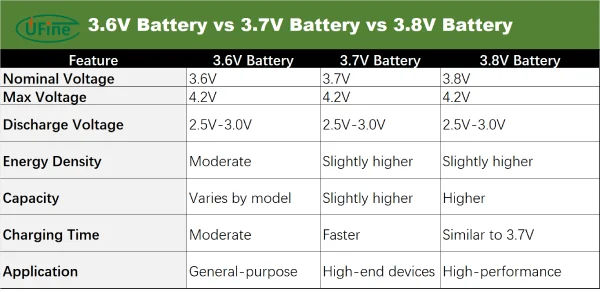
So instead of focusing only on voltage numbers, it’s better to think in terms of chemistry and application, because that’s what really determines performance and compatibility.
Part 6. What is a 3.6V battery pack?
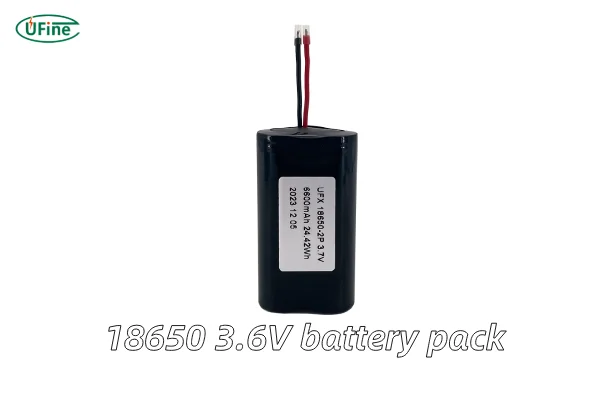
A 3.6V battery pack consists of multiple 3.6V cells connected together to provide higher energy storage or a different voltage output. These packs are commonly used in high-drain applications, such as:
- Power Tools: Battery packs for drills, saws, and other tools are often composed of multiple 3.6V cells.
- Medical Devices: Devices like pacemakers or insulin pumps might use custom 3.6V battery packs for reliable, long-lasting power.
- Electric Vehicles: Small electric scooters or bikes use 3.6V battery packs to power their motors.
These packs are often designed to deliver a specific voltage and capacity, with protective circuits to ensure safe charging and discharging. They are more efficient than individual cells when higher power output or longer run-time is needed.
Part 7. Can I use a 3.7v battery instead of a 3.6v battery?
This is one of the most searched questions—and also one of the most misunderstood.
In most real-world cases, the answer is:
Yes, you can use a 3.7V battery instead of a 3.6V battery.
Why? Because they are typically the same lithium-ion chemistry labeled differently.
However, there are a few important conditions:
- Your device must support lithium-ion voltage range (up to 4.2V)
- The battery size and discharge rating must match
- The protection circuit (if any) must be compatible
If you ignore these factors, even a “matching voltage” battery can still cause issues.
So instead of focusing only on “3.6V vs 3.7V,” it’s smarter to think in terms of system compatibility.
Part 8. Why devices are designed for 3.6v lithium batteries
You might wonder: why do so many devices specifically use 3.6V lithium batteries instead of something like 5V or 12V systems?
The answer is actually about efficiency and design simplicity.
Most modern portable electronics are built around single-cell lithium-ion systems because:
- A single cell provides a usable voltage range (2.5V–4.2V)
- It reduces weight and complexity
- It allows compact battery packs
- It works well with DC-DC converters for stable output
In other words, the device doesn’t directly “use” 3.6V. Instead, it uses a battery system that naturally operates around that voltage range and then regulates it internally.
That’s also why a 3.6 v lithium ion battery is so common in IoT devices, sensors, and portable electronics—you get efficiency without complex multi-cell design.
Part 9. How to choose the right 3.6v rechargeable lithium battery
When you’re selecting a 3.6 volt rechargeable battery, voltage is just the starting point. The real decision comes down to how the battery behaves in your specific device.
You should pay attention to:
- Capacity (mAh) – how long it lasts
- Discharge rate – whether it can handle peak load
- Protection circuit (BMS/PCB) – safety control
- Physical size – compatibility with device housing
And most importantly, don’t treat all “3.6V batteries” as identical. Two batteries with the same voltage rating can perform very differently depending on internal chemistry and build quality.
Part 10. FAQs
1. Are all 3.6V lithium batteries rechargeable?
Yes, most 3.6V lithium batteries are rechargeable lithium-ion cells, but always check if the battery is labeled “rechargeable” or “primary” to avoid confusion.
2. What devices commonly use 3.6V lithium batteries?
They are widely used in flashlights, cameras, medical devices, IoT sensors, and portable electronics that require compact energy storage.
3. How long does a 3.6V lithium battery last?
Typically, a good-quality 3.6V lithium battery lasts 300–1000 charge cycles, depending on usage, temperature, and depth of discharge.
4. Can a 3.6V battery be replaced with a higher mAh version?
Yes, as long as the voltage, size, and discharge requirements match, a higher capacity (mAh) battery is usually safe and will last longer.
5. Why does my 3.6V battery not show 3.6V on a multimeter?
Because 3.6V is a nominal value. A fully charged battery reads about 4.2V, and it drops gradually during use.
6. Is it safe to mix different 3.6V batteries in one device?
Generally no. Mixing batteries with different capacities, ages, or brands can cause imbalance and reduce performance or safety.
Related Tags:

More Articles
Best 24V Lithium Battery: Top 10 Compared
Discover the top 24V lithium batteries. We compare capacity, price, cycle life, safety features, and the best options for different applications.
Top LFP Cell Manufacturers in China You Should Know
Looking for reliable LiFePO4 cells? Explore China's top LFP battery manufacturers, key technologies, production capabilities, and supplier selection tips.
Check If Your Charger Works: Simple Test Guide
Think your battery charger's broken? Quick tests can show you for sure. See if it’s the charger or the battery that's causing issues. Read more.
Best Camera Batteries: 7 Brands Compared & Tested
Looking for the best camera battery? Compare 7 top brands, including OEM and third-party options, to find the right battery for your camera.
What You Need to Know About Portable Fan Batteries
Discover the best portable electric fan battery, its types, lifespan, and maintenance tips. Learn how to choose the right one and keep it running longer.


