

The global wearable device lithium battery market has experienced rapid growth due to the increasing adoption of smart wearables such as smartwatches, fitness trackers, and health monitoring devices. According to Market Report Analytics, the market was valued at approximately USD 8.5 billion in 2024 and is projected to reach USD 22.3 billion by 2034, representing a CAGR of 10.2%.
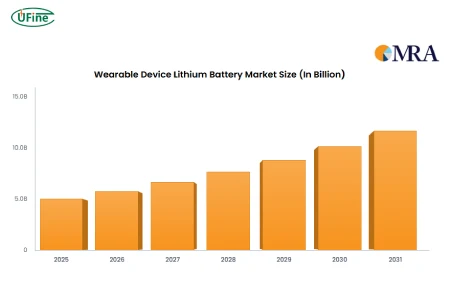
Additional reports indicate that the market’s growth is driven by:
- Rising consumer demand for health and fitness tracking
- Integration of wearables into IoT and healthcare ecosystems
- Technological advances in battery miniaturization and energy density
Regionally, the Asia-Pacific market is growing fastest, led by China, Japan, and Korea, while smartwatches and fitness trackers dominate the end-use applications.
Part 1. Challenges in wearable battery power design
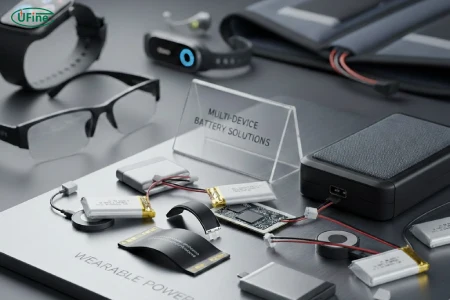
Wearable devices present unique power challenges compared to traditional electronics:
- Compact size & high energy density — Devices like smart rings and watches require maximum runtime in minimal form factors.
- Long runtime & low self-discharge — Devices should operate for days without frequent recharging.
- Safety & reliability — Overcharge, over-discharge, and short-circuit protection are critical.
- Thermal & environmental stability — Devices must function reliably across wide temperature ranges and user conditions.
These challenges necessitate tailored wearable battery pack solutions rather than generic batteries.
Smart Ring Battery Solution: This application overview outlines key battery considerations for smart rings, including ultra-compact size, energy efficiency, and stable performance. Smart Ring Battery Application
Part 2. Our wearable battery pack solutions
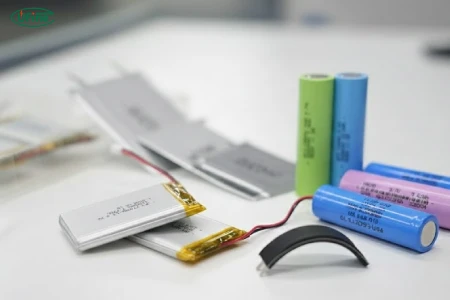
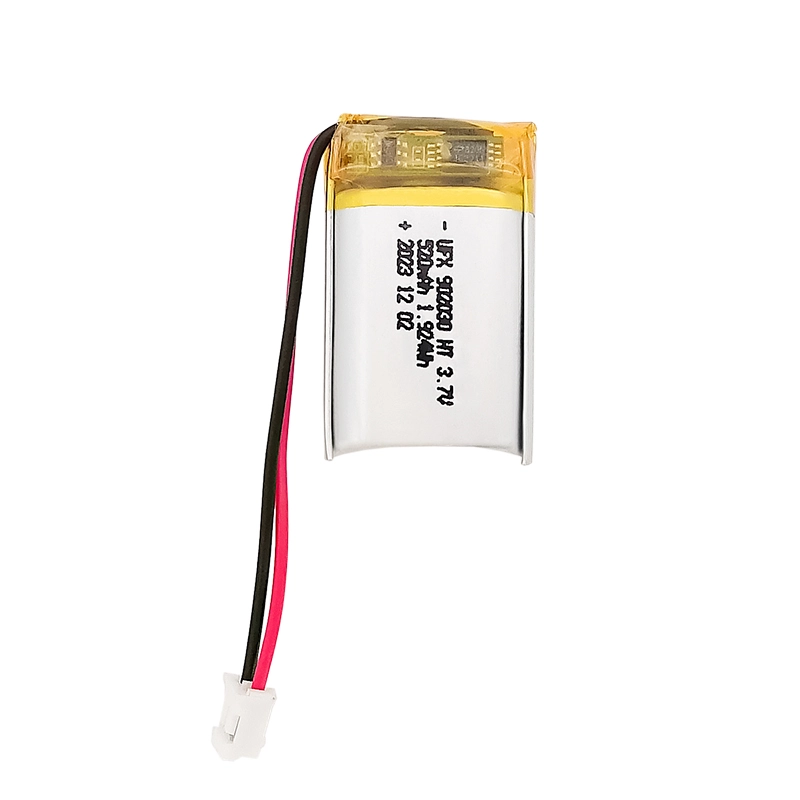
We provide a comprehensive range of wearable battery packs designed for diverse applications:
| Application | Battery Type | Voltage | Capacity | Key Characteristics |
|---|---|---|---|---|
| Smartwatch | Li‑Po / Li‑Ion | 3.7V | 200–1000 mAh | Thin profile, suitable for compact design |
| Fitness Tracker | Li‑Po | 3.7V | 50–500 mAh | Lightweight, stable performance |
| Smart Ring / Glasses | Li‑Po | 3.7V | 20–150 mAh | Miniaturized, ergonomic design |
| Health/Medical Wearables | Li‑Po / Custom | 3.7–7.4V | 100–500 mAh | High reliability, safety-focused |
Each series balances size, performance, and safety to meet demanding wearable environments.
Use Case: This use case explains how lithium batteries are integrated into wearable antiemetic devices, focusing on reliability, runtime, and patient-safe operation. Ufine Battery Increases The Battery Life Of Antiemetic Devices By 20%
Ufine Battery can tailor wearable battery packs to meet specific requirements, including capacity, voltage, form factor, and shape — suitable for prototype evaluation or full-scale production.
Find A Solution NowPart 3. Core technology advantages
Our wearable lithium batteries incorporate leading technologies:
| Feature | Specification | Notes |
|---|---|---|
| Energy Density | 200–1000 mAh | Supports small form factor devices |
| Operating Temperature | -20°C to 60°C | Ensures stable performance in varying environments |
| Cycle Life | 800+ | Suitable for long-term use |
| Charge Efficiency | 1.5h full charge | Optimized for intermittent charging |
| Safety Protections | Integrated protection circuits | Overcharge, over-discharge, short circuit |
See how wearable lithium batteries are manufactured under controlled processes to ensure consistency, safety, and performance.
Part 4. Certifications & compliance
Our batteries meet the highest global safety and regulatory standards:
- CE – European safety compliance
- UL – North American safety certification
- UN38.3 – Lithium battery transport safety
- RoHS / REACH – Environmental compliance
Key international regulations :
- EU Battery Directive
- US CPSC Battery Standards
- IATA Dangerous Goods Regulations
- Japan PSE Electrical Appliance Safety Law
Ufine Battery ensures batteries meet international safety and environmental standards, and can assist with regulatory guidance for wearable devices across different regions.
View Certification DetailsPart 5. R&D support for wearable device projects

We provide full-cycle support for wearable battery projects:
- Feasibility & Power Planning — Early-stage requirements, performance estimation, cost assessment
- Custom Development & Prototyping — Small-batch samples, multi-round iterations
- Performance Testing — Lifecycle, temperature tolerance, safety evaluations
- Manufacturing Scale-Up — Quality continuity from prototype to mass production
- Design Optimization — Form factor, power management, and device integration
We partner with clients to deliver solutions from concept to mass production, supporting small orders, iterative sample adjustments, and full technical guidance.
High Energy Density
It stores large amounts of energy in a smaller and lighter package
Longer Cycle Life
Withstands extensive charge and discharge cycles
Low Self-Discharge
Maintains power longer when not in use
Safety
Minimizes the risk of accidents and ensures safe operation
More Information About Wearable Device Battery
-
What battery chemistries are commonly used in wearable devices and what are their differences?
-
What factors influence the real‑world battery life of wearable devices?
-
Why do some wearable devices need to be charged daily while others last multiple days?
-
Can ultra‑thin lithium batteries maintain performance at extreme temperatures?
-
What safety and protection features are important in wearable batteries?
Latest Blogs
About Lithium Battery Industry News

JST vs Molex: The Right Battery Connector Choice
JST or Molex for your battery? Learn how connector selection affects current, voltage drop, reliability, and device performance.
2026/09/15 Ufine
Custom Battery Pricing: Costs Manufacturers Don’t Mention
A low battery quote may not be the final cost. Discover common hidden expenses that affect custom lithium battery projects.
2026/09/15 Ufine

Battery Wire Length: Hidden Cause of Power Loss
A longer battery wire can cause voltage drop, power loss, and unstable operation. Learn how wire length affects battery performance.
2026/09/14 Ufine

How Device Sleep Modes Affect Battery Life
Think sleep mode extends battery life? Learn why devices still drain power and how firmware, hardware, and batteries affect runtime.
2026/09/14 Ufine

LiPo Battery and PCB Design: Clearance, Insulation, and Placement
Learn how to optimize LiPo battery PCB clearance, insulation, placement, wiring, and thermal design—and avoid common integration mistakes.
2026/09/14 Ufine

Battery Calibration: Why Is Your Battery % Wrong?
Is your battery percentage inaccurate? Learn how battery calibration works, when you need it, and how to fix unexpected battery drops.
2026/09/09 Ufine

