
- Key Takeaways
- Part 1. What is a silicon battery anode?
- Part 2. How does a silicon anode battery work?
- Part 3. Why silicon battery anodes matter (performance benefits)?
- Part 4. Key challenges of silicon anode batteries
- Part 5. Silicon vs graphite anodes (engineering comparison)
- Part 6. How engineers solve silicon anode problems?
- Part 7. Application-based selection guide for silicon anode batteries
- Part 8. Future of silicon battery technology
- Part 9. FAQs about silicon anode batteries
Silicon battery anodes are one of the most important upgrades in modern lithium-ion batteries. As energy demand increases in EVs, electronics, and energy storage, traditional graphite anodes are reaching their limits. Silicon offers much higher capacity, but it also introduces engineering challenges.
This guide explains how silicon anode batteries work, where they are used, and how to evaluate them in real applications.
Key Takeaways
- Silicon anode batteries can deliver up to 10× higher theoretical capacity than graphite (3,579 mAh/g vs 372 mAh/g).
- The biggest challenge is ~300% volume expansion, which affects cycle life and stability.
- Most commercial batteries today use silicon-carbon composite anodes, not pure silicon.
- Silicon lithium batteries are ideal for high energy density applications like EVs and drones.
- Cycle life is improving, but still lower than graphite in many cases.
- For engineering selection, silicon is best when energy density matters more than lifespan and cost.
Part 1. What is a silicon battery anode?
A silicon battery anode is the negative electrode in a lithium-ion battery that uses silicon or silicon-based materials to store lithium ions.
In a typical battery:
- The anode stores lithium ions during charging
- The cathode releases lithium ions
Compared with graphite, silicon anodes for lithium-ion batteries can store significantly more lithium. This is why they are considered a breakthrough material.
👉 For a deeper comparison, see: silicon battery anode vs graphite
Part 2. How does a silicon anode battery work?
The working principle is similar to standard lithium-ion batteries:
- During charging, lithium ions move from cathode → anode
- Silicon absorbs lithium and forms lithium-silicon alloys
- During discharge, ions move back to the cathode
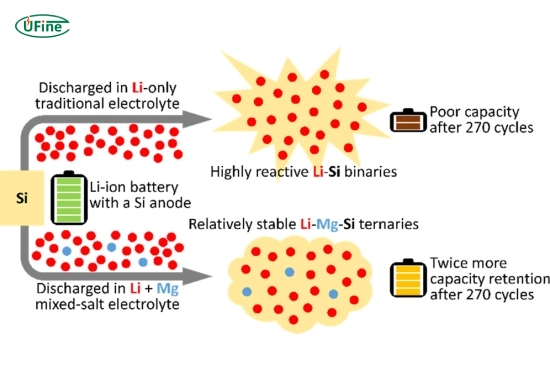
Key engineering issue: Silicon expands up to 300% during lithiation.
This causes:
- Particle cracking
- Loss of electrical contact
- Rapid capacity fade
This is the main reason silicon anode batteries are still evolving.
Part 3. Why silicon battery anodes matter (performance benefits)?
Silicon battery anodes are widely studied because they directly improve battery performance.
1. Much Higher Energy Density
- Graphite: ~372 mAh/g
- Silicon: ~3,579 mAh/g
This enables:
- Longer EV driving range
- Smaller battery packs
- Higher capacity consumer devices
2. Faster Charging Potential
Silicon can absorb lithium ions more quickly. This supports fast charging designs when paired with the right electrolyte and BMS.
3. Compact And Lightweight Design
Higher energy density means fewer cells are needed for the same capacity.
4. Material Availability
Silicon is abundant and widely available, making it attractive for long-term scaling.
Part 4. Key challenges of silicon anode batteries
Despite strong advantages, silicon anode batteries face real engineering limitations.
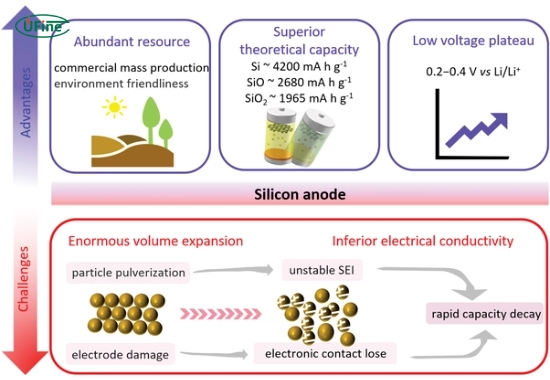
1. Volume Expansion (~300%)
This leads to:
- Mechanical stress
- Electrode cracking
- Reduced cycle life
2. Shorter Cycle Life
- Typical silicon-dominant batteries: ~300–500 cycles
- Graphite batteries: 1000+ cycles
3. Unstable Sei Layer
Silicon reacts with electrolyte, forming an unstable solid electrolyte interphase (SEI). This consumes lithium and reduces efficiency.
4. Manufacturing Complexity
Silicon anode materials require:
- Advanced binders
- Nanostructuring
- Precise coating processes
You can explore how batteries are manufactured here: battery production process
Part 5. Silicon vs graphite anodes (engineering comparison)
| Parameter | Silicon Anode | Graphite Anode |
|---|---|---|
| Capacity | ~3,579 mAh/g | ~372 mAh/g |
| Cycle Life | 300–500 cycles | 1000+ cycles |
| Expansion | Up to 300% | Minimal |
| Cost | Higher | Lower |
| Maturity | Emerging | Mature |
Practical takeaway
- Choose graphite → when long cycle life and low cost matter
- Choose silicon anode battery → when high energy density is critical
Part 6. How engineers solve silicon anode problems?
To make silicon lithium batteries practical, several solutions are used:
1. Silicon-Carbon Composite Anodes
- Most common commercial solution
- Combines conductivity + flexibility
- Reduces expansion stress
2. Nano-Structured Silicon
- Nanoparticles reduce cracking
- Better mechanical stability
3. Advanced Binders
- Elastic binders hold particles together
- Improve cycle life
4. Protective Coatings
- Stabilize SEI layer
- Reduce side reactions
5. Electrolyte Optimization
- Special additives improve stability
Part 7. Application-based selection guide for silicon anode batteries
Choosing a silicon anode battery depends on your application priorities.
| Application | Why Use Silicon Anode | Key Requirement |
|---|---|---|
| Electric Vehicles | Longer range, fast charging | Balance energy density & cycle life |
| Drones / UAVs | Lightweight, high capacity | High discharge rate |
| Consumer Electronics | Slim design, longer usage | Compact size |
| Energy Storage | Higher energy per footprint | Cost & lifespan balance |
| Aerospace / Defense | High performance systems | Reliability + energy density |
👉 For high-rate cylindrical cells, see: li-ion 18650 battery
Part 8. Future of silicon battery technology
Silicon battery anode technology is moving toward hybrid designs:
- Silicon + graphite blends
- Pre-lithiation techniques
- Solid-state battery integration
Companies are scaling production, especially for EV batteries.
Industry trend:
- Short term → silicon additives (5–20%)
- Mid term → high-silicon composites
- Long term → near-full silicon anodes
Part 9. FAQs about silicon anode batteries
What is a silicon anode battery?
A silicon anode battery is a lithium-ion battery that uses silicon-based material as the anode to increase energy storage capacity.
Why is silicon used in lithium-ion batteries?
Because silicon can store much more lithium ions than graphite, improving energy density.
What is the biggest problem with silicon anodes?
Volume expansion (~300%), which leads to cracking and shorter lifespan.
Are silicon anode batteries commercially available?
Yes, but mostly as silicon-carbon composites, not pure silicon anodes.
When should I choose a silicon battery over graphite?
When your application needs higher energy density, smaller size, or faster charging, and can accept shorter cycle life.
Related Tags:

More Articles

Can Battery Degradation Be Reversed on LFP Batteries?
Can LFP battery degradation be reversed? Learn what causes LFP degradation, how to read its degradation curve, recover apparent capacity, and slow aging.
What’s the Difference Between Volts and Amps? A Beginner’s Guide
Learn the difference between volts and amps, how voltage and amperage work together, and how to calculate watts and current with simple examples.
Double A vs Triple A Battery: Understanding Size, Capacity, and Compatibility
Compare AA vs AAA batteries by size, voltage, capacity, runtime, chemistry, and compatibility. Learn which battery fits your device and lasts longer.
The Ultimate Guide to Battery Terminal Adapters
Compare battery terminal adapters for top post, side post, stud, marine, and U1 batteries. Learn how to choose, install, and maintain them safely.
What Can a 12V 50Ah Lithium Battery Power? Real-World Applications Explained
Learn what a 12V 50Ah lithium battery can power, realistic runtimes, inverter limits, charging methods, and uses for RVs, camping, solar, and backup.


