
- Part 1. Why compare sodium-ion and lithium-ion?
- Part 2. Technical basics of each battery type
- Part 3. Sodium-ion vs lithium-ion: detailed technical comparison
- Part 4. Chemical & physical differences that matter
- Part 5. Cost comparison: why sodium-ion is cheaper
- Part 6. Application
- Part 7. Can sodium-ion replace lithium-ion?
- Part 8. Future outlook (2026–2030)
- Part 9. FAQs
If you’re comparing sodium-ion vs lithium-ion batteries, the key difference is energy density (Li-ion wins) vs cost & safety (Na-ion wins). In this article, we provide a full performance comparison including cycle life, charging speed, cost per kWh, temperature performance, applications, and future outlook.
Part 1. Why compare sodium-ion and lithium-ion?
Lithium-ion batteries have defined the energy storage industry for over a decade. However:
- Lithium resources are geographically concentrated (Chile, Argentina, China, Australia)
- Supply chains for nickel and cobalt face cost and environmental pressure
- ESS markets are shifting toward safer, lower-cost chemistries
- EV and renewable energy markets continue expanding
Sodium-ion technology, supported by breakthroughs from CATL, HiNa Battery, Faradion, and BYD, is becoming commercially viable.
Key question:
Are sodium-ion batteries ready to compete with lithium-ion batteries, or are they complementary technologies?
This article answers exactly that.
Part 2. Technical basics of each battery type
1 Sodium-ion Battery (SIB) Technology Explained
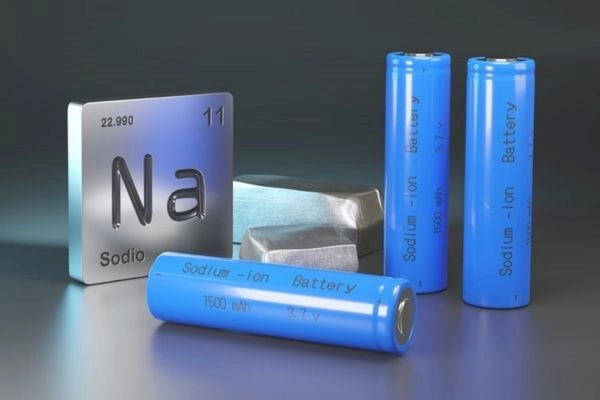
A sodium-ion battery uses Na⁺ ions as charge carriers. Its general structure:
- Cathode: Sodium-containing oxides, polyanionic compounds, or PBAs
- Anode: Hard carbon (most mature), or emerging alloy-type materials
- Electrolyte: Sodium salts in organic solvent
- Separator
- Current Collectors: Aluminum for both electrodes (a major cost advantage)
Learn About the Cathode and Anode of the Battery
Electrochemical Mechanism
The working principle is similar to lithium-ion:
Cathode (charging):
NaₓMO₂ → Naₓ₋yMO₂ + yNa⁺ + ye⁻
Anode (charging):
Hard carbon + yNa⁺ + ye⁻ → NaᵧC
Sodium’s ionic radius (102 pm vs Li’s 76 pm) means:
- Slightly slower diffusion
- Lower energy density
- Higher structural stability at low temperatures
Main Sodium-ion Cathode Types
| Chemistry | Features |
|---|---|
| NaMnO₂ | Good cycle life, wide temp range |
| NVPF (Na₃V₂(PO₄)₂F₃) | High voltage (~3.8 V), stable |
| Prussian Blue / PBA | Low cost, easy manufacturing, used by CATL |
| Layered Oxides | Higher energy density, still developing |
Performance Range
- Energy density: 100–160 Wh/kg
- Cycle life: 2,500–6,000 cycles
- Temperature: Performs well at –20°C and below
- Cost advantage: Up to 30–50% cheaper than Li-ion
2 Lithium-ion Battery (LIB) Technology Explained
Lithium-ion batteries use Li⁺ ions moving between cathode and anode.
Key Components
- Cathode: NCM, NCA, LFP, LCO
- Anode: Graphite, silicon–carbon
- Electrolyte: Lithium salts
- Current Collectors: Copper (anode), Aluminum (cathode)
Electrochemical Mechanism
LiₓMO₂ ↔ Liₓ₋yMO₂ + yLi⁺ + ye⁻
C₆ + yLi⁺ + ye⁻ ↔ LiᵧC₆
Performance Range
- Energy density: 180–260 Wh/kg
- Cycle life: 1,500–4,000 cycles
- Power capability: High-rate charging possible
- Commercial maturity: Highly standardized
Lithium-ion remains the best choice for high energy density applications such as EVs and portable electronics.
Part 3. Sodium-ion vs lithium-ion: detailed technical comparison
Below is a more advanced, engineering-grade comparison table.
| Feature | Sodium-ion (Na-ion) | Lithium-ion (Li-ion) |
|---|---|---|
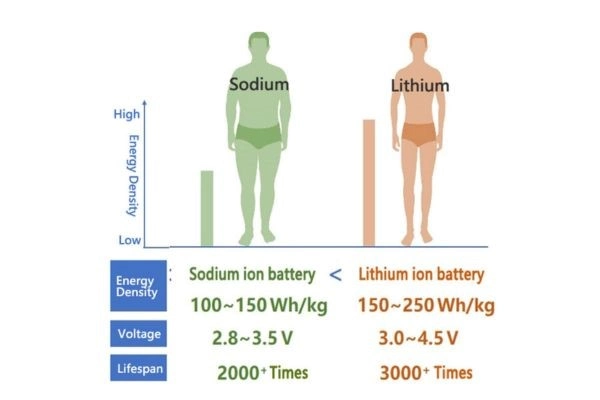
| Energy Density | 100–160 Wh/kg | 180–260 Wh/kg |
| Cycle Life | 3000–6000 cycles | 1500–4000 cycles |
| Charging Speed | Moderate to fast | Moderate |
| Raw Materials | Sodium & aluminum (abundant, low cost) | Lithium, cobalt, nickel, copper (costly, limited supply) |
| Safety | Very high; low thermal-runaway risk | Higher risk of overheating/explosion |
| Temperature Performance | Excellent at low temperatures | Medium stability at low temperatures |
| Cost per kWh | Lower | Higher |
| Commercial Maturity | Emerging technology | Highly mature & widely adopted |
| Best For | Energy storage, grid, backup systems | EVs, electronics, aerospace |
Part 4. Chemical & physical differences that matter
1 Ionic Radius & Diffusion Kinetics
- Na⁺ radius: ~102 pm
- Li⁺ radius: ~76 pm
Larger ions mean Na-ion batteries have:
- Slower ion diffusion
- Lower intercalation capacity
- Lower energy density
- Higher stability under cold temperatures
2 Energy Density Limitations
Lithium’s small ion size and strong electrochemical potential allow:
- High-voltage cathodes
- High-capacity graphite/silicon anodes
- High-energy-density structures
Sodium’s larger ion size limits:
- Host materials
- Intercalation voltages
- Packing efficiency
This is why sodium-ion is not a competitor for long-range EVs, at least for now.
3 Current Collector Difference
- Li-ion requires copper (expensive) for the anode
- Na-ion can use aluminum for both cathode and anode
This reduces cost significantly and avoids the risk of copper dissolution.
4 Safety Comparison
Sodium-ion batteries show:
- Lower thermal-runaway probability
- Lower risk of dendrite formation
- Higher tolerance to mechanical abuse and overcharge
They are ideal for markets with safety-critical requirements.
Part 5. Cost comparison: why sodium-ion is cheaper
1 Raw Materials
- Lithium-ion depends on costly materials: Li, Ni, Co, Cu
- Sodium-ion uses abundant Na and Al
2 Manufacturing
Sodium-ion batteries can reuse existing Li-ion production lines, lowering factory conversion cost.
3 Cost Model Estimates (2025)
- Sodium-ion cost: 40–70 USD/kWh
- LFP lithium-ion cost: 90–120 USD/kWh
- NCM lithium-ion cost: 120–160 USD/kWh
This is why sodium-ion is ideal for energy storage and low-speed EV markets.
Part 6. Application
1 Sodium-ion best for
- Utility-scale ESS
- Solar/wind storage
- Telecom base stations
- Backup power systems
- Off-grid applications
- Two/three-wheelers & low-speed EVs
- Regions with extreme cold climate
2 Lithium-ion best for
- EVs (NCM, NCA, LFP)
- Consumer electronics
- Aerospace
- Power tools
- High-energy-density ESS
Part 7. Can sodium-ion replace lithium-ion?
No — but it will complement it.
Lithium-ion remains unmatched in energy density.
Sodium-ion excels in:
- Cost
- Safety
- Environmental impact
- Supply chain resilience
- Low-temperature performance
Industry experts expect sodium-ion to become a mainstream technology in:
- Energy storage
- Low-speed EVs
- Grid and renewable integration
Part 8. Future outlook (2026–2030)
Key Developments
- CATL’s 160 Wh/kg first-generation sodium-ion cells
- 200+ Wh/kg second-generation sodium-ion under development
- Faradion & Tata producing SIB modules
- HiNa Battery building megawatt-scale SIB ESS projects
- Increasing adoption in telecom and ESS markets
Expected Trends
- Sodium-ion cost to decrease by another 20–30%
- Large renewable energy storage projects accelerate adoption
- China leading global SIB production capacity
- Hybrid systems (Na-ion + Li-ion) becoming popular in ESS
Part 9. FAQs
Are sodium-ion batteries safer than lithium-ion?
Yes. They have lower risk of overheating and thermal runaway.
Are sodium-ion batteries suitable for EVs?
Yes, but mainly for low-speed EVs. Not suitable for long-range EVs yet.
Do sodium-ion batteries work better in cold temperatures?
Yes. They maintain better charge–discharge performance at –20°C or lower.
Will sodium-ion replace lithium-ion?
No. They will co-exist. Sodium-ion is ideal for ESS; lithium-ion remains best for EVs and electronics.
Related Tags:

More Articles

JST vs Molex: The Right Battery Connector Choice
JST or Molex for your battery? Learn how connector selection affects current, voltage drop, reliability, and device performance.
Custom Battery Pricing: Costs Manufacturers Don’t Mention
A low battery quote may not be the final cost. Discover common hidden expenses that affect custom lithium battery projects.
Battery Wire Length: Hidden Cause of Power Loss
A longer battery wire can cause voltage drop, power loss, and unstable operation. Learn how wire length affects battery performance.
How Device Sleep Modes Affect Battery Life
Think sleep mode extends battery life? Learn why devices still drain power and how firmware, hardware, and batteries affect runtime.
LiPo Battery and PCB Design: Clearance, Insulation, and Placement
Learn how to optimize LiPo battery PCB clearance, insulation, placement, wiring, and thermal design—and avoid common integration mistakes.


