
- Key Takeaways
- Part 1. What is a group 48 battery?
- Part 2. Size, voltage & terminal layout
- Part 3. Types of Group 48 batteries
- Part 4. Group 48 Batteries capacity & price comparison
- Part 5. Group 48 Batteries performance parameters
- Part 6. Group 48 deep cycle batteries
- Part 7. Installation & compatibility tips
- Part 8. Maintenance tips for longevity
- Part 9. Environmental & recycling considerations
- Part 10. FAQ
Looking for a reliable battery for your car, RV, or backup power system? You’ve probably seen the term “group 48 battery” floating around. But what does it really mean, and how do you pick the right one? Don’t worry—we’ll break it all down in a way that’s easy to understand. By the end, you’ll know everything from battery sizes and types to maintenance tips and advanced lithium upgrades.
Key Takeaways
- Group 48 batteries are standardized, making it easy to find compatible replacements.
- Available in flooded lead-acid, AGM, and lithium types, each serving different needs.
- Lithium group 48 batteries offer long life, maintenance-free operation, and lightweight design.
- Knowing your battery’s size, voltage, and capacity ensures proper fit and optimal performance.
Part 1. What is a group 48 battery?
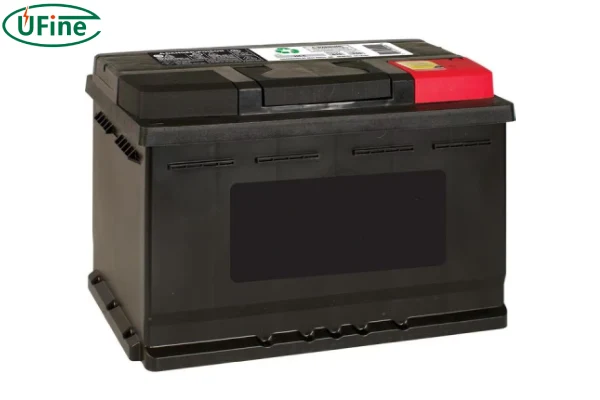
A group 48 battery is a size and specification standard defined by the Battery Council International (BCI) (nofollow). Think of it like a clothing size for batteries: when you buy a group 48 battery, it’s designed to fit most vehicles and equipment that specify this size.
They are widely used in:
- Cars and SUVs for starting, lighting, and ignition (SLI)
- Marine vessels for engine starting and onboard electronics
- RVs for powering appliances off-grid
- Backup systems for homes or businesses
By sticking to the group 48 standard, manufacturers ensure interchangeability and reliability.
Core Structural Components
Regardless of chemistry, a typical group 48 battery consists of the following key components:
Electrodes (Anode & Cathode):
These are the active materials where electrochemical reactions occur. The composition varies by battery type (lead-based or lithium-based).
Electrolyte:
The medium that allows ion transport between electrodes. It can be liquid sulfuric acid, absorbed electrolyte, or lithium salt in organic solvents.
Separator:
A porous insulating layer that prevents internal short circuits while allowing ions to pass through.
Battery Case:
A rigid enclosure (usually polypropylene) designed to withstand vibration, temperature changes, and chemical exposure.
Terminals:
External electrical connection points, typically top-post terminals in group 48 batteries, designed for high-current automotive applications.
Part 2. Size, voltage & terminal layout
The physical size of a group 48 battery is standardized:
| Dimension | Measurement |
|---|---|
| Length | 12.1 in (30.7 cm) |
| Width | 6.9 in (17.5 cm) |
| Height | 7.5 in (19 cm) |
The voltage is almost always 12 volts, ideal for automotive applications and standard electrical systems.
Terminal Layout: Most group 48 batteries use top post terminals, but some marine and RV applications use side posts. Always check your vehicle’s requirements before buying. Using the wrong terminal orientation can make installation tricky or even unsafe.
Part 3. Types of Group 48 batteries
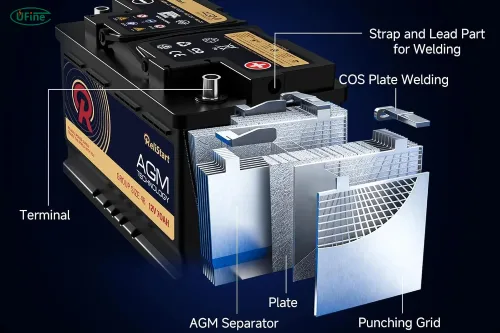
Group 48 batteries come in three main types, each with its own strengths:
1 Flooded Lead-Acid Batteries
In flooded lead-acid and AGM group 48 batteries, energy is stored and released through a reversible chemical reaction between lead (Pb), lead dioxide (PbO₂), and sulfuric acid (H₂SO₄).
During discharge:
- Lead dioxide at the positive plate and lead at the negative plate react with sulfuric acid.
- Electrical energy is released as electrons flow through the external circuit.
- Both plates gradually convert to lead sulfate (PbSO₄).
During charging:
- An external power source reverses the reaction.
- Lead sulfate converts back into lead dioxide and lead.
- Sulfuric acid concentration is restored.
Affordable and reliable, but require periodic maintenance like topping up with distilled water.
2 AGM (Absorbent Glass Mat) Batteries
AGM batteries improve upon flooded designs by absorbing the electrolyte in fiberglass mats, which:
- Reduces internal resistance
- Improves vibration resistance
- Enables faster charge acceptance
- Sealed, maintenance-free, and spill-proof.
- Can handle higher electrical demands and last longer than traditional flooded batteries.
This is why group 48 AGM batteries are widely used in modern vehicles with start-stop systems and higher electrical loads.
3 Lithium (LiFePO4) Batteries
A group 48 lithium battery, typically based on LiFePO₄ (Lithium Iron Phosphate) chemistry, operates on a fundamentally different principle.
Instead of chemical conversion, lithium batteries rely on lithium-ion intercalation:
- Lithium ions move between the cathode (LiFePO₄) and the anode (graphite).
- Electrons flow through the external circuit to power loads.
- The crystal structure of the electrodes remains largely intact during cycling.
Key structural advantages:
- No liquid acid or gas generation
- Extremely low internal resistance
- Flat voltage curve during discharge
Because of this structure, lithium group 48 batteries can safely operate at:
- Higher depth of discharge (80–90%)
- Higher charge and discharge rates
- Significantly longer cycle life
A built-in Battery Management System (BMS) continuously monitors voltage, current, and temperature to prevent overcharge, over-discharge, and thermal stress.
To understand how a lithium battery BMS differs from a PCB and why it’s crucial for safety and longevity, check out this deeper comparison
- Lightweight, long-lasting (up to 10+ years), fast-charging, and maintenance-free.
- Higher upfront cost, but better long-term value.
Scenario Example: If you’re going on a week-long RV trip off-grid, an AGM battery might power your devices for a day or two, but a lithium group 48 battery will keep your fridge, lights, and electronics running all week without worry.
| Feature | Lead-Acid / AGM | Lithium (LiFePO₄) |
|---|---|---|
| Energy Storage Mechanism | Chemical conversion | Ion intercalation |
| Electrolyte | Sulfuric acid (liquid or absorbed) | Lithium salt (organic solvent) |
| Internal Resistance | Moderate | Very low |
| Gas Generation | Possible | None |
| Required Protection | Venting | BMS |
| Structural Stability | Moderate | High |
Part 4. Group 48 Batteries capacity & price comparison
Capacity, measured in ampere-hours (Ah), shows how much energy your battery can store. Here’s a quick comparison:
| Type | Typical Capacity (Ah) | Approx. Price (USD) |
|---|---|---|
| Flooded Lead-Acid | 60–70 | $100–$150 |
| AGM | 65–75 | $150–$220 |
| Lithium | 70–75 | $200–$250+ |
A higher capacity means longer runtime before recharge, which is critical for RVs, marine applications, or backup power.
Part 5. Group 48 Batteries performance parameters
| Type | Lifespan | Self-Discharge | Temp Range | Pros / Cons |
|---|---|---|---|---|
| Flooded Lead-Acid | 3–5 yrs | High | -20°C to 50°C | Cheap, maintenance required |
| AGM | 5–7 yrs | Medium | -30°C to 60°C | Maintenance-free, good for high loads |
| Lithium | 10+ yrs | Low | -20°C to 60°C | Lightweight, fast charge, expensive |
This table helps you pick the right type based on lifespan, environmental conditions, and usage scenario.
Part 6. Group 48 deep cycle batteries
Deep cycle batteries are designed to provide steady power over a long period, unlike standard starter batteries. They’re perfect for:
- RVs and campers – powering appliances while off-grid
- Marine vessels – running onboard electronics
- Solar systems – storing solar energy for nighttime
- Backup power systems – ensuring electricity during outages
Switching to a lithium deep cycle group 48 battery improves efficiency, reduces weight, and eliminates the need for frequent maintenance.
For a more complete overview of deep cycle lithium battery technologies and their advantages in renewable and off-grid systems, this guide breaks it down step by step.
Part 7. Installation & compatibility tips
- Always check your vehicle or equipment’s battery compartment size before purchasing.
- Make sure terminal orientation matches your setup (top vs side post).
- If connecting multiple batteries in parallel or series, ensure compatibility to avoid imbalance or damage.
- For marine or RV setups, consider corrosion-resistant terminal coatings.
Part 8. Maintenance tips for longevity
Charging profiles by type:
| Type | Recommended Charger | Max Charge Current | Float Voltage |
|---|---|---|---|
| Flooded Lead-Acid | IUoU charger | 10–15% of Ah | 13.5–13.8V |
| AGM | AGM-compatible IU charger | 20–25% of Ah | 13.6–13.8V |
| LiFePO₄ | CC/CV LiFePO₄ charger | 30–50% of Ah | 14.4V (per cell) |
Even maintenance-free batteries benefit from good habits:
- Inspect Regularly – Look for corrosion, damage, or leaks.
- Keep Charged – Avoid deep discharges; store around 50–75% charge if unused.
- Store Properly – Cool, dry areas are best; extreme temps shorten battery life.
- Use Compatible Chargers – Wrong chargers can permanently damage the battery.
Pro Tip: For official battery care and safety, see Exide’s Battery Care Page (nofollow).
Part 9. Environmental & recycling considerations
- Lead-acid batteries are highly recyclable but contain toxic lead and acid—dispose properly.
- Lithium batteries have lower environmental impact but should still be recycled at designated centers.
Proper disposal ensures you do your part for the environment while staying safe.
Part 10. FAQ
Can I replace a flooded group 48 battery with lithium?
Yes, but check your alternator output and voltage limits; lithium has slightly different charging characteristics.
How do I know if my battery needs replacing?
Look for slow starts, dim lights, or a multimeter reading below 12V after charging.
Are lithium batteries safe in hot climates?
Yes, most LiFePO4 batteries handle temperatures up to 60°C, but avoid direct sunlight for prolonged periods.
Related Tags:

More Articles
How to Choose the Right 3S LiPo Battery 5000mAh for Your RC Hobby Projects?
Learn how to choose the best 3S LiPo battery 5000mAh for RC cars, drones, boats, and planes. Compare C ratings, runtime, connectors, charging, and safety tips.
Comparing Semi Truck Batteries vs. Truck Batteries
Compare semi truck batteries and truck batteries by size, CCA, lifespan, and battery type. Learn how to choose the right truck battery for your vehicle.
Top 10 Flat Lithium Ion Battery Options for Compact Devices
Explore top flat lithium ion battery options, key specifications, and selection factors for compact electronics, medical devices, and energy storage systems.
Top 10 High Capacity Batteries: Best Large Capacity Battery Options
Compare 10 high capacity batteries for portable devices, backup systems, and industrial use. Find the best large capacity battery.
Top 10 Deep Cycle Lithium Battery 2026
Not all lithium batteries are equal. We tested 10 options to reveal the best lithium deep cycle battery for RV, solar, and backup power systems.


