
- Key Takeaways
- Part 1. Battery manufacturing process flow chart
- Part 2. Battery raw material selection
- Part 3. Electrode production
- Part 4. Electrolyte preparation
- Part 5. Battery cell assembly
- Part 6. Battery electrolyte filling process
- Part 7. Battery formation and conditioning
- Part 8. Battery module and pack assembly
- Part 9. Battery quality control and testing
- Part 10. Battery packaging and labeling
- Part 11. Battery recycling and disposal
- Part 12. Advancements in battery manufacturing
- Part 13. FAQs about the battery manufacturing process
The battery manufacturing process is a highly controlled industrial workflow that converts raw materials into reliable energy storage devices. Modern battery production involves precision chemistry, advanced automation, and strict quality control to ensure safety, performance, and long cycle life.
From material selection and electrode fabrication to cell assembly, formation, and testing, each stage directly affects battery capacity, lifespan, and safety. Understanding the battery manufacturing process flow chart is essential for engineers, product designers, and procurement teams evaluating battery suppliers.
This guide explains how batteries are produced step-by-step and highlights the key technologies used in modern battery manufacturing.
Key Takeaways
- The battery manufacturing process consists of several critical stages: raw material preparation, electrode production, cell assembly, electrolyte filling, formation, testing, and pack assembly.
- Electrode coating and calendering strongly influence battery energy density and internal resistance.
- Battery formation is a crucial electrochemical step that builds the SEI layer and determines long-term stability.
- Strict quality control and safety testing ensure batteries meet international performance and safety standards.
- Modern battery production lines rely on automation, environmental control, and advanced monitoring systems to maintain consistency and scalability.
Part 1. Battery manufacturing process flow chart
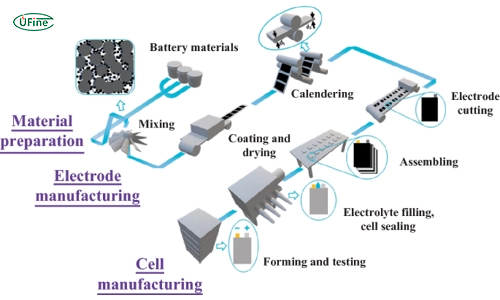
A simplified battery manufacturing process flow chart typically includes the following stages:
| Stage | Key Process | Purpose |
|---|---|---|
| Raw Material Preparation | Lithium salts, graphite, cathode materials | Ensures chemical purity |
| Electrode Production | Mixing, coating, drying, calendering | Creates anode and cathode layers |
| Cell Assembly | Stacking or winding electrodes | Builds internal cell structure |
| Electrolyte Filling | Vacuum filling and wetting | Enables ion transport |
| Formation | Initial charge cycles | Creates stable SEI layer |
| Testing & Aging | Electrical and safety testing | Ensures reliability |
| Module / Pack Assembly | BMS integration | Final application-ready system |
Part 2. Battery raw material selection
The first stage in battery manufacturing is selecting high-purity raw materials. Material quality directly determines battery capacity, lifespan, and safety.
Common materials used in lithium battery production include:
- Lithium compounds – Provide high energy density in lithium-ion batteries
- Nickel – Increases energy density in NMC and NCA cathodes
- Cobalt – Improves structural stability and conductivity
- Graphite – The most widely used anode material
- Lithium Iron Phosphate (LFP) – Known for safety and long cycle life
Material chemistry also defines the battery type. For a deeper explanation, see: Types of Lithium Batteries Explained
Part 3. Electrode production
Electrode manufacturing is one of the most critical steps in the battery assembly process because it determines energy density, conductivity, and cycle life.
1 Cathode manufacturing
The cathode defines the battery’s voltage and capacity. The production process includes:
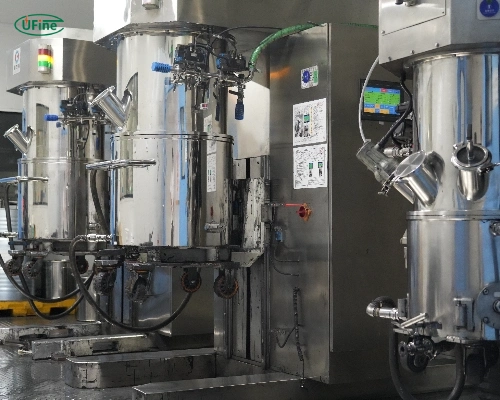
- Material Mixing: Active materials (such as LiFePO4 or NMC), conductive carbon, and binders are mixed into a slurry.
- Coating: The slurry is coated onto aluminum foil using precision coating machines.
- Drying: Industrial drying ovens remove solvents to stabilize the electrode layer.
- Calendering: High-pressure rollers compress the electrode to optimize thickness and density.
2 Anode manufacturing
The anode controls lithium ion storage and charge efficiency.
Production steps include:
- Graphite Slurry Preparation
- Coating onto Copper Foil
- Drying and Solvent Removal
- Calendering for Density Optimization
Advanced manufacturers may also apply surface treatments to improve conductivity and cycle life.
Part 4. Electrolyte preparation
The electrolyte enables lithium ion transport between electrodes, allowing the battery to charge and discharge.
Typical electrolyte preparation involves:
- Solvent selection (e.g., carbonate solvents)
- Lithium salt dissolution such as LiPF₆
- Additives to improve stability, cycle life, and safety
Electrolyte formulation is often proprietary and can significantly affect battery performance.
For safety standards related to lithium batteries, see the guidelines from the UL safety certification organization.
Part 5. Battery cell assembly
Cell assembly integrates the prepared electrodes into a functional battery cell.
1 Winding or stacking
Two main assembly methods are used:
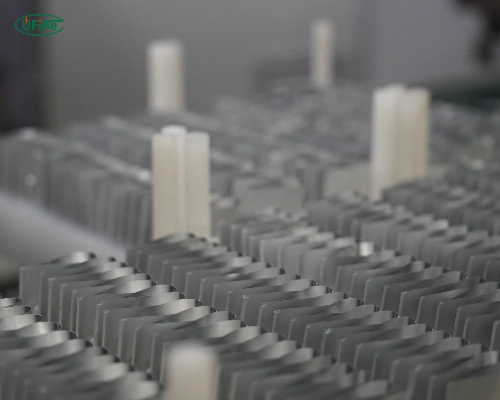
- Winding (Jelly Roll): Common in cylindrical batteries such as 18650 or 21700 cells.
- Stacking: Used in pouch and prismatic batteries for higher energy density.
2 Cell enclosure
After stacking or winding, the electrode assembly is inserted into a casing:
- Cylindrical cells – steel casing
- Prismatic cells – aluminum shell
- Pouch cells – laminated aluminum polymer film
The casing protects internal components and maintains structural stability.
Part 6. Battery electrolyte filling process
Electrolyte filling ensures that the electrodes are fully saturated for optimal ion movement.
- Vacuum Filling
- Cells are placed in a vacuum chamber to remove air and moisture.
- This allows electrolyte to penetrate internal pores effectively.
- Electrolyte Injection
- Precise dosing equipment injects the correct amount of electrolyte.
- Maintains conductivity while minimizing leakage risk.
- Soaking and Wetting
- Cells are left to soak for several hours or days.
- This allows the electrolyte to fully infiltrate electrode microstructures.
- Cell Sealing
- Cells are sealed using different methods depending on cell type:
- Heat sealing (pouch cells)
- Crimping (cylindrical cells)
- Laser welding (prismatic cells)
- Cells are sealed using different methods depending on cell type:
Part 7. Battery formation and conditioning
Battery formation is one of the most important stages in the battery manufacturing process.
1 Formation
Cells undergo controlled charge-discharge cycles to form the Solid Electrolyte Interphase (SEI) layer on the anode.
This layer:
- Stabilizes the electrolyte interface
- Prevents electrolyte decomposition
- Extends battery life
Formation can take several days and consumes significant factory energy.
2 Conditioning
After formation, cells undergo additional cycles and aging to stabilize performance and detect early defects.
This process ensures consistent performance across production batches.
Part 8. Battery module and pack assembly
Once individual cells pass testing, they are assembled into battery modules and battery packs.
Key steps include:
- Series/parallel connections to achieve target voltage and capacity
- Battery Management System (BMS) integration
- Thermal management systems
The BMS monitors:
- Cell voltage balance
- Temperature
- Charging and discharging protection
These systems are essential for applications like electric vehicles, energy storage systems, and industrial equipment.
Part 9. Battery quality control and testing
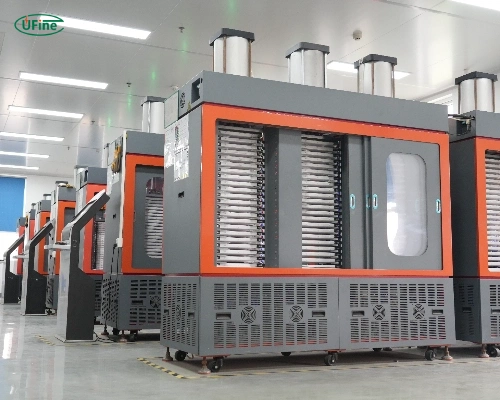
Strict quality control ensures safe and reliable battery production.
- Visual Inspection
- Technicians check for casing defects, alignment errors, and leakage.
- Electrical Testing
- Tests measure capacity, internal resistance, voltage consistency, and self-discharge rate.
- Safety Testing
- Safety tests may include overcharge testing, short-circuit testing, and thermal stability testing.
- These tests help prevent thermal runaway, a critical safety concern in lithium batteries.
- Industry safety testing often follows international standards such as IEC battery safety standards.
- Cycle Life Testing
- Cells are repeatedly charged and discharged to evaluate long-term performance and durability.
- Cycle life testing predicts battery lifespan in real applications.
Part 10. Battery packaging and labeling
After testing, batteries move to final packaging.
Steps include:
- Protective encapsulation for transport safety
- Labeling with voltage, capacity, and manufacturing data
- Shipping packaging compliant with international transport regulations
Part 11. Battery recycling and disposal
Sustainable battery production requires responsible recycling.
The recycling process includes:
- Battery collection
- Chemistry sorting
- Material recovery (lithium, nickel, cobalt)
- Safe disposal of residual components
Organizations such as the International Energy Agency (IEA) highlight recycling as a critical part of the battery supply chain.
Part 12. Advancements in battery manufacturing
The battery manufacturing industry continues evolving to improve energy density, safety, and sustainability.
- Solid-State Batteries
- Solid electrolytes replace liquid electrolytes, improving safety and enabling higher energy density.
- Silicon Anodes
- Silicon can store significantly more lithium ions than graphite, potentially increasing battery capacity.
- Cobalt-Free Cathodes
- Chemistries such as LFP reduce reliance on cobalt while improving safety and lowering costs.
- Advanced Battery Recycling
- New recycling technologies aim to recover materials more efficiently and reduce environmental impact.
- Smart Battery Management Systems
- Modern BMS technologies use advanced algorithms to estimate State of Charge (SOC), State of Health (SOH), and thermal performance.
- These improvements enhance safety and extend battery lifespan.
Part 13. FAQs about the battery manufacturing process
What is the battery manufacturing process?
The battery manufacturing process includes several stages: raw material preparation, electrode production, cell assembly, electrolyte filling, formation, testing, and final pack assembly. Each step ensures the battery meets performance and safety standards.
What is battery formation in manufacturing?
Battery formation is the first controlled charging process that creates the SEI layer on the anode. This layer stabilizes the battery chemistry and is essential for long cycle life.
What equipment is used in battery production?
Modern battery production lines use specialized equipment such as slurry mixers, coating machines, drying ovens, calender rollers, stacking machines, electrolyte filling systems, and automated formation cabinets.
Why is electrode coating important in battery manufacturing?
Electrode coating determines active material distribution, thickness, and conductivity, which directly affect energy density, internal resistance, and overall battery performance.
How long does the battery manufacturing process take?
Depending on the battery type and formation process, the complete battery manufacturing process can take several days to a few weeks, with formation and testing accounting for a large portion of the time.
Related Tags:

More Articles
Dead Battery or Device Failure? How to Find the Cause
Think your device is broken? Learn how to tell if the problem comes from battery aging or hardware failure before replacing your electronics.
Why iPhone Duo Uses Two Batteries: The Engineering Behind Foldable Phone Power
Why do foldable phones need two batteries? Explore the engineering challenges behind iPhone Duo’s dual-battery architecture and future battery trends.
Solid-State Batteries: 3 Myths You Need to Know
Solid-state batteries promise safer EVs and longer range, but the reality is more complex. Discover the challenges behind this next-gen technology.
Battery Capacity vs Discharge Rate: The Choice Engineers Face
Higher capacity or higher discharge rate? Learn how to choose the right LiPo battery for longer runtime, stable power output, and better device performance.
Battery Cable Size Guide: Choose the Right Wire Fast
Not sure what battery cable size you need? Learn how to select the right wire gauge, terminal size, and cable for safer, more efficient battery systems.


